
Before you even think about searching for a lawyer, the first and most critical step is to get crystal clear on what you actually need. This means looking inward to assess your specific situation, your communication style, and exactly what a “win” looks like for you. Taking this step transforms a vague, frustrating search into a targeted mission to find the right counsel.
Defining Your Legal Needs Before You Search
Jumping into a lawyer search without a clear roadmap is like sailing without a compass. You’ll drift, waste time, and likely end up somewhere you didn’t intend to be. For high-net-worth individuals and businesses, the stakes are simply too high for that kind of guesswork. A vague idea like “I need a business lawyer” is useless—precision is your most powerful tool here.
This process starts with what I call a ‘legal needs assessment.’ This isn’t just about picking a practice area. It’s about drilling down into the specifics of your situation and expectations. This assessment will become the filter you use to evaluate every single candidate.
Mapping Out Your Specifics
First, outline the core issue. Are you navigating a complex M&A transaction with cross-border tax implications? Are you facing high-stakes intellectual property litigation? Or do you need sophisticated, ongoing counsel for multi-generational estate planning? Get as granular as you possibly can.
Once the “what” is clear, you need to focus on the “how.” Think honestly about your ideal working relationship with your counsel.
- Communication Style: Do you need detailed weekly email updates to feel comfortable, or is a quick phone call every other week enough? There’s no right answer, but you need to know your answer.
- Risk Tolerance: Are you looking for an aggressive litigator who is ready for a courtroom battle from day one? Or do you prefer a skilled negotiator who can find a swift, quiet, and strategic resolution behind the scenes?
- Ideal Outcome: What does success actually look like? Is it securing a specific monetary award, closing a deal by a non-negotiable deadline, or simply mitigating potential damage and moving on?
A well-defined legal objective is the bedrock of a successful attorney-client relationship. It ensures you and your counsel are aligned on the definition of ‘winning’ from the very beginning.
This simple process flow breaks it down perfectly: start with your situation, clarify your expectations, and then define your desired outcome.
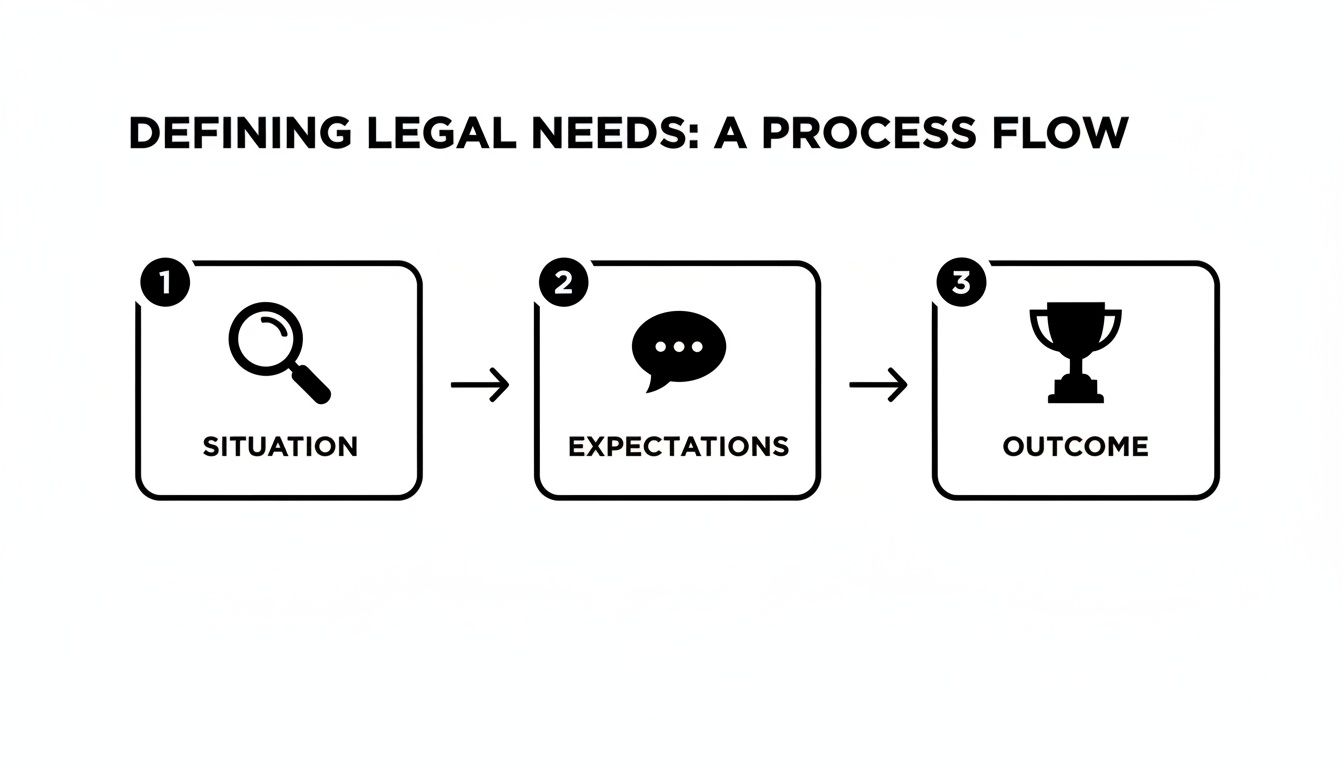
This three-part framework shifts your mindset from being problem-focused to being solution-oriented, giving you a specific, actionable set of criteria for your search.
To make this tangible, I’ve put together a simple checklist. Use it to codify your needs before you start looking at attorney profiles or making calls.
Your Legal Needs Assessment Checklist
Use this checklist to define the key criteria for your ideal legal counsel before starting your search.
| Criteria | Your Requirement (Example) | Why It Matters |
|---|---|---|
| Practice Area Specialization | “M&A for tech companies, specifically SaaS” | Niche expertise ensures they understand your industry’s unique risks and opportunities. |
| Firm Size & Resources | “Boutique firm with partner-level attention” | Determines the level of personal service and resources available for your matter. |
| Communication Frequency | “Weekly email summary and bi-weekly calls” | Aligns expectations and prevents frustration over perceived lack of updates. |
| Risk Appetite | “Prefers negotiation and settlement over litigation” | Ensures your attorney’s strategic approach matches your personal or business philosophy. |
| Fee Structure Preference | “Open to a blended rate or fixed fee” | Helps you filter out firms whose billing practices don’t align with your budget or preferences. |
| Desired Outcome (Best Case) | “Close the acquisition by Q4 for under $50M” | A clear, measurable goal gives your attorney a target to aim for from day one. |
Having these answers written down will not only guide your search but also make your initial conversations with potential attorneys far more productive.
Understanding the Legal Marketplace
Defining your needs also helps you make sense of the vast legal landscape. There are approximately 859,000 lawyers in the United States, with that number projected to grow by 5% by 2033. That’s an overwhelming number of choices.
But clarity helps you narrow the field. Knowing a bit about professional demographics can also help you find an attorney whose background and perspective align with yours. For instance, women now represent 39% of lawyers, and the median age is 46. This kind of information, which you can explore more insights about lawyer demographics on Rev.com, helps turn a massive, intimidating field into a manageable shortlist of highly qualified candidates.
How to Find and Vet Top-Tier Legal Talent
Forget about scrolling through generic, pay-to-play online directories. When the stakes are this high, you won’t find the best lawyers there. Instead, elite legal talent is found through trusted networks and carefully vetted platforms where quality—not advertising budget—is the only thing that matters.

Your search should always start with the professional circle you already trust. The people managing your financial and business affairs are an incredible, and often overlooked, source for high-quality legal referrals.
Tap Into Your Trusted Professional Network
Your accountant, financial advisor, or wealth manager already has a deep understanding of your financial picture and risk tolerance. More importantly, they work with attorneys constantly on behalf of clients just like you. They have firsthand knowledge of who is effective, responsive, and truly a master of their specific domain.
Don’t just ask for a name—ask for context. Specificity is key. Instead of a generic, “Do you know a good business lawyer?” try asking, “Who do you recommend for navigating a SaaS company acquisition with complex IP considerations?”
Consider these high-value referral sources:
- Accountants and Financial Advisors: They see the results of legal work in black and white on the balance sheet.
- Industry Peers and Competitors: Other executives in your field have almost certainly faced similar challenges and can point you to counsel who already understands your market dynamics.
- Bankers and Lenders: Especially in transactional law like real estate or M&A, bankers have a front-row seat to which lawyers get deals done efficiently and which ones don’t.
A warm referral from a trusted professional who has worked directly with an attorney is worth more than a hundred anonymous five-star online reviews. It provides a layer of pre-vetting that you simply cannot get from a public directory.
Once you have a few names from your personal network, it’s time to broaden the search to specialized, curated sources.
Differentiate Between Directories and Curated Networks
It’s crucial to understand the difference between an open-for-all directory and an invitation-only network. One is a phone book; the other is a shortlist of proven experts like those found in the Haute Lawyer Network.
Standard directories are often just advertising platforms where any lawyer can buy a listing, resulting in a massive variation in quality.
Curated legal networks, in contrast, are exclusive. Members are typically vetted based on peer nominations, a proven track record of success, and professional accolades. These platforms are designed to connect discerning clients with pre-qualified talent, saving you the immense effort of sifting through thousands of unverified profiles.
The Real Vetting Process Begins
With a shortlist from both personal referrals and trusted networks, the real work starts. This is where you move beyond reputation and dig into the objective facts of each candidate’s professional history. This isn’t about a gut feeling; it’s about disciplined due diligence.
Your first stop, without exception, should be the State Bar Association website for every state where the attorney is licensed to practice. This is non-negotiable. Look for:
- Active and in Good Standing: A simple confirmation that their license is current.
- Disciplinary History: Check for any public reprimands, suspensions, or disbarments. Even a minor, past infraction is something you need to know about and ask them to explain.
Next, analyze their actual work. Many attorneys publish articles, case studies, or white papers on their firm’s website or professional platforms like LinkedIn. This content is a window into how they think. Are they just summarizing legal news, or are they providing sharp, forward-thinking analysis? Look for substantive content that shows deep knowledge in your specific area of need.
Finally, review client testimonials with a critical eye. Vague praise like “they were great to work with” is far less valuable than specific feedback. Look for testimonials that mention concrete outcomes, communication styles, or strategic insights that align with what you’re looking for. Authentic, detailed reviews offer a glimpse into the actual client experience, helping you move from a name on a page to a credible, top-tier candidate.
Evaluating a Lawyer’s Real-World Expertise
A prestigious law degree and a corner office are table stakes, not proof of competence. When you need to find a good lawyer for a high-value matter, their true worth is revealed in their real-world track record, the stability of their team, and their standing within their specific legal community. Learning to read between the lines of a resume is essential.

This means digging deeper than credentials to find tangible markers of a high-performing legal professional. It’s about assessing their practical experience, industry authority, and the operational strength of their practice.
Look for Signs of a Stable and Successful Practice
One of the most powerful—and often overlooked—indicators of a well-run, successful practice is team stability. High turnover among attorneys or key support staff like paralegals is a significant red flag. It can point to internal chaos, overworked teams, or a lack of leadership—any of which can directly impact the quality and consistency of service you receive.
On the flip side, long attorney tenure and a stable support team signal a healthy, thriving environment. This stability fosters deep institutional knowledge and seamless collaboration, giving you a consistent point of contact. It shows the firm is a place where talented people choose to build their careers, which is a strong vote of confidence in its management and success.
The legal industry itself is grappling with talent challenges. According to 2023 research, 81% of lawyers identified talent recruitment and retention as a key focus. The market for experienced lawyers moving between firms also saw a sharp 35% decline in 2023, showing that securing top-tier legal talent is getting harder. For clients, a firm that successfully retains its lawyers is likely more stable and better equipped to handle complex workloads. You can read the full research on law firm talent trends to understand how this affects client service.
Gauge Their Authority in the Field
Truly exceptional lawyers don’t just practice law; they shape it. They’re recognized by their peers as authorities in their niche. You can find evidence of this by looking at their professional contributions beyond day-to-day casework.
These activities aren’t vanity projects; they are clear indicators of deep and current expertise. They show the attorney isn’t just a consumer of legal information but a producer of high-level strategic thought.
Consider these signs of an industry leader:
- Published Works: Do they write insightful articles for legal journals or trade publications? Look for pieces that offer sharp analysis, not just summaries of recent court decisions. An article titled “Navigating New Risks in Arbitration Agreements” shows far more proactive expertise than a simple case summary.
- Speaking Engagements: Have they been invited to speak at major industry conferences or lead continuing legal education (CLE) seminars for other lawyers? Being chosen to educate one’s peers is a powerful endorsement of their expertise.
- Media Commentary: Are they quoted by reputable news outlets as an expert on legal matters in their field? This demonstrates that journalists and editors view them as a trusted source.
An attorney who actively contributes to the legal conversation is more likely to be on the forefront of emerging trends and strategies, giving you a critical advantage in your case.
This kind of public-facing work serves as a form of peer review. It means their ideas and strategies have been vetted and respected by other experts.
Assess the Firm’s Overall Resources
Finally, a great lawyer is backed by a great firm with the right resources to support your case. This is especially critical in complex litigation or transactions that require a deep bench of talent and sophisticated tools.
During your evaluation, dig into the operational capacity of the firm. You need to know if they have the horsepower to see your matter through to a successful conclusion, no matter what challenges arise.
Key resources to investigate include:
- Support Staff: Does the lead attorney have experienced paralegals, junior associates, and administrative staff to handle tasks efficiently? This ensures the senior lawyer can focus on high-level strategy.
- Technology and E-Discovery: For litigation, ask about their capabilities for handling large volumes of electronic data (e-discovery). A firm with modern tech is more efficient and cost-effective.
- Expert Network: In specialized fields, cases often hinge on the testimony of expert witnesses. An established firm will have a robust network of credible experts—from forensic accountants to industry-specific engineers—ready to be called upon.
Evaluating these tangible elements—team stability, industry authority, and firm resources—gives you a much clearer picture of a lawyer’s real-world capabilities than a resume ever could.
How to Run an Effective Initial Consultation
The initial consultation is where your research hits the real world. This isn’t a sales pitch you just sit through; it’s a two-way interview. You’re sizing them up, and they’re evaluating the merits—and complexities—of your case. Treat it that way.
This is your chance to get past the polished resume and see how a lawyer actually thinks. The goal is to move beyond canned answers and get a genuine sense of their strategic mind, communication style, and whether you can trust them with a high-stakes matter.
Setting the Stage for a Productive Meeting
Before you even step into their office or join the video call, get organized. Send a concise summary of your situation to the attorney at least 48 hours ahead of time. This allows them to have a substantive conversation from minute one, instead of spending half the meeting just getting up to speed.
Your brief should include:
- The key parties involved: A quick who’s who.
- A timeline of critical events: Just the most important dates and actions.
- Your primary objective: What’s the best-case outcome you’re aiming for?
- The top three questions you need answered: This focuses the conversation on what matters most.
This simple act of preparation signals you’re an organized, serious client—exactly what top-tier lawyers look for. It also puts you in control of the agenda.
Asking Questions That Reveal True Strategy
Anyone can answer, “Have you handled cases like this before?” The answer is almost always “yes,” and it tells you nothing useful. To find a truly great lawyer, you have to ask questions that force them to reveal their strategic process.
Instead of generic queries, try these more powerful prompts:
1. “Based on the summary I sent, what are the top three risks or weaknesses you see in my position right now?”
This immediately tests their ability to spot issues—and their honesty. A great lawyer will be direct about potential hurdles. A less confident one might sugarcoat things.
2. “Can you walk me through your strategic approach for a case like mine, from today to a potential resolution?”
Listen for a clear, logical roadmap. Do they mention key milestones, decision points, and how they would adapt if things changed? This reveals their foresight.
3. “Who on your team would handle the day-to-day work on my file, and what is their experience?”
This is critical. You need to know if you’re hiring the partner you’re speaking with or a junior associate you’ve never met. It clarifies who your main point of contact will be.
For a deeper dive into framing these conversations, our guide on powerful questions to ask a lawyer offers more ideas.
Here are a few more targeted questions you can adapt for your consultation.
Strategic Questions for Your Lawyer Consultation
Ask these powerful questions to gauge a potential lawyer’s expertise, strategy, and overall fit for your case.
| Question Category | Sample Question | What You’re Really Asking |
|---|---|---|
| Experience & Track Record | “Tell me about a past case with similar complexities. What was the outcome and what did you learn?” | “Have you really done this before, and can you prove it with a relevant example?” |
| Strategic Thinking | “What are the first 3 things you would do if we were to move forward today?” | “Do you have an immediate action plan, or are you just going to react?” |
| Team & Resources | “Who is the primary point of contact? What is your firm’s protocol for client communication?” | “Am I going to be passed off to a junior associate? How accessible are you?” |
| Billing & Costs | “Can you provide a budget estimate for the initial phase of this matter?” | “Are you transparent and organized about fees, or will I be surprised by the bills?” |
Asking the right questions can make the difference between hiring a decent lawyer and a truly exceptional one.
Pay as much attention to the questions the lawyer asks you as you do to their answers. A top attorney will be just as interested in vetting you and your case. They will ask pointed, insightful questions to gauge your credibility, your expectations, and your willingness to be a good partner in the legal process.
Spotting Critical Red Flags
Sometimes, what a lawyer doesn’t say is more telling than their prepared answers. During the consultation, stay vigilant for behaviors that signal a poor fit. These aren’t minor issues; they’re serious warnings.
Be wary of any attorney who:
- Guarantees a specific outcome. This is unethical in most jurisdictions and completely unrealistic. No honest lawyer would ever promise a win.
- Dismisses or minimizes your concerns. If they talk over you or make you feel like your questions are unsophisticated, walk away. A good lawyer is a patient educator.
- Is unprepared for your meeting. If they clearly haven’t read the summary you sent, it’s a major red flag regarding their diligence and respect for your time.
- Is evasive about fees. A professional should be able to clearly explain their billing structure. Hesitation here often precedes billing disputes down the road.
Making a confident hiring decision hinges on this initial conversation. By preparing thoroughly, asking strategic questions, and watching for red flags, you can move beyond a superficial evaluation and find a true legal partner.
Understanding Fee Structures and Making Your Decision
Navigating the financial side of legal representation can feel like learning a new language. But getting this part right is absolutely critical for a healthy, transparent, and successful relationship with your attorney.
This isn’t just about the final bill. It’s about understanding the value you’re receiving and ensuring there are no unpleasant surprises waiting for you down the road.

Any lawyer worth their salt will be direct and clear about how they bill for their time. Let’s break down the most common structures you’ll encounter so you can confidently figure out what makes sense for your specific situation.
Decoding the Different Types of Legal Fees
You’re likely to run into four main types of fee arrangements. Each one is better suited for different kinds of legal work, and knowing the difference is key to comparing proposals from different firms.
- Hourly Rate: This is the traditional model where you pay an agreed-upon rate for the time the attorney and their team—associates, paralegals—spend on your case. It’s common for litigation, complex business negotiations, and ongoing advisory work where the total time commitment is hard to predict.
- Flat Fee: For well-defined, predictable tasks like drafting a will, forming a standard LLC, or handling an uncontested divorce, many lawyers offer a single, fixed price. This gives you cost certainty, which is a huge advantage.
- Contingency Fee: Used primarily in personal injury and some collection cases, this means the lawyer only gets paid if they win. Their fee is a pre-agreed percentage of the settlement or court award.
- Retainer Fee: A retainer is often misunderstood. Think of it as a down payment against future legal work. The firm bills their hourly rates against this fund, and you’ll likely need to replenish it if it runs out. You can learn more about the average retainer fee for a lawyer to get a better sense of what to expect.
Asking which structure a lawyer prefers for a matter like yours is a great way to gauge their experience with that specific type of case.
A detailed, transparent fee agreement isn’t just a formality—it’s the hallmark of a professional and trustworthy practice. If a lawyer is vague or hesitant to put billing terms in writing, that’s a serious red flag.
Beyond the Billable Hour: Looking at Total Value
When you hire the right lawyer, you’re not just paying for their time. You’re investing in their expertise, their strategic thinking, and the outcome they can achieve for you.
The cheapest option is rarely the best, especially when the stakes are high. An experienced, more expensive attorney who resolves your issue in 10 hours delivers far greater value than a less skilled one who takes 50 hours only to achieve a worse outcome.
Your decision should hinge on the intersection of cost and strategy. Does their proposed plan of action seem sound? Is it efficient? Are they clear about how they will staff the case to control costs—for example, by using paralegals for research and junior associates for more routine filings?
You need complete transparency on all costs, not just the lawyer’s headline rate. The fee agreement must clearly outline:
- How they bill for other professionals (paralegals, associates).
- Which administrative or “out-of-pocket” expenses are passed on to you (e.g., court filing fees, expert witness fees, travel).
- The billing increment they use (e.g., tenths of an hour).
Getting this level of detail upfront prevents misunderstandings and helps you accurately forecast the total investment.
Making a Confident Hiring Decision
Once you’ve interviewed your top candidates and reviewed their fee proposals, it’s time to make a choice. Resist the temptation to decide based on a single factor, whether it’s price or personality. A more objective approach will always serve you better.
Use a simple framework to compare your finalists side-by-side. Create a scorecard and rate each candidate on a scale of 1-5 across the key criteria you identified from the start.
Here’s a sample framework you can adapt:
| Evaluation Criteria | Lawyer A Score (1-5) | Lawyer B Score (1-5) | Lawyer C Score (1-5) |
|---|---|---|---|
| Niche Expertise & Track Record | 5 | 4 | 5 |
| Strategic Approach | 4 | 5 | 3 |
| Communication & Responsiveness | 5 | 4 | 4 |
| Team Stability & Firm Resources | 4 | 4 | 5 |
| Fee Structure & Value | 4 | 5 | 4 |
| Total Score | 22 | 22 | 21 |
This process forces you to weigh every critical factor. In this example, Lawyers A and B are tied. Your next step would be to look at the criteria that matter most to you—perhaps communication style or their specific strategic approach is the tie-breaker. This structured method ensures you select not just a good lawyer, but the right lawyer.
Common Questions About Hiring a Lawyer
Even the most structured search for legal counsel can leave you with a few lingering questions. Getting straight answers is the final step before you commit, giving you the confidence that you’re making a well-informed decision.
How Much Should I Expect to Pay for a Good Lawyer?
There’s no single answer, as legal fees are all over the map. The cost depends on the lawyer’s track record, the firm’s reputation, where they’re located, and just how complex your situation is. For high-stakes corporate litigation or sensitive family matters, it’s not uncommon for elite attorneys in cities like New York or Los Angeles to bill well over $1,000 per hour.
But the real goal isn’t finding the cheapest rate—it’s securing the best value. A top-tier lawyer who can resolve your issue in half the time is often less expensive in the long run than a less experienced one who drags out the process, only to deliver a weaker outcome. Always insist on a detailed fee agreement upfront that clearly outlines every potential cost.
What Is the Difference Between a Curated Legal Network and a Standard Directory?
Understanding this is the key to a smarter, faster search. A standard online directory is really just a massive, open database. Anyone can pay to be listed, which leaves you with a huge, unfiltered list of wildly inconsistent quality. The entire burden of vetting falls on your shoulders.
A curated legal network, on the other hand, is usually an invitation-only or heavily vetted platform.
- Vetting Process: Members are chosen based on proven expertise, peer recognition, and a history of success in their practice area.
- Quality Over Quantity: The goal is to showcase a smaller, more elite group of professionals, not just list every lawyer in town.
- Time Savings: These networks essentially hand you a pre-qualified shortlist, saving you dozens of hours and dramatically lowering the risk of a bad hire.
Think of it this way: a directory is a phone book; a curated network is an honor roll.
Is a Large Law Firm Better Than a Small Boutique Firm?
The right firm size has nothing to do with prestige and everything to do with your specific legal needs. Each model offers unique strengths, and the “better” option is simply the one that aligns with the demands of your case.
Large, multi-practice firms bring enormous resources to the table, including a deep bench of specialists across dozens of legal fields. This is the perfect setup for complex corporate litigation that might involve tax, intellectual property, and international law all at once. They have the people and the infrastructure to handle massive legal battles.
Boutique firms offer something different: deep, focused expertise in a single niche. You get more personalized service and direct, consistent access to the senior partners you actually hired. This model is ideal when you need world-class expertise without the layers of a massive corporate structure.
The best choice isn’t the biggest firm—it’s the firm with the precise expertise, resources, and client service model that your unique situation demands.
What Should I Do If I Am Not Satisfied With My Current Lawyer?
It’s an unfortunate situation, but it happens. If you’re unhappy, the first step is always to try and fix it directly. Schedule a meeting to calmly and clearly explain your concerns, whether they’re about strategy, communication, or billing. A frank conversation can often clear up simple misunderstandings.
If that doesn’t work and the relationship is broken, you always have the right to switch attorneys. Start by reviewing your original engagement letter for any clauses about termination.
From there, you can begin your search for new counsel. Once you’ve hired someone, your new lawyer will typically handle the professional handoff. They’ll formally notify your previous attorney and manage the secure transfer of your entire case file, ensuring a smooth transition.
Finding pre-vetted legal talent shouldn’t be left to chance. The Haute Lawyer Network connects discerning clients with the nation’s most respected legal professionals, all showcased through the trusted Haute Living media platform. Elevate your search and connect with excellence.