
Drafting a legal brief is more art than science. It’s about building a persuasive narrative that methodically walks a judge through the facts, applies the law, and lands on a single, inevitable conclusion: your client should win. It all starts with a compelling story and ends with a clear request for court action.
Building the Blueprint for Your Legal Brief
Before you write a single word of your argument, you need a blueprint. A winning brief isn’t just a jumble of facts and case citations; it’s a carefully constructed narrative that guides the court exactly where you want them to go.
Think of it like building a house. You wouldn’t just start throwing up walls without a foundation and a clear architectural plan. The same goes for legal writing. Each section has a specific job, and they all have to work together perfectly. If one part is weak—say, a confusing Statement of Facts—the entire argument can feel shaky and unconvincing.
Mapping Out the Core Components
Every legal brief follows a recognized structure. This isn’t just about following rules for the sake of it; it’s about creating a logical flow that makes your reasoning impossible to ignore. A judge should be able to move from your introduction to your conclusion without ever feeling lost.
The main building blocks usually include:
- Front Matter: This is the first impression. It includes the cover page, Table of Contents, and Table of Authorities, giving the reader a roadmap.
- Argument Section: This is the heart of your brief. It’s where you lay out your legal arguments, backed by solid case law and statutes.
- Conclusion and Relief: Your closing argument. You’ll summarize your key points and tell the court exactly what you want it to do.
This diagram gives you a good visual of how these pieces fit together.
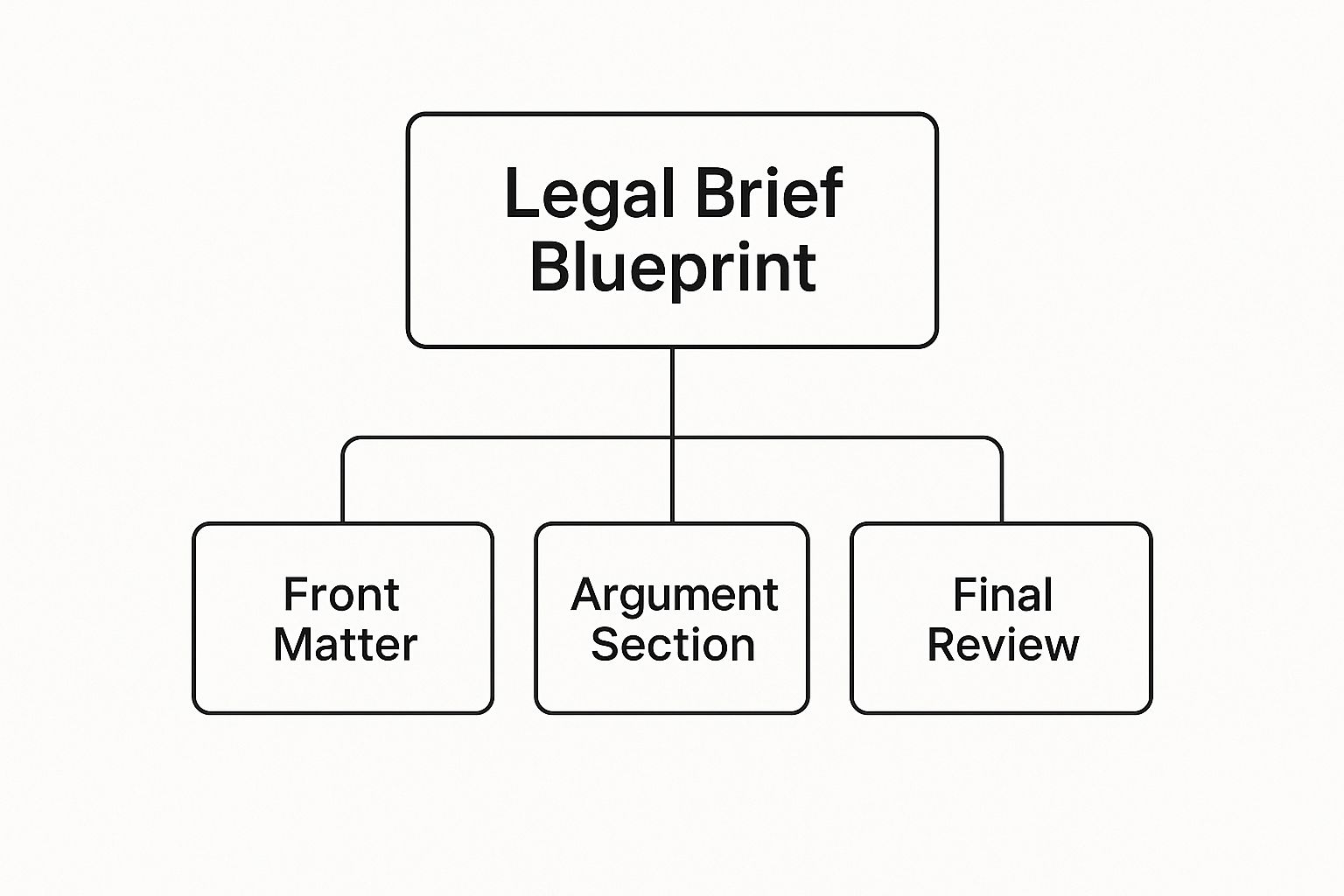
As you can see, the process is sequential. You move from organizing your case to building the argument and then polishing the final product.
The Strategic Purpose of Each Section
Knowing why each section exists is crucial. Take the Table of Authorities (TOA). It’s not just a boring list of cases. A well-organized TOA is your first chance to signal to the court that your research is airtight and your arguments are built on a rock-solid legal foundation. It telegraphs competence.
To get a clearer picture of how each component functions, here’s a quick breakdown of the core sections and what you should focus on for each.
Core Components of a Legal Brief
| Section | Primary Purpose | Key Focus Area |
|---|---|---|
| Cover Page & Front Matter | To provide essential case information and a roadmap for the reader. | Strict compliance with court rules (formatting, case numbers, party names). |
| Table of Contents | To allow for quick navigation of the brief’s structure. | Accuracy and clear, descriptive headings that preview your arguments. |
| Table of Authorities | To list all legal sources cited and signal the strength of your research. | Correct citation format and organization by jurisdiction and type of authority. |
| Statement of the Case | To present the factual and procedural history in a compelling narrative. | Weaving a persuasive, fact-based story that subtly frames the legal issues. |
| Argument | To present the legal analysis and persuade the court to adopt your position. | Strong topic sentences, logical reasoning (IRAC), and seamless integration of case law. |
| Conclusion | To summarize the argument and state the specific relief requested. | Brevity, clarity, and a precise statement of the action you want the court to take. |
This table serves as a good checklist to ensure you’re hitting the right notes in every part of your brief.
Your brief’s structure is the first argument you make. A clean, logical, and compliant format tells the court you are a credible, organized, and professional advocate before they even read your first point.
The Statement of the Case is your chance to set the stage. This isn’t just a dry recitation of what happened; it’s the beginning of your story. You’re framing the narrative in a way that is both factually bulletproof and quietly persuasive, creating a favorable impression that you’ll build on throughout the document.
Crafting a Compelling Legal Narrative

The Argument section is where your case lives or dies. This isn’t the place for a dry recitation of facts and legal citations; it’s where you weave those elements into a persuasive story. Your job is to make the judge’s decision feel not just logical, but completely inevitable.
Think of yourself as a storyteller. The court needs to understand the why behind the what. A well-framed argument transforms a collection of legal points into a cohesive and powerful narrative that sticks.
Lead With Your Strongest Point
Judges are drowning in paper. You have to grab their attention from the very first sentence. Always, always open your Argument with your most potent, case-winning point.
This move does more than just make a good first impression—it sets the entire tone. By landing your heaviest punch first, you frame the rest of the case from a position of strength. Weaker or subordinate arguments can follow, but your opening salvo has to be the one that can win the fight on its own.
In a breach of contract case, for example, don’t bury the lede with a minor procedural squabble. Hit them immediately with the clear, unambiguous language from the signed agreement that the other side violated. This tactic establishes the core of your case and instantly puts your opponent on the back foot.
Seamlessly Integrate Case Law
Your narrative is only as strong as the legal scaffolding holding it up. But case law shouldn’t feel like a clunky interruption. It needs to be an organic part of the story you’re telling.
Here are a few ways I’ve found to do this effectively:
- Introduce, Cite, Explain: State your point in plain English. Drop in the citation that backs it up. Then, crucially, explain how that specific case or statute applies to the facts at hand.
- Use Parentheticals: A quick parenthetical after a citation can summarize a holding without breaking your flow. Something like, (holding that a signed waiver is binding) gets the job done fast.
- Quote Sparingly: Resist the urge to block-quote huge chunks of text. Save direct quotes for language that is exceptionally powerful or precise. Most of the time, paraphrasing a court’s reasoning and applying it to your facts is far more persuasive.
This approach shows the court you don’t just know the law—you understand how to apply it with nuance.
A well-crafted legal brief guides the reader to a conclusion they feel they’ve reached on their own. It’s persuasion, not dictation. The seamless integration of facts and law is what makes this possible.
Dismantle Counterarguments Proactively
A truly great brief doesn’t just make its own case. It anticipates the other side’s best arguments and systematically dismantles them before they can gain any traction.
Addressing potential counterarguments head-on shows the court you’ve considered every angle and that your position is the only one that holds up under scrutiny. This isn’t about building a straw man to knock down. You need to identify the strongest, most credible points your opponent is likely to make and confront them directly. Explain why their interpretation of the facts is flawed or why the legal authority they’re leaning on is distinguishable from your case.
This level of foresight demonstrates confidence and proves you’ve done your homework. It’s a skill honed through experience, and many practitioners can benefit from studying the strategies used by a top-tier appellate lawyer, as they are masters at dissecting legal arguments. This preemptive approach fortifies your position and leaves the court with very little room for doubt.
Fortifying Your Argument with Rock-Solid Research

An argument without authoritative support is just an opinion. The real power of your legal brief comes from the meticulous research that supports every single assertion you make. This isn’t just about finding one case that sounds good; it’s about building an unshakeable legal foundation for your narrative.
Every claim, every interpretation, and every conclusion must be anchored to solid legal ground. Think of your research as the steel frame of a skyscraper—it’s invisible to most, but absolutely essential for the building’s integrity. Without it, even the most eloquent argument will crumble under the slightest pressure.
The digital age has completely changed this process. The global legal publishing market was valued at around $999.9 billion in 2023, a number that underscores the immense value placed on accurate, up-to-date legal information. Drafting an effective brief means knowing how to navigate this ocean of information.
Leveraging Modern Legal Databases
Gone are the days of being buried in dusty legal reporters for hours on end. Today’s legal databases are incredibly powerful, but you need a strategy to get the best results. Simply typing a few keywords into the search bar is a fast track to getting overwhelmed by irrelevant case law.
To get the most out of platforms like Westlaw, LexisNexis, or CoCounsel, you have to think like an investigator.
- Start Broad, Then Get Specific: Begin with general terms related to your legal issue to get a feel for the landscape. From there, use filters and advanced search operators to zero in on your specific jurisdiction, court level, and fact pattern.
- Trace the Connections: Don’t just find one good case and stop. Use tools like Shepard’s or KeyCite to see how that case has been treated by other courts. Has it been affirmed, questioned, or even overturned? This is critical.
- Look Beyond Case Law: Your research isn’t done until you’ve explored relevant statutes, regulations, and even secondary sources like law review articles. These can provide the deeper context that makes your argument stand out.
The goal of research isn’t just to find cases that support you; it’s to understand the entire conversation the courts are having about your issue. This deeper knowledge lets you anticipate counterarguments and position your case far more effectively.
Organizing Your Findings for Maximum Impact
Finding the right authorities is only half the battle. The real challenge is organizing them so they’re actually useful when you start writing. A messy folder full of random PDFs is a liability, not an asset.
I always recommend creating a research memorandum or an annotated outline. For each key point in your argument, list the primary cases and statutes that support it. Include a quick parenthetical summary of the holding and a note on how it applies to your specific facts.
This method does two crucial things:
- It forces you to connect every piece of research directly to a specific part of your argument.
- It creates a ready-made reference guide, saving you from having to re-read sources every time you draft a new section.
This organized approach is more important than ever. With the rise of legal tech, understanding how artificial intelligence is revolutionizing legal practice can give you a significant advantage in speed and accuracy, helping you turn solid research into a winning brief even faster.
Writing with Clarity in a Complex World

The old image of a lawyer drowning in dusty, incomprehensible texts is dead. In today’s courts, the most powerful legal briefs aren’t the ones with the most esoteric vocabulary; they’re the ones with the sharpest, most direct arguments. Clarity is the new gold standard.
Think about the judge on the other side of your brief. They’re dealing with a massive caseload and don’t have time to decode convoluted sentences or slog through legalese. Your job is to make their job easier. Clear writing makes your logic transparent and your argument exponentially more persuasive.
Embracing Plain English in Legal Writing
Let’s be clear: adopting a “plain English” approach doesn’t mean dumbing down your argument. It means sharpening it. It’s about cutting away the jargon and fluff to let the powerful core of your legal reasoning shine through.
A complex argument presented simply is the mark of a master. On the flip side, a simple argument buried in complex language often just signals a lack of confidence. The legal world is overwhelmingly moving in this direction, with courts valuing concise language that gets straight to the point. You can find more on this shift by checking out the latest legal writing trends at YourResearchAttorney.com.
Here are a few ways to start right now:
- Trim the Fat: Get ruthless with unnecessary words. Instead of “due to the fact that,” just write “because.”
- Use Strong Verbs: Ditch passive phrases. “The court decided” is far more powerful than “a decision was made by the court.”
- Shorten Your Sentences: Break up those long, winding sentences into more digestible thoughts. It’s not just easier to read; it creates a better rhythm.
The goal is to write with such clarity that the judge gets your point on the first pass. Every moment they spend re-reading is a moment you risk losing them.
The Power of the Active Voice
One of the fastest ways to breathe life and clarity into your brief is to favor the active voice. It’s direct, concise, and clearly assigns responsibility.
Look at the difference:
- Passive: “The contract was breached by the defendant.”
- Active: “The defendant breached the contract.”
The active version is shorter, more forceful, and leaves no room for doubt. It gives your writing authority. While the passive voice has its place, making the active voice your default will make your arguments significantly stronger.
How Technology Is Sharpening Arguments
This push for clarity is getting a major boost from legal technology. AI-powered drafting tools can now flag passive voice, suggest simpler words, and even check for consistent terminology throughout your entire brief.
Beyond that, predictive analytics platforms are giving lawyers insight into how certain arguments might land with a specific judge or court. This data-driven approach helps you craft arguments that are not only clear but also strategically targeted. This is a critical piece of learning how to draft a legal brief that truly lands with its audience in the modern legal world.
The Final Polish That Makes Your Brief Shine
You’ve poured weeks into research, writing, and strategy. The conclusion is finally done. It’s incredibly tempting to just hit “print” and be done with it. Don’t.
This final review is what separates a good brief from a great one. A single typo, a misplaced comma, or a citation error can instantly undermine your credibility. It casts a shadow of doubt over an otherwise solid argument, and it’s a risk you can’t afford to take. Think of this not as proofreading, but as protecting your professional reputation.
The Macro Review: A Logic and Flow Check
Before you start hunting for typos, take a big step back. Read the entire brief from a 30,000-foot view.
Does the argument actually flow? Are your headings signposting the content correctly, or are they just generic labels? This is your last chance to make sure the narrative you’ve built is cohesive and, most importantly, persuasive.
Put yourself in the judge’s shoes. Read it as if you’re seeing it for the first time. Are there jarring transitions? Any confusing leaps in logic? A classic mistake is emphasizing certain facts in your Argument section that you barely mentioned in the Statement of the Case. That kind of inconsistency screams sloppy and weakens your entire position.
The Micro Edit: Getting Granular
Once you’re confident in the structure, it’s time to pull out the microscope. This is where you hunt for errors with precision. I find it’s best to do this in multiple, separate passes, focusing on one thing at a time.
- Citation Perfection: Check every single citation. Make sure it conforms to Bluebook or local court rules. Don’t just rely on automation; tools like Westlaw’s Quick Check are a great start, but a final human review is non-negotiable.
- Grammar and Punctuation: Read each sentence deliberately. Grammar checkers are helpful, but they often miss the context-specific nuances of legal writing.
- Consistency Check: This is huge. Ensure you’re using the same terminology, party names, and abbreviations throughout. If you call them “the Company” on page 3, don’t switch to “the Corporation” on page 15. It’s a small detail that makes a big difference.
One of the most effective self-editing tricks I’ve learned is to read the brief out loud. Your ear will catch awkward phrasing, run-on sentences, and clumsy wording that your eyes have learned to skim over. It feels a bit silly, but it works every time.
Finally, get a fresh set of eyes on it. A colleague who is completely unfamiliar with the case can spot ambiguities you’ve gone blind to after staring at the document for weeks.
This collaborative polish is more than just good practice; it reflects the professional and ethical diligence our field demands. For more on this, check out this practical guide to mastering legal and ethical issues. This is how you take a finished draft and turn it into a brief that truly shines.
Lingering Questions About Drafting a Legal Brief
Even seasoned attorneys run into sticky situations when drafting a brief. Once you have the fundamentals down, it’s often the finer points that can trip you up. Let’s tackle some of the most common questions that pop up, so you can move forward with confidence.
How Much Detail Is Too Much?
One of the trickiest balancing acts is getting the level of factual detail right. You have to give the court enough context to grasp the issues, but you can’t afford to drown them in irrelevant minutiae.
A great rule of thumb I’ve always followed is to ask one simple question: does this fact directly support a legal point I’m making in the Argument section? If the answer is no, it’s probably just noise. For instance, in a contract dispute, the color of the CEO’s car is useless. The exact date a critical email was sent? Absolutely vital. Every detail must be a deliberate building block for your legal analysis.
What’s the Right Tone to Strike?
Another frequent question is about tone. Of course, professionalism is non-negotiable, but your writing shouldn’t be so sterile and robotic that it puts the judge to sleep.
Your goal should be a tone that is confident, respectful, and authoritative. Steer clear of overly aggressive language or, even worse, personal attacks on opposing counsel. That kind of behavior just undermines your credibility and distracts from the actual strength of your arguments.
Is Brief Writing Still a Core Skill for the Future?
With all the shifts in the legal industry, it’s fair to wonder how critical this skill will remain. While a research brief from Clio noted a temporary dip in law practice billing back in 2020, legal caseloads have been on the rebound ever since.
In fact, the demand is growing. Businesses are expected to ramp up their legal needs in the years to come, which means the need for sharp, persuasive legal briefs isn’t going anywhere. You can dig into these legal trends to get the full picture.
Ultimately, knowing how to draft a legal brief effectively is still a cornerstone of successful legal practice. Answering these common questions helps you refine your process, turning a good draft into a persuasive, court-ready document that truly serves your client.
Elevate your professional visibility and connect with high-net-worth clients. The Haute Lawyer Network is a curated platform designed to showcase the nation’s top attorneys. Become a member today.