
Setting up a family trust is more than just a legal task; it’s a deliberate strategy to define your legacy. The entire process centers on creating a solid framework to manage and protect your wealth for the people you care about most, often with the key goals of sidestepping probate and softening the blow of estate taxes.
Think of it as maintaining a degree of control over your assets long after you’re gone.
Why a Family Trust Is a Non-Negotiable for Your Legacy

A family trust isn’t just a stack of papers. It’s an act of stewardship over your family’s future. For high-net-worth families, in particular, it serves as the cornerstone of a sophisticated estate plan, laying out a clear roadmap for how assets will be handled for generations.
Without a trust, your estate could get stuck in probate—a lengthy, public, and surprisingly expensive court process.
The real driver here is control. A trust gives you the power to dictate the exact terms under which your beneficiaries receive their inheritance. That kind of foresight is invaluable in today’s complex financial world.
Bypassing Probate and Keeping Your Affairs Private
One of the most immediate benefits of a trust is its ability to completely bypass the probate process. When assets are titled in the name of the trust, they aren’t considered part of your personal estate upon your death. This means they can be distributed to your heirs much faster and, crucially, without public court filings.
Probate can drag on for a year or even longer. Worse, it creates a public record of your assets and who gets what, a detail most families would rather keep private. A trust ensures the transfer of your wealth remains seamless and confidential.
Smart Tax Planning and Asset Protection
A thoughtfully constructed trust can also deliver substantial financial advantages. Depending on the specific structure you choose, a family trust can significantly minimize estate taxes, potentially saving your heirs a fortune.
Certain types of trusts also build a protective wall around the assets, shielding them from creditors, lawsuits, and even a beneficiary’s own financial missteps.
Here’s why so many establish a family trust:
- Avoiding Probate: Your assets pass directly to beneficiaries without court interference, which saves an enormous amount of time and money.
- Maintaining Privacy: Unlike a will, a trust is a private document. Your family’s financial matters stay out of the public domain.
- Exercising Control: You can set specific conditions for distributions, like tying funds to educational milestones, a certain age, or even the purchase of a first home.
- Protecting Beneficiaries: A trust can safeguard assets for loved ones who may be too young or not financially prepared to manage a significant inheritance on their own.
A trust is the foundational tool to ensure your specific wishes are honored. It provides a structured plan that protects your family from potential conflicts and external threats, securing the legacy you’ve worked so hard to build.
Ultimately, taking the time to understand what is a living trust and how it operates is the first critical move toward building a durable estate plan. For anyone serious about preserving their wealth, it’s an investment in true peace of mind.
Choosing The Right Trust Structure For Your Goals
Once you’ve decided to create a family trust, your first major decision is selecting the right structure. This isn’t just a box-ticking exercise; it’s a strategic choice that will define the trust’s power and purpose for decades to come.
The two fundamental paths are the revocable living trust and the irrevocable trust. Each serves a very different purpose.
The Revocable Trust: Your Flexible Estate Plan
Think of a revocable trust as your estate’s dynamic blueprint. As the grantor, you keep your hands firmly on the wheel—you can amend the terms, move assets in and out, or even dissolve the whole thing whenever you see fit.
Its main draw for many families is the powerful combination of probate avoidance and retained control. While you’re alive, you can act as the trustee, managing the assets just as you always have. Nothing really changes from a practical standpoint.
For instance, an entrepreneur with a rapidly growing company might use a revocable trust. It allows them to transfer business interests and other assets into the trust structure without sacrificing the agility needed to respond to market shifts or personal opportunities. When you pass or become incapacitated, your chosen successor trustee simply steps in to manage things according to your written instructions, completely bypassing the courts.
The Irrevocable Trust: A Fortress For Your Assets
Opting for an irrevocable trust is a move driven by goals that go far beyond just avoiding probate. This is the structure you choose for maximum asset protection and serious estate tax mitigation. When you transfer assets into an irrevocable trust, you are legally giving up ownership and control.
While that sounds drastic, it’s an incredibly powerful strategy. By moving assets out of your personal estate, they become shielded from future creditors, lawsuits, and—most critically—federal and state estate taxes. For high-net-worth families, this maneuver can translate into millions of dollars in tax savings for their heirs.
Imagine a family focused on preserving a legacy for their grandchildren. They might place appreciating assets, like a real estate portfolio or a block of stock, into an irrevocable trust. This not only removes the current value of those assets from their taxable estate but, just as importantly, ensures all future growth is also protected from estate taxes down the line.
This kind of strategic wealth preservation is more critical than ever. Global family wealth has surged by 67% in recent years, now topping $5.5 trillion. As a result, trusts have become the go-to vehicle for managing this growth, with the number of family offices worldwide now exceeding 8,000. You can learn more about this trend from Deloitte’s analysis on the rapid expansion of family wealth management.
Revocable vs Irrevocable Trusts: Key Differences For HNWIs
To create a family trust that truly serves your long-term vision, you need to understand the practical trade-offs. The choice isn’t just about legal jargon; it’s about aligning the trust’s fundamental characteristics with your family’s unique financial picture and legacy goals.
This table cuts through the noise and breaks down the essential distinctions.
| Feature | Revocable Living Trust | Irrevocable Trust |
|---|---|---|
| Control & Flexibility | High. You can amend, change beneficiaries, or revoke the trust at any time. | Low. Once established, terms are generally permanent and cannot be changed. |
| Probate Avoidance | Yes. Assets held in the trust bypass the public probate process. | Yes. Assets are outside your probate estate. |
| Estate Tax Reduction | No. Assets are still considered part of your taxable estate. | Yes. Assets are removed from your estate, significantly reducing tax liability. |
| Asset Protection | Limited. Assets are generally not protected from your own creditors. | High. Assets are typically shielded from creditors and lawsuits. |
| Best For | Individuals who want flexibility, control, and privacy while avoiding probate. | High-net-worth individuals focused on tax reduction and creditor protection. |
It’s important to remember that this isn’t always an either/or decision. Many sophisticated HNW estate plans use a combination of trusts to achieve different objectives. A revocable trust might act as the central hub for managing the bulk of an estate for simple administration, while one or more irrevocable trusts are used to hold specific assets for tax and protection purposes.
Ultimately, the right structure comes down to a single question: What are you trying to accomplish? If your priority is maintaining flexibility during your lifetime, a revocable trust is likely the answer. But if your primary objective is building a tax-proof, protected legacy for future generations, the irrevocable path is the one to explore.
Drafting Your Trust With Purpose and Precision
The language inside your trust document is its engine. Every word, every phrase, every clause dictates how your legacy will be managed for decades to come. This is where your intentions become legally binding instructions, and going beyond a simple template is what separates an adequate trust from one built to last.
Vague instructions create loopholes. Loopholes create ambiguity, and ambiguity almost always leads to family conflict or a trustee misinterpreting your wishes down the road. Precision is everything—it ensures your exact desires are carried out, no matter how much the world changes.
Defining Beneficiaries With Foresight
Identifying your beneficiaries seems simple enough, but a truly robust plan accounts for future generations and unforeseen events. Simply listing your children’s names is a rookie mistake. What if a child passes away before you? Do their shares go to their siblings, or do they pass down to their own children—your grandchildren?
This is where a single legal term, “per stirpes,” can make all the difference. It’s a Latin phrase meaning “by branch,” and it’s a powerful tool for multi-generational planning.
- Here’s a real-world scenario: You have two children, Alex and Brenda, named as equal beneficiaries.
- Without Per Stirpes: If Alex dies before you, his 50% share could automatically go to Brenda. This would leave Alex’s children with nothing from your trust, likely a devastating and unintended outcome.
- With Per Stirpes: If Alex passes away, his 50% share flows directly down to his children. This simple designation ensures your grandchildren are not accidentally disinherited.
Failing to include this specific language is one of the most common and heartbreaking oversights we see.
Setting Clear Distribution Standards
One of the greatest advantages of a trust is your ability to control how and when your assets are distributed. You can protect a beneficiary from their own financial immaturity, outside creditors, or a future divorce. A common and highly effective method is to use what’s known as an ascertainable standard.
The most widely recognized standard is HEMS, which stands for Health, Education, Maintenance, and Support. This gives your trustee clear, yet flexible, marching orders:
- Health: Covers medical, dental, and even long-term psychological care.
- Education: Can include everything from college tuition to specialized vocational training.
- Maintenance and Support: This is the most flexible part, designed to help a beneficiary maintain their accustomed standard of living.
Using a HEMS standard gives the trustee a defensible framework for every decision. It keeps them from being too stingy or too generous and shields them from a beneficiary demanding cash for a speculative business idea or a luxury sports car you never would have approved of.
This structure allows the trustee to respond to legitimate needs while staying true to your core values.
Incorporating Essential Protective Clauses
Beyond who gets what and when, a few key provisions act as a legal fortress around the trust assets and your beneficiaries. These aren’t optional add-ons; they are fundamental to any well-drafted family trust.
A spendthrift clause is arguably one of the most critical protections. This provision legally restricts a beneficiary’s ability to sell or give away their interest in the trust. More importantly, it prevents their creditors from coming after the trust’s assets to satisfy a debt. If a beneficiary gets into financial trouble, goes through a messy divorce, or is sued, the assets held within a properly drafted trust remain secure.
Another sophisticated tool is the appointment of a Trust Protector. This is an independent third party who isn’t the trustee but is granted specific powers to oversee the trust’s administration. A Trust Protector can be given the power to:
- Remove or replace a trustee who isn’t performing their duties properly.
- Amend the trust to adapt to major changes in tax law.
- Settle disputes between trustees and beneficiaries before they escalate.
Think of the Trust Protector as an auditor and an emergency release valve, all in one. It adds a critical layer of accountability and flexibility, ensuring the trust remains effective for generations. Without these purposeful clauses, a trust is merely a suggestion; with them, it’s a powerful and enduring fortress for your family’s future.
Bringing Your Trust to Life by Funding It Correctly
A beautifully drafted trust document is worthless if it doesn’t actually own anything. Think of it as an empty vault; its true power is only unlocked when you fill it with the assets it was designed to protect. This process is called funding, and frankly, it’s the most critical action you’ll take after signing the papers.
Failing to properly fund your trust is a surprisingly common—and costly—mistake. Any assets left in your individual name will likely have to go through the public, expensive probate process you set out to avoid. This single oversight can completely undermine your estate plan, leaving your family with the exact legal headaches you worked so hard to prevent.
The Mechanics of Retitling Your Assets
Funding a trust isn’t a single action but a series of them, tailored to each type of asset you own. The goal is simple: change the legal owner from your name to the name of the trust, such as “The John and Jane Smith Family Trust.”
Here’s what that looks like in practice for common assets:
- Real Estate: You’ll need to sign a new deed—often a quitclaim or warranty deed—transferring your property from you as an individual to you as the trustee. This new deed must be notarized and officially recorded with the county recorder’s office where the property sits.
- Bank Accounts: For checking, savings, and money market accounts, you will work directly with your bank to change the account title. Some institutions might require you to close the old account and open a new one in the trust’s name.
- Investment Accounts: Brokerage and investment accounts are retitled by completing a change of ownership form from the financial institution. The process is usually straightforward, but it demands careful attention to detail.
An unfunded trust is just an expensive plan on paper. Properly moving assets into it is what gives your estate plan real-world legal authority and ensures it works as intended when your family needs it most.
This graphic shows the core decisions you make when drafting the trust, which sets the stage for a successful funding process.
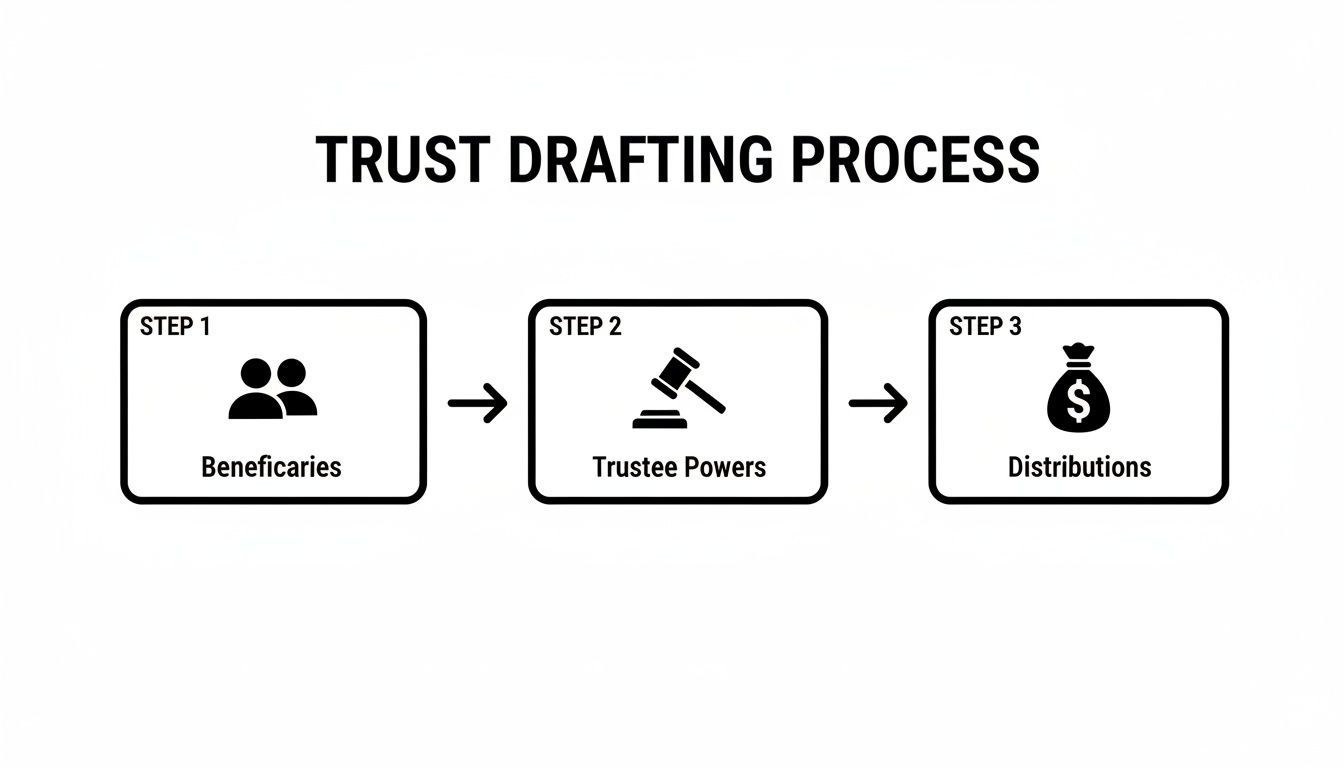
Defining beneficiaries, trustee powers, and distribution rules are the foundational pillars that must be in place before funding can even begin.
Navigating Complex and Specialized Assets
Some assets require a more specific touch. For example, tangible personal property like art, jewelry, and collectibles can be transferred using a document called an “Assignment of Property.” This is a simple document that lists the items and formally assigns their ownership to the trust.
Life insurance is another key asset to address. You can either name the trust as the primary beneficiary of the policy or, in some cases, transfer ownership of the policy itself to the trust—a common strategy in advanced estate tax planning.
This level of detail is crucial in today’s booming wealth management landscape. The global market for Private Trust Company Setups recently hit USD 1.42 billion and is projected to reach USD 2.75 billion by 2033. Properly funding your trust with stocks, real estate, and other assets helps you avoid probate’s typical 2-7% fees, a significant reason why high-net-worth families increasingly rely on these structures.
Ultimately, the goal is to leave no asset behind. Meticulously retitling everything from your primary residence to your brokerage accounts ensures your trust can do its job: bypassing probate, protecting your heirs, and preserving your legacy. To fully grasp the consequences, it helps to understand what probate is and how it works—the very system a well-funded trust is designed to circumvent.
Choosing the Right Trustee to Manage Your Legacy

Once you’ve mapped out the architecture of your family trust, you’ll arrive at what is arguably the most critical decision of the entire process: who will be in charge? Your trustee is the legal steward of your legacy, bound by a strict fiduciary duty to manage assets, handle distributions, and execute your wishes to the letter.
This is no honorary title. The job demands a delicate balance of financial savvy, objective judgment, and an unwavering commitment to your family’s best interests. Whether you appoint a relative or hire a professional has profound implications for the future you’re trying to build.
The Case for a Family Member Trustee
Naming a trusted relative—a responsible sibling or an adult child—often feels like the most intuitive move. They know your family’s history, have personal relationships with the beneficiaries, and typically won’t charge a fee, saving the trust significant money over its lifetime.
This can work beautifully when the assets are straightforward and family dynamics are harmonious. Imagine a trust holding a family home and a brokerage account for two financially stable adult children; one of them could likely manage it without issue.
But don’t underestimate the emotional weight. A family trustee has to be capable of denying a loved one’s request for funds or making tough calls that could easily strain family ties.
When to Consider a Corporate Trustee
For more complex estates, or in families where conflict is a possibility, a corporate trustee is often the smarter play. These professional fiduciaries—usually the trust department of a bank or a specialized trust company—bring impartiality, deep expertise, and institutional longevity to the role.
They are fluent in the language of trust administration, tax law, and investment management. More importantly, their objectivity acts as a firewall against family disputes.
Bringing in a professional is almost essential in these situations:
- Complex Assets: The trust holds a family business, commercial real estate, or other sophisticated investments requiring specialized oversight.
- Potential for Conflict: Beneficiaries have a history of disagreement, making an impartial decision-maker non-negotiable for keeping the peace.
- Special Needs Beneficiaries: The trust must be managed by someone who intimately understands the complex rules governing government benefits to protect a loved one’s eligibility.
Choosing the right trustee is a cornerstone of effective estate planning. It’s a crucial decision, especially when a 2023 survey revealed that 60% of Americans don’t even have a basic will or living trust, while the U.S. Trusts & Estates sector has grown to a $290.1 billion industry. The best approach involves selecting trustees—be they family or corporate—who can precisely execute your plan. Read more about the essential steps to establish a family trust.
Smart Strategies for Trustee Selection
You don’t have to pick just one. Many sophisticated plans use a hybrid model, appointing a family member and a corporate institution as co-trustees. This approach marries personal insight with professional discipline, often yielding the best of both worlds.
Another non-negotiable step is naming successor trustees. Life is unpredictable. Your first choice may pass away, become incapacitated, or simply no longer wish to serve. By clearly designating a line of succession in your trust document, you ensure a seamless transfer of control, preventing your legacy from being left adrift.
Partnering With an Expert Attorney for Lasting Success
While it’s empowering to understand the mechanics of a family trust, the actual execution is where elite legal expertise becomes absolutely essential. Using online templates might seem like a smart way to cut costs, but this DIY approach is often a gateway to critical errors—mistakes that can invalidate the entire trust and cost your family infinitely more down the road.
Hiring an experienced trusts and estates attorney isn’t just another line-item expense; it’s the foundational investment in your legacy’s durability. A true expert does far more than fill out forms. They architect a bespoke strategy, one that accounts for your specific financial picture and unique family dynamics.
Red Flags That Demand Professional Guidance
Certain scenarios are far too complex for a one-size-fits-all solution and immediately signal the need for specialized legal counsel. If your estate includes any of the following, professional guidance is non-negotiable to ensure your trust is both legally sound and effective:
- Significant or Complex Assets: This includes ownership of a closely-held business, commercial real estate holdings, or a sophisticated investment portfolio with alternative assets.
- International Holdings: Any assets located outside the U.S. fall under a different web of laws and tax treaties, requiring an expert to navigate them correctly.
- Blended Family Dynamics: Crafting precise, unambiguous provisions for children from previous marriages is crucial to preempting disputes and claims against the estate.
- Beneficiaries with Special Needs: A specialized trust is required to provide for a loved one without inadvertently disqualifying them from essential government benefits.
A skilled attorney does more than just draft a document; they anticipate future challenges and use precise legal language to neutralize them from the start. This foresight is what protects your assets and prevents your trust from becoming a source of bitter family conflict.
Engaging a specialist is about making sure every clause is legally airtight and that the trust operates exactly as you intend for generations to come. That level of precision is what turns a piece of paper into a powerful fortress for your family’s legacy.
Finding the Right Legal Partner
Your relationship with your attorney should feel like a long-term strategic partnership. You need a professional who only practices in trusts and estates, ideally one with a track record of handling estates of a similar size and complexity to your own. A general practitioner simply doesn’t have the niche expertise required for this level of planning.
The right counsel will ask deep, probing questions about your family, your assets, and what you ultimately want to achieve. Their job is to translate that vision into a legally resilient structure built to stand the test of time. For those seeking this top tier of legal expertise, a curated network can help you find an estate planning attorney near you who is already vetted for their experience with high-net-worth clients. This partnership is the final, and most critical, step in securing your family’s future.
Answering Your Questions on Family Trusts
When you start digging into family trusts, a few practical questions almost always come up. It’s natural to wonder about the costs, who’s in control, and how to keep the plan current. Let’s clear up some of the most common questions we hear from clients.
How Much Does It Cost to Set Up a Family Trust?
There’s no one-size-fits-all price tag for creating a family trust. The cost is a direct reflection of your family’s financial picture and what you want to accomplish.
For a relatively standard revocable living trust, you can expect legal fees from a highly qualified attorney to be in the $2,500 to $5,000 range. This covers the essential drafting and initial guidance.
However, for high-net-worth families with more moving parts—like business succession, provisions for a special needs heir, or sophisticated tax strategies using irrevocable trusts—the investment can easily reach $7,000 or more. This premium covers the advanced legal architecture and in-depth asset funding strategy required to protect substantial wealth.
Think of this not as an expense, but as an investment in certainty. The upfront cost for elite legal counsel is a fraction of the probate fees, estate taxes, and family litigation that a poorly constructed trust can trigger down the road.
Can I Be the Trustee of My Own Revocable Trust?
Absolutely. In fact, for a revocable living trust, it’s the standard arrangement. As the grantor—the person creating the trust—you will almost always serve as the initial trustee. This gives you complete, uninterrupted control over your assets. You can buy, sell, and manage your property exactly as you did before.
The trust document also names a successor trustee. This is the critical appointment of the person or institution you’ve chosen to manage the trust if you become incapacitated or after your death. Their job is to step in immediately, without any court involvement, and execute the instructions you’ve laid out.
How Often Should I Review My Family Trust?
A trust is a living document, not a file you sign and forget. To keep it aligned with your life and the law, a comprehensive review every three to five years is a smart move.
More importantly, major life events should trigger an immediate call to your attorney for a review. These are moments when your circumstances change, and your estate plan must change with them.
- A marriage, divorce, or the death of a spouse.
- The birth or adoption of a new child or grandchild.
- A major shift in your financial status—a significant inheritance, business sale, or even a loss.
- The death of a beneficiary or a named successor trustee.
- Substantial changes in federal or state tax laws.
Regular check-ins ensure your trust remains a precise tool for protecting your legacy, no matter how your life evolves.
Navigating the complexities of trust creation requires elite legal expertise. Haute Lawyer Network connects you with a curated selection of the nation’s top attorneys, ensuring your legacy is crafted with the precision and foresight it deserves. Learn more and find your expert legal partner today.