Adopting your stepdaughter is a formal legal process that solidifies your parental rights and responsibilities, ensuring she has the same legal security as a biological child. The journey involves meeting eligibility criteria, obtaining consent from the other biological parent, filing a petition with the court, and attending a final hearing.
Your Guide to Stepparent Adoption
Deciding to legally adopt your stepdaughter is a defining moment for any blended family. It transforms an emotional bond into a permanent, legally recognized parent-child relationship—a critical step that provides her with the same inheritance rights, social security benefits, and insurance access as a biological child.
This guide is your roadmap. We’ll break down a complex legal process into clear, manageable parts, walking you through the entire journey from the initial eligibility checks to the final court hearing that makes it all official.
Why Formal Adoption Matters
You may already feel like her parent in every way that counts, but a legal adoption formalizes that role. It grants you the authority to make critical decisions regarding her:
- Medical Care: Consent to treatments and access her medical records.
- Education: Enroll her in school and make key educational decisions.
- Legal Matters: Act on her behalf in any legal situations that arise.
This legal finality is about more than just paperwork. It’s about providing your stepdaughter with the lifelong security of knowing her place in the family is protected, no matter what the future holds.
Stepparent adoptions are a common and vital part of forming blended families in the United States. In 2022, private domestic adoptions, including those by stepparents, totaled 51,101. Stepparent adoptions made up just over 50% of that number, highlighting how many families, just like yours, are taking this important step. You can explore more data on stepparent adoption from the National Council for Adoption.
What to Expect on This Journey
The path to adoption involves several key stages, each with its own requirements and considerations. Think of it as a series of milestones leading to one of the most rewarding days of your life.
To give you a clear picture of what lies ahead, we’ve summarized the major milestones in the stepparent adoption process. This table provides a quick-glance roadmap of what to expect.
Key Stages of a Stepparent Adoption
| Stage | Primary Goal | Typical Timeframe |
|---|---|---|
| Eligibility & Consent | Confirm you meet state requirements and secure consent from the other biological parent. | 1-3 Months |
| Filing the Petition | Prepare and submit all necessary legal documents to the family court. | 2-4 Weeks |
| Home Study & Hearing | Complete any required evaluations and attend the final court hearing for approval. | 2-6 Months |
Each stage comes with its own set of tasks and potential challenges, but knowing the sequence helps you prepare for the journey and stay on track.
Navigating Eligibility and Consent Requirements
Before you can even begin the paperwork to formally adopt your stepdaughter, you’ll need to clear a few foundational legal hurdles. Every state has specific criteria a stepparent must meet to be eligible, acting as a gatekeeper to ensure the family structure is stable enough for this significant legal step.
Most states, for example, require you to be married to the child’s biological parent for a minimum period, often six months to a year. You’ll also likely need to meet residency requirements, proving you’ve lived in the state—and sometimes the specific county—for a set amount of time before filing your petition.
Securing Consent from the Other Biological Parent
This is often the most critical and emotionally charged part of the entire process: getting legal consent from your stepdaughter’s other biological parent. When you adopt her, their parental rights are legally terminated. Forever. It’s a profound legal action, and the courts treat it with the gravity it deserves.
The smoothest path, of course, is when the other parent supports the adoption. They see it’s in their child’s best interest and willingly sign a consent form to relinquish their rights. This makes the entire process far less contentious and moves things forward quickly.
But life isn’t always that simple. What if they refuse? Or what if you can’t even find them? This is where things get more complicated, but it doesn’t mean the adoption is impossible. The law provides ways to proceed, but the burden of proof is now squarely on you to convince a judge that terminating their rights is justified.
A court’s primary duty is to protect the child’s best interests. When a biological parent’s rights are at stake, the judge will require clear and convincing evidence that termination is the right and necessary step for the child’s well-being and stability.
This visual decision tree helps illustrate the initial questions you’ll face regarding your marriage and the other parent’s consent.
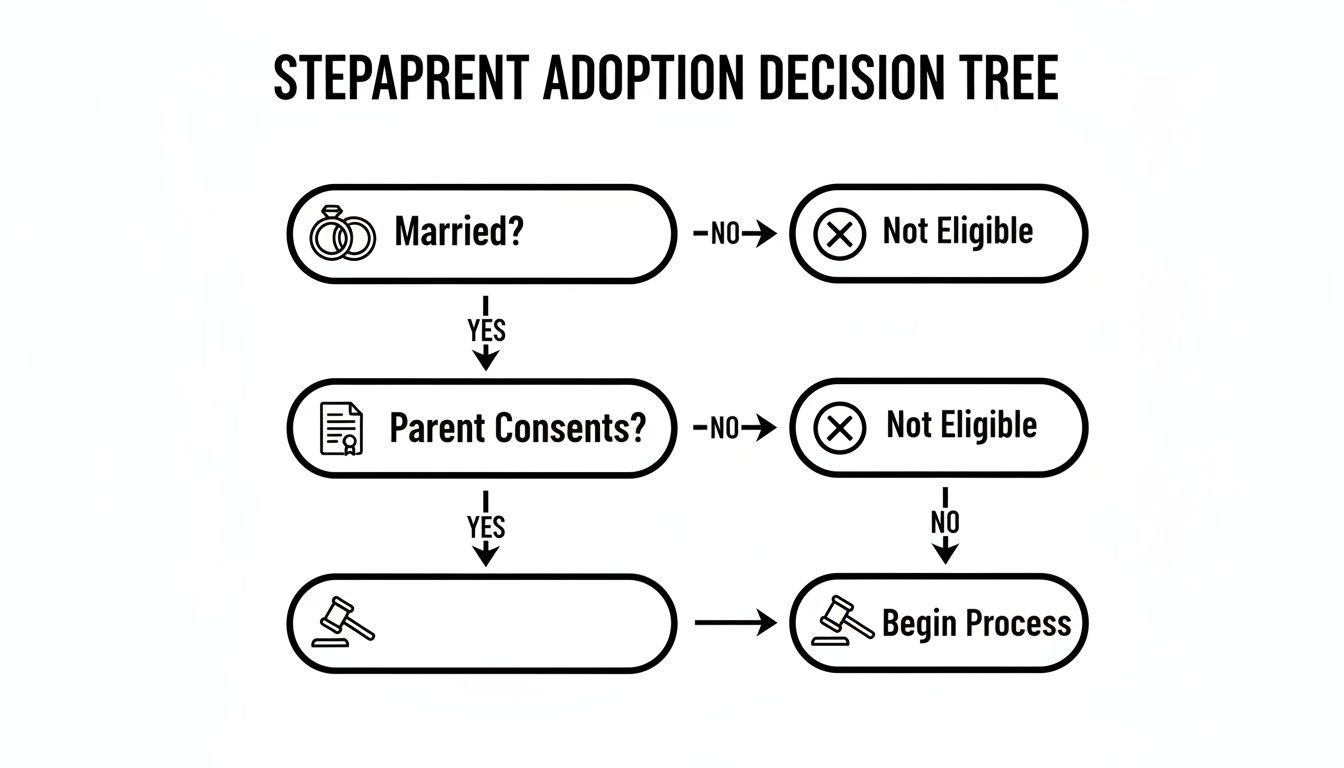
As the flowchart shows, being married and having the other parent’s consent are the most direct routes to beginning the adoption process.
When a Court May Terminate Parental Rights
If the other biological parent won’t consent or has disappeared, you’ll have to petition the court to involuntarily terminate their parental rights. This is a very high legal bar to clear. You can’t just do it because you don’t get along.
Common grounds a court will consider for termination include:
- Abandonment: This is a big one. If the parent has had virtually no contact and provided zero financial support for a specific period (usually six months to a year, depending on state law), a court may find they have abandoned the child.
- Unfitness: This covers a range of serious issues, from a documented history of child abuse or neglect to chronic substance abuse or long-term incarceration that makes parenting impossible.
- Failure to Support: Consistently failing to pay court-ordered child support can be a factor, but it’s often much stronger when combined with a lack of contact or other fitness issues.
Successfully arguing for involuntary termination requires meticulous documentation. You’ll need to gather evidence like text messages, emails, financial records, and even witness testimony. Given how complex and high-stakes this is, you can get valuable insights from experts who have navigated these exact situations; you can find child custody legal advice you can trust from experienced family law attorneys.
The Importance of Your Stepdaughter’s Consent
As children get older, their own voice becomes legally significant in the adoption process. Most states require the child’s formal, written consent once they reach a certain age, which is typically between 10 and 14 years old.
This isn’t just a box to check. A judge will want to be absolutely certain this is what she truly wants. They may even speak with her privately in their chambers to confirm her feelings about the adoption, away from any potential family pressure.
When you have this conversation, it needs to be handled with sensitivity. Frame it as a way to make your family official in every sense, solidifying her legal security and your lifelong commitment to her as her parent.
Preparing and Filing Your Adoption Paperwork
Once you’ve confirmed eligibility and secured the necessary consents, it’s time to tackle the administrative heart of the process: the paperwork. This part is all about precision. It can feel like a mountain of forms, but thinking of it as a detailed checklist makes it far more manageable.
The core document is the Petition for Adoption. This is your formal, legal request to the court, clearly stating who you are, your relationship to your stepdaughter, and most importantly, why this adoption is in her best interest. This petition officially kicks off the legal proceedings.
Gathering Your Essential Documents
Accuracy is everything here. A single missing document or a simple mistake can cause frustrating delays, pushing your court date back and adding a ton of unnecessary stress. Before you even touch the petition, get all your supporting materials in order.
Your document checklist will almost always require these items:
- Original Birth Certificate: You’ll need a certified copy of your stepdaughter’s birth certificate.
- Marriage Certificate: This is the certified proof of your legal relationship with your spouse.
- Signed Consent Forms: This includes the notarized consent from the non-custodial parent and the written consent from your stepdaughter if she’s old enough to provide it (usually 12-14).
- Proof of Identity: Standard copies of your driver’s license or another government-issued ID will be needed.
Having these documents ready to go will make completing the actual petition a much smoother experience. This prep work is the foundation for a successful filing.
Completing and Filing the Adoption Petition
When you fill out the Petition for Adoption, be meticulous and honest. The form requires personal details about you, your spouse, and your stepdaughter. You’ll also need to explain the situation with the other biological parent—whether they are deceased, have consented, or if you’re asking the court to terminate their parental rights.
After the petition and all supporting documents are compiled, you’ll file them with the proper court, which is typically the family or circuit court in the county where you live. Expect to pay a filing fee, which usually runs between $200 and $500, depending on your state and county.
Pro Tip: Make copies of every single page you file with the court. Keep a complete set for your personal records. This simple step is an absolute lifesaver if anything gets misplaced or you need to reference a document down the road.
Trying to navigate local court rules and specific forms can be tricky, and even tiny errors can get your packet rejected. This is where professional guidance becomes invaluable. To get a better feel for what working with a legal expert entails, check out this practical family law attorney consultation guide.
Navigating Background Checks and Clearances
Even in a stepparent adoption where you’ve been in the child’s life for years, background checks are standard. This is a non-negotiable step designed to protect your stepdaughter’s welfare. The court’s primary duty is ensuring the adoption is in the child’s best interest, and these checks are fundamental to that responsibility.
You should be prepared for a few key things:
- Criminal History Check: You’ll almost certainly be fingerprinted for state and federal criminal background screenings.
- Child Abuse and Neglect Clearance: The court will check official state registries to confirm there is no history of child abuse or neglect.
Think of these checks as a standard procedure, not a reflection on you personally. They are a universal safeguard in every adoption case. Completing them quickly is essential to keeping your case on track for the final hearing.
The Home Study And Final Court Hearing
Once the initial paperwork is filed, the process advances to the final stages: the home study and the court hearing. The term “home study” can sound intimidating, conjuring up images of a white-glove inspection, but for stepparent adoptions, the reality is almost always far less invasive.
The court’s goal here is simple: to ensure your stepdaughter is in a safe, stable, and supportive home. It’s a protective measure, a final check to confirm that making the adoption official is truly in her best interest.

What To Expect From The Home Study
In many states, the home study requirement for a stepparent adoption is either waived entirely or significantly streamlined. This makes sense—you already live with your stepdaughter and spouse. The court recognizes this isn’t a new placement but the legal formalization of an existing family.
If your jurisdiction does require a home study, it’s usually a straightforward process. You can generally expect:
- Interviews: A social worker or court investigator will meet with you, your spouse, and possibly your stepdaughter. They’ll ask about your family life, your relationship with your stepdaughter, and your reasons for adopting.
- Home Visit: This is typically a brief walkthrough to confirm the home is a safe and suitable environment. They are not judging your interior design; they are checking for basic safety standards.
- Document Review: The investigator will review the documents you’ve filed and may ask for supporting information, like income verification.
The home study is fundamentally a conversation. Be open, be honest, and let your genuine love for your stepdaughter shine through. The investigator is there to verify the positive family environment you’ve already created.
Preparing For The Final Court Hearing
The final hearing is the moment it all becomes official. It’s typically a celebratory and brief event, especially in an uncontested stepparent adoption. This is where a judge reviews your case, asks a few final questions, and signs the decree that legally makes your stepdaughter your child.
Feeling prepared is the key to confidence on this important day. While the atmosphere is far less adversarial than other court proceedings, knowing what to expect can calm any nerves. You can find excellent advice on how to prepare for a custody hearing, and many of the same principles of organization and mindset apply here.
Historically, uncontested stepparent adoptions have an exceptionally high success rate. When all parties are in agreement, family court data reveals over 90% of these petitions are approved. This streamlined process, which often takes just a few months, stands in stark contrast to the more intensive checks required in other adoption pathways.
What Happens In The Courtroom
The final hearing is usually a positive and emotional experience. You, your spouse, and your stepdaughter will appear before the judge, along with your attorney if you have one.
The judge will likely:
- Confirm Identities: Ask everyone to state their names for the record.
- Review The Petition: Briefly go over the key facts of your adoption case.
- Ask Questions: The judge may ask you and your spouse why you feel the adoption is in the child’s best interest. They might also ask your stepdaughter (if she’s old enough) if she consents and understands what it means.
These questions aren’t designed to trip you up. They are simply to confirm that everyone understands the legal and emotional significance of the moment. The atmosphere is generally warm and supportive, with most judges taking a moment to congratulate the newly-official family.
Once satisfied, the judge will sign the final decree of adoption. In that instant, you become your stepdaughter’s legal parent, with all the rights and responsibilities that title holds.
Life After the Adoption Is Finalized
The moment the judge’s gavel falls and the adoption is final is pure relief. It’s the finish line after months of paperwork, background checks, and emotional hurdles. Go celebrate—you’ve earned it. But once the confetti settles, there are a few practical loose ends to tie up to make your new family structure official in the eyes of the world.
Think of it as the administrative victory lap. These next steps are what truly lock in the legal security you’ve worked so hard to give your daughter.
Obtaining a New Birth Certificate
One of the most powerful and symbolic steps is getting an amended birth certificate for your daughter. This new document officially lists you as her parent, replacing the biological parent whose rights were terminated.
The court that finalized the adoption will provide the right forms or direct you to your state’s vital records office. Expect a processing fee and a bit of a wait—it can take anywhere from a few weeks to several months, depending on your state’s backlog.
This new birth certificate is more than just a piece of paper. It’s the permanent, legal record that affirms your role as her parent and serves as the foundational document for updating everything else.
If you’re also changing her last name, this is the time to do it. Her new name will be printed right on the amended certificate, which simplifies all future updates.
Updating Key Records and Information
With the new birth certificate in hand, you can start updating all the other critical records. This is where your new legal status meets the practical, day-to-day realities of being a parent. Neglecting this part can lead to logistical headaches down the road.
I always advise clients to make a simple checklist of every agency and organization that needs the updated information.
Your list should include, at a minimum:
- Social Security Administration: Get in touch with the SSA to update her official record. If her name has changed, you’ll need to request a new Social Security card.
- Health and Dental Insurance: This is a big one. Add your daughter to your insurance policies as a legal dependent immediately to ensure there are no gaps in her medical, dental, or vision coverage.
- School and Daycare: Give the school a copy of both the adoption decree and the new birth certificate. This officially lists you as the legal parent for all emergency contacts, communications, and permissions.
Securing Her Financial Future
The adoption fundamentally changes your family’s financial and legal picture. Updating your estate plan isn’t just a suggestion—it’s an absolute necessity and a core responsibility of your new role.
Here’s what needs to happen right away:
- Update Your Will or Trust: Have your attorney revise your estate planning documents to explicitly name your daughter as your child. This ensures she has the exact same inheritance rights as any biological children.
- Review Beneficiary Designations: Go through all your life insurance policies, retirement accounts (401(k)s, IRAs), and other financial accounts. Add her as a beneficiary to provide for her future security.
- Consider a College Savings Plan: If you haven’t started one, now is the perfect time to open a 529 plan or another educational savings account in her name.
Taking care of these final administrative tasks closes the loop on the entire process. It’s the final act that ensures the permanency you fought for is reflected in every corner of her life.
Common Questions About Adopting a Stepdaughter
Even with a clear roadmap, the journey to adopt your stepdaughter is deeply personal, and it’s natural to have specific questions about the details. Families often run into the same practical concerns around cost, timelines, and tricky family dynamics.
Let’s clear up some of the most common questions we hear from clients. Our goal is to demystify these hurdles so you can focus on what truly matters: formalizing your bond with your daughter.
What Is the Average Cost of a Stepparent Adoption?
The cost to adopt a stepdaughter is almost always more affordable than other types of adoption, but the total expense hinges on one critical factor: whether the other biological parent contests it.
Here’s what you can generally expect:
- Uncontested Adoptions: If the other parent consents and the process is straightforward, your costs will mostly be court filing fees (typically $200-$500) and attorney fees. An uncontested adoption might cost between $2,000 and $5,000.
- Contested Adoptions: The moment you have to petition the court to terminate the other parent’s rights, the costs escalate. This involves more legal work, investigations, and court appearances, pushing legal fees up significantly.
Always get a clear fee structure from your attorney upfront to avoid any surprises down the road.
How Long Does the Adoption Process Usually Take?
Like the cost, the timeline is all about cooperation. An uncontested stepparent adoption, where everyone is on the same page, can be surprisingly quick. In many cases, you can finalize the entire process in as little as three to six months.
However, if the adoption is contested or you can’t find the other biological parent, the timeline can stretch out considerably. A contested case could easily take a year or more to resolve as the court navigates the complex process of involuntarily terminating parental rights.
The single biggest factor determining your timeline is the consent of the other biological parent. A signed consent form is the key to an efficient and streamlined process.
What Happens If We Can’t Find the Other Biological Parent?
This is a common and stressful situation, but it doesn’t have to be a dead end. If you’ve made a genuine, documented effort to find the other parent without success, the adoption can still move forward.
Your attorney will need to prove to the court that you’ve performed a “diligent search.” This isn’t just a casual look; it involves checking public records, contacting last known relatives, and sometimes publishing a notice in a local newspaper. If those exhaustive efforts fail, the court can allow the adoption to proceed without their consent, often on grounds of abandonment.
Can We Change My Stepdaughter’s Last Name?
Absolutely. The adoption hearing is the perfect time to legally change her last name to yours if that’s your family’s wish. The name change request is simply included as part of the adoption petition you file with the court.
Once the judge signs the final adoption decree, it will include the official order for the name change. That legal document is what you’ll use to update her birth certificate, Social Security card, and all other records, making her place in your family official in every way.
Do I Need to Hire an Attorney to Adopt My Stepdaughter?
While you aren’t legally required to hire an attorney in most states, trying to handle a stepparent adoption on your own (known as “pro se”) is a significant risk. Adoption law is a minefield of procedural requirements and strict deadlines.
A small mistake on a form or an improperly served notice can get your case dismissed or delayed for months, adding frustration and cost to an already emotional process.
Hiring an experienced family law attorney ensures:
- Every document is filed correctly and on schedule.
- You are fully prepared for your court appearance.
- You have a skilled advocate in your corner if the case becomes contested.
The investment in proven legal expertise offers invaluable peace of mind and dramatically increases the likelihood of a smooth, successful adoption.
Navigating the complexities of a stepparent adoption requires expert guidance. The attorneys in the Haute Lawyer Network are recognized leaders in family law, selected for their professional excellence and commitment to their clients. Connect with a top-tier attorney who can provide the strategic advice and compassionate support your family deserves.
Find a Premier Family Law Attorney on Haute Living