So, you’re wondering how long this is all going to take. It’s the first question on everyone’s mind, and the honest answer is: it depends. On average, a divorce can be finalized in as little as three months or drag out for well over a year.
The timeline really comes down to one crucial element: are you and your spouse on the same page, or are you preparing for a fight?
Your Divorce Timeline: What to Realistically Expect

Before anything else, it’s important to set realistic expectations. Every divorce has its own unique rhythm, shaped by state laws, emotional hurdles, and the sheer logistics of untangling a shared life. Think of it as a journey with two very different paths—one is a straight shot down the highway, and the other is a winding country road full of unexpected detours.
What determines which path you take? The level of agreement between you and your spouse. A simple, uncontested divorce where you’ve already sorted out the big issues can move surprisingly fast. But a contested divorce, where you’re at odds over assets, support, or kids, will almost certainly be a much longer haul.
The Two Divorce Paths
The route you end up on will define your timeline more than anything else. Here’s a quick look at how the two paths usually play out:
- Uncontested Divorce: This is the express lane. If you and your spouse agree on property division, spousal support, and all custody matters, things can wrap up relatively quickly. Often, these cases are finalized not long after the state’s mandatory “cooling-off” period ends, putting the timeline somewhere in the 3 to 6-month range.
- Contested Divorce: This is the scenic route—and not in a good way. It involves lawyers negotiating, mediators trying to find common ground, and potentially court hearings to settle disputes. Every point of disagreement adds more time to the clock, pushing the process from 6 months to 18 months or even longer, particularly if you have complex finances or custody battles.
To give you a clearer picture, here’s a simple breakdown of what to expect.
Average Divorce Timelines at a Glance
| Divorce Type | Average Timeframe | Key Characteristics |
|---|---|---|
| DIY / Uncontested | 3 – 6 Months | Both spouses agree on all terms. Minimal lawyer involvement. Primarily waiting on court processing and mandatory waiting periods. |
| Mediation / Collaborative | 6 – 12 Months | Spouses work with neutral professionals to reach agreements. Avoids court battles but requires productive negotiation. |
| Contested Litigation | 12 – 24+ Months | Spouses cannot agree and require a judge to decide. Involves discovery, hearings, and potentially a full trial. |
As you can see, the more cooperation, the faster the resolution. The more conflict, the more you can expect the process to stretch out.
The single biggest factor determining your divorce’s length is whether you and your spouse agree on the major issues. Cooperation directly controls the clock, while conflict adds months or even years to the process.
The bottom line is that the answer to “how long does a divorce take?” isn’t one number but a wide spectrum. This guide will walk you through each stage, point out the common delays, and give you some real strategies to get through it all as efficiently as possible.
Uncontested vs. Contested: The Two Roads of Divorce
The single biggest factor that dictates how long a divorce will take isn’t the state you live in or even the lawyer you hire—it’s whether you and your spouse can agree on the major issues. This one variable creates two completely different paths: the uncontested divorce and the contested divorce.
Think of it like planning a road trip. An uncontested divorce is where both of you have already agreed on the destination, the route, and who controls the radio. The map is drawn, making the journey faster, smoother, and far less expensive.
A contested divorce, on the other hand, is a road trip with no map, where every single turn is up for debate. One person wants to go north, the other south. These disagreements over assets, kids, and support become major roadblocks that can add months, or even years, to the journey.
What Defines an Uncontested Divorce
An uncontested divorce means you and your spouse have reached a complete agreement on all key matters before the divorce is finalized. This doesn’t mean you never had disagreements; it just means you worked through them without needing a judge to make the decisions for you.
To be truly uncontested, you must have a solid agreement on:
- Division of Assets: Who gets the house, the cars, the investments, and the retirement accounts.
- Division of Debts: A clear plan for handling the mortgage, credit card balances, and any other loans.
- Child Custody and Parenting Time: A detailed parenting plan outlining where the children will live and how major decisions will be made.
- Child Support and Spousal Support: An agreement on the amount and duration of any financial support.
Once these pieces are in place, the legal process becomes mostly administrative. Your attorney drafts the settlement agreement, files the required paperwork, and you wait for the court’s approval. The timeline is then mainly controlled by your state’s mandatory waiting period, often resulting in a finalized divorce in just a few months.
An uncontested divorce is the business-like dissolution of a marriage. By focusing on mutual agreement, couples bypass the lengthy and costly court battles that define contested cases, dramatically shortening the timeline.
The Realities of a Contested Divorce
A divorce becomes contested the moment you and your spouse can’t agree on any significant issue. Even a dispute over something small, like a piece of furniture, can stall the entire process. But the major delays almost always come from the big, emotionally charged issues.
If you can’t agree on a parenting plan, for instance, a court might order custody evaluations, psychological assessments, and multiple hearings. If a family business is involved, financial experts like forensic accountants may be needed to determine its value. Each of these steps brings in new professionals, creates more paperwork, and causes significant delays.
The path forward usually involves intense negotiation through lawyers or working with a neutral third party. Understanding the critical differences between divorce mediation vs litigation is essential here, as choosing a more collaborative route can help you settle disputes without a full-blown trial.
Ultimately, if you still can’t reach an agreement, a judge will make the final decisions for you—but only after a long and very expensive court process. This is exactly why contested divorces can easily stretch beyond a year.
The Key Stages of the Divorce Process
Trying to understand the divorce timeline can feel like staring at a giant, tangled knot. But it gets a lot clearer when you see it as a series of distinct stages instead of one overwhelming event. Think of it like a project with a defined sequence of steps, each with its own purpose and timeline.
Knowing this roadmap helps you anticipate what’s coming, spot potential delays, and feel more in control. It turns an unpredictable marathon into a series of manageable sprints.
This infographic breaks down the two main paths a divorce can take—uncontested versus contested—and the typical steps you’ll encounter on each journey.
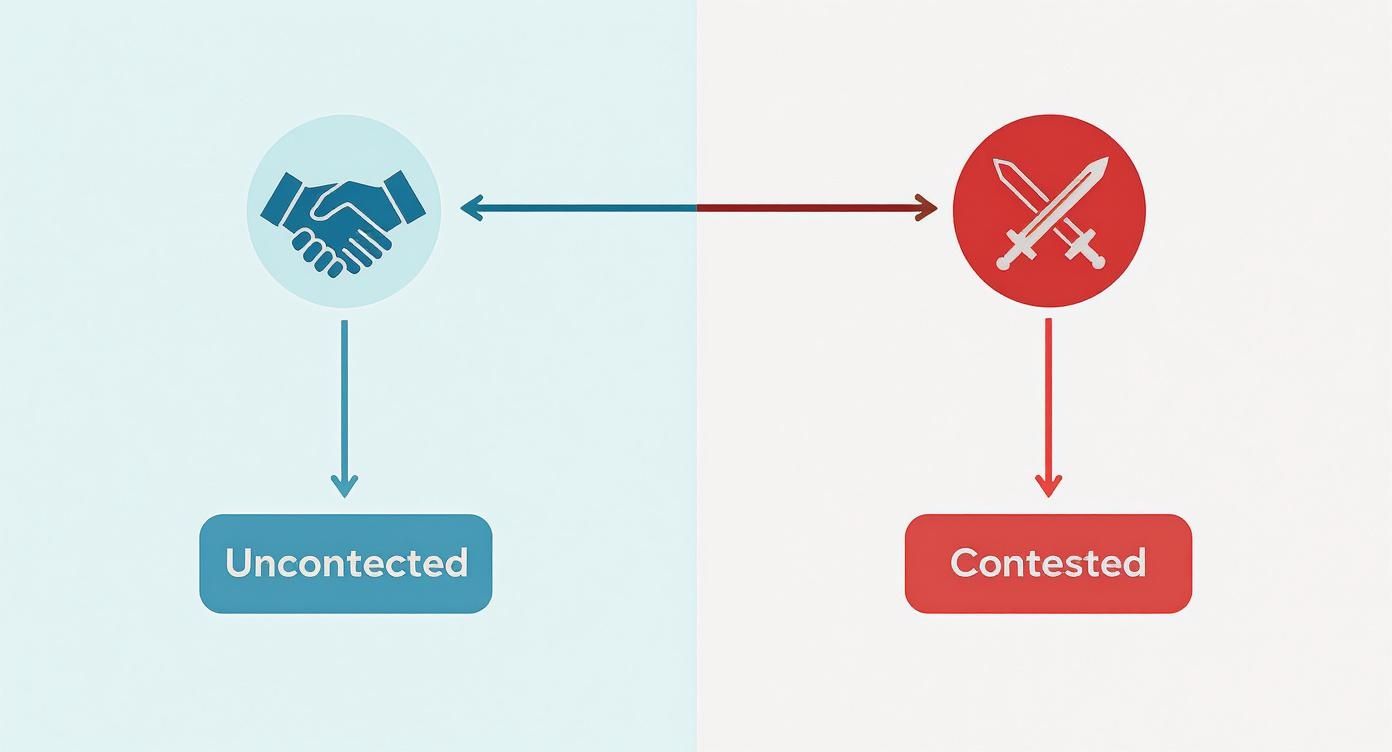
As you can see, the uncontested route is pretty direct. The contested path, however, involves more detours and decision points that can add serious time to the clock.
Stage 1: Filing the Petition and Serving Papers
The starting gun for any divorce is the filing of a document called a Petition for Dissolution of Marriage. One spouse, now known as the Petitioner, files this with the court to formally state their desire to end the marriage. It also lays out their initial requests for how assets, debts, and child-related issues should be handled.
Once filed, the other spouse—the Respondent—has to be officially notified. This isn’t just a text or a phone call; it’s a formal legal procedure called “service of process.” They are personally handed a copy of the petition and a summons, a critical step that ensures both people know the case has begun. This stage can take anywhere from a few days to a few weeks, depending on how easy it is to locate and serve the Respondent.
Stage 2: The Response and Temporary Orders
After being served, the clock starts ticking for the Respondent. They typically have 20 to 30 days to file a formal response with the court. In this document, they’ll either agree with what the petition says or contest the claims.
Right around this time, either spouse can also ask the court for temporary orders. These are short-term rulings that set ground rules for things like finances, child custody, and who stays in the house while the divorce is ongoing. A temporary order can bring much-needed stability by clarifying how bills get paid or who has the kids on which days.
A crucial takeaway is that the procedural length of divorce varies widely. In the United States, where the divorce rate is about 2.3 per 1,000 people, the legal proceedings can last from a few months to 18 months or longer, influenced heavily by mandatory waiting periods and the complexity of custody and asset division. Discover more insights about U.S. divorce statistics on divorcecanbesimple.com.
Stage 3: Discovery and Negotiation
Get ready, because this is often the longest and most demanding stage, particularly if you and your spouse don’t see eye-to-eye. Discovery is the formal process where both sides gather information and evidence from each other. This means exchanging financial records, answering written questions (called interrogatories), and sometimes giving sworn testimony out of court (depositions).
The whole point of discovery is to get a complete, transparent financial picture so assets and debts can be divided fairly. This phase can easily stretch on for several months, especially if one person is uncooperative or the finances are a complicated mess.
While information is being collected, the attorneys are usually in negotiation mode, trying to hammer out a settlement. This can happen through direct talks, mediation, or another process like collaborative law.
Stage 4: Settlement or Trial and Final Judgment
The finish line looks very different depending on whether you were able to reach an agreement during negotiations.
- If a Settlement is Reached: A formal settlement agreement is drafted and signed by both of you. It’s then submitted to a judge, who reviews it to make sure everything is fair and legal before signing the final Decree of Dissolution.
- If No Settlement is Reached: Your case moves on to trial. This means you’ll both present evidence and arguments to a judge, who will then make the final decisions on all the unresolved issues for you.
Once that judge signs the final decree—either approving your settlement or issuing orders after a trial—your marriage is legally over. This is the moment that officially closes the legal chapter of your divorce.
Common Roadblocks That Can Delay Your Divorce
While every divorce follows a similar legal path, some journeys are far longer than others. The real answer to “how long does a divorce take?” isn’t found in the legal paperwork itself, but in the obstacles that pop up along the way. Think of these issues as unforeseen traffic jams on your legal road trip—they can turn a simple drive into a frustrating, extended ordeal.
Understanding these common roadblocks is the first step to navigating around them. By recognizing what can stall progress, you can work to address these issues proactively and potentially save yourself a massive amount of time, money, and emotional strain.
High-Conflict Custody Disputes
Nothing grinds a divorce to a halt faster than intense disagreements over children. When parents simply cannot agree on a parenting plan, the court has no choice but to step in and decide what is in the child’s best interest. This is a slow, methodical process that can easily add months—or in some cases, over a year—to your timeline.
The delays come from a series of required legal procedures, which may include:
- Custody Evaluations: A neutral, third-party expert is brought in to assess the family dynamics and make a formal recommendation to the judge.
- Guardian ad Litem: An attorney may be appointed for the sole purpose of representing the children’s interests.
- Multiple Court Hearings: Judges rarely make a final custody decision in one sitting. They often require several hearings to gather testimony and evidence from all sides.
Each of these steps involves scheduling different professionals, waiting for detailed reports, and getting back on the court’s crowded calendar, all of which takes a considerable amount of time.
Complex or Hidden Financial Assets
Untangling a couple’s finances is a core part of any divorce, but it becomes a major roadblock when the assets are complicated or one spouse isn’t being transparent. If your marital estate includes things like a family business, intricate investment portfolios, or multiple real estate properties, the process of valuation and division gets exponentially more difficult.
The need for financial experts like forensic accountants or business valuators is a primary driver of delays. Their work is meticulous and time-consuming, but essential for ensuring a fair and equitable division of assets.
Even worse, any suspicion of hidden assets can trigger an exhaustive and lengthy investigation. If one spouse believes the other is concealing money or property, their attorney will likely initiate a deep dive into financial records. This isn’t just a simple review; it often involves subpoenas, depositions, and expert analysis. You can learn more about why hidden assets are more common than you think and the serious complications they cause.
Emotional Resistance and Lack of Cooperation
Finally, the human element cannot be overstated. A divorce marks the end of a significant chapter in someone’s life, and sometimes one spouse is simply not ready to let go. This emotional resistance often shows up as a complete lack of cooperation, which can sabotage the timeline at every single turn.
This stonewalling can look like:
- Refusing to sign necessary paperwork.
- Ignoring calls and emails from the other party’s attorney.
- Failing to provide required financial documents on time.
- Contesting every minor point out of principle rather than a legitimate disagreement.
This kind of behavior forces the other spouse’s attorney to file motions with the court just to compel basic actions. This creates unnecessary legal steps that clog up the system and can extend the divorce process indefinitely.
Divorce is already a difficult process, but these common roadblocks can make it significantly longer and more expensive. Understanding what they are is the first step toward a more efficient resolution. Below is a table breaking down some of these common issues and how they impact your timeline.
Common Divorce Delays and Their Impact
| Delay Factor | Potential Time Added | How to Mitigate |
|---|---|---|
| High-Conflict Custody | 6-18 months | Consider mediation or hiring a parenting coordinator early in the process. |
| Complex Asset Division | 4-12 months | Engage financial experts (forensic accountants, valuators) from the start. |
| Hidden Asset Search | 6-24 months | Provide your attorney with all evidence of suspected concealment upfront. |
| Spouse’s Uncooperativeness | 3-9 months | Document all attempts at communication and have your attorney file motions to compel. |
| Backlogged Court System | 2-6 months | Explore alternative dispute resolution (ADR) like mediation or collaborative divorce. |
While some delays are unavoidable, many can be managed with the right strategy and legal counsel. Being proactive and transparent is often the fastest way to the finish line.
How State Laws and Waiting Periods Impact Your Timeline
Even if you and your spouse are in perfect agreement, the state you live in ultimately sets the speed limit for your divorce. Think of it as a hard cap; no matter how quickly you settle things, state law dictates the absolute minimum time it will take. This is all thanks to two key legal concepts: residency requirements and mandatory waiting periods.
Before a court will even look at your divorce petition, you have to prove you belong there. This is where residency requirements come in. You or your spouse must have lived in the state—and often, a specific county—for a minimum amount of time. This period can be anywhere from a brief 90 days to a full year, depending on where you file.
Understanding Waiting Periods
Once you meet residency rules and officially file for divorce, a new clock starts ticking. It’s called the mandatory waiting period, but most people know it as the “cooling-off” period. Its purpose is exactly what it sounds like: to give couples a final, legally required pause to reconsider their decision and avoid impulsive choices made in the heat of conflict.
This waiting period is one of the biggest factors determining your timeline, and it varies wildly from state to state.
- In Texas, you’ll be waiting at least 60 days after filing.
- Washington state imposes a 90-day waiting period.
- California is famous for its longer timeline, requiring a six-month wait from the day the other spouse is served with the papers.
This means that even in a picture-perfect, uncontested divorce where every single issue is resolved on day one, the process cannot be finalized faster than the state-mandated timeline allows.
These legal timelines are non-negotiable and form the baseline for how long your divorce will take, completely separate from the time spent negotiating assets or custody. While national data shows the median length of marriages ending in divorce is around 12 years, the process of legally ending it is controlled by these specific state rules. You can find more facts about divorce in the United States from Pew Research Center.
Actionable Strategies to Speed Up Your Divorce

Knowing the potential roadblocks is only half the battle; actively navigating around them is what makes the difference. While you can’t control court backlogs or mandatory waiting periods, you can take powerful steps to significantly shorten the timeline.
The key is shifting from a reactive mindset to a proactive one. Instead of waiting for conflict to escalate, consider alternative dispute resolution methods from the very beginning.
Methods like mediation and collaborative divorce are specifically designed to keep you out of a courtroom. They focus on cooperative negotiation with neutral professionals, helping you and your spouse find common ground far faster than letting a judge decide your future.
The Power of Preparation and Compromise
The single greatest action you can take is to be impeccably organized with your finances. The discovery phase, where financials are exchanged, is notoriously the longest and most contentious part of a contested divorce. You can accelerate this dramatically by gathering key documents before the process even begins.
Create a comprehensive file with the following:
- Proof of Income: Recent pay stubs, W-2s, and tax returns for the last three years.
- Asset Information: Bank statements, retirement and investment account summaries, and property deeds.
- Debt Records: Statements for mortgages, auto loans, credit cards, and any other liabilities.
Beyond organization, a willingness to compromise is non-negotiable for a faster resolution. Divorce isn’t about winning every single point; it’s about finding a fair path forward for both parties.
Every issue you can resolve directly with your spouse is one less issue your attorneys have to spend time—and your money—negotiating. A skilled legal team is essential for guiding these discussions, and understanding how to choose the right divorce lawyer for your specific situation is a critical first step.
By focusing on solutions rather than conflict, you transform the divorce process. Proactive organization and a commitment to negotiation can save you thousands of dollars and, more importantly, months of valuable time.
Common Questions About Divorce Timelines
Even with a general timeline in mind, every separation brings its own unique questions. Here are some straightforward answers to the most common queries we see about how long the divorce process really takes.
Does a Divorce Move Faster With No Kids or Major Assets?
Absolutely. A less entangled life almost always translates into a quicker, more streamlined separation.
When there’s no parenting plan to negotiate or complex assets like businesses and retirement accounts to divide, you eliminate the biggest sources of potential conflict. This puts couples on a much faster track, often allowing them to reach a full agreement and finalize their divorce as soon as the state’s mandatory waiting period is over.
Does It Matter Who Files for Divorce First?
From a legal standpoint, filing first offers almost no strategic upper hand. The person who files is called the “Petitioner,” and the other spouse is the “Respondent,” but the court sees them as equals.
The Petitioner might pay the initial filing fee and get to speak first in court, but these procedural details rarely have any real impact on the outcome or the timeline.
The decision of who files first is mostly procedural. It doesn’t give one spouse more power or a faster track to finalization; the core timeline is still dictated by mutual cooperation and state law.
What Is a Default Divorce and Is It Quicker?
A default divorce is what happens when one spouse files the petition and the other simply fails to respond within the legally required timeframe. The court can then grant the divorce based on the Petitioner’s requests alone.
While it can be faster than a drawn-out contested divorce, it’s not an ideal strategy—it’s more of a last resort. This scenario typically comes up only when a spouse cannot be located or is completely refusing to participate in the process at all.
Navigating the complexities of a high-asset or high-profile divorce requires exceptional legal expertise. At Haute Lawyer Network, we connect you with the nation’s most respected attorneys, ensuring you have a trusted advisor by your side. Find elite-level representation by exploring our curated network at https://hauteliving.com/lawyernetwork.