
When you’re navigating a separation, the term “joint custody” gets thrown around a lot, but what does it actually mean for your family? Think of it less like cutting something in half and more like becoming co-CEOs of the most important venture of your lives: raising your child.
It’s a legal framework designed to keep both parents deeply and meaningfully involved, which is a goal courts increasingly favor.
What Does Joint Custody Really Mean for Your Family?

At its heart, joint custody reflects a modern understanding of family law: that kids thrive when they maintain strong, healthy relationships with both parents. The days of one parent getting the kids on the weekend are fading.
This shift is clear in the data. Shared physical custody arrangements in the U.S. have more than doubled in recent decades, jumping from just 13% before 1985 to 34% between 2010 and 2014. You can explore more data about this growing trend and see how it’s reshaping post-divorce family life.
The Two Pillars of Joint Custody
To really get a handle on joint custody, you need to break it down into its two core components. A court can award these together or separately, tailoring the arrangement to a family’s specific situation.
Here’s a quick breakdown to make it crystal clear.
Joint Custody at a Glance: The Two Core Components
| Type of Custody | What It Means for Parents | Common Examples |
|---|---|---|
| Joint Legal Custody | You both have an equal say in the big-picture decisions that shape your child’s life. | Choosing schools, approving non-emergency medical care, deciding on religious upbringing. |
| Joint Physical Custody | This is the “where” and “when.” It outlines the schedule of where the child lives and spends their time. | A 50/50 split, alternating weeks, or a schedule where the child spends significant, regular time with both parents. |
These two pillars work in tandem. Let’s look a little closer.
Joint Legal Custody is all about the power to decide. It means both parents share the right and responsibility to make crucial choices about their child’s health, education, and general welfare. You’re partners in planning your child’s future.
Joint Physical Custody, on the other hand, deals with the day-to-day logistics. It determines where the child lays their head at night. It doesn’t always mean a perfect 50/50 split, but it ensures the child has a real, consistent home life with each parent.
The ultimate goal isn’t a flawless 50/50 division of time but rather the creation of a stable, predictable, and loving environment where the child thrives with two actively involved parents.
So, while legal custody is about the decision-making authority, physical custody is about the parenting schedule. Together, they create a structure that supports the child’s bond with each parent, fostering collaboration and consistency long after the separation is finalized.
Understanding Different Joint Custody Arrangements

Joint custody isn’t a rigid, one-size-fits-all template. Think of it more like a flexible framework you and your co-parent can shape to fit your family’s unique needs, work schedules, and even where you live. The real goal is to build a structure that provides stability for your child while making sure both parents stay deeply involved.
This flexibility really shines when you look at how joint legal and joint physical custody work in the real world. While they often go hand-in-hand, they actually govern two very different parts of a co-parenting life.
The Power of Shared Decision Making
Joint legal custody is the strategic side of parenting. It’s what ensures both parents have an equal voice in the major decisions that will shape their child’s future. This isn’t about the small, day-to-day stuff like what’s for dinner or what to wear to school; it’s about the foundational pillars of your child’s upbringing.
These big-picture decisions typically include:
- Education: Choosing schools, arranging for tutoring, or agreeing on special educational programs.
- Healthcare: Making non-emergency decisions about medical, dental, and psychological care.
- Religion: Deciding on a child’s religious or spiritual upbringing, if any.
- Extracurriculars: Agreeing on significant commitments like competitive sports or arts programs.
Having joint legal custody empowers both parents to stay connected to their child’s development. You’re not just a visitor in your child’s life—you’re a co-captain steering the ship.
Joint custody is less about dividing a child’s time perfectly and more about multiplying their support system. The arrangement ensures that the child benefits from the guidance, love, and perspective of two committed parents.
Crafting a Practical Physical Custody Schedule
While legal custody is about shared rights, physical custody is all about shared time. This is where the logistics of how joint custody works become tangible and real. The objective is to create a living arrangement that feels consistent and secure from the child’s perspective.
There are several common schedules parents often start with, each with its own rhythm:
- Week-On/Week-Off: This simple 7/7 schedule gives your child long, stable stretches with each parent, which reduces the number of handoffs. It tends to work well for older kids and teenagers who can handle more time away from one parent.
- The 2-2-3 Schedule: Here, the child is with Parent A for two days, Parent B for the next two, and then back with Parent A for a three-day weekend. The rotation flips the following week. This schedule is great for younger kids, as it ensures they never go more than a few days without seeing each parent.
- The 2-2-5-5 Schedule: With this plan, the child is with Parent A for two days, Parent B for two days, then Parent A for five days, and finally Parent B for five days. It offers a predictable mix of short and longer stays.
Of course, these are just starting points. Many families create custom schedules—like a 60/40 or 70/30 split—that still qualify as joint physical custody. The defining factor isn’t a perfect 50/50 split, but that both parents have significant, recurring, and meaningful time with their child.
How Courts Determine Joint Custody

When parents can’t agree on a custody plan, the final decision lands with a judge. It’s a common misconception that courts pick sides or simply grant the wishes of one parent over the other. The reality is far more child-focused.
A judge’s entire process is guided by one single, powerful principle: the best interests of the child.
This isn’t just some vague legal jargon. It’s a comprehensive standard that requires the court to step into the child’s shoes and evaluate the entire family situation from that perspective. Think of the judge as an investigator, carefully assembling a complete picture of the child’s life to determine what arrangement will truly help them thrive.
There’s a growing global consensus that keeping both parents actively involved is usually the best-case scenario. In Europe, for example, a study across 21 nations revealed that nearly 21.7% of children from separated families now live in a joint physical custody arrangement. This trend signals a significant worldwide shift toward shared parenting. You can read the full study on co-parenting trends to see how these dynamics are evolving.
Key Factors in the “Best Interest” Standard
So, what exactly does a judge look at when applying this standard? While the specific language can vary by state, the core factors are remarkably consistent.
A judge will carefully weigh things like:
- Each Parent’s Ability to Provide Stability: This goes beyond just financial resources. It’s about creating a safe, nurturing, and predictable home environment.
- The Child’s Emotional Bonds: The court examines the strength and nature of the child’s relationship with each parent, as well as with siblings and other important figures in their life.
- Each Parent’s Physical and Mental Health: A parent’s health is only relevant if it directly impacts their capacity to care for the child safely and effectively.
- The Parents’ Willingness to Cooperate: This is huge. A judge needs to see that both parents can communicate respectfully and make decisions together. Constant conflict is a major red flag for a joint custody arrangement.
The Child’s Preference and Other Considerations
As kids get older and more mature, their own opinions start to matter more. A judge probably won’t give much weight to a five-year-old’s preference, but they will absolutely listen to the well-reasoned thoughts of a teenager.
The court’s primary objective is to create an arrangement that fosters the child’s happiness, security, mental health, and emotional development. The final custody order will reflect the path the judge believes best achieves that outcome.
Ultimately, the decision is a balancing act. A judge will also look at any history of domestic violence, how well the child is adjusted to their current school and community, and even practical matters like the distance between the parents’ homes.
Understanding these factors gives you a clear roadmap of what’s truly important in a courtroom. It shifts the focus away from a “winning” versus “losing” mindset and toward what truly matters: your child’s well-being.
Building a Co-Parenting Plan That Actually Works
A joint custody arrangement lives or dies by the quality of its co-parenting plan. Don’t think of this as just a court document; it’s the operational blueprint for your child’s life post-divorce. A great plan isn’t a weapon to win arguments—it’s a guide designed to prevent them from ever starting.
The biggest mistake parents make is leaving things vague. An agreement to “share the holidays” sounds nice, but it’s an invitation for a fight come November. A strong plan gets into the weeds, anticipating the friction points and creating a clear path forward. This gives your child much-needed consistency and gives both parents predictability.
Core Components of an Effective Plan
To build a plan that can withstand the test of time, you have to nail down a few non-negotiable details. Overlooking these is what leads to confusion, frustration, and often, a trip back to your lawyer’s office.
At a minimum, your plan needs to explicitly outline:
- A Precise Physical Custody Schedule: Get granular. Define the exact days and transition times. Who handles pickup? Where does the handoff happen—at school, at home? The more detail, the better.
- Holiday and Vacation Calendars: Map out all major holidays, school breaks (summer, winter, spring), and the kids’ birthdays. Most parents find an alternating-year system works best to keep things fair.
- Communication Guidelines: Set the ground rules for how you’ll communicate about the children. Will you use a co-parenting app, stick to email, or use text messages for emergencies only? Agreeing on response times for non-urgent matters can also save a lot of headaches.
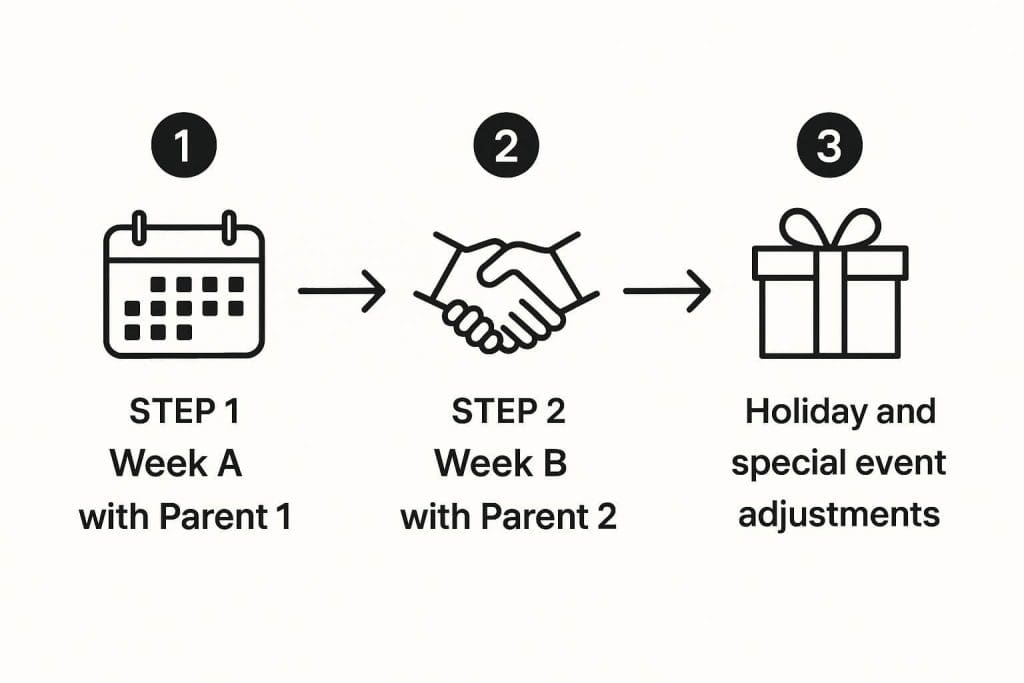
As the image shows, a basic weekly rotation is your foundation. But a truly effective plan accounts for all the special events and holidays that disrupt that routine.
Decision Making and Conflict Resolution
Beyond the calendar, your plan needs a clear process for making big decisions together. This is where joint legal custody becomes real. It’s one thing to share the title; it’s another to actually agree on schooling, medical treatments, and extracurriculars.
Think of your parenting plan as a living document. Its real power is in providing a roadmap for resolving disagreements before they escalate. The more detail you include now, the less you’ll have to argue about later.
Your plan should have a built-in framework for what happens when you and your co-parent just can’t agree. This is a critical step that helps you avoid running back to court every time a conflict pops up.
A simple, effective dispute resolution clause often follows a two-step process:
- Direct Discussion: The parents agree to first try and resolve the issue directly through a scheduled conversation.
- Mediation: If that fails, you’ll agree to attend at least one session with a neutral third-party mediator before filing any motions with the court.
This kind of structured approach keeps everyone focused on problem-solving, not winning. As you build these clauses, understanding the fundamental differences between divorce mediation vs litigation is incredibly valuable.
Ultimately, a well-crafted parenting plan is the single best investment you can make in a peaceful co-parenting future. To help you cover all your bases, the table below outlines the essential elements every strong plan should include.
Essential Elements of a Strong Parenting Plan
| Category | Key Details to Include | Why It’s Important |
|---|---|---|
| Physical Custody Schedule | Exact days, times for transitions, pickup/drop-off locations, and responsibilities. | Eliminates ambiguity and creates a predictable routine for the child. |
| Holiday & Vacation Schedule | A multi-year calendar for major holidays, school breaks, and birthdays (e.g., alternating years). | Prevents annual conflicts over high-stakes family time and allows for long-term planning. |
| Decision-Making Authority | Specifies how major decisions (education, health, religion) are made—jointly or with one parent having final say. | Clarifies roles and avoids power struggles over significant life choices for the child. |
| Communication Protocols | Preferred methods (app, email), expected response times, and rules for respectful interaction. | Fosters a business-like co-parenting relationship and reduces emotionally charged conflicts. |
| Dispute Resolution | A required, multi-step process (e.g., direct discussion, then mandatory mediation) before court action. | Saves time, money, and emotional stress by promoting out-of-court problem-solving. |
| Travel & Relocation | Rules for out-of-state or international travel, including passport arrangements and notification periods. | Ensures both parents are informed and provides safeguards against parental kidnapping concerns. |
| Financial Responsibilities | Details for expenses outside of child support, such as extracurriculars, school trips, and medical co-pays. | Prevents constant arguments over money and clarifies who is responsible for what. |
By thoughtfully addressing each of these areas, you’re not just creating a legal document—you’re building a foundation for stability and cooperation that will benefit your child for years to come.
Weighing the Benefits and Challenges of Joint Custody
Choosing a custody arrangement is one of the most critical decisions you’ll make for your family’s future. While joint custody is often seen as the modern ideal, it’s crucial to look past the concept and understand the day-to-day reality. It offers incredible benefits, but it also demands a level of commitment and cooperation that isn’t right for everyone.
Understanding this dynamic is the first step. For many families, the rewards are undeniable, building healthier co-parenting relationships and giving children a much-needed sense of stability after a separation.
The Clear Advantages for Children and Parents
The most powerful argument for joint custody is its positive impact on the child. Consistent, meaningful time with both parents reinforces the emotional bonds that are so vital for development. Children in these situations often feel more secure, stable, and deeply loved because it’s clear both parents remain fully invested in their lives.
For parents, the benefits are just as significant. Sharing the immense duties of raising a child—from homework and doctor’s visits to the financial and emotional load—dramatically reduces individual stress. This shared responsibility model helps prevent parental burnout and gives each parent the space to maintain their own career and personal life.
Properly executed, joint custody doesn’t just divide a child’s time; it multiplies their support system. The mindset shifts from “Mom’s house” and “Dad’s house” to simply “my two homes,” both filled with love and stability.
Over time, this collaborative approach often leads to a more respectful and effective co-parenting dynamic, which is one of the best gifts you can give your children.
Acknowledging the Practical and Emotional Hurdles
Of course, what works on paper doesn’t always translate smoothly into daily life. The challenges of joint custody are very real and require a proactive, solutions-oriented mindset. The biggest initial hurdle is often logistics. Managing two households—with two sets of clothes, toys, and school supplies—demands exceptional organization and flexibility from everyone involved.
An even greater challenge arises when communication falters. Joint custody is nearly impossible to sustain in a high-conflict environment. If every conversation about your child’s needs turns into an argument, the constant tension can cause more harm than the separation itself. Navigating these complexities is where professional guidance becomes indispensable, and it’s wise to find an experienced family law lawyer who can offer strategic advice.
Interestingly, legal reforms that encourage joint custody have had a powerful societal impact. After Spain passed laws favoring joint arrangements, they skyrocketed from 11% to 40% in reform regions. This shift corresponded with a staggering 40% drop in intimate partner violence cases involving children. You can learn more about these legal reform findings and their broader effect on family well-being.
Ultimately, the success of any joint custody plan comes down to one core principle: the ability of both parents to consistently put their child’s well-being ahead of their own conflicts. It requires maturity, mutual respect, and an unwavering commitment to making it work.
Common Questions About Joint Custody Answered
Even with a detailed parenting plan in hand, real life has a way of throwing curveballs. The day-to-day realities of co-parenting will inevitably bring up questions and situations you didn’t anticipate.
Let’s tackle some of the most common issues parents run into. Getting clear on these points now can help you sidestep future conflicts and build a stronger foundation for working together.
Does Joint Custody Always Mean a 50/50 Time Split?
This is easily the biggest misconception out there, and the short answer is no. While a 50/50 schedule is a popular option, the legal term “joint physical custody” simply means both parents have significant, ongoing time with their child. The math doesn’t have to be perfect.
A judge’s number one priority is a stable and predictable routine that serves the child’s best interests, not what seems “fair” to the parents. This can lead to all sorts of arrangements depending on the family’s unique situation:
- A true 50/50 split, like alternating weeks or a 2-2-3 rotation.
- A 60/40 or 70/30 schedule that gives one parent a bit more time while keeping the other deeply involved.
The real goal isn’t a stopwatch-level division of time. It’s about making sure the child maintains a healthy, meaningful relationship with both parents. In many ways, joint legal custody—the shared right to make major decisions—is the most critical piece of the puzzle, no matter the physical schedule.
What Happens if One Parent Wants to Relocate?
One parent can’t just pack up and move a significant distance with the child. A potential relocation is a major legal event that throws the current custody order into question. It requires one of two things: the other parent’s written consent or a new court order.
If you don’t agree to the move, the parent who wants to relocate must formally petition the court. A judge will then decide the issue based only on the child’s best interests, not on the parent’s career goals or personal wishes.
The court will weigh factors like:
- The underlying reason for the move (e.g., a better job vs. a whim).
- How the move will impact the child’s bond with the parent left behind.
- Whether a realistic long-distance parenting plan is even possible.
A relocation almost always requires a formal modification of your custody agreement. Trying to move without the court’s permission is a serious misstep that can damage your credibility and even jeopardize your custody rights.
Can We Change Our Joint Custody Agreement Later On?
Absolutely. In fact, you should expect to. Custody agreements are living documents, not set-in-stone contracts. What works for a toddler who needs constant supervision is going to be completely impractical for a teenager juggling school, sports, and a social life.
To officially change the agreement, you’ll usually need to show a “significant change in circumstances.” This could be anything from a parent’s new work schedule to a child’s evolving academic or medical needs.
If you and your co-parent both agree on the new terms, you can submit a modified plan to the court for a simple approval. If you can’t agree, one parent will have to file a motion, and a judge will determine if the change is in the child’s best interest. For complex modifications, seeking guidance from top-tier family law professionals can be instrumental in reaching a favorable outcome.
How Do We Handle Disagreements on Big Decisions?
This is where a well-crafted parenting plan proves its worth. Your agreement should be your first line of defense, spelling out a clear process for resolving disputes over major decisions like education, healthcare, or religious upbringing.
A good plan creates a built-in escalation path:
- Direct Communication: First, the plan should require both of you to sit down and make a good-faith effort to talk it through.
- Mediation: If that fails, the next step is often mandatory mediation with a neutral professional who can help guide you toward a compromise.
- Parenting Coordinator: Some plans even appoint a “tie-breaker,” like a parenting coordinator, who can make a binding recommendation.
Going back to court is the final, last-resort option. Having this framework in place is crucial for keeping disagreements from spiraling into expensive and emotionally draining legal battles.