
It all begins with a formal legal document known as a Petition for Dissolution of Marriage. This filing officially kicks off the legal proceedings. From there, the papers must be legally delivered—or “served”—to your spouse, who then has a specific window of time to respond.
Starting the Divorce Process with a Strategic Filing
Initiating a divorce is far more than an emotional step; it’s a calculated legal move that lays the groundwork for the entire case. The first move is filing the divorce petition, but this document is no mere formality. It outlines your initial requests to the court on everything from how you want assets divided to who gets custody of the children.
For high-net-worth individuals, two things are especially critical right at the outset: establishing the grounds for divorce and, most importantly, selecting the proper jurisdiction.
Choosing Your Grounds and Jurisdiction
While most states are “no-fault”—meaning you just need to cite irreconcilable differences—the choice of where you file can dramatically shift the financial outcome. State laws vary wildly on how they treat separate versus marital property, how they value complex business assets, and the formulas used for spousal and child support.
Filing in a community property state versus an equitable distribution state, for example, could easily mean a difference of millions of dollars. If you and your spouse have residences in multiple states, making a strategic choice of venue can be your most powerful opening move.
The divorce process in the U.S. generally starts with one spouse (the petitioner) filing a complaint. The other spouse (the respondent) is then served and typically has about 20 to 30 days to file a response, though this can vary by state.
Key Takeaway: The location where you file for divorce is not an arbitrary choice. It’s a strategic decision that can influence everything from how a family business is valued to whether an inheritance is considered a marital asset.
The Petitioner vs. The Respondent
There are distinct advantages to being the one who files first—the petitioner. It allows you to set the initial tone and, to some degree, the timeline of the case. You get the first opportunity to present your side of the story to the court, both in writing and potentially at the first hearing for temporary orders. Being proactive often prevents you from being caught on the defensive.
In fact, there is often a tactical edge in filing first, and understanding the benefits is a key part of building a strong opening strategy with your legal team.
This infographic provides a clear visual of these foundational steps.
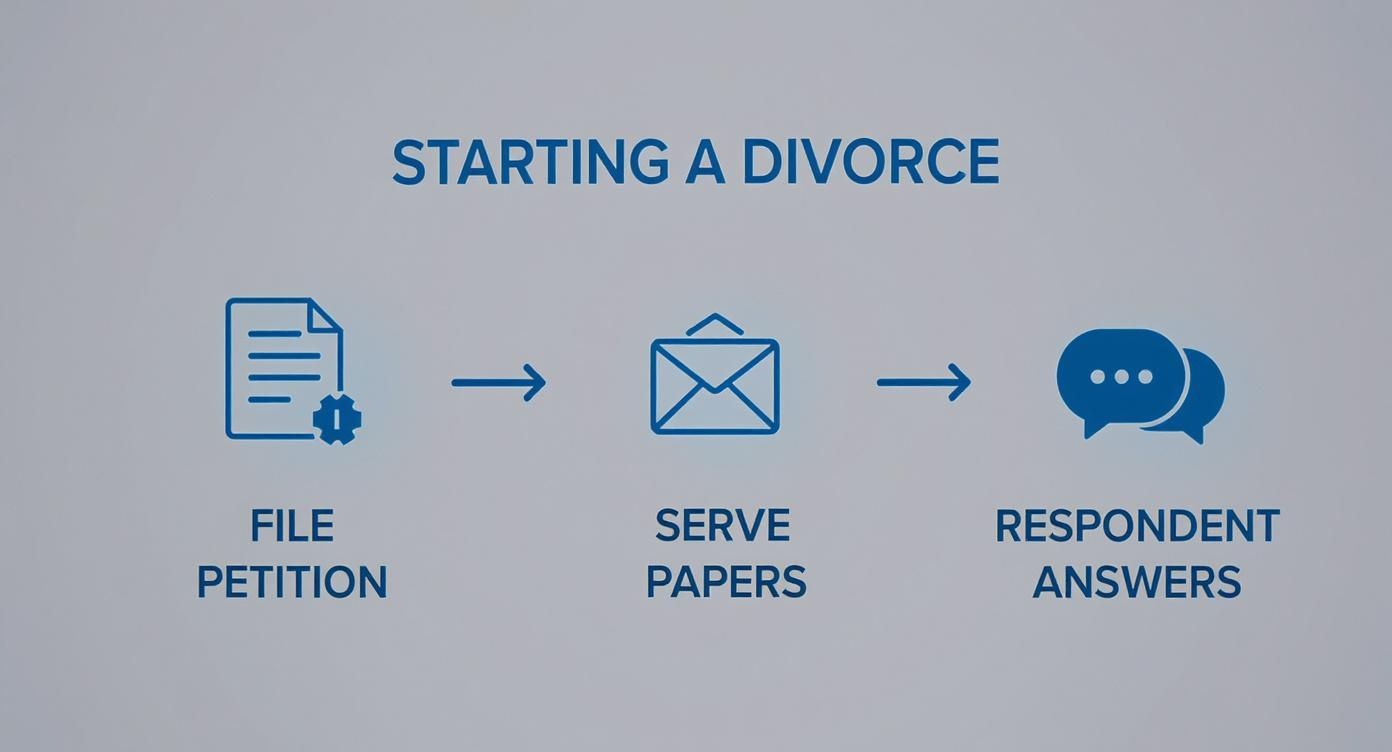
As the visual shows, the process moves sequentially. One person initiates the action, the other is formally notified, and then they have a chance to answer.
Serving the Papers: A Necessary Formality
Once the petition is filed with the court, it has to be formally delivered to your spouse. This is called “service of process,” and it’s a non-negotiable legal requirement ensuring the other party is officially aware of the divorce and has a chance to respond. While it can feel confrontational, it’s a crucial step.
There are a few ways to get this done:
- Personal Service: A professional process server or sheriff’s deputy physically hands the documents to your spouse. This is the gold standard and the most legally sound method.
- Substituted Service: If personal delivery isn’t working, papers might be left with a competent adult at your spouse’s home or workplace.
- Service by Mail: In some jurisdictions, sending the documents via certified mail with a return receipt is an option.
- Waiver of Service: If the divorce is amicable, your spouse can simply sign a waiver acknowledging they received the documents without needing formal service.
Successfully serving the papers starts a legal clock. Your spouse will then have a limited time, usually 20-30 days, to file their formal response with the court. Their answer will either agree with your petition or contest it, setting the stage for everything that comes next.
Mastering Financial Discovery and Asset Valuation

Once the divorce petition is filed, the process shifts to what is often the most contentious and critical stage for affluent couples: financial discovery. This isn’t a simple exchange of pay stubs and tax returns. It’s a forensic deep-dive into the entire financial history of your marriage.
Every asset, every liability, every income source—it all has to be brought into the light, identified, and valued. For high-net-worth individuals, this is where the real battle is often fought. The objective is to build an undeniable, comprehensive balance sheet of the marital estate, which becomes the bedrock of any settlement negotiation.
The Mandatory Exchange of Financial Information
Discovery is a formal, court-mandated exchange of information. Both you and your spouse are legally required to provide a complete and honest accounting of your finances, typically on a formal document called a Financial Affidavit or Statement of Net Worth. There’s no room for ambiguity.
The entire process is designed to level the playing field, ensuring neither spouse can leverage informational asymmetry to their advantage. It is meticulous, document-intensive, and absolutely crucial to get right.
Expect to produce a mountain of paperwork, including:
- Tax Returns: Personal, business, and trust returns going back at least three to five years.
- Financial Statements: All bank, brokerage, and retirement account statements, including those held individually, jointly, or in a child’s name.
- Business Records: For any business interest, this means profit and loss statements, balance sheets, shareholder agreements, and loan documents.
- Credit and Loan Documents: Loan applications can be a goldmine for uncovering previously undisclosed assets or debts.
- Real Estate Records: Deeds, appraisals, and mortgage statements for every single property are required.
This isn’t just about a snapshot of your current wealth. Discovery is designed to look back several years to spot red flags, like large, unexplained money transfers or the sale of valuable assets right before the divorce filing.
The Dangers of Hiding Assets
The temptation to downplay the value of a business or “forget” about a cryptocurrency wallet can be strong when millions are on the line, but it’s a catastrophic error in judgment. Hiding assets is fraud.
If discovered—and skilled forensic accountants almost always find them—the consequences are severe. A judge can award a disproportionately larger share of the marital estate to your spouse, impose heavy financial penalties, and even force you to pay their entire legal bill.
Courts have the power to reopen a finalized divorce years later if hidden assets surface. It’s a high-risk gamble that rarely pays off. As you’ll see, hidden assets are more common than you think, leading to costly mistakes.
Valuing Complex and Unique Assets
For affluent couples, the marital portfolio often includes far more than a primary residence and a 401(k). Accurately valuing sophisticated, illiquid, and unique assets is not a job for a standard CPA; it demands a team of specialized experts.
A forensic accountant is often the most valuable player on a high-net-worth divorce team. They’re trained financial detectives who can trace funds, uncover financial discrepancies, and provide ironclad valuations for the most complex assets.
Here’s where the complexity really shows, and why specialists are non-negotiable:
| Asset Type | Valuation Challenge | Expert Required |
|---|---|---|
| Closely-Held Business | Determining true cash flow, accounting for personal “add-backs,” and calculating enterprise value. | Forensic Accountant / Business Valuator |
| Private Equity/Hedge Funds | Valuing illiquid investments with complex capital call commitments and layered fee structures. | Financial Analyst / Fund Specialist |
| Art & Collectibles | Authenticity, provenance, and fluctuating market demand make valuation highly subjective. | Certified Appraiser / Art Expert |
| Intellectual Property | Patents, trademarks, and royalties require projecting future income streams and market potential. | IP Valuation Specialist |
These experts don’t just pull a number out of thin air. They produce exhaustive reports designed to withstand intense scrutiny in negotiations and in court. This rigorous approach is what ensures you are dividing the actual value of your estate, not a number based on guesswork.
Crafting Your Settlement Agreement Through Negotiation

Now the real work begins. With all the financial discovery laid bare, the process shifts from investigation to resolution. All that meticulous work valuing businesses, real estate, and unique assets now becomes the foundation for negotiating a comprehensive settlement.
This is the stage where you decide the final division of everything—assets, liabilities, and any ongoing support.
Contrary to what you see in the movies, very few high-asset divorces end in a dramatic courtroom battle. Litigation is the last resort, not the first move. Why? Settling out of court is almost always faster, far less expensive, and, most importantly, keeps you and your spouse in control of the outcome. Handing that power over to a judge is a gamble few sophisticated individuals are willing to take.
Choosing Your Negotiation Pathway
Not all negotiations are created equal. The path you choose dramatically impacts the cost, the tone, and the ultimate efficiency of your divorce. For high-net-worth cases, the primary routes are mediation, collaborative divorce, and traditional attorney-led negotiation. Each has its place, depending entirely on the level of conflict and financial complexity.
You can think of it this way: traditional negotiation is a strategic match where your attorney directs every move. Mediation brings in a neutral referee to guide the conversation. Collaborative divorce gets everyone—both spouses and their professional teams—to agree to work together toward a shared solution.
When the stakes are this high, a one-size-fits-all approach is a recipe for disaster. You have to select the pathway that aligns with your family’s unique dynamics.
Comparing Divorce Dispute Resolution Methods
Choosing how to negotiate your settlement is one of the most critical decisions in a high-net-worth divorce. The table below breaks down the most common methods, helping you understand which approach might be the best fit for your specific circumstances. Each has distinct advantages and potential downsides when significant assets are involved.
| Method | Process Overview | Best For… | Key Drawback |
|---|---|---|---|
| Mediation | A neutral third-party mediator facilitates discussion and helps the couple find common ground. The mediator does not make decisions. | Couples who can communicate constructively but need help resolving specific issues, like alimony or a complex asset division. | Can be ineffective if there’s a significant power imbalance or a lack of good faith from one party. |
| Collaborative Divorce | Both spouses and their attorneys sign an agreement to stay out of court. A team of professionals (financial, family specialists) works together to find solutions. | Couples committed to a transparent, low-conflict resolution who want to preserve a co-parenting or business relationship. | If the process fails, both parties must hire entirely new legal teams to start over, adding significant cost and delay. |
| Attorney-Led Negotiation | Attorneys for each spouse communicate and negotiate directly on their clients’ behalf to hammer out an agreement. | High-conflict situations, cases with a history of distrust or hidden assets, or when one spouse is emotionally overwhelmed. | Can be more adversarial and costly than other methods, potentially escalating conflict if not handled carefully. |
Ultimately, the goal of any of these methods is to arrive at a final, binding agreement that allows the divorce to be finalized as “uncontested,” thereby avoiding a costly and unpredictable trial.
A Closer Look At Mediation
In mediation, a neutral third party guides a structured conversation between you and your spouse. This process is completely confidential and voluntary. The mediator isn’t there to give legal advice or make rulings; their job is to help you identify common ground, explore creative solutions, and navigate sticking points.
- Best For: Couples who are generally on the same page but need professional guidance to finalize the exact terms of a support agreement or the division of a specific asset.
- Real-World Scenario: A couple agrees on how to divide their stock portfolio but can’t agree on the valuation and split of a jointly owned venture capital investment. A mediator with financial expertise can help them find a neutral business appraiser and structure a fair buyout.
Mediation keeps the control entirely in your hands and allows for creative solutions a judge might never order, like complex business succession plans or multi-year asset transfers.
Exploring The Collaborative Divorce Model
Collaborative divorce is a highly structured, team-based approach where everyone signs a binding agreement to stay out of court. Your team isn’t just your attorney; it often includes neutral financial professionals, divorce coaches, and family counselors all working together toward a settlement.
This model is built on total transparency and a shared goal of a peaceful outcome. If either spouse decides to abandon the process and go to court, both collaborative attorneys must withdraw. This creates a powerful incentive to see the negotiation through to the end.
Key Insight: The collaborative process is designed to preserve relationships. This is invaluable when you have to co-parent children or continue as partners in a family business long after the divorce is final. It turns an adversarial fight into a problem-solving exercise.
When Attorney-Led Negotiation Is Necessary
In a traditional negotiation, your lawyer communicates directly with your spouse’s lawyer to work out the terms of an agreement. This method becomes essential when communication between spouses has completely broken down or when a significant power imbalance exists.
While it can feel more adversarial, this approach provides a crucial buffer in high-conflict divorces. Your attorney acts as both your advocate and your shield, managing all communications and protecting your rights every step of the way.
It’s worth noting that data from the U.S. Census Bureau shows around 90% of divorces involve contested issues that require resolution through processes just like these. The negotiation phase is where the vast majority of divorces are settled. For more context, you can explore detailed U.S. divorce statistics on DivorceCanBeSimple.com. This underscores just how critical it is to navigate these negotiation pathways with care and expertise.
Preparing for Divorce Litigation When Talks Stall
While the vast majority of high-net-worth divorces find resolution outside the courtroom, sometimes settlement talks completely break down. When negotiation, mediation, or collaboration fails to produce a fair agreement, the only path forward is litigation.
This is the moment the process shifts dramatically. It means a judge—not you or your spouse—will make the final, binding decisions on everything from asset division and alimony to the future of a family business. It’s an expensive, emotionally draining, and time-consuming route, but it’s often necessary to protect your financial future when an amicable solution just isn’t on the table.
The Anatomy of a Divorce Trial
A divorce trial isn’t a single event but a methodical, structured process. Knowing what to expect can take some of the mystery out of it and help you and your legal team build the strongest possible case. The entire goal is to present a clear, evidence-backed story that convinces the judge to rule in your favor.
This is where all the exhaustive work from the financial discovery phase truly pays off. Every single document, appraisal, and expert report becomes a potential piece of evidence to be presented and challenged in court.
A trial typically unfolds in several distinct phases:
- Pre-Trial Motions: Before the trial even starts, attorneys will argue legal points to decide what evidence is allowed or to handle procedural matters.
- Opening Statements: Each side’s lawyer lays out a roadmap for the judge, explaining what they intend to prove with their evidence.
- Presentation of Evidence: This is the heart of the trial. Attorneys call witnesses to the stand and submit documents, reports, and valuations to build their case.
- Closing Arguments: In the final stage, lawyers summarize all the evidence and make their last, best argument for why the law supports their client’s position.
The Role of Expert Witnesses
In high-asset litigation, expert witnesses are not a luxury—they are a necessity. While you and your spouse will testify, a judge often depends heavily on impartial, third-party experts to understand complex financial pictures. Your attorney will put these specialists on the stand to explain their findings and defend their professional opinions under oath.
For instance, a forensic accountant can clarify the true cash flow of a complex business entity, an art appraiser can validate the value of a prized collection, or a vocational expert can offer an opinion on a spouse’s realistic earning potential. Their testimony gives the court the credible, objective data needed to rule on assets worth millions. It is precisely this level of detailed financial evidence that requires sophisticated family law counsel for ultra-wealthy families, who know how to orchestrate this complex presentation.
A Judge’s Perspective: Remember, the judge knows nothing about your life, your business, or your finances beyond what is presented in court. The trial is your one and only opportunity to educate them and prove your case with clear, compelling evidence.
Managing the Pressures of Litigation
The financial and emotional toll of a divorce trial cannot be overstated. The process can last anywhere from several months to, in some complex cases, several years. Delays can come from court backlogs, the complexity of the assets involved, or procedural disputes.
Beyond the significant legal fees, the uncertainty and constant conflict can be immense. Preparing for litigation means preparing for this reality. You need to work with your legal team not just on legal strategy, but also on managing your own expectations and emotional resilience. A trial is a marathon, not a sprint. The final decree issued by the judge is legally binding, and it will close this chapter while setting the terms for your new financial reality.
Finalizing Your Divorce and Moving Forward
That moment when you receive the final, signed divorce decree can feel like the end of a long, exhausting journey. While it is the last official milestone in the process, it’s actually the starting line for a critical new phase: untangling your life. This court order legally ends your marriage and, more importantly, makes every term of your settlement fully enforceable.
But don’t be mistaken—this document is not a magic wand. It’s the blueprint, not the finished construction. The decree itself doesn’t automatically transfer a single dollar or change a beneficiary on an insurance policy. That work falls squarely on your shoulders, and failing to act can create a messy web of legal and financial problems for years to come.
Executing the Terms of Your Agreement
Think of your divorce decree as a set of instructions. Now, it’s time to follow them, meticulously. This post-divorce execution phase is where the legal theory of your settlement becomes a financial reality. It’s how you build a clean and complete separation to protect the wealth you fought to secure.
It’s a common misconception that once the judge’s signature is on the paper, everything is done. In my experience, many people are shocked by the sheer volume of administrative legwork required after the final judgment. A new, urgent checklist of financial tasks begins the moment your divorce is finalized.
Key Insight: A divorce decree grants you the right to receive certain assets or payments. It does not automatically transfer them. Proactive follow-through is non-negotiable to secure your financial future and prevent future disputes.
Your Essential Post-Divorce Checklist
To properly protect your assets and truly finalize the separation, you must immediately get to work. Each of these steps involves specific actions and paperwork to align your new financial life with the court’s order. While U.S. divorce rates hover around 2.3 per 1,000 people, a surprising number of individuals are unprepared for these post-decree responsibilities. For more context on these trends, you can explore detailed global divorce statistics and analysis.
Here is a practical, actionable checklist of what to tackle first:
- Update Real Estate Titles: If you were awarded a property, your ex-spouse must sign a quitclaim deed to remove their name from the title. This is the legal document that officially transfers their ownership interest to you. Without it, they are still on the hook—and still on the title.
- Refinance Joint Debts: Any mortgages or loans still in both your names must be refinanced into the sole name of the person responsible for the debt. Until that happens, the lender still sees you both as legally liable. No exceptions.
- Divide Retirement Accounts: This is a big one. Transferring funds from a 401(k) or pension isn’t a simple wire transfer. It requires a special court order called a Qualified Domestic Relations Order (QDRO). This document needs to be drafted by an expert, approved by the court, and then submitted to the plan administrator for execution.
- Change Beneficiary Designations: This is one of the most overlooked—and most dangerous—steps. Immediately update the beneficiaries on all life insurance policies, retirement accounts, and investment accounts to remove your ex-spouse. Failure to do so could result in your entire life insurance payout going to them instead of your children.
- Revise Your Estate Plan: Your will, trusts, and powers of attorney were almost certainly created with your spouse as a central figure. All of these documents must be updated immediately to reflect your new marital status and wishes.
- Close Joint Accounts: Go through every joint bank and credit card account and close them systematically. This severs the last of your day-to-day financial ties and prevents any unauthorized spending.
Diligently completing these tasks ensures your divorce is final not just on paper, but in every practical, financial sense. This is the final bridge to cross on your way to a secure and truly independent future.
Common Questions About the High-Net-Worth Divorce Process

Navigating the divorce process step by step often feels like learning a new language, especially when significant assets are on the table. Even with a clear roadmap, specific questions inevitably come up. This is where we address the most pressing concerns high-net-worth individuals face.
Understanding these nuances is critical. The answers can directly shape your financial strategy and long-term security. From the timeline to the privacy of your financial affairs, having clear answers provides confidence during a time of great uncertainty.
How Long Does a High-Net-Worth Divorce Take?
This is almost always the first question I get. Unlike a standard divorce that might wrap up in a few months, a high-net-worth case can easily stretch 12 to 18 months, and sometimes much longer.
The main reason is the sheer complexity of financial discovery and asset valuation. You can’t just glance at a bank statement. Accurately appraising a closely-held business, tracing offshore accounts, or valuing a unique art collection is a meticulous, time-consuming process. These steps simply cannot be rushed without risking a major financial misstep.
Key Takeaway: Patience is a strategic asset. The length of your divorce is often directly proportional to the financial complexity involved. Rushing to the finish line can lead to costly oversights.
Will My Financial Information Become Public Record?
This is a major concern for affluent individuals who rightfully value their privacy. The answer is nuanced: while divorce proceedings are generally public record, there are ways to protect sensitive financial details.
Your attorney can file motions to seal certain financial documents, shielding them from public view. This is standard practice for business records containing trade secrets or detailed statements of net worth. Even better, resolving your case through private mediation or a collaborative divorce process keeps the granular financial details out of the courtroom and, therefore, off the public record entirely.
What Is the Difference Between Marital and Separate Property?
Distinguishing between marital and separate property is a cornerstone of any high-net-worth divorce settlement. Understanding this concept is fundamental to protecting what’s yours.
- Marital Property: This is everything acquired by either spouse during the marriage—assets, income, debts—regardless of whose name is on the title. Think of this as the “pot” that gets divided.
- Separate Property: This generally includes assets owned before the marriage, inheritances received by one spouse, or gifts given to one spouse individually.
But here’s a critical warning: separate property can become marital property through commingling. If you deposit inheritance money into a joint checking account and pay marital bills from it, you may have unintentionally converted it into a marital asset.
How Does Global Context Affect Divorce?
The legal framework for divorce varies dramatically across the world. Globally, the divorce rate averages about 1.6 divorces per 1,000 people, but that number hides huge differences. For instance, countries like the Maldives report rates as high as 5.52 per 1,000, partly due to simplified procedures.
In contrast, nations with strict cultural or legal barriers like India have rates closer to 0.1 per 1,000, highlighting how societal norms shape the divorce process. You can discover more insights about these global divorce rate trends and what they mean on Soulmatcher.app.
Navigating a high-net-worth divorce requires exceptional legal skill and strategic insight. To connect with a top-tier attorney who understands the complexities of your situation, explore the Haute Lawyer Network, a curated community of the nation’s most respected legal professionals. Elevate your legal strategy by finding the right advocate at https://hauteliving.com/lawyernetwork.