A first-offense DUI conviction triggers a cascade of consequences that begin long before you ever step foot in a courtroom. The most immediate and often surprising penalty is an automatic administrative license suspension. This can happen within days of your arrest and is completely separate from any criminal charges you might face.
What Happens Immediately After a First DUI Arrest

The moments after a DUI arrest are confusing and stressful. What many don’t realize is that you are immediately thrust into a two-front battle: one with the Department of Motor Vehicles (DMV) and the other with the criminal court system.
The DMV’s involvement is swift and decisive. This civil process, often called an Administrative License Revocation (ALR), is initiated the moment you either fail a chemical test (blowing over the 0.08% BAC limit) or refuse to take one. This isn’t a criminal punishment; it’s a civil action the state takes to get potentially impaired drivers off the road as quickly as possible.
The Two-Front Battle Begins
You are immediately on the clock. Most states give you an incredibly narrow window—often just 7 to 10 days—to formally request a hearing with the DMV to fight this automatic suspension. If you miss this deadline, your license will be suspended on a set date, no matter what happens later in your criminal case.
This dual-track system is a critical concept to grasp. Winning your DMV hearing doesn’t mean your criminal case goes away, and pleading guilty in court doesn’t automatically resolve your DMV issues. They are two independent tracks with different rules and standards of proof.
At the same time, the wheels of the criminal justice system start turning. After being arrested and booked, you’ll be given a court date for your arraignment. This is your first official appearance before a judge, where the state will formally present the charges against you and you’ll be asked to enter a plea.
To help you keep track of these overlapping consequences, here’s a quick summary of what a first-time offender typically faces.
Common First DUI Penalties at a Glance
| Penalty Category | Common Range or Consequence |
|---|---|
| Administrative License Suspension | 90 days to 1 year (varies by state and test refusal) |
| Criminal Fines & Fees | $500 to $2,000+ (not including court costs) |
| Potential Jail Time | Up to 6 months (often suspended for first offenses) |
| Probation | 1 to 3 years (supervised or unsupervised) |
| DUI Education Classes | 3 to 9 months of mandatory classes |
| Ignition Interlock Device | Required for 6 months to 1 year in many states |
These penalties can stack up quickly, creating a complex legal situation that is difficult to manage without professional guidance.
Urgent First Steps to Take
How you handle these first few days is crucial. The decisions you make now can dramatically influence the outcome for both your driving privileges and your criminal record. Here’s what you need to prioritize immediately:
- Check Your Paperwork: Scour every document the police gave you. Find the deadline for requesting your DMV hearing—it’s non-negotiable.
- Secure Legal Counsel: This is the single most important step. Knowing how to choose the right attorney for your case is essential for navigating both the administrative and criminal proceedings effectively.
- Document Everything: Write down every detail you can remember about the traffic stop, the arrest, and any sobriety or chemical tests. Do it while the memory is fresh.
The True Cost of a First DUI Conviction

When people hear about first offense DUI penalties, their minds usually jump straight to the court-ordered fine. But that initial dollar amount is just the tip of a massive financial iceberg. The reality is that a single DUI conviction can snowball into a sum that rivals a down payment on a house or a year of college tuition, creating a financial burden that can last for years.
The expenses start racking up almost immediately—long before a judge ever bangs a gavel. The first big hit is almost always attorney fees, which are critical for anyone trying to navigate the notoriously complex legal system. Depending on your case and where you live, these fees alone can run from several thousand to well over ten thousand dollars.
But that’s just the beginning. A conviction triggers a cascade of mandatory, and often hidden, costs that you’ll be paying out of pocket.
The Never-Ending List of DUI Expenses
Think of your bank account as a bucket. A DUI doesn’t just take one big scoop out; it pokes a dozen small holes that continuously drain your money for months, if not years. These costs often include:
- Court and Administrative Fees: These are completely separate from the fine and cover the court’s operational costs. They can easily tack on hundreds more to your total bill.
- Mandatory DUI Education: The court will order you to enroll in—and pay for—state-approved alcohol education or treatment programs.
- License Reinstatement Fees: After your suspension is over, you don’t just get your license back. You have to pay the DMV a fee to have it reinstated.
- Towing and Impound Fees: Your car was likely towed from the scene of the arrest, and the impound lot charges a daily storage fee until you can pay to get it back.
The total financial impact is often a complete shock. It’s not a one-and-done payment but a long series of expenses that can derail your budget, wipe out your savings, and seriously impact your financial future.
This relentless stream of payments shows just how severely one mistake can damage your economic stability. The National Highway Traffic Safety Administration (NHTSA) estimates that a first-time DUI can cost an offender more than $10,000 in total—and that’s before you even factor in lost wages or skyrocketing car insurance premiums. You can learn more by reading the NHTSA’s analysis on the cost of drunk driving.
The Ignition Interlock Device Burden
For many people, another major expense is the Ignition Interlock Device (IID). This in-car breathalyzer is a common requirement for first-time offenders who want to regain any driving privileges. You don’t just buy it once; you’re on the hook for a whole host of associated costs.
These IID-related expenses typically include:
- Installation Fee: A one-time charge for a certified technician to install the device in your vehicle.
- Monthly Leasing and Monitoring Fees: You’ll pay a recurring fee every single month for as long as the device is required.
- Regular Calibration Fees: The IID has to be calibrated every 30 to 60 days to ensure it’s working correctly, and each visit costs money.
- Removal Fee: Once your required term is finally over, you have to pay one last time to get the device professionally removed.
Each of these costs piles on top of the others, making the final price tag of a DUI conviction far higher than most people ever imagine. It’s a sobering financial reality that goes well beyond that initial court fine.
Losing Your License and How to Get It Back

Let’s be honest. For most people hit with a DUI, the fine is painful, but the loss of their driver’s license is what truly turns their world upside down. Suddenly, getting to work, taking kids to school, or just running basic errands becomes a logistical nightmare.
The whole process can feel incredibly confusing because you’re not just dealing with one license suspension—you’re dealing with two, and they happen on separate tracks. One is the administrative suspension from the DMV, and the other is a criminal suspension from the court if you’re convicted.
Administrative vs. Criminal Suspensions
Think of the administrative suspension as the DMV’s immediate reaction. It’s a civil action, not a criminal penalty, and it happens fast. If you fail or refuse a chemical test during your arrest, the DMV can pull your driving privileges, often within days. Their goal is simple: get a potentially unsafe driver off the road as quickly as possible.
The criminal suspension is different. This one only kicks in if you are convicted or plead guilty in court. It’s part of your sentence, and the length—typically anywhere from 90 days to a full year for a first offense—depends entirely on your state’s laws and the specifics of your case.
Understanding this dual system is crucial. You could win your DMV hearing and keep your license, only to have a judge suspend it later. On the flip side, your criminal case might get dismissed, but if you missed the deadline for the DMV hearing, you could still lose your license.
Applying for a Restricted License
Losing your license doesn’t always mean you’re completely stranded. Many states allow you to apply for a restricted or hardship license, which lets you drive for specific, essential purposes. This isn’t a free pass to drive whenever you want; it comes with very strict rules.
Most restricted licenses limit you to:
- Driving to and from work.
- Attending court-ordered DUI classes or treatment.
- Transporting children to school or daycare.
- Traveling to necessary medical appointments.
Reinstating Your Full Driving Privileges
Getting your unrestricted license back involves more than just waiting out the suspension period. You’ll have a checklist of requirements from both the court and the DMV that must be completed.
Before you can legally drive again, you’ll generally need to:
- Serve the entire suspension period.
- Complete any mandatory alcohol education programs.
- Pay all your fines, court costs, and a separate license reinstatement fee to the DMV.
- File proof of SR-22 insurance, which is a special certificate confirming you have high-risk auto coverage.
- Install an Ignition Interlock Device (IID) if the court or DMV requires it.
An IID is essentially a breathalyzer for your car. It’s wired directly into the ignition, and you have to blow into it before you can start the engine. If it detects any alcohol, your car simply won’t start. It’s a technology designed to make absolutely sure you’re not driving under the influence.
Understanding Jail Time and Probation Requirements
For anyone facing a first-time DUI, the thought of jail is almost always the first and most terrifying prospect. It’s a completely valid fear, but the reality is that long jail sentences for a non-aggravated first offense are incredibly rare.
Most states reserve serious jail time for repeat offenders or for cases where an accident caused injuries. A first-time offender might face a mandatory minimum of 48 hours to a few days, but even that can sometimes be waived by a judge in favor of alternatives like extensive community service. For a first mistake, the court’s goal is usually rehabilitation, not just punishment.
The Reality of Probation
Far more common than a long jail stay is being placed on probation. Think of it as a conditional sentence—you avoid jail, but in exchange, you have to follow a strict set of rules for a specific period, usually lasting from one to three years.
Violating any of those terms can land you right back in court, where the judge can impose the original, harsher sentence that was suspended. And yes, that includes jail time.
Probation isn’t just about “staying out of trouble.” It’s an active, supervised period where the court monitors your behavior to ensure you’re taking the conviction seriously and addressing the issues that led to the DUI in the first place.
This supervised period is a significant intrusion on your personal freedom and demands absolute compliance.
What Probation Looks Like in Real Life
Living on probation means your life is no longer entirely your own. A probation officer and the court will have a direct say in many of your day-to-day activities. While the exact terms vary by state and judge, most DUI probation sentences include a mix of the following:
- Regular Check-Ins: You’ll almost certainly have to report to a probation officer on a set schedule, whether it’s in person or over the phone.
- Random Substance Testing: Expect random, unannounced drug and alcohol screenings. The goal is to ensure you are staying completely sober.
- Mandatory Community Service: Courts often require offenders to complete a specific number of hours (e.g., 40 to 100 hours) working for an approved non-profit.
- Victim Impact Panels: Many sentences require you to attend a session where victims of drunk driving accidents share their stories. It’s a powerful and sobering experience designed to drive home the real-world consequences.
- Alcohol Education: You will be required to enroll in, pay for, and successfully complete a state-approved DUI education program or alcohol treatment course.
These aren’t suggestions; they are court-ordered mandates. Failing to show up for community service or missing a meeting with your probation officer is a probation violation, which can trigger more severe first offense DUI penalties.
How DUI Penalties Vary From State to State
When it comes to first offense DUI penalties, there’s no single rulebook for the United States. It’s more like 50 different playbooks, each with its own set of rules, consequences, and loopholes. The state where an arrest occurs is the single biggest factor in determining just how severe the penalties will be.
What might earn you a moderate fine and probation in one jurisdiction could easily result in mandatory jail time and a year-long license suspension just across the state line. This dramatic variation means that understanding your local laws isn’t just helpful—it’s absolutely critical. Your location doesn’t just tweak the outcome; it can completely redefine it.
Strict vs. Moderate State Laws
To see this in action, just look at the contrast between states. A state like Arizona, for instance, is known for having some of the most aggressive DUI laws in the nation. For a first offense, even with a BAC just over the legal limit, a person faces mandatory jail time—even if it’s only for 24 hours. The fines are substantial, and an Ignition Interlock Device (IID) is almost always part of the sentence.
On the other hand, a state with more moderate penalties might waive jail time entirely for a standard first offense, perhaps offering community service as an alternative. Fines are often lower, and the license suspension period might be shorter. This stark difference is why generalized advice is so dangerous; only the specific statutes of the state where the offense occurred truly matter.
This infographic breaks down some of the most common penalties handed down for a first DUI conviction.
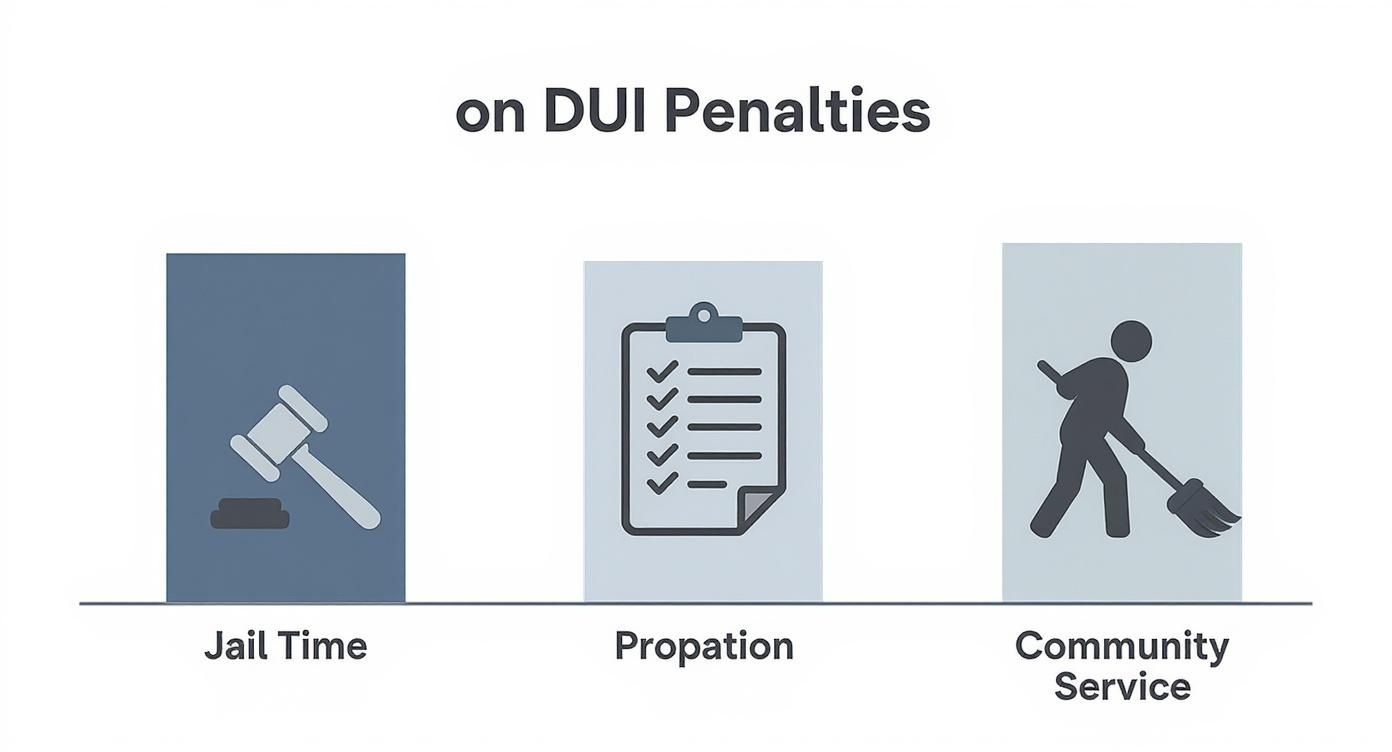
As you can see, probation is a very common element of sentencing. It’s frequently paired with community service requirements and, in a significant number of cases, at least some jail time.
To highlight just how much these penalties can differ, the table below provides an illustrative comparison of typical first-offense consequences across several states.
State-by-State First DUI Penalty Comparison
| State | Typical Fine Range | Minimum Jail Time | License Suspension Period |
|---|---|---|---|
| California | $390 – $1,000+ | 48 hours (often convertible) | 6 months |
| Texas | Up to $2,000 | 72 hours | 90 days – 1 year |
| Florida | $500 – $1,000 | Up to 6 months | 180 days – 1 year |
| Arizona | $1,250+ | 10 days (can be reduced) | 90 days |
| New York | $500 – $1,000 | Up to 1 year | 6 months (revocation) |
This table is just a snapshot and doesn’t account for aggravating factors, but it clearly shows the wide spectrum of potential outcomes a person might face depending entirely on geography.
Key State-Level Legal Doctrines
Beyond the core penalties of fines and jail, specific legal doctrines introduce even more variation from one state to the next. Grasping these concepts is key to understanding the full picture.
- Implied Consent Laws: Nearly every state has an implied consent law on the books. In short, by obtaining a driver’s license, you have automatically agreed to submit to a chemical test (like a breathalyzer) if an officer has probable cause to suspect you of a DUI. Refusing this test triggers its own set of penalties—often an immediate and lengthy license suspension that can be even harsher than the one for the DUI itself.
- Zero Tolerance Laws: For drivers under the legal drinking age of 21, every single state enforces “zero tolerance” laws. These policies set the legal BAC limit much lower, typically at 0.02% or even 0.00%. This means that for a young driver, even one drink can lead to a DUI charge with consequences that can follow them for years.
The legal landscape for DUIs is constantly in flux, with state legislatures frequently updating their statutes. Keeping up with these changes is essential for anyone navigating the justice system.
Because these laws are so localized and subject to regular revision, getting advice from a legal professional who specializes in your state’s DUI laws is non-negotiable. They are the only ones equipped to provide accurate guidance based on the current statutes and legal precedents that apply directly to your case. For a glimpse into how these laws evolve, you can learn more about the new DUI laws of 2025 to see how quickly penalties can change.
The Long-Term Consequences Beyond the Courtroom
Even after the court case is closed, a first-offense DUI conviction casts a long shadow. These “collateral consequences” can quietly disrupt your finances, career, and even your personal freedom for years, long after the fines are paid and probation is a distant memory.
One of the first and most painful hits is to your auto insurance. Once you have a DUI on your record, insurers immediately reclassify you as a high-risk driver. The result? Your premiums can easily double or even triple overnight. This isn’t a short-term penalty; you can expect to pay thousands more for coverage over the next three to five years.
Professional and Personal Roadblocks
A DUI conviction doesn’t just stay in your driving history; it can create serious professional roadblocks. If driving is a core part of your job—whether you’re a salesperson, a delivery driver, or a field technician—a conviction could put your employment at risk.
Many professional licensing boards also have strict conduct rules that can be triggered by a DUI. This can lead to disciplinary action or prevent you from getting a license in fields like:
- Nursing and healthcare
- Aviation and piloting
- Law and real estate
- Commercial driving
The conviction becomes a permanent part of your background, a red flag that can limit future opportunities and reshape your career path in ways you never anticipated.
This blemish on your record can also complicate international travel. Canada, for example, views a DUI as a serious offense and can deny you entry at the border, sometimes for years after the conviction. This could disrupt everything from family vacations to international business opportunities.
The permanent nature of this record often leads people to ask what, if anything, can be done. It’s a common and critical question, and you can explore more about whether you can get a DUI off your record in our detailed guide. These lasting consequences underscore how a single mistake can extend far beyond the courtroom, impacting nearly every aspect of your life.
Your Top Questions About a First DUI, Answered
After a DUI arrest, the uncertainty can be overwhelming. Your mind is probably flooded with questions about what comes next. Getting clear, straightforward answers is the first step toward taking back control. Here, we address the most pressing concerns people face after a first-time DUI charge.
Can a First-Offense DUI Be Reduced?
Yes, it’s possible to get a first-time DUI charge reduced to a lesser offense, often called a “wet reckless” or another traffic violation. However, this outcome—usually secured through a plea bargain—is never guaranteed.
Whether a reduction is on the table often depends on the specific facts of your case. A very low Blood Alcohol Concentration (BAC), procedural missteps by the arresting officer, or proof that testing equipment was faulty can all give an attorney leverage to negotiate. An experienced lawyer is essential for finding these weaknesses and arguing for a better outcome on your behalf.
How Long Will a First DUI Stay on My Record?
This is a critical question, and the answer is complex. In many states, a DUI conviction can stay on your permanent criminal record forever, appearing on background checks for jobs, housing, and professional licenses.
For driving purposes, the offense typically remains on your DMV record for a set period—usually five to ten years. During this time, it will crush your insurance rates and be used to impose much harsher penalties if you’re ever charged with another DUI. Some states offer a path to expunging or sealing the record after you’ve completed your sentence, but this legal fix isn’t available everywhere.
An expungement doesn’t erase the past, but it can effectively hide the conviction from public view, making it much easier to move forward with your life. Understanding your state’s specific laws on record-clearing is vital.
Do I Really Need a Lawyer for a First Offense?
While you have the right to represent yourself, going it alone is a massive risk. The legal system for a first-offense DUI is surprisingly complex, involving two separate battles: one in criminal court and another with the DMV over your license.
A skilled DUI attorney knows how to navigate both systems at the same time. They can challenge the evidence against you, negotiate with prosecutors for reduced penalties, and protect your rights at every turn. The investment in professional legal counsel almost always leads to a better result, potentially saving you from jail time, crippling fines, and a longer license suspension.
Navigating the legal fallout of a DUI requires expert guidance. The Haute Lawyer Network connects you with premier attorneys across the United States who are selected for their professional excellence. Elevate your defense by finding the right legal professional for your case. Learn more at https://hauteliving.com/lawyernetwork.