
For attorneys, social media marketing isn’t just about posting updates. It’s a calculated strategy to build your firm’s brand, forge connections with potential clients, and cement your authority in a crowded field. The goal isn’t just to advertise; it’s to create genuine value that drives real, measurable growth for your practice.
Building Your Social Media Foundation
A winning social media strategy never starts with a clever post. It begins with a solid, well-researched foundation. Jumping onto platforms without a clear plan is like heading to court without preparing your case—you might make some noise, but you won’t get the verdict you want.
This foundational work is about answering the “why” before you even think about the “what.” Are you aiming to generate five new qualified leads per month for your family law practice? Or is your goal to become the go-to thought leader for tech startups in your city? Your objectives will define every single action you take.
Defining Your Goals and Audience
First things first: you need specific, measurable goals. Vague aspirations like “get more clients” are useless. A concrete goal sounds more like, “increase website consultation form submissions from social media by 20% within six months.”
Next, pinpoint your ideal client with surgical precision. Don’t just target “people needing a will.” Create a detailed persona.
- Demographics: Are they 45-year-old small business owners, young parents in their early 30s, or executives nearing retirement?
- Pain Points: What legal questions keep them up at night? Are they worried about protecting their assets, navigating a divorce, or ensuring their business is compliant?
- Online Habits: A corporate counsel will be on LinkedIn, while a personal injury client might be more active in local Facebook groups.
Knowing this persona dictates which platforms you use and what you talk about. You wouldn’t try to find a high-net-worth estate planning client on TikTok, just as you wouldn’t market to teenagers on LinkedIn.
The data backs this up. A staggering 85% of lawyers now use social media in their marketing plans. Better yet, 71% report that it generates new leads, proving its power for client acquisition. LinkedIn remains a powerhouse, preferred by 77% of law firm owners for its professional networking capabilities.
Choosing The Right Platforms
Not all social media platforms are created equal, especially in the legal world. Your choice should be a direct reflection of your practice area and your ideal client’s online behavior. A corporate litigator will find their audience in a very different place than a family law attorney.
This matrix breaks down the top platforms to help you make an informed decision.
Platform Selection Matrix for Law Firms
Platform | Primary Audience | Best For Practice Areas | Content Focus |
Professionals, B2B, corporate executives | Corporate Law, M&A, IP, Employment Law, Commercial Litigation | Thought leadership articles, case studies, professional networking, industry news | |
General consumer, local communities | Family Law, Personal Injury, Estate Planning, Real Estate | Client testimonials, community engagement, educational videos, local event promotion | |
Younger demographics (25-45), visual-focused | Boutique firms, Brand-focused practices (e.g., fashion, tech law) | Behind-the-scenes content, attorney spotlights, visual Q&As, brand storytelling | |
X (Twitter) | Journalists, media, professionals, tech-savvy users | Media Law, Tech Law, Public Policy, Appellate Law | Breaking legal news, quick legal commentary, engaging in industry conversations |
Selecting one or two platforms where your ideal clients are most active is far more effective than trying to be everywhere at once. Quality and consistency on the right channels will always outperform a scattered, inconsistent presence on all of them.
Analyzing the Competitive Landscape
Once you know who you’re talking to, it’s time to see what your competitors are saying. Identify three to five firms in your practice area and region and do some recon on their social media profiles.
- What platforms are they actually using?
- What kind of content are they sharing? (Blog links, videos, staff photos?)
- How often are they posting?
- Is anyone actually engaging with them? (Look at likes, comments, and shares.)
- What’s their brand voice—formal and academic, or casual and approachable?
This isn’t about copying their strategy. It’s about finding the gaps. If all your competitors are posting dry legal updates, you have a massive opportunity to stand out with engaging, client-focused Q&A videos. By seeing where their approach falls short, you can carve out a unique and more effective space for your firm. Finding a reputable attorney listing can also offer a snapshot of how top professionals are positioning themselves.
The results from a well-planned strategy are tangible, not theoretical.
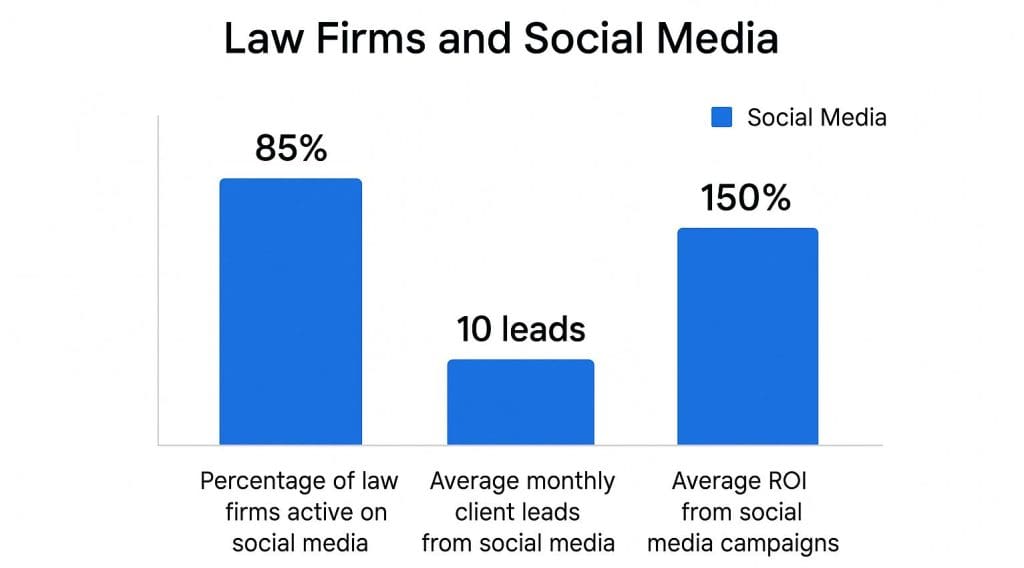
This data shows that high adoption rates are backed by measurable returns in both lead generation and overall campaign profitability, making it a critical investment for any modern law firm.
Creating Content That Connects and Converts
A solid social media foundation is a great start, but the content you actually share is what will drive your marketing forward. For law firms, this is a tricky balancing act. Your content needs to be compelling enough to stop someone from scrolling, informative enough to build real trust, and, of course, compliant with all bar association rules.
The key is to completely shift your mindset. Stop thinking about “selling legal services” and start thinking about “solving problems.” Your potential clients aren’t scrolling through Instagram looking for a sales pitch; they’re looking for answers and a bit of reassurance. Your social media feed should be the place they find it, positioning you as a knowledgeable and, just as importantly, approachable authority.
Humanize Your Firm Through Content
Here’s a simple truth: people hire people, not faceless corporations. The number one job of your content is to humanize your practice and make your team relatable. This is how you build a connection long before someone even thinks about needing a lawyer.
A fantastic way to do this is by breaking down complex legal topics into simple, digestible posts. You need to think less like you’re writing a legal brief and more like you’re having a helpful conversation.
- Educational Posts: A simple graphic explaining the difference between “probate” and “estate administration” can be incredibly effective. Or a short video clarifying common myths about personal injury claims.
- Behind-the-Scenes Glimpses: Share a photo of your team volunteering at a local charity event. Post about a firm anniversary celebration. Show the real people behind the law degrees.
- Attorney Spotlights: Run a quick Q&A with an associate. Ask them why they chose to practice family law. This helps potential clients see the person, not just the professional.
This kind of content pulls back the curtain on the legal process, making your firm feel far more accessible. In a profession that’s often seen as intimidating, that’s a massive advantage.
The Power of Video in Legal Marketing
Video isn’t just a nice-to-have anymore; it’s absolutely essential for grabbing attention. The social media marketing industry is a $160 billion global arena, and video is its undisputed star player. With 4.95 billion people worldwide spending over two hours a day on these platforms, short-form video on Instagram Reels, TikTok, and YouTube Shorts is where the eyes are.
This is your opportunity to really stand out from the competition.
Pro Tip: You don’t need a professional film crew. A smartphone with decent lighting and clear audio is all you need to get started. In fact, authenticity often performs much better than high-production gloss.
Think about creating a weekly “Ask an Attorney” series where you answer one common, non-specific question in a 60-second Reel. A real estate attorney, for instance, could quickly explain why a title search is so critical. This provides immediate value and showcases your expertise in a modern, engaging way.
Share Success Stories—Ethically
Client stories are incredibly powerful, but you have to handle them with extreme care to protect confidentiality and avoid making any promises or guarantees. The trick is to focus on the client’s journey and the problem you helped them solve, not the specific case outcome. And always get explicit, written consent before sharing anything.
For example, an immigration attorney could share a story about helping a family navigate the complex visa process, highlighting their relief and happiness without revealing sensitive details. To see how these narratives can be framed powerfully and ethically, you can learn more about immigrant success stories and the legal guidance behind them.
This approach builds powerful social proof and demonstrates your firm’s real-world impact in a way that’s both compliant and respectful.
Develop a Content Calendar and Voice
Consistency is everything in social media. A content calendar is your roadmap, making sure you post regularly and cover a good mix of topics. You don’t need a design background, either. Tools like Canva have made it incredibly easy to design professional-looking graphics in minutes.
Here’s a look at a simple template you can find on Canva to start getting organized.

This screenshot shows just how easy it is to find templates that help you plan your posts, which is key to maintaining a consistent message and visual brand.
Just as important as what you post is how you say it. Your firm’s tone of voice needs to strike the right balance—professional yet approachable. Be the expert, but not the academic. Write your captions as if you were explaining a legal concept to a smart friend who just happens to not be a lawyer. Ditch the dense legal jargon and stick to clear, direct language.
Finally, every single post needs a purpose. Your call-to-action (CTA) tells your audience what to do next. Instead of a hard sell, use softer, value-driven CTAs. Think “Download our free estate planning checklist” or “Visit our blog to learn more about the divorce process.” These CTAs offer more value and gently guide potential clients deeper into your world without running afoul of advertising rules.
Navigating Social Media Ethics and Compliance

For attorneys, social media operates under an entirely different set of rules. A single misstep on LinkedIn isn’t just a marketing gaffe; it can spiral into a serious ethical violation with real professional consequences.
This isn’t about killing your online personality. It’s about building a digital reputation that’s not just engaging, but also bulletproof under scrutiny.
The blurred lines of digital communication make it dangerously easy to cross an ethical boundary without even realizing it. A seemingly helpful DM can be interpreted as legal advice, and a celebratory post about a big win can inadvertently breach client confidentiality. Your success with attorney social media marketing hinges on mastering these nuances.
The Unintentional Attorney-Client Relationship
One of the biggest risks out there is accidentally forming an attorney-client relationship. It happens all the time. A potential client slides into your DMs with a detailed story about their specific legal mess, looking for a quick opinion.
If you offer any kind of specific guidance, you could be seen as having provided legal advice. That opens a Pandora’s box of potential problems, from future conflicts of interest to malpractice claims. To avoid this, your policy for DMs and public comments has to be airtight.
- Never offer analysis or advice on specific facts presented in a DM or comment.
- Always respond with a polite, clear message directing them to schedule a formal consultation through your firm’s official channels.
- Include a disclaimer in your social media bios. Something simple stating that interactions on the platform do not create an attorney-client relationship.
Avoiding Guarantees and Misleading Statements
Your social media content should aim to educate and inform, never to promise. State bar advertising rules are crystal clear about prohibiting any statements that create unjustified expectations about results.
Posting things like, “We win big for our clients!” or “Guaranteed maximum settlement!” is a fast track to a disciplinary committee. It’s a clear violation.
Instead, shift your focus. Talk about your process, your experience, and your firm’s dedication to its clients.
Your marketing should build confidence in your capabilities, not guarantee a specific result. Focus on your firm’s experience, approach, and dedication. This builds trust without crossing ethical lines.
This subtle change in language is everything. It transforms your content from a prohibited advertisement of outcomes to an acceptable showcase of your professional qualifications.
The Rules on Testimonials and Confidentiality
Client testimonials are incredibly powerful marketing tools, but they are also an ethical minefield. Before you even think about sharing a client’s rave review, you absolutely must have their explicit, informed, and written consent.
Even with consent, you have to ensure the testimonial isn’t misleading or unverifiable.
Beyond that, client confidentiality is absolute. It extends to all your online activity. Never discuss case specifics, even if you think you’re being hypothetical or have anonymized the details. A harmless-sounding post about a “fascinating real estate deal downtown” might contain just enough information for someone to connect the dots.
Before any post goes live, run it through this simple checklist:
- Is it Educational? Does this offer general legal information, not specific advice?
- Is it Professional? Does it uphold the dignity of the profession?
- Does it Promise? Does it avoid any guarantees or predictions of success?
- Is it Confidential? Does it protect all client information, no matter how minor?
- Does it Disclose? Is it clearly labeled as “Advertising Material” if your state bar requires it?
By embedding these ethical guardrails into your social media strategy, you can confidently build your firm’s brand and connect with potential clients—without ever putting your license on the line.
Managing Your Day-to-Day Social Media

A brilliant social media strategy is just a document until you execute it. The real work—and the real results—happen in the daily management of your channels. It’s the consistent posting, thoughtful engagement, and strategic networking that elevates a plan into a powerful brand-building asset.
This daily commitment is what separates firms that see a genuine return from those with profiles that just gather dust. It requires a smart blend of proactive content distribution and reactive community management, ensuring your firm stays visible, credible, and approachable.
Establishing a Consistent Workflow
On social media, consistency is the engine. Sporadic, unpredictable posting sends a clear signal to potential clients: your firm isn’t fully committed. To avoid this, you need a workflow that’s both manageable and effective. Automation is your best ally here.
Social media management tools are non-negotiable for a busy law practice. Platforms like Buffer, Hootsuite, or Sprout Social let you schedule all your posts in advance. This means you can block out just a couple of hours—say, on a Monday morning—to plan and load in your content for the entire week.
This “batching” approach ensures a steady stream of content hits your feed without requiring you to log in and post manually every single day. More importantly, it frees you up to focus on the part of day-to-day management that actually builds relationships: genuine engagement.
A consistent posting schedule does more than just keep your feed active. It signals to both algorithms and audiences that your firm is a reliable source of information, which builds trust and improves visibility over time.
Mastering Community Management
Social media is a conversation, not a billboard. Posting content is only half the job. The other, more critical half is managing the dialogue that follows. This means responding to comments, answering questions, and handling direct messages with absolute professionalism.
Your response protocol should be clear and firm-wide:
- Acknowledge Promptly: Aim to respond to all legitimate comments and messages within 24 hours. This shows you’re attentive and value your audience.
- Be Helpful, Not Prescriptive: When someone asks a legal question, provide general information and guide them toward an official consultation. Never, ever give legal advice in the comments or DMs.
- Maintain Professionalism: Even when faced with negative or critical comments, your response must remain courteous. A calm, respectful reply can de-escalate a situation and reflects well on your firm’s character.
Handling inquiries in direct messages requires an even finer touch. A potential client might share sensitive details, creating an immediate ethical gray area. Your response should be to politely stop the conversation and immediately redirect them to a secure, formal channel, like your website’s contact form or a dedicated email. This protects both them and your firm from serious missteps.
To help law firms navigate the crowded market of management tools, here’s a quick overview of some popular options suitable for solo attorneys and small to mid-sized practices.
Social Media Management Tool Overview
Tool | Best For | Key Features | Starting Price |
Buffer | Solo practitioners and small firms | Simple post scheduling, basic analytics, intuitive interface, content calendar view. | ~$6/month per channel |
Hootsuite | Firms managing multiple brands or locations | All-in-one dashboard, advanced scheduling, social listening, detailed analytics. | ~$99/month |
Sprout Social | Mid-sized to larger firms needing deep insights | Advanced analytics, team collaboration tools, robust social listening, CRM integration. | ~$249/month |
Later | Visually-focused practices (e.g., PI, Real Estate) | Instagram-first design, visual content calendar, link-in-bio tools, user-generated content features. | ~$25/month |
Each of these platforms offers a different level of sophistication and pricing. The key is to choose one that fits your firm’s current needs and budget, allowing you to streamline your workflow without overcomplicating things.
Leveraging Different Post Types
Not all posts are created equal. An effective daily strategy mixes organic content with paid advertising when the moment is right. Organic posts are your regular, unpaid updates that build community and nurture relationships with your existing followers.
Paid ads, often called “boosted” posts, are used to push your message out to a much wider, highly targeted audience. You don’t need a massive budget to see an impact. For instance, if you’ve written a valuable blog post on changes to local real estate law, you could spend as little as $50 to boost that post directly to homeowners in your specific county.
This surgical approach ensures your best content reaches the people most likely to need your services, turning a simple update into a legitimate lead-generation tool.
Networking and Generating Referrals on LinkedIn
For attorneys, LinkedIn is far more than a digital résumé—it’s a powerful referral engine. Daily management here looks different. It’s less about broadcasting firm news and more about making strategic connections.
Dedicate 15 minutes each day to actively engaging on the platform. This means leaving thoughtful comments on posts from colleagues, connecting with professionals in complementary fields (like accountants or financial planners), and sharing valuable industry articles.
This consistent, professional interaction keeps you top-of-mind and builds a robust referral network, making your social media efforts a direct driver of firm growth.
Using Paid Ads to Reach Your Ideal Clients
Building a community with organic posts is important, but it’s a slow burn. When you need to generate new leads now, paid advertising on social media is the fuel for your firm’s engine. It gives you a direct, immediate line to the specific people who need your legal services.
Think of it as moving from a billboard on a random highway to a perfectly placed ad in a trade journal read only by your ideal clients. You’re not just shouting into the void; you’re having a conversation with the right people at the right time. This is where attorney social media marketing transforms from a branding exercise into a serious client acquisition machine.
Targeting with Surgical Precision
The real magic of social ads isn’t just reach—it’s the incredibly sharp targeting capabilities. You can build a custom audience with a level of accuracy that was unthinkable just a few years ago.
For instance:
- A personal injury lawyer can target users within a 10-mile radius of their office who recently showed interest in motorcycle safety content or even visited an ER.
- An estate planning attorney can focus their budget on individuals aged 50-65 in high-income zip codes who follow financial planning publications.
- A B2B intellectual property firm can use LinkedIn to get ads directly in front of C-suite executives and founders in the tech sector.
These platforms allow you to filter audiences by location, age, interests, online behaviors, job titles, and much more. This means your marketing dollars stop being a gamble and start being a calculated investment in reaching qualified potential clients. To really succeed, you have to get these nuances right, especially if you’re trying to attract high-value cases in competitive areas like personal injury litigation.
Designing Ad Campaigns That Convert
A powerful ad is more than just a boosted post. It needs a clear goal, sharp copy, and a compelling visual. The entire structure of the ad depends on what you want the user to do.
Driving traffic to a blog post about a new law? Your call-to-action (CTA) should be “Learn More.” Trying to get the phone to ring? The CTA needs to be “Get a Free Consultation” or “Download Our Guide.”
The ad copy has to be direct, empathetic, and centered on the client’s problem. Instead of “We are experienced family law attorneys,” try, “Navigating a divorce is difficult. We provide clear, straightforward guidance.” That subtle shift speaks directly to a user’s pain point.
Key Takeaway: The best legal ads don’t sell legal services. They offer solutions to complex, stressful problems. Your ad should feel like a beacon of help in a crowded and confusing social media feed.
Pair your copy with a professional, high-quality image or, even better, a short video. Video consistently outperforms static images on engagement. A quick clip of an attorney explaining a key legal concept can build instant trust and rapport before a potential client even clicks.
Measuring Your Return on Ad Spend
One of the biggest advantages of digital advertising is that it’s completely measurable. You can track every dollar and know exactly what it generated, taking the guesswork out of your marketing budget.
Keep a close eye on these key metrics:
- Cost Per Click (CPC): How much you pay each time someone clicks your ad.
- Click-Through Rate (CTR): The percentage of people who see your ad and actually click it.
- Conversion Rate: The percentage of clickers who then take the desired action (like filling out your contact form).
- Cost Per Lead (CPL): Your total ad spend divided by the number of new leads you got.
By tracking these numbers, you can A/B test different ad versions—tweaking headlines, images, or audience targets—to see what truly connects. The goal is to continuously refine your strategy to lower your Cost Per Lead. It’s about spending smarter, not just spending more.
The advertising landscape for law firms is always evolving. With nearly 4.9 billion people using social media globally, data-driven strategies are no longer optional. While platforms like LinkedIn are ideal for B2B practices, Facebook and Instagram remain powerful for consumer-facing law. And don’t ignore emerging video platforms like TikTok and YouTube for building brand awareness. This data-first approach turns paid social advertising from an expense into a predictable, scalable investment in your firm’s growth.
The Most Common Questions We Hear About Social Media
Jumping into social media can feel like another full-time job, especially when you’re already managing a demanding caseload. Most attorneys have the same practical questions about the time commitment, how to measure success, and what to do when things go wrong.
Let’s cut through the noise and address these concerns head-on. This isn’t about adding one more overwhelming task to your plate; it’s about building a smart, efficient strategy that actually works for your practice.
How Much Time Do I Realistically Need to Invest?
This is always the first question, and the answer is surprisingly manageable. You don’t need to spend hours a day glued to your screen. The real key is consistency, not a massive time dump.
Aim for a focused 20-30 minutes per day. This time should be spent on high-impact activities, not just mindless scrolling or posting. With the right strategy and tools, you can map out and schedule an entire week’s worth of content in just a couple of hours.
Here’s what that daily commitment looks like in practice:
- 10 minutes: Check your notifications and respond to comments, direct messages, and new connection requests. Engagement is your top priority.
- 10 minutes: Engage with content from others. Leave a thoughtful comment on a LinkedIn post from a potential referral source or a prospective client.
- 5 minutes: Quickly review your content calendar and make any adjustments needed for the next day’s posts.
The most effective social media strategies are built on sustainable habits, not exhausting sprints. A consistent 20 minutes a day is far more valuable than a frantic four-hour session once a month.
What Metrics Actually Signal Success?
Likes and follower counts are often called “vanity metrics” for a good reason—they look impressive but don’t automatically translate into new business. While they show people are seeing your content, you need to track metrics that are tied directly to your firm’s bottom line.
Forget the fluff. Focus on these indicators instead:
- Website Clicks: How many people are actually leaving the social platform to visit your firm’s website? This is a powerful signal of genuine interest.
- Consultation Form Submissions: Use tracked links to see exactly how many people who arrived from social media filled out your contact or consultation form.
- Direct Message Inquiries: Are you receiving legitimate inquiries about your services through DMs? Track how many of these convert into actual consultations.
- Engagement Rate: This goes beyond likes. It’s the total number of comments, shares, and saves divided by your follower count. A high rate proves your content is truly resonating with your audience.
How Should I Handle Negative Comments or Reviews?
Sooner or later, every active social media profile will attract a negative comment. The way you handle it says far more about your firm’s professionalism than the comment itself.
The golden rule is simple: never delete the comment (unless it’s clear spam or uses offensive language) and never get into a public argument.
Your response should be prompt, professional, and designed to take the conversation offline immediately. A simple, polished reply works best:
“Thank you for your feedback. We take all client concerns seriously. Please contact our office directly at [phone number] or [email address] so we can address this matter privately.”
This approach shows you’re responsive and professional without validating the complaint publicly or risking a breach of client confidentiality. It turns a potential negative into a public display of your firm’s character and commitment to resolution.
Elevate your firm’s reputation and connect with high-value clients through the Haute Lawyer Network. Our curated platform provides unparalleled visibility and branding opportunities, aligning your practice with a legacy of luxury and excellence. To learn how we can amplify your digital presence and drive meaningful growth, visit us at https://hauteliving.com/lawyernetwork.