
The moments after a DUI first offense arrest are a chaotic mix of flashing lights, stress, and a flood of questions. Suddenly, you’re tangled in a legal system that feels designed to confuse you. It’s not just one problem, either—you’re facing two separate battles at the same time: a criminal case and an administrative fight with the DMV over your license. The first step toward getting through it is understanding what’s happening.
What Happens Immediately After a DUI Arrest
A DUI arrest isn’t random; it follows a predictable script. Think of it like a set of dominoes—once the traffic stop happens, a whole chain of events is already in motion. Knowing what those dominoes are can take some of the fear out of the equation and give you a clear roadmap of the road ahead.
It nearly always starts with a traffic stop. An officer needs a legitimate reason to pull you over, what the law calls reasonable suspicion. This could be something as simple as speeding, drifting between lanes, or forgetting to use a turn signal. From that point on, everything you do and say is under a microscope.
The Roadside Investigation and Arrest
If the officer thinks you might be impaired, they’ll start what’s called a roadside investigation. This usually means asking you to step out of the car to perform standardized field sobriety tests (SFSTs). These are designed to test your balance, coordination, and ability to follow instructions.
After the physical tests, you’ll likely be asked to blow into a small, handheld preliminary breathalyzer. Based on how you did on the tests, what you said, and the breath test results, the officer makes a decision: arrest or no arrest.
If you are arrested, you’ll be taken to the station for booking. This part is pretty much what you see on TV:
- Paperwork: They take down your name, address, and other personal details.
- Mugshot: Your photo is taken for the official record.
- Fingerprinting: Your prints are recorded and logged into a criminal database.
- Chemical Test: This is the big one. You’ll be required to take a formal chemical test—usually breath, but sometimes blood or urine—to get an official reading of your Blood Alcohol Concentration (BAC). Refusing this test is a serious decision with its own heavy consequences, often including an automatic, year-long license suspension.
Vehicle Impoundment and Initial Release
While all this is happening at the station, your car is getting towed and impounded. You’re on the hook for all the towing and storage fees, which start adding up immediately. After you’ve been processed, you’ll either be released on your “own recognizance” (a promise to show up for court), be required to post bail, or be held until your first court date, which is called an arraignment.
The fallout from a first DUI starts fast. Insurance rates typically spike by 71% after an arrest, and when you combine that with fines, legal fees, and impound costs, the financial hit can be staggering. You can see more statistics on these far-reaching effects on sandlawnd.com.
Right now, you are officially fighting on two fronts. The criminal charges are for the courts to decide. At the same time, the DMV (or your state’s equivalent) has started its own separate process to suspend your driver’s license. It’s absolutely critical to understand these are two independent cases, each with its own deadlines, rules, and hearings.
Navigating the Two Fronts of a DUI Case
Getting hit with a DUI first offense feels like you’ve been thrown into a fight with two opponents at once. In one corner, you have the criminal court system, with a prosecutor laser-focused on getting a conviction. In the other, you have the Department of Motor Vehicles (DMV), which is moving just as aggressively to revoke your license.
These two battles don’t wait for each other—they happen simultaneously. This is the single most important thing to understand right from the start. What happens in your criminal case and what happens with the DMV are two entirely separate processes, each with its own set of rules, deadlines, and consequences. Winning in court won’t automatically save your license, and losing your license doesn’t mean you’re automatically guilty of a crime. You have to fight both.
This graphic breaks down how that single moment of arrest immediately splits your case into two distinct legal paths.
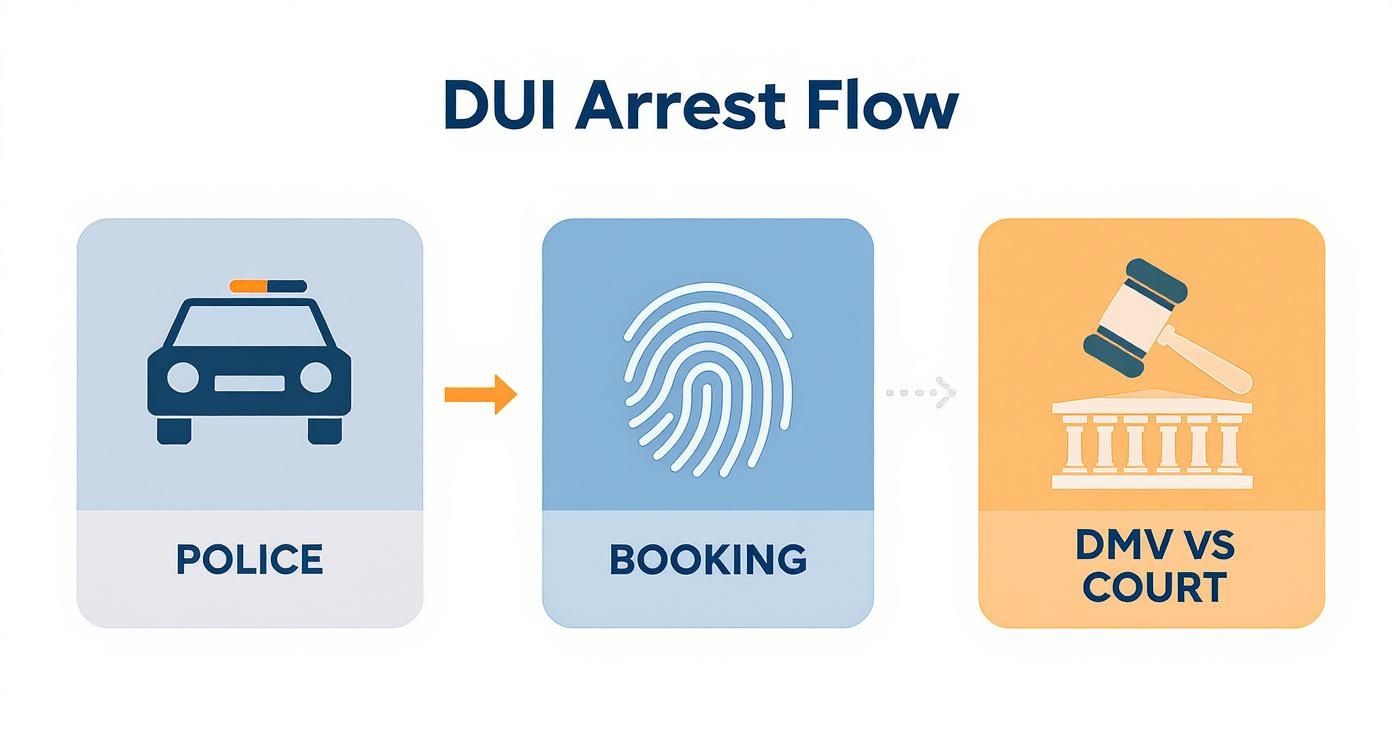
As you can see, the arrest is just the beginning. From there, you’re dealing with two powerful government bodies, each with its own agenda.
The Administrative Front: Your Fight with the DMV
The first and most time-sensitive battle is with the DMV. This process moves at lightning speed, and if you hesitate, you lose. The moment you are arrested, a clock starts ticking. Most states give you only 10 to 30 days to request a formal hearing to challenge the automatic suspension of your driver’s license.
Missing this deadline is a fatal error in a DUI case. If you don’t request that hearing in time, you automatically lose your right to fight the suspension. Your license will be suspended, no matter what happens down the road in your criminal case.
This administrative hearing is your one shot to argue why you should keep your driving privileges. A skilled attorney can represent you and pick apart the state’s case: Was there probable cause for the traffic stop? Was the breathalyzer calibrated correctly? Even if the hearing doesn’t go your way, it can open the door to a restricted or hardship license, allowing you to drive to critical locations like work, school, or doctor’s appointments.
The Criminal Front: Your Case in Court
While the DMV process is sprinting forward, your criminal case is moving along on a much slower, more deliberate timeline. This is the part most people imagine when they think of a “DUI charge”—it involves prosecutors, judges, courtrooms, and the potential for a trial. This journey has a few key stages.
- Arraignment: This is your first formal appearance in court. The judge will read the official charges against you, and you’ll enter a plea. In nearly every case, the correct plea at this stage is “not guilty.” This protects your rights and gives your attorney the time needed to dig into the evidence.
- Pre-Trial Motions and Negotiations: After the arraignment, your lawyer gets to work demanding all the evidence the prosecutor plans to use against you. This is called discovery, and it includes everything from the police report and body cam footage to the breathalyzer’s maintenance logs. Armed with this information, your attorney can file motions to get weak evidence thrown out or start negotiating with the prosecutor for a better outcome, like a plea to a lesser charge.
- Trial or Plea: The reality is that the vast majority of DUI first offense cases are resolved with a plea agreement. But if the prosecutor isn’t offering a fair deal, your case will head to trial. There, the government has to prove its case against you “beyond a reasonable doubt” to a judge or a jury.
A successful DUI defense requires a strategy that treats the DMV and the criminal court as two parts of a whole. An experienced attorney knows how to manage both fronts, making sure a move in one arena doesn’t create a disaster in the other.
Potential Penalties for a First DUI Offense
Don’t let the term “first offense” fool you into thinking it’s a minor issue settled with a simple fine. For a DUI first offense, that couldn’t be further from the truth. A conviction sets off a chain reaction of serious penalties that change dramatically based on your state, the specifics of your arrest, and your Blood Alcohol Concentration (BAC) level.
It’s not a single slap on the wrist. Think of it as a complex web of consequences hitting your freedom, your finances, and your future all at once. The formula for punishment is different everywhere—a DUI in California won’t look the same as one in Florida—which makes understanding the stakes in your specific area absolutely critical.
Jail Time and Community Service
The thought of jail is, for most people, the most terrifying part. While a long sentence is rare for a standard first offense, some jail time is mandatory in many states, even if it’s just for 48 to 72 hours. Judges sometimes have the power to swap jail for other penalties, but that’s never a guarantee.
When jail is a possibility, courts often look to alternatives that serve as both punishment and rehabilitation:
- Community Service: You could be ordered to complete 40 to 80 hours of work for a nonprofit or government agency.
- Work Release Programs: Some jurisdictions might let you serve your time on weekends or with an electronic tether, allowing you to keep your job.
- Probation: Almost every DUI conviction comes with probation, typically for 12 to 36 months. This means strict rules, regular check-ins, and a total ban on alcohol.
License Suspension and Driving Restrictions
Losing your license is one of the most immediate and disruptive penalties. A conviction almost guarantees a mandatory license suspension, which can last anywhere from 90 days to a full year for a typical DUI first offense.
This is more than just an inconvenience; it can threaten your job, your education, and your ability to manage family life. Some states offer hardship licenses for essential driving, but they aren’t easy to get and come with severe limitations. It’s also worth noting that the legal landscape is always changing. You can learn more about the new DUI laws of 2025 to see how regulations might be shifting in your area.
A DUI conviction goes far beyond the courthouse steps. It follows you onto the road with devices that monitor your sobriety and into your wallet with dramatically increased insurance costs that can last for years.
Mandatory Education and Ignition Interlock Devices
The courts are focused on making sure a first offense is the last offense. To do that, they require programs and technology designed to stop it from happening again. You’ll almost certainly have to enroll in and pay for a state-approved DUI education program, which could be a weekend course or several months of classes.
On top of that, many states now require you to install an Ignition Interlock Device (IID) in your car, even for a first offense. This is a small breathalyzer wired into your car’s ignition. You have to blow into it to start the car and at random times while you’re driving.
You’re on the hook for all the costs, which add up quickly:
- Installation Fee: Usually $100 to $200.
- Monthly Leasing Fee: Runs from $75 to $150 a month.
- Removal Fee: Another charge when the required time is up.
Over a year, an IID can easily set you back more than $1,200.
The Financial Fallout: Fines and Soaring Insurance
The financial hit from a DUI is staggering, and it goes way beyond the court fine. Fines typically range from $500 to $2,000, but the secondary costs are where the real pain is. One of the biggest long-term expenses is the spike in your car insurance. After a first DUI, your premiums could nearly double. A typical policy can skyrocket from $2,630 to $5,106 a year—a stunning 94% increase.
This financial pressure can make it incredibly difficult to stay legally on the road.
To give you a clearer picture of how much these penalties can vary, here’s a snapshot of what a first-offense DUI looks like in a few different states.
Typical First Offense DUI Penalties: A State-by-State Snapshot
This table highlights just how different the consequences can be depending on where you are. What might be a standard penalty in one state could be far more severe in another, showing why a DUI charge is serious no matter the jurisdiction.
| State | Typical Jail Time | Potential Fines | Mandatory License Suspension | Ignition Interlock Device (IID) Requirement |
|---|---|---|---|---|
| California | Up to 6 months | $390 – $1,000+ | 6 – 10 months | Often required for 6 months |
| Texas | 3 – 180 days | Up to $2,000 | 90 days – 1 year | May be required for 1 year |
| Florida | Up to 6 months | $500 – $1,000 | 180 days – 1 year | Required for 6 months if BAC > 0.15 |
| New York | Up to 1 year | $500 – $1,000 | Minimum 6 months | Required for at least 12 months |
As you can see, there’s no such thing as a “simple” DUI. The combination of jail, fines, license loss, and technology requirements creates a heavy burden, underscoring the importance of understanding the specific laws you’re up against.
How to Build a Strong DUI Defense Strategy

Being arrested for a DUI first offense isn’t a conviction. It’s critical to remember that an arrest is just the start of the legal process—not the end of the story. Building a powerful defense means shifting your focus away from the penalties and toward the hard facts of your case to find the weaknesses in the prosecutor’s argument.
Think of the prosecution’s case like a chain. For them to get a conviction, every single link has to be strong and legally sound. A winning defense strategy is all about finding and breaking the weakest link. That requires a methodical deep dive into every piece of evidence, from the second the officer first noticed your car until the moment you were formally charged.
Even when the evidence feels overwhelming, a seasoned DUI attorney knows exactly where to look for procedural mistakes, faulty equipment, or violations of your constitutional rights. Those details can turn what seems like a lost cause into a very winnable case.
Questioning the Initial Traffic Stop
The entire DUI case stands on one foundation: the legality of the traffic stop. An officer can’t just pull you over on a whim. They must have what the law calls “reasonable suspicion” that you broke a law. This is the very first link in that chain.
If the stop was unlawful from the get-go, any evidence collected afterward—including field sobriety tests and breathalyzer results—can be thrown out of court. Lawyers often call this the “fruit of the poisonous tree” doctrine.
Common reasons for a traffic stop that an attorney might challenge include:
- Vague justifications: An officer writing you were “driving suspiciously” in their report might not be specific enough to hold up.
- Minor infractions: Did one tire briefly touching the line for a split second truly justify a full-blown traffic stop?
- Anonymous tips: Was the stop based entirely on an unconfirmed tip from someone who didn’t even give their name?
Challenging the stop is a powerful first line of defense. If your lawyer can prove the officer didn’t have a valid reason to pull you over, the entire case could be dismissed before anyone even looks at the chemical test results.
An arrest is merely an accusation supported by an officer’s opinion. A strong defense strategy challenges that opinion by scrutinizing the evidence and holding the prosecution to its high burden of proof.
Scrutinizing Field Sobriety and Chemical Tests
Once the stop is established, the next battleground is the evidence used to prove impairment. This covers both the Standardized Field Sobriety Tests (SFSTs) and the chemical tests like breath, blood, or urine. Every one of these procedures is governed by strict scientific and legal protocols.
Field sobriety tests are notoriously subjective. Your performance can be thrown off by all sorts of things that have nothing to do with alcohol, such as:
- Nerves or exhaustion
- Pre-existing physical disabilities or injuries
- Poor lighting or an uneven road surface
- Confusing or incorrect instructions from the officer
Chemical tests aren’t foolproof, either. Breathalyzer machines need precise calibration and routine maintenance to work correctly. A good attorney will demand the device’s service logs to check for a history of malfunctions or missed inspections. Any slip-up from the required protocol can make the results inadmissible.
Blood tests, while generally more accurate, come with their own rigid chain-of-custody requirements. If the sample was mishandled, stored improperly, or analyzed by an unqualified lab tech, the results can be successfully challenged. A skilled defense lawyer will pick apart every step, from the needle stick to the final lab report, looking for errors to use to your advantage. A DUI first offense case is often won or lost based on the integrity of this so-called “scientific” evidence.
Why Hiring a Specialized DUI Lawyer Matters

After a DUI first offense arrest, the temptation to handle it alone—or with a general practice lawyer—is strong. The thought process is understandable: “It’s my first time, how complicated can it really be?” This is one of the most dangerous and costly assumptions you can make.
A DUI charge isn’t like a simple traffic ticket. It’s a complex legal battleground involving intricate scientific evidence, strict procedural rules, and prosecutors whose entire job is to secure convictions. A general attorney might know the law, but a specialized DUI lawyer lives and breathes it every single day. They are specialists in a field where deep, focused knowledge is often the only thing standing between a conviction and a dismissal.
The Specialist Advantage in a DUI Case
Think about it this way: if you needed heart surgery, you wouldn’t go to your family doctor. You’d find the best cardiac surgeon you could. The same logic applies here. A dedicated DUI lawyer brings a unique, targeted skill set that a generalist simply can’t offer.
These attorneys have spent their entire careers mastering the nuances of DUI law. They know the local judges, the prosecutors, and even the tendencies of the arresting officers. More importantly, they understand the science behind breathalyzers and blood tests—including their inherent flaws and high failure rates.
A specialized DUI lawyer doesn’t just know the law; they know the players, the science, and the winning strategies. Their entire practice is built around finding the hidden weaknesses in cases that seem airtight to an untrained eye.
This specialized focus is absolutely critical. For example, while the U.S. sets its blood alcohol concentration (BAC) limit at 0.08%, a true specialist knows how to leverage global standards to build a stronger case. Many European countries, like France and Germany, use a stricter 0.05% limit, and data from these regions can be used to inform powerful arguments about impairment levels and testing accuracy. You can see more about these international standards on JMW.co.uk.
Dissecting Evidence and Negotiating Better Outcomes
A skilled DUI attorney’s first move is to take the prosecutor’s case apart, piece by piece. They will meticulously review every shred of evidence, from the arresting officer’s initial report to the maintenance and calibration logs for the breathalyzer machine.
- Challenging the Stop: Was the traffic stop even legal in the first place? If the officer lacked probable cause, all evidence gathered afterward could be thrown out.
- Analyzing Sobriety Tests: Were the field sobriety tests administered correctly? Were they conducted under appropriate conditions, or was it a dark, uneven roadside?
- Scrutinizing Chemical Tests: Was the breathalyzer properly calibrated and maintained? Was the blood sample handled according to the strict chain-of-custody protocols required by law?
By uncovering these procedural errors, an attorney creates leverage. This leverage is everything when it comes to negotiating with the prosecutor. Instead of just accepting a standard plea deal, a specialist can often argue for a much better outcome—like getting the charge reduced to reckless driving (sometimes called a “wet reckless”), which carries far lighter penalties and avoids the lifelong stigma of a DUI conviction. Ultimately, finding the right legal counsel is the most critical first step you can take, and our guide on how to find an attorney offers valuable insights to start your search.
Common Questions About a First DUI Offense
Once the shock of a DUI first offense arrest begins to fade, a wave of urgent, practical questions almost always follows. The uncertainty is overwhelming—what happens to my license, my job, my future? This section cuts through the noise to provide direct answers to the most pressing concerns, helping you replace confusion with clarity.
Getting a handle on these issues is the first step toward regaining control. Let’s tackle them one by one.
Will a First DUI Give Me a Criminal Record Forever?
This is usually the biggest fear, and for good reason. A criminal record can throw up roadblocks to employment, housing, and even educational opportunities. The short answer is yes, a DUI first offense conviction means you will have a permanent criminal record. In nearly every state, it’s classified as a misdemeanor, not a simple traffic violation.
But “permanent” doesn’t always mean there are no options down the road. Whether you can clear your record depends entirely on your state’s laws around expungement or record sealing.
- Expungement: This process essentially has the conviction erased from your public record, as if it never happened.
- Record Sealing: This makes the conviction invisible to the general public (including most employers), though it remains accessible to law enforcement.
Unfortunately, many states have made it exceptionally difficult—or impossible—to expunge a DUI. They view it as a serious public safety issue and want the record to serve as a long-term deterrent. The rules vary dramatically from one state to another, so knowing your local options is critical. You can learn more about whether you can get a DUI off your record to see what may be possible in your jurisdiction.
A DUI conviction isn’t a traffic ticket you just pay and forget. It’s a criminal offense that will show up on background checks for years, impacting your career and personal life. This long-term fallout is precisely why fighting the charge from day one is so important.
Can I Get in Trouble for Refusing a Breathalyzer?
Yes, absolutely. Refusing a chemical test like a breathalyzer or blood draw triggers its own set of immediate and serious penalties, completely separate from the DUI charge itself. This is all thanks to a legal principle called “implied consent.”
The moment you get a driver’s license, you automatically agree to submit to chemical testing if you are lawfully arrested for a DUI. It’s part of the bargain for the privilege of driving. If you break that deal by refusing, the DMV will punish you for it.
The consequences are often swift and non-negotiable:
- Automatic License Suspension: This is the most common penalty. Your license will be suspended for a long time, often a full year, with zero possibility of getting a restricted or hardship license to drive to work.
- Use as Evidence: The prosecutor can—and will—use your refusal against you in court. They’ll argue that you refused because you knew you were guilty and were trying to hide the evidence.
- Separate Penalties: These administrative penalties happen no matter what happens in your criminal DUI case. Even if you are found not guilty of the DUI, your license will stay suspended simply because you violated the implied consent law.
Refusing the test is a major decision with its own guaranteed consequences, making it a difficult choice in a high-pressure situation.
How Much Will a First DUI Actually Cost Me?
The financial fallout from a DUI first offense is almost always far worse than people imagine. The fine handed down by the judge is just the tip of the iceberg. When you add up every associated expense, the final tally can easily climb into the thousands, often exceeding $10,000 to $20,000 by the time everything is paid.
Think of it as a series of mandatory costs that you become responsible for the second you’re convicted.
Here’s a realistic breakdown of where the money actually goes:
| Expense Category | Estimated Cost Range | Description |
|---|---|---|
| Court Fines and Fees | $500 – $2,500 | This is the direct penalty imposed by the court for the conviction. |
| Attorney Fees | $2,500 – $10,000+ | A specialized DUI lawyer is a critical investment with fees varying by case complexity. |
| Insurance Hikes | $1,500 – $3,000+ per year | Your premiums can easily double or triple for 3-5 years after a conviction. |
| DUI Education Classes | $300 – $1,000 | Mandatory, state-approved courses on alcohol and drug abuse. |
| IID Installation & Leasing | $1,000 – $2,000 per year | Includes installation, monthly monitoring fees, and removal of the ignition interlock device. |
| License Reinstatement Fees | $100 – $500 | Administrative fees paid to the DMV to get your license back. |
| Towing and Impound Fees | $200 – $800 | The cost to retrieve your vehicle after it’s towed from the scene of the arrest. |
These costs stack up incredibly fast, creating a financial burden that can last for years. The sheer price tag is another powerful reason why mounting a strong defense from the very beginning isn’t just about protecting your freedom—it’s about safeguarding your financial future.
Facing a DUI charge is a serious matter that requires expert legal guidance. The attorneys featured in the Haute Lawyer Network are recognized for their excellence and are ready to provide the sophisticated representation you need. To connect with a top-tier legal professional who can protect your rights and navigate the complexities of your case, explore our curated network. Find the expert legal counsel you deserve at https://hauteliving.com/lawyernetwork.