Most people think of a DUI as a serious traffic ticket—a costly mistake, but a misdemeanor nonetheless. In many cases, they’re right. But a handful of specific circumstances can instantly elevate the charge from a misdemeanor to a life-altering felony.
The distinction isn’t just about semantics; it’s the difference between a major inconvenience and a conviction that can permanently derail your life. A misdemeanor DUI is a serious problem, but a felony DUI is a catastrophic one, carrying penalties that extend far beyond fines and a suspended license.
The Critical Line Between Misdemeanor and Felony DUI

So, where is that line drawn? It’s not arbitrary. The legal system escalates a DUI charge to a felony when the driver’s actions demonstrate a heightened level of recklessness or a clear pattern of dangerous behavior. This isn’t just about being impaired; it’s about the consequences of that impairment.
Once a DUI crosses into felony territory, the stakes skyrocket. We’re talking about lengthy state prison sentences, the permanent loss of civil rights like voting or owning a firearm, and a criminal record that creates nearly insurmountable obstacles to professional licensing and future employment.
Key Felony Triggers at a Glance
Certain factors are almost universally recognized as triggers that push a standard DUI into the felony category. Across the United States, a DUI charge becomes a felony primarily when it involves repeat offenses, causing injury or death, or having a child in the car.
Many states, for instance, will automatically charge a third DUI as a felony, especially if the prior offenses occurred within a certain window. You can find more details on how common these arrests are at geraldmillerlawyer.com. This framework ensures the most severe consequences are reserved for the most dangerous situations.
A felony conviction is more than just a legal label; it’s a permanent mark that can redefine a person’s future. It affects everything from professional licenses and employment opportunities to fundamental rights like voting and firearm ownership.
To understand this distinction clearly, it helps to see the scenarios side-by-side. The table below offers a high-level comparison of the circumstances that typically define whether a DUI is treated as a misdemeanor or a felony.
Misdemeanor vs. Felony DUI Key Triggers
| Factor | Typical Misdemeanor DUI Scenario | Common Felony DUI Trigger |
|---|---|---|
| Prior Offenses | A first-time DUI with no other aggravating factors. | Having multiple prior DUI convictions, often three or more within a specific timeframe. |
| Injury or Harm | An incident with no collision or only minor property damage. | Causing a crash that results in serious bodily injury or death to another person. |
| Passengers | Driving alone or with other adult passengers. | Driving while impaired with a minor (child) in the vehicle, known as child endangerment. |
| License Status | Driving with a valid, unrestricted driver’s license. | Committing a DUI while driving on a license that is already suspended or revoked for a prior DUI. |
This table provides a foundational understanding of the triggers that prosecutors and courts look for. Now, let’s explore each of these factors in greater detail to see how they play out in the real world.
The Factors That Escalate a DUI to a Felony
Not every DUI charge carries the same weight. A first-time offense with no complications is often a serious but manageable misdemeanor. However, the presence of certain aggravating factors can instantly transform the charge into a felony, fundamentally changing the stakes and potential consequences.
Think of these factors as tripwires. Once crossed, they signal to the prosecution that the incident wasn’t just a mistake in judgment but a grave threat to public safety. This is the critical distinction that elevates a case from a severe warning to a life-altering felony prosecution.
Causing Bodily Injury or Death
The surest way a DUI becomes a felony is by causing an accident that harms or kills another person. In the eyes of the law, this isn’t just a driving infraction anymore—it’s a violent crime.
When an impaired driver injures someone, the charge often escalates to vehicular assault. If the accident proves fatal, the driver faces charges like vehicular manslaughter or even homicide. The driver’s intoxication is viewed as the direct cause of the tragedy, and the legal system responds with its most severe penalties, often leading to years—or decades—in state prison.
A History of Prior DUI Convictions
Prosecutors and judges have very little patience for repeat offenders. While a first, or sometimes even a second, DUI is treated as a misdemeanor, a pattern of offenses signals a dangerous disregard for the law. A third or fourth conviction within a certain time frame will almost always trigger an automatic felony charge.
This is where state “lookback periods” become crucial. This is the window of time prosecutors can use to count prior convictions against you.
- Some states have shorter lookback periods, like 5 or 7 years.
- Others, like Colorado, have a lifetime lookback, meaning a DUI from decades ago can still be used to enhance a new charge to a felony.
The logic is straightforward: a history of impaired driving demonstrates a persistent danger to the community. The law responds by dramatically increasing the consequences to get the driver off the road.
This system is designed to ensure that those who don’t learn their lesson face progressively harsher outcomes.
High Blood Alcohol Content (BAC)
The degree of intoxication matters immensely. While 0.08% is the universal legal limit for Blood Alcohol Content (BAC), many states have enhanced penalties for drivers who are excessively impaired. Driving with an “aggravated” or “extreme” BAC—usually 0.15% or higher—can elevate a DUI to a felony, even for a first offense in some jurisdictions.
A high BAC tells the court this wasn’t a borderline case. It indicates profound impairment, which correlates directly with a much higher risk of causing a catastrophic accident.
Child Endangerment and Other Factors
Driving under the influence with a child in the car is one of the most serious aggravating circumstances. This is universally treated as child endangerment and often results in an immediate felony charge, regardless of the driver’s history. The law is designed to fiercely protect vulnerable passengers, and the penalties reflect the severity of placing a child in that kind of peril.
Several other actions can also push a DUI into felony territory:
- Driving on a Suspended License: If your license was already suspended for a prior DUI, getting another one shows blatant defiance of a court order.
- Fleeing from Law Enforcement: Attempting to evade the police adds a separate and serious criminal charge on top of the DUI.
- Causing Significant Property Damage: While not as severe as injuring a person, causing a major crash with extensive property damage can also be an escalating factor.
Each of these elements acts as a red flag for prosecutors, signaling that a standard misdemeanor charge is simply not enough to address the driver’s reckless actions.
How Felony DUI Laws Vary Across the US
Navigating DUI laws across the United States is like trying to follow a road map where the rules of the road change every time you cross a state line. An offense that triggers a felony DUI charge in Texas might be treated as a simple misdemeanor just one state over.
This patchwork of regulations creates an incredibly complex legal environment where the exact same actions can lead to drastically different consequences depending on where the arrest occurs. There is no single federal law defining what makes a DUI a felony; each state legislature sets its own criminal code.
The Critical Role of Lookback Periods
One of the most significant variables in this legal maze is the “lookback period.” This is the window of time that a state considers prior DUI convictions when charging a new offense. A shorter lookback period can be a huge advantage for a defendant, as older offenses might no longer count against them.
For example, some states use a five or seven-year lookback. A DUI from eight years ago simply wouldn’t factor into a new charge. But in stark contrast, states like Colorado have a lifetime lookback period, where a conviction from decades ago can still be used to elevate a new arrest to a felony. This single legislative choice can be the difference between probation and a lengthy prison sentence.
The infographic below highlights the most common circumstances that push a DUI charge from a misdemeanor to a felony.
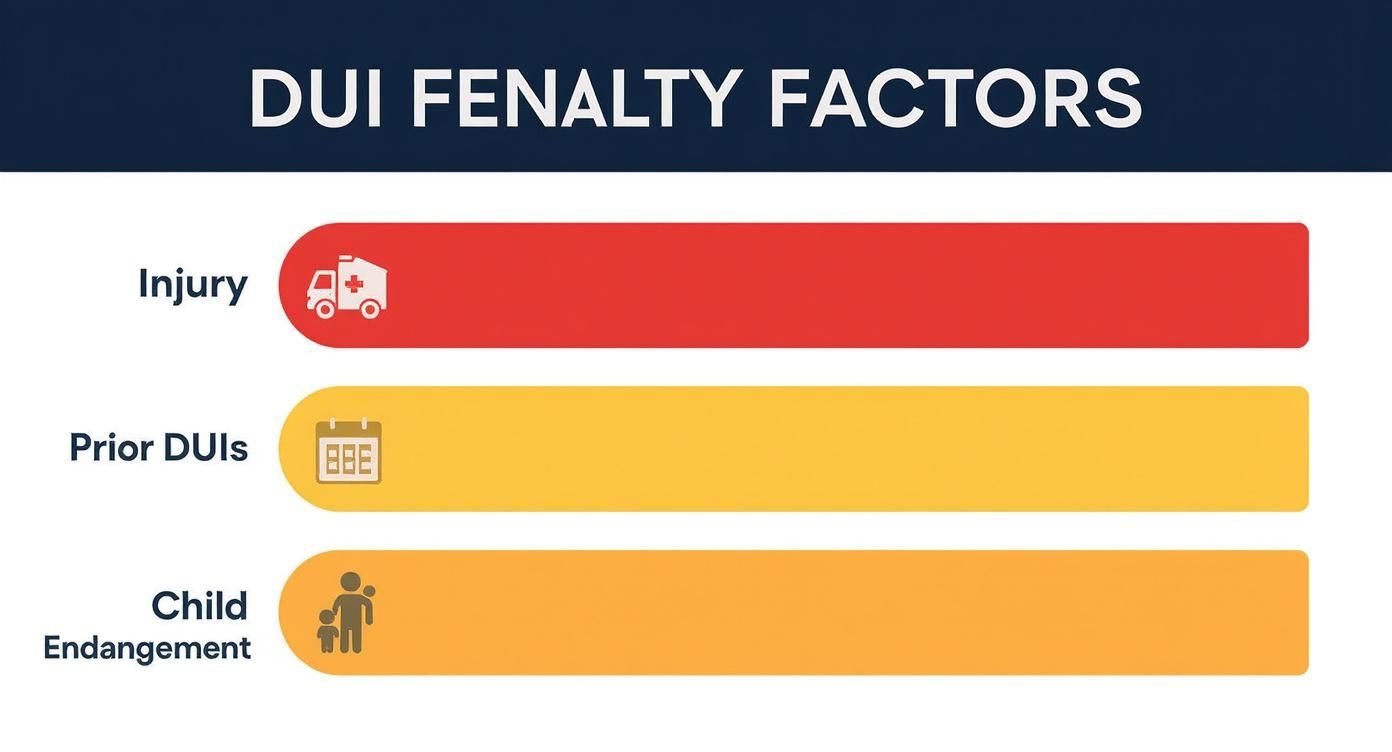
As the chart illustrates, causing an injury or having a history of prior DUIs are the two most dominant triggers for felony charges nationwide.
State-by-State Felony DUI Thresholds
When you start comparing state statutes side-by-side, the differences become glaring. In Texas, for instance, a third DUI is typically charged as a felony, carrying a potential prison sentence of two to ten years.
Let’s put these variations into perspective with a few more examples:
- California: A fourth DUI within a 10-year period is a felony. A DUI causing injury can also become a felony, even on a first offense.
- Florida: A third DUI within 10 years or a fourth DUI overall qualifies as a third-degree felony.
- New York: A second DUI conviction within 10 years is classified as a Class E felony.
The following table offers a comparative glance at just how much these critical thresholds can differ across jurisdictions.
Felony DUI Thresholds in Select US States
A comparative look at what triggers a felony DUI charge in different states, focusing on repeat offenses and other common factors.
| State | Felony Trigger (Repeat Offense) | Injury or Death Classification | Lookback Period |
|---|---|---|---|
| California | 4th Offense | Felony Wobbler (Injury); Felony (Death) | 10 Years |
| Texas | 3rd Offense | Felony (Serious Injury or Death) | Lifetime |
| Florida | 3rd Offense within 10 years, or 4th overall | Felony (Serious Injury or Death) | Lifetime |
| New York | 2nd Offense | Felony (Serious Injury or Death) | 10 Years |
| Arizona | 3rd Offense | Felony (Injury or Death) | 7 Years |
This table underscores why a one-size-fits-all defense strategy is doomed to fail. As these laws are constantly evolving, staying informed is non-negotiable. You can learn more by exploring some of the new DUI laws of 2025 and how they might affect future cases.
Understanding the specific lookback period and repeat offense threshold in your state is the first step in assessing the true legal risk of a DUI charge. A miscalculation here can have severe, long-lasting consequences.
Ultimately, the geographic location of an arrest is a primary determinant of its severity. The arbitrary nature of state lines does little to soften the harsh reality that a drive across a border can fundamentally alter the legal jeopardy you face.
The Life-Altering Consequences of a Felony DUI

A felony DUI isn’t just a more serious traffic ticket. It’s a seismic legal event that permanently redirects the course of a person’s life. The consequences aren’t temporary setbacks; they are a cascade of severe, lasting penalties that infiltrate every corner of your personal and professional world.
These consequences split into two clear categories. First are the direct criminal penalties handed down by the court—the prison time and fines meant to punish the offense. Second are the collateral consequences, the shadow penalties that follow you long after your official sentence has been served.
Direct Criminal Penalties
When a DUI crosses the line into felony territory, the punishments escalate exponentially. The court’s focus shifts from rehabilitation to severe punishment, a direct reflection of the offense’s gravity. These penalties are harsh, often mandatory, and designed to send an unmistakable message.
The most immediate and frightening penalty is prison. Unlike a misdemeanor, which might land you in county jail for a few months, a felony DUI conviction often means a long-term sentence in a state prison. We’re talking years, not months, especially if the incident involved serious injury or a fatality.
Beyond prison, the financial hit is staggering. Fines for a felony DUI can easily soar into the tens of thousands of dollars, making misdemeanor fines look trivial. On top of that, the court will order a long-term, and sometimes permanent, revocation of your driver’s license.
A felony DUI conviction is a permanent mark. In most states, it cannot be expunged or sealed from your criminal record. This means it will surface on every background check for the rest of your life, creating a perpetual barrier to opportunities.
The Lasting Collateral Consequences
The fallout from a felony DUI extends far beyond the courtroom. These collateral consequences, sometimes called the “civil death” of a felony conviction, can be just as devastating as the criminal penalties themselves—and they are almost always permanent.
One of the most profound impacts is the loss of fundamental civil rights. As a convicted felon, you will almost certainly lose:
- The Right to Vote: Many states strip felons of their voting rights, sometimes for life.
- The Right to Own a Firearm: Federal and state laws almost universally ban convicted felons from possessing firearms.
- The Right to Serve on a Jury: A felony conviction typically means a lifetime disqualification from jury duty.
Professionally, the damage can be catastrophic. Many licensed professions—including law, medicine, finance, and even real estate—have strict character and fitness standards that a felony conviction immediately violates. This can trigger the revocation of a professional license or block you from ever obtaining one in the first place.
Navigating a Future with a Felony Record
The challenges don’t end there. A felony record creates immense hurdles in day-to-day life. Landlords frequently deny housing applications to convicted felons, and employers across nearly every industry are understandably hesitant to hire someone with that kind of history. If you are not a U.S. citizen, a DUI a felony conviction is often classified as an aggravated felony, which can trigger mandatory deportation.
Understanding these lifelong impacts is critical. The legal battle is the immediate fire, but the long-term repercussions require a forward-thinking strategy. For those facing such a charge, exploring ways to clear their record is a natural next step, though rarely an option for felonies. You can learn more about whether you can get a DUI off your record and the immense challenges involved. Ultimately, a felony DUI isn’t just a legal outcome; it’s a complete redefinition of your future.
How a Defense Is Built Against a Felony DUI

Walking into court facing a felony DUI can feel like the fight is already lost, but a charge is a long way from a conviction. An elite legal defense isn’t just about showing up; it’s about systematically dismantling the prosecution’s case, piece by piece, until reasonable doubt is all that remains.
The entire process starts where the incident began: the traffic stop. A strong defense scrutinizes the legality of that initial interaction with law enforcement. If the officer didn’t have a legitimate reason or probable cause to pull you over, everything that followed—the field sobriety tests, the breathalyzer, the arrest itself—could be deemed inadmissible.
This is the “fruit of the poisonous tree” doctrine in action, a fundamental principle in criminal defense. Any evidence gathered from an illegal stop is tainted and can often be thrown out, sometimes causing the state’s entire case to crumble before it ever gets to a jury.
Questioning the Evidence
Beyond the stop itself, every shred of evidence the prosecution presents has to be challenged. This is where deep technical and scientific knowledge separates a standard defense from a sophisticated one, especially when it comes to chemical tests.
- Breathalyzer Calibration: Was the breathalyzer device properly maintained and calibrated according to strict protocols? A skilled attorney will subpoena the machine’s maintenance logs, looking for any inconsistencies that could invalidate the reading.
- Blood Test Procedures: Who actually drew the blood, and were they qualified? More importantly, was the blood sample handled and stored correctly to prevent contamination or degradation, which can artificially inflate the BAC reading?
- Chain of Custody: The prosecution must prove the blood sample was securely handled from the moment it was drawn to the second it was tested. Any break or gap in this chain of custody can make the results completely unreliable.
A top-tier legal team also investigates the arresting officer’s actions with a fine-toothed comb. Were the field sobriety tests administered exactly according to standardized guidelines? Were you properly read your rights? Every deviation from protocol is a potential weakness that can be used to challenge the officer’s testimony and the evidence they collected.
A successful felony DUI defense is almost always won in the details. It’s about uncovering the small but critical procedural mistakes, scientific flaws, or rights violations that were overlooked. When freedom and reputation are on the line, this obsessive level of detail is the only acceptable standard.
Building a Proactive Counter-Narrative
Finally, a truly robust defense does more than just poke holes in the prosecution’s story; it builds its own compelling counter-narrative. This could mean presenting dashcam footage that contradicts the officer’s report, finding eyewitnesses who tell a different story, or introducing medical records that show a pre-existing condition that could easily be mistaken for impairment.
Ultimately, defending against a DUI a felony requires a multi-pronged strategy that attacks the state’s case from every conceivable angle. It demands a sophisticated understanding of constitutional law, forensic science, and police procedure. For anyone facing charges of this magnitude, learning how to choose the right attorney for your case is the single most important decision you’ll make. The right legal mind can spot the vulnerabilities in the prosecution’s case and build a defense designed to protect your future.
A Look at Severe Drunk Driving on the Global Stage
To truly understand the weight of a felony DUI charge in the United States, it helps to look beyond our own borders. While American laws are tough, the fundamental idea—treating severe drunk driving as a serious crime—is a global standard. Looking at how other nations handle these offenses gives us crucial context and shows just how universally unacceptable this behavior is.
Different countries have their own legal philosophies, but the goal is always the same: to protect the public from a completely preventable tragedy. The specific penalties might differ, but the message is crystal clear worldwide.
A Global Perspective on DUI Penalties
Around the world, the response to a severe or fatal drunk driving incident is almost always harsh. In most developed nations, a fatal crash caused by an impaired driver isn’t just a traffic violation; it’s prosecuted as a major criminal act, much like manslaughter or vehicular homicide here in the US.
The statistics tell a grim story. In Europe, an estimated 25% of all road deaths are linked to alcohol. South Africa faces some of the highest rates of fatal crashes tied to alcohol consumption. And in Great Britain, fatal accidents involving drunk drivers shot up by more than 15% between 2018 and 2021. You can explore more global data on this issue at jmw.co.uk.
The global consensus is clear: when impaired driving leads to catastrophic outcomes, the legal response must be severe. This shared philosophy underscores why felony DUI laws in the U.S. are designed to impose life-altering consequences on the most dangerous offenders.
For instance, countries with very low tolerance for drunk driving often enforce penalties that include:
- Mandatory jail or prison time for any offense that results in injury or death.
- Extremely high fines, which can be calculated as a percentage of the offender’s income.
- Long-term or permanent license revocations to keep dangerous drivers off the road for good.
This comparative view makes it obvious that holding dangerously impaired drivers accountable with felony charges is not some uniquely American approach. It’s part of a worldwide effort to combat a behavior that needlessly destroys lives. The aggressive prosecution of these cases in the U.S. simply reflects a legal and ethical standard recognized by responsible nations everywhere. This broader perspective helps clarify why the line between a misdemeanor and a felony is drawn so sharply—and defended so fiercely.
Your Pressing Questions About Felony DUIs
When you’re facing a potential felony DUI, the questions come fast and carry immense weight. Below, we cut through the legal jargon to provide clear answers to the most urgent concerns.
Can a First-Time DUI Really Be a Felony?
Yes, absolutely. While most first-offense DUIs are charged as misdemeanors, certain severe circumstances can elevate even a first-time arrest to a felony. This isn’t a common scenario, but it’s a devastatingly real one.
The most frequent trigger is an accident causing serious bodily injury or death. In these tragic situations, the driver’s impairment is viewed as the direct cause of the harm, prompting prosecutors to pursue severe charges like vehicular assault or manslaughter, regardless of the driver’s clean prior record. A handful of states might also escalate a first offense for other extreme factors, such as having a child in the vehicle or registering an exceptionally high BAC.
How Long Does a Felony DUI Stay on Your Record?
For life. A felony DUI conviction becomes a permanent part of your criminal record in nearly every jurisdiction. Unlike lesser offenses, these convictions are almost never eligible for expungement or record sealing.
This means the conviction will surface on virtually all background checks—indefinitely. It creates lifelong hurdles to employment, professional licensing, housing, and even international travel. A felony record is a permanent shadow that follows you.
The finality of this record is one of its most punishing consequences, truly underscoring the gravity of the charge and the necessity of a formidable defense.
What Is DUI Manslaughter?
DUI Manslaughter is precisely what it sounds like: a severe felony charge brought when an impaired driver causes a fatal accident. It is one of the most serious driving-related crimes anyone can face, often carrying the potential for decades behind bars.
Jurisdictions may use different legal terms—like Vehicular Homicide—but the essence of the charge is identical. The prosecution’s goal is to draw a direct line from a person’s death to the driver’s decision to get behind the wheel while under the influence. Their case hinges on proving the driver’s impairment was the primary cause of the fatal crash.
When facing a charge as serious as a felony DUI, securing elite legal representation is not a luxury—it’s a necessity. The Haute Lawyer Network is a curated directory of the nation’s most respected attorneys, selected for their professional excellence and proven results. Our platform connects you with premier legal professionals who can protect your future. Find the right attorney for your case by visiting us at https://hauteliving.com/lawyernetwork.