So, do you need a lawyer for small claims court? The honest, albeit frustrating, answer is: it depends.
While the system is intentionally designed for you to represent yourself, the decision to bring in legal counsel really comes down to the complexity of your case, how much is on the line, and—critically—whether your opponent has lawyered up. For many, a quick consultation is the secret weapon that provides a decisive edge.

Making the Call on Legal Help
Deciding whether to hire an attorney for a small claims dispute can feel like a high-stakes judgment call. On one hand, the court’s simplified procedures are meant to help individuals and businesses resolve conflicts without plunging into costly, full-blown legal battles.
On the other hand, a simple procedural misstep or a poorly structured argument can sink your case before it even gets going, wasting both your time and money. The goal isn’t just to show up; it’s to build a winning case.
This means you need to understand the basic rules of evidence, present a clear and persuasive story, and be ready for whatever the other side throws at you. An attorney’s guidance here can be invaluable, even if they never set foot in the courtroom.
Why Even Brief Advice Matters
Historical data really drives this point home. A landmark study of small claims cases uncovered an astonishing trend: plaintiffs who got any kind of pretrial help—whether from a lawyer or even a paralegal—achieved a 100% victory rate.
Success wasn’t tied to their wealth or education; it was directly linked to preparation. You can dive deeper into these findings on the importance of pretrial guidance. What this proves is that the game-changer isn’t necessarily having a lawyer argue for you in court, but having one help you polish your strategy beforehand.
When to Consider a Lawyer: A Quick Decision Guide
To help you make a smart call, we’ve put together a quick-glance table. It breaks down common scenarios to help you assess whether going it alone, booking a one-off consultation, or hiring full representation is the right move for your situation.
| Scenario | Go Pro Se (Self-Represent) | Consult an Attorney | Hire an Attorney |
|---|---|---|---|
| Claim is small (<$2,000) and straightforward | ✅ | ||
| Opponent has hired an attorney | ✅ | ✅ | |
| Case involves a complex contract or technical evidence | ✅ | ✅ | |
| You are the defendant facing a significant claim | ✅ |
Think of this as your initial gut check. If your situation falls into the “Consult” or “Hire” columns, it’s a strong signal that professional advice could be the difference between winning and walking away with nothing.
Navigating the Small Claims Court Arena
It’s tempting to think of small claims court as a sort of “court lite”—a simplified version of a traditional courtroom. In reality, it’s a highly specialized venue designed for one thing: resolving financial disputes quickly and efficiently, without the crushing expense and procedural headaches of higher courts. This streamlined design is precisely why the system exists—to be accessible enough for individuals and businesses to represent themselves.
But “accessible” should never be mistaken for simple. The single most important rule is the jurisdictional limit, which dictates the absolute maximum amount of money you can recover. This isn’t a suggestion; it’s a hard ceiling, and it varies dramatically from one state to the next.
State-by-State Monetary Limits
This financial cap is the first hurdle. If your claim exceeds it, you’re in the wrong place, and your case will be dismissed outright. Understanding these limits isn’t just procedural; it’s a strategic necessity.
The differences between states can be staggering:
- California: An individual can sue for up to $12,500, but a business is capped at just $6,250.
- New York: The limits are much more modest, typically between $3,000 and $5,000, depending on the specific city or town court.
- Texas: Justice Courts, the state’s small claims equivalent, permit claims up to a much higher $20,000.
- Florida: The small claims threshold is set at $8,000.
These numbers define the battlefield. If a client owes you $15,000 for a project in California, you can’t file in small claims court without agreeing to waive your right to the extra $2,500. That’s a significant financial haircut and a decision that often benefits from professional legal advice.
The Typical Disputes You’ll Encounter
While the fact patterns are endless, the disputes themselves usually fall into a handful of familiar categories. These are the everyday financial conflicts that are perfectly suited for this expedited process.
Small claims court is the express lane for civil justice. It’s built for straightforward disputes where the issue is money owed or property lost—not complex legal arguments.
You’ll most often see cases involving:
- Breach of Contract: A freelance consultant isn’t paid after delivering on a project, or a high-end contractor fails to complete a home renovation as specified in the agreement.
- Property Damage: A neighbor’s tree falls and damages your custom landscaping, or a valet service scrapes the side of your luxury vehicle.
- Security Deposit Returns: A landlord on a high-end rental property unlawfully withholds your security deposit after you’ve moved out.
- Unpaid Invoices: A business client simply refuses to pay for services rendered or goods delivered, leaving you with an outstanding debt.
Grasping these core elements—the monetary limits and the common case types—gives you a clear map of the landscape. It helps you determine if small claims is the right venue for your dispute and sets the stage for the crucial decision: whether you should navigate it alone.
Calculating the Real Cost of Legal Counsel

When considering a lawyer for small claims court, the decision often boils down to a simple cost-benefit analysis. But a truly strategic analysis goes far beyond the sticker price of legal fees.
Think of it as calculating your potential “return on legal investment” (ROLI). The objective isn’t merely to win; it’s to ensure your net recovery makes the entire endeavor worthwhile.
An attorney’s fee might seem disproportionate against a small claim, but in certain situations, that expense is precisely what prevents a total loss. This is especially true when navigating a complex business contract or facing a well-prepared opponent. The right counsel can maximize what you recover, shield you from aggressive counterclaims, and most importantly, save you invaluable time.
Breaking Down Attorney Fee Structures
Understanding how attorneys charge is the first step in calculating your ROLI. Their fee model directly impacts your final take-home amount, so it’s essential to know the common structures you’ll encounter. You can learn more about how much a lawyer costs in our detailed guide, but here are the primary models relevant to small claims.
- Hourly Rate: You pay the attorney for every hour they spend on your case. This is common for consultations or coaching sessions where you simply need strategic advice before representing yourself.
- Flat Fee: A single, predetermined price for a specific service, like drafting a demand letter or preparing you for your court appearance. This offers cost certainty, which is ideal for budgeting.
- Contingency Fee: The attorney takes a percentage of the amount you recover, but only if you win. This model is less common in small claims because the potential recovery is low, but it may be an option for certain cases.
The most critical question is not “Can I afford a lawyer?” but rather, “Can I afford to lose this case?” For a business, a loss isn’t just about the money; it’s about precedent, reputation, and time diverted from core operations.
Attorney Fee Structures vs Potential Claim Recovery
The table below illustrates how different fee models can affect your net recovery. It’s a simplified breakdown to help you visualize the financial trade-offs.
| Fee Structure | Typical Cost/Percentage | Best For Claims of… | Key Consideration |
|---|---|---|---|
| Flat Fee | $500 – $2,500 | $3,000 – $7,500 | Provides cost predictability. Ideal when you want a defined service like case review or document preparation without open-ended hourly billing. |
| Hourly Rate | $250 – $500+/hr | $5,000 – $10,000+ | Best for complex cases requiring ongoing strategic guidance, but costs can escalate. Use for limited-scope representation or coaching. |
| Contingency | 30% – 40% | $7,500 – $10,000+ | Aligns the attorney’s incentive with yours. Less common in small claims but may be viable if the case is strong and the amount is high. |
This comparison highlights that the right fee structure depends entirely on your specific circumstances—the amount at stake, the complexity, and your tolerance for financial risk.
When Are Legal Fees Justified
The justification for hiring an attorney hinges on the amount at stake versus the complexity of the case. A simple, undisputed $1,000 claim for an unpaid invoice likely doesn’t warrant several hundred dollars in legal fees. You could easily spend more on the lawyer than you stand to gain.
Conversely, consider a $7,500 dispute over a breach of a service agreement with multiple technical clauses. Here, an attorney’s fee is a sound investment. They can dissect the contract, formulate a strong legal argument, and dismantle any technical defenses the other party might raise.
In this scenario, the lawyer’s fee protects a substantial sum and dramatically increases the odds of a full recovery, delivering a strong ROLI. The key is to weigh the legal cost against the very real risk of losing everything.
Gaining a Decisive Edge with an Attorney
While cost is always a consideration, the real question is more fundamental: how important is it that you win? Hiring an attorney isn’t just about getting advice; it’s about deploying a powerful tactical advantage that can fundamentally alter the outcome of your case. Think of it as bringing a grandmaster to a high-stakes chess match.
You know the facts of your case inside and out. But a lawyer knows the rules of the game—the procedural tripwires, the evidentiary standards, and the subtle art of persuasion that resonates with a judge. Their involvement elevates your case from a simple recitation of events into a compelling legal narrative designed to win.
The Statistical Power of Representation
This advantage isn’t just theoretical; the numbers tell a stark story. Data from Florida’s small claims system reveals a dramatic shift in outcomes when a lawyer is involved. Self-represented individuals do well against their peers, winning 64% of the time. But that success rate plummets to just 31% when they face an opponent with an attorney.
Conversely, parties with legal counsel achieve an impressive 78% win rate against those going it alone. This isn’t a minor edge—it’s a game-changing disparity driven by an attorney’s mastery of procedural rules and evidence. You can see a deeper breakdown of these small claims statistics and what they mean for your case. Suddenly, the legal fees start to look less like an expense and more like a strategic investment.
Dismantling Weak Arguments with Legal Precision
Let’s ground this in a real-world scenario. Imagine you run a boutique marketing agency and a former freelance contractor sues you for $10,000. The contractor claims you withheld payment for work that was never approved and failed to meet the quality standards in your agreement.
Without counsel, you might show up with a folder of emails and project notes, hoping the judge sees things your way. It becomes a classic “he said, she said” situation.
An experienced attorney approaches this with surgical precision. They would:
- File a Motion to Dismiss: If the contractor’s claim is legally flawed from the start, a lawyer can move to have it thrown out before you ever see the inside of a courtroom.
- Conduct Targeted Discovery: They can legally compel the contractor to produce specific documents or communications that prove the work was substandard or that they violated key terms of the contract.
- Craft a Legal Argument: Instead of just saying “the work was bad,” a lawyer argues a “material breach of contract“—a precise legal doctrine that invalidates the contractor’s right to payment.
This is the difference between simply telling your story and methodically dismantling your opponent’s case. An attorney applies legal principles to protect your finances and your business’s reputation. In these situations, legal counsel isn’t a safety net; it’s your most effective weapon.
Strategies for Winning Before and After Court
Securing a favorable verdict in small claims court might feel like the end of the road, but it’s often just the halfway point. A judgment in your favor is a piece of paper, not cash in hand. The real victory is actually collecting the money you’re owed, a process that demands a smart approach both before you ever file and long after the judge has ruled.
This is where thinking like a lawyer becomes critical. Before you even set foot in a courthouse, an attorney can run a quick asset check on the other party. It’s a simple but vital step that answers one question: can they actually pay you? There’s no point in spending time, money, and energy to win a judgment against someone with no collectible assets.
The Problem of the Uncollectible Judgment
Winning your case but never seeing a dime is an incredibly common and frustrating outcome. It’s not just a feeling; the data is stark. Federal court statistics show that self-represented plaintiffs win a final judgment only 3% of the time. The problem is even worse in small claims. Surveys out of New York show that while nearly 80% of claimants might “win,” a staggering 75% struggle to ever collect. You can read more about the pro se crisis and collection challenges to see just how widespread this issue is.
This is exactly why a pre-litigation strategy is so essential. An attorney helps you decide if the fight is even worth fighting from a purely financial perspective.
Exploring Powerful Alternatives to Court
Sometimes, the best move is to avoid the courtroom entirely. Mediation, for example, offers a confidential and collaborative way to resolve a dispute where a neutral third party helps you both find common ground and reach a settlement.
For businesses, mediation isn’t just about settling a bill; it’s about preserving a valuable relationship with a client or partner that litigation would almost certainly destroy. It gives you a level of control over the outcome that you completely surrender in a courtroom.
Mediation saves an immense amount of time and money, and the final agreements are just as legally binding as a court order. It provides a clear path to resolution without the adversarial nature of a trial, which can be easily delayed if the other side knows how to ask for a continuance in court.
Post-Judgment Collection Tools
If a lawsuit is your only option and you do secure a judgment, an attorney then becomes your enforcement arm. They have access to powerful legal tools designed specifically to turn that paper victory into actual funds—tools that are nearly impossible for an individual to navigate alone.
An attorney can effectively use:
- Wage Garnishments: A court order sent to the defendant’s employer, requiring them to withhold a portion of their earnings and send it directly to you.
- Bank Levies: An order that allows you to seize funds directly from the defendant’s known bank accounts to satisfy the judgment.
- Property Liens: A legal claim placed on the defendant’s real estate, which ensures you get paid before the property can ever be sold or refinanced.
These tools transform a passive judgment into an active collection campaign, dramatically increasing your odds of a full financial recovery.
Your Final Decision Checklist
Making the final call on whether to hire a lawyer for small claims court comes down to a clear-eyed assessment of your situation. This isn’t just about the dollar amount on the table; it’s a strategic decision that balances cost, complexity, and the immense value of your own time.
To move forward with confidence, you need to work through a few critical questions. Your answers will illuminate the most logical path, whether that means confident self-representation, a strategic one-time consultation, or bringing in full legal counsel to protect your interests.
Core Questions to Guide Your Decision
- What is the true value of my claim? Look beyond the simple dollar amount. Are there business principles or critical relationships at stake? Sometimes, winning a case is essential for setting a precedent.
- How complex is the evidence? A case built on a single unpaid invoice is one thing. A dispute revolving around a multi-page contract filled with technical clauses demands a completely different level of expertise.
- Does my opponent have a lawyer? If the other side has retained counsel, you are at an immediate and significant tactical disadvantage. Statistics consistently show this single factor can dramatically shift the odds.
- What is my time actually worth? Be honest and calculate the hours you’ll pour into preparing documents, researching court procedures, and attending hearings. For most business owners and high-net-worth individuals, that time is far more profitably spent elsewhere.
This flowchart helps visualize the path your case might take, from initial dispute resolution options all the way through the collection process.
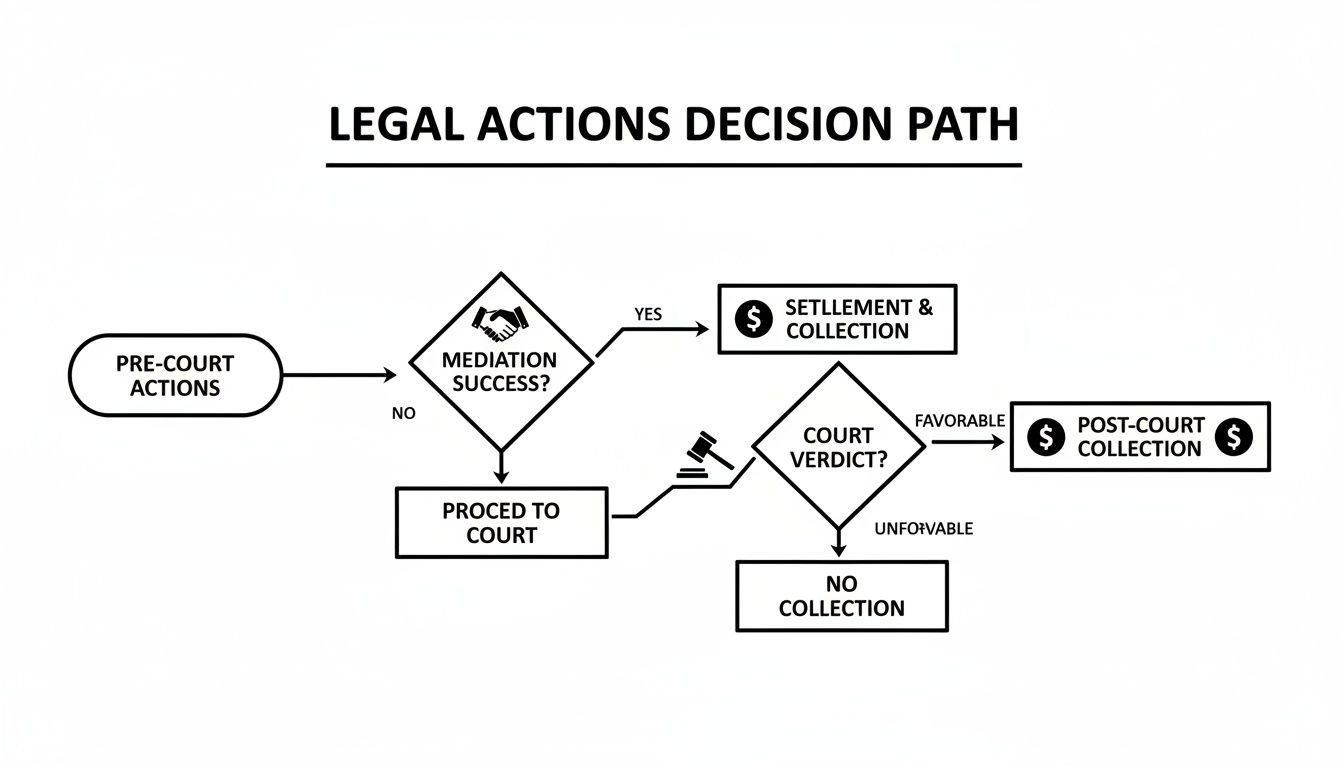
As the chart makes clear, the legal process extends far beyond the verdict. A successful outcome often hinges on post-judgment actions like collections, a phase where professional guidance can be invaluable.
Key Questions for a Potential Attorney
If your self-assessment points toward getting legal help, the next step is finding the right expert. A brief consultation can be incredibly revealing, so prepare yourself by learning the most effective questions to ask a lawyer during an initial meeting.
A productive legal consultation isn’t about getting free advice. It’s an interview to determine if an attorney possesses the specific experience and strategic mindset required to win your case.
When you speak with them, be ready with targeted questions:
- What is your specific experience with cases like mine in this particular small claims court?
- Based on what I’ve shared, what is your frank assessment of my case’s strengths and weaknesses?
- What is your recommended strategy, and what are the estimated costs for your services—whether for a brief consultation or for full representation?
Common Questions from the Courtroom Floor
When deciding whether to bring in counsel for small claims court, business owners and individuals often run into the same practical questions. Here’s a look at the most common scenarios.
Can I Sue for the Maximum If My Damages Are Higher?
No. This is a hard-and-fast rule of small claims court. To file, you must agree to waive any amount over the court’s jurisdictional limit.
For instance, if your actual damages total $12,000 but the court’s ceiling is $10,000, you are legally forfeiting that extra $2,000. The trade-off is clear: you accept a smaller, faster recovery in exchange for avoiding a much costlier and more complex battle in a higher civil court.
What Happens If I Lose My Case?
If you’re the plaintiff and you lose, the case is effectively over. You can’t refile the same claim, and your options to appeal are usually very limited, if they exist at all.
As the defendant, however, a loss is a different story. It results in a legally enforceable judgment against you. If you fail to pay, the plaintiff can initiate serious collection actions, including wage garnishments or bank levies, which can cause significant damage to your credit and financial standing.
An attorney can be invaluable here, either to identify potential grounds for an appeal or to step in and negotiate a more manageable post-judgment settlement.
Can a Non-Attorney Employee Represent My Business?
The answer depends entirely on your state’s laws, and getting it wrong can be a fatal procedural error.
Some jurisdictions are flexible, allowing an officer or a designated employee to represent a corporation or LLC. Others are rigid, demanding that any business entity—other than a sole proprietorship—must be represented by a licensed attorney. Misinterpreting this rule can get your case thrown out before you even have a chance to argue its merits.
Protecting your interests requires access to premier legal expertise. The Haute Lawyer Network is a curated directory of top-tier attorneys, selected for their professional excellence. We provide unparalleled visibility, connecting you with the legal leaders your situation demands. Explore the Haute Lawyer Network today to find the right counsel for your case.