
When you face a divorce, the very first decision you make—how to approach it—can define the entire experience. It’s a choice between cooperation and conflict, a fork in the road that leads to vastly different emotional and financial outcomes.
On one path is mediation, a private, collaborative process where you and your spouse sit down with a neutral professional to negotiate your own settlement. On the other is litigation, a formal, public court battle where a judge imposes the final decisions upon you.
The path you choose isn’t just a legal formality; it’s a statement about how you intend to close one chapter of your life and begin the next.
Choosing Your Path in a Divorce
Understanding the core philosophy behind mediation and litigation is the first step. Are you looking to maintain control and find common ground, or do you need a judge to intervene and issue a binding ruling?
Divorce mediation is built on the principle of self-determination. It puts you and your spouse in the driver’s seat, empowering you to craft everything from property division to co-parenting schedules. This all happens behind closed doors, offering a confidential space to work through sensitive issues without public scrutiny.
Litigation is the opposite. It’s an adversarial system bound by rigid court rules and procedures. It becomes necessary when one party refuses to negotiate in good faith, or when serious issues like domestic violence or hidden assets demand a judge’s intervention. Here, your attorneys present arguments, and a judge makes the final call.
Key Philosophical Differences
The distinction isn’t just about process; it’s about purpose. Mediation is designed to foster open communication and find creative, custom-fit solutions for your family’s future. Litigation, by its very nature, is a zero-sum game focused on winning arguments based on past events.
The goal of mediation is to find a mutually acceptable solution. The goal of litigation is for one side to win. This fundamental difference in purpose transforms the entire experience of a divorce.
This choice has a profound impact on your post-divorce relationship, especially when children are involved. A cooperative settlement process can lay a healthy foundation for co-parenting. An adversarial court battle, however, often leaves behind a trail of resentment that can last for years. Before you commit to a path, it’s crucial to find a lawyer who aligns with your approach and can offer personalized advice.
Comparing the Core Approaches
To see these differences in action, here’s a high-level breakdown of what to expect from each path:
| Aspect | Divorce Mediation | Divorce Litigation |
|---|---|---|
| Control | You and your spouse make all final decisions together. | A judge has the final say and issues binding orders. |
| Privacy | The process is completely private and confidential. | Proceedings and records are public. |
| Pace | You set the schedule, often resolving issues in weeks or months. | The court’s calendar dictates the timeline, often taking years. |
| Focus | Collaborative problem-solving and future-focused planning. | Proving your case and focusing on past grievances. |
A Step-by-Step Comparison of Each Process
To really grasp the difference between divorce mediation and litigation, you have to look beyond simple definitions and see them as two completely different journeys. Each path has its own distinct sequence of events, and that sequence determines your level of control, privacy, and day-to-day involvement from start to finish. The procedural steps alone reveal the fundamental divide between collaborative problem-solving and an adversarial court battle.
The Divorce Mediation Process Unpacked
Mediation is a structured yet flexible process built to empower you and your spouse. It’s a series of private, guided meetings with a neutral professional steering the conversation.
- Selecting a Mediator: This is a joint decision. You and your spouse must agree on a neutral third-party mediator whose experience and approach feel right for your situation.
- Initial Sessions: The process often kicks off with individual meetings, giving each spouse a chance to privately share their perspective with the mediator. This is usually followed by joint sessions where you, your spouse, the mediator, and sometimes your respective attorneys are all present.
- Information Gathering: Forget the formal, often combative “discovery” of litigation. Mediation relies on a cooperative exchange of financial documents and other necessary information. Honesty here is the foundation of a workable agreement.
- Negotiation and Problem-Solving: With the mediator facilitating, you and your spouse tackle the key issues—asset division, spousal support, parenting plans—and explore potential solutions together. The mediator doesn’t make decisions; they help you find common ground.
- Drafting the Agreement: Once you’ve reached a consensus on all points, the mediator drafts a Memorandum of Understanding (MOU). This document simply details all the terms you’ve agreed upon.
- Legal Review and Finalization: Each of you should have your own independent attorney review the MOU. Once everyone approves, the document is converted into a legally binding marital settlement agreement, which is then filed with the court to finalize the divorce.
The Divorce Litigation Process Explained
Litigation is a formal, public, and often painfully long path dictated entirely by court rules and schedules. It’s an adversarial process where each side’s attorney works to convince a judge that their position is the correct one.
- Filing a Petition: One spouse, the “petitioner,” files a formal petition for divorce with the court. This legal document is then served to the other spouse, the “respondent,” which officially starts the lawsuit.
- Formal Discovery: This is a prolonged and often contentious phase. Each side uses legal tools like depositions, interrogatories, and subpoenas to demand information and evidence from the other. It can feel invasive and drags on for months.
- Pre-Trial Motions and Hearings: Throughout the case, attorneys file various motions asking the judge to make temporary orders on custody, support, or who gets to stay in the marital home. This can mean multiple court appearances before a trial is even on the horizon.
- Settlement Negotiations: Believe it or not, most litigated cases (over 90%) still settle before trial. The catch is that these negotiations often happen under the intense pressure of an impending court date, and only after significant time and money have already been spent.
- Trial: If you can’t reach a settlement, the case goes to trial. Both sides present evidence and witnesses, and a judge makes the final, binding decisions on every unresolved issue.
- Final Judgment: The judge issues a final divorce decree that lays out their rulings. This judgment is a public record and can be appealed, which could drag the process out even longer.
The process you choose dictates who is in control of the outcome. Take a look at this high-level breakdown of the key procedural differences.
Key Procedural Differences: Mediation vs. Litigation
| Aspect | Divorce Mediation | Divorce Litigation |
|---|---|---|
| Control | You and your spouse retain control over the decisions and final outcome. | A judge holds the ultimate decision-making power. |
| Privacy | The process is private and confidential. Nothing is public record. | Court proceedings and the final judgment are public record. |
| Timeline | Driven by the couple’s ability to schedule meetings and agree. | Dictated by the court’s calendar and legal deadlines. |
| Communication | Direct, facilitated communication between spouses is central to the process. | Communication primarily happens through attorneys; direct contact is limited. |
| Outcome | A mutually agreed-upon settlement customized to your family’s needs. | A binding court order that may not reflect either party’s preferences. |
Ultimately, these differences in procedure aren’t just about logistics—they directly impact the finality, cost, and emotional toll of the divorce.
The most significant procedural difference lies in who holds the power. In mediation, you and your spouse are the architects of your own agreement. In litigation, you hand that decision-making power over to a judge who does not know you or your family.
This chart visualizes the stark differences in cost, time, and satisfaction that result from these distinct processes.
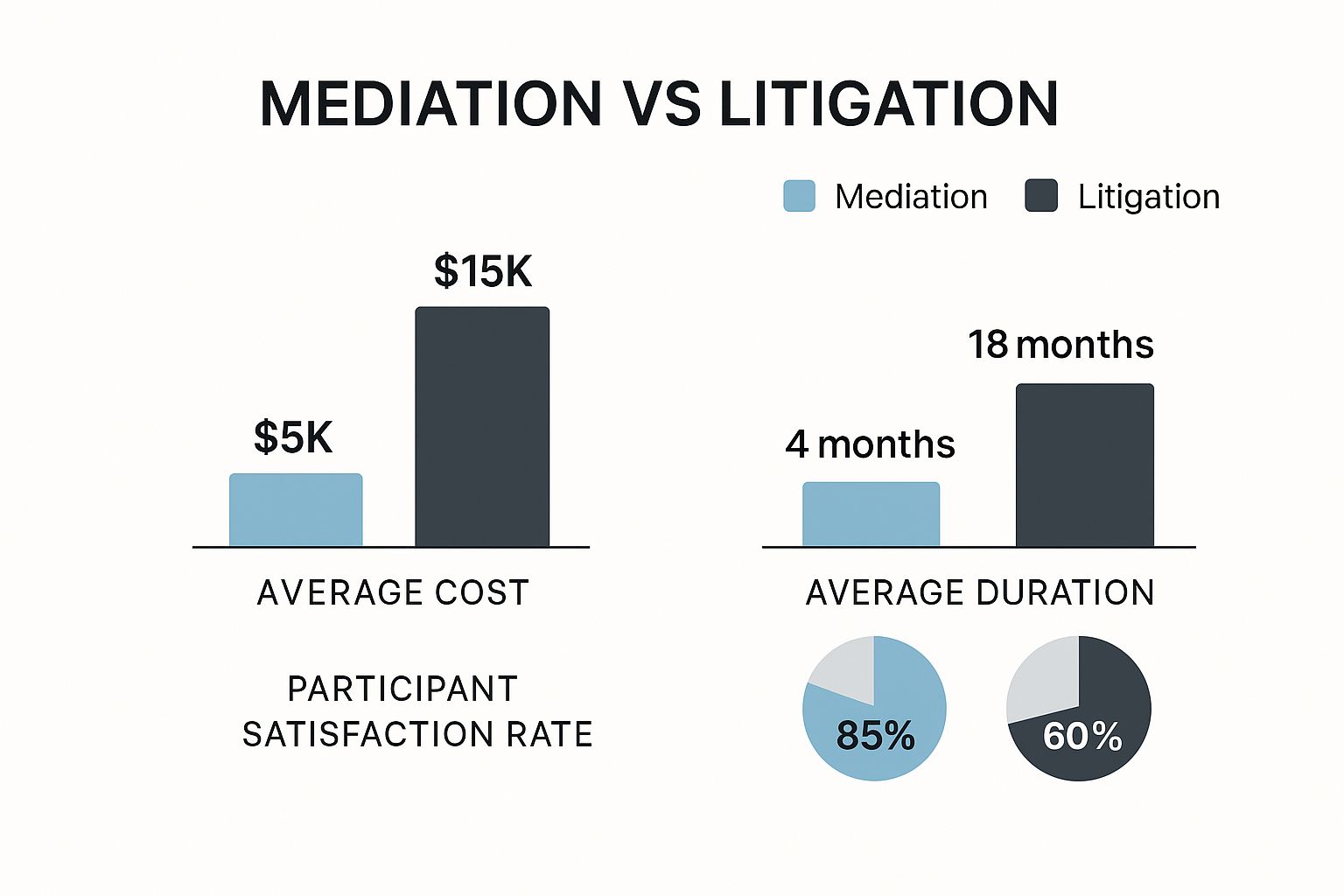
The data speaks for itself. Mediation is consistently not only faster and more affordable but also leads to outcomes that people are far more satisfied with in the long run.
The True Financial and Emotional Costs of Divorce
When choosing between divorce mediation and litigation, you’re not just selecting a legal process; you’re deciding on a path that will profoundly shape your financial and emotional future. This is where abstract legal concepts become tangible realities—measured in dollars drained from your accounts and sleepless nights. The real cost of a divorce isn’t just the final legal bill; it’s the cumulative toll of every financial blow and emotional wound suffered along the way.

Unpacking the Financial Burden
The financial gap between mediation and litigation isn’t just a gap—it’s a chasm. The disparity comes down to the number of professionals billing for their time. Mediation is built for efficiency; litigation is structured for battle.
In a typical mediation, you and your spouse share the cost of one neutral mediator. Expenses are largely predictable: the mediator’s hourly rate plus the time required to draft a final agreement. There are no surprise expert witness fees or staggering bills for court filings.
Litigation, on the other hand, creates a costly financial ecosystem that can quickly spiral.
- Dual Attorney Retainers: Each spouse must hire their own attorney, often with upfront retainers costing thousands of dollars apiece.
- Escalating Billable Hours: Every email, phone call, and document from two separate legal teams is billed, causing costs to mount exponentially.
- Expensive Discovery: Formal discovery—the process of gathering evidence—is incredibly expensive, involving fees for depositions, subpoenas, and extensive document requests.
- Expert Witness Fees: Need a forensic accountant, a property appraiser, or a child custody evaluator? Each expert adds another significant layer of expense.
This financial drain isn’t a short-term problem. A contentious litigated divorce can easily deplete savings, retirement funds, and home equity, leaving both parties financially crippled as they attempt to start over.
The financial model of litigation is inherently adversarial. It creates a system where prolonged conflict directly translates to higher legal fees for everyone involved, except the clients.
The Emotional Toll of the Process
Just as the financial outcomes differ, so does the emotional impact. The structure of each process either mitigates or inflames the inherent stress of ending a marriage.
Mediation offers a private, controlled setting designed to de-escalate conflict. The mediator guides productive conversations, helping spouses articulate their needs without resorting to accusations. This collaborative approach can preserve a degree of mutual respect—an invaluable asset for future co-parenting.
Litigation, by its nature, is an adversarial system that often turns spouses into enemies. The process demands a focus on past grievances to build a legal case, poisoning any goodwill that may have remained.
- Loss of Control: In court, a judge—a stranger to your family—makes life-altering decisions about your children and your finances.
- Public Exposure: Your personal conflicts, financial details, and parenting disputes become part of the public record, open for anyone to see.
- Prolonged Uncertainty: The court dictates the timeline, which can stretch for years, trapping you in a constant state of anxiety and stress.
This sustained conflict inflicts lasting emotional scars on both adults and children, making it difficult to heal. The fallout from a bitter court battle can damage relationships and mental well-being long after the divorce decree is signed.
Efficiency and Success Rates
The structural differences also lead to vastly different timelines. Statistically, mediation is far more efficient, with around 70-80% of mediated cases reaching a successful settlement. This often happens within a few sessions over several days.
In contrast, litigation can drag on for months or even years due to court backlogs and procedural requirements like filing lawsuits, discovery, and waiting for trial dates. This time difference is critical, as lengthy litigation only serves to amplify legal fees and emotional strain.
For high-net-worth individuals, the stakes are exponentially higher, as complex assets can make litigation impossibly expensive and emotionally destructive. To understand these unique challenges, you might want to learn more about why ultra-wealthy families need sophisticated family law counsel. The choice between these paths can mean the difference between preserving wealth and watching it vanish into legal fees.
How Your Choice Impacts Children and Co-Parenting
For parents going through a divorce, no decision feels heavier than how it will affect their children. The choice between mediation and litigation isn’t just about legal tactics; it’s a choice that defines your co-parenting relationship for years to come. The path you take now sets the tone for your family’s future and directly shapes the environment your children will grow up in.

Mediation, at its core, is designed to preserve the co-parenting relationship. It brings both parents to the table to make decisions together, reinforcing the fact that you’re still a parenting team, even if you’re no longer married. This collaborative approach helps dismantle the destructive “us vs. them” mentality.
Litigation, on the other hand, is an adversarial process by nature. It often forces parents into opposing corners, where each side is incentivized to highlight the other’s faults to “win” on issues like custody. This can permanently poison any remaining goodwill. Children are incredibly perceptive and absorb this tension, which often leads to anxiety and painful loyalty conflicts.
Crafting Child-Focused Parenting Plans
One of the biggest wins for mediation is the power it gives you to create a truly customized parenting plan. You and your co-parent know your children’s schedules, personalities, and needs better than anyone else—certainly better than a judge. Mediation empowers you to design a plan that genuinely works for your unique family.
This process opens the door to creative solutions a court would never think to impose:
- Flexible Schedules: You can design holiday schedules that honor specific family traditions or build in automatic adjustments to parenting time as your kids get older.
- Detailed Co-Parenting Rules: Get ahead of future arguments by agreeing on guidelines for everything from introducing new partners to managing screen time consistently across both homes.
- Future-Focused Problem Solving: Your plan can include a clear process for how you’ll resolve disagreements down the road, preventing a return to conflict.
In contrast, litigation almost always ends with a standardized, court-ordered parenting plan. A judge, who has limited time and knows very little about your family, imposes a rigid schedule. These one-size-fits-all orders rarely align with your children’s best interests or your work lives and often become a new source of conflict.
The core difference is empowerment versus imposition. Mediation empowers you to be the architects of your family’s future, while litigation results in a future imposed upon you by the court system.
The Long-Term Impact on Co-Parenting
The ripple effects of your choice last long after the divorce is finalized. The communication skills and mutual respect developed in mediation lay a healthy foundation for years of successful co-parenting. When you learn how to solve problems together during the divorce, you’re far better equipped to handle the challenges that will inevitably pop up as your children grow.
A litigated divorce, however, frequently leaves a toxic legacy of bitterness and mistrust. After spending months or even years in a legal battle, it’s incredibly difficult to suddenly switch to a cooperative co-parenting dynamic. This lingering animosity can turn every school play, holiday, and schedule change into another fight, with your children stuck in the middle.
Ultimately, the choice between mediation and litigation has a profound and lasting impact on your children’s well-being. By choosing a path that prioritizes cooperation, you’re making a direct investment in a more peaceful and stable future for them. Understanding the nuances of family law and its specialists can provide the clarity needed to make the best decision during this challenging time.
When to Choose Mediation vs. When Litigation Is Your Only Option
Choosing between divorce mediation and litigation isn’t just about preference. It’s a strategic decision rooted in the hard realities of your relationship, finances, and ability to cooperate. There’s no single “right” answer—the best path is the one that fits your family’s specific dynamics.
A clear-eyed assessment of your situation is the first step. Understanding the ideal scenarios for each approach will give you the confidence to choose a process that truly protects your interests.
Ideal Scenarios for Divorce Mediation
Mediation works best when there’s a foundation of mutual respect and a shared goal of reaching a fair agreement. You don’t have to be friends, but you do need to be able to communicate without the conversation completely breaking down. It’s the right choice for couples who want to keep control of their own outcome.
Consider mediation your best bet when these conditions are in place:
- You Can Communicate Respectfully: You can sit in a room together and tackle tough subjects without it turning into a shouting match. Finding a workable solution is more important to both of you than “winning.”
- Both Parties Want Control: You and your spouse would rather design your own settlement—from the parenting plan to asset division—than let a judge who doesn’t know you make those calls.
- There is Financial Transparency: You are both committed to putting all financial cards on the table, honestly and voluntarily. Trust in the numbers is non-negotiable for mediation to succeed.
- Prioritizing Children’s Well-being: Your main objective is to shield your kids from conflict and establish a co-parenting relationship that can last for years to come.
Mediation is for couples who, despite everything, can still act like business partners to dissolve their marriage. They’re ready to build a future, not fight over the past.
Even in high-conflict divorces, mediation can provide a constructive path forward. Research shows that a controlled mediation environment can de-escalate tensions, whereas the court system often fuels hostility. This is especially true when complex assets are involved. You can find more insights on managing high-conflict cases at JAMS.
When Litigation Becomes Unavoidable
While mediation is often preferable, it’s not always appropriate or safe. Litigation, for all its costs and stress, serves a vital purpose: it provides legal protection and judicial authority when cooperation is off the table.
Sometimes, the courthouse is the only place that can enforce the rules and protect someone who is vulnerable.
Litigation is less of a choice and more of a necessity in certain situations. A court’s power is essential when you’re facing issues that mediation simply isn’t designed to handle safely or effectively.
These red flags almost always mean litigation is the only way forward:
- Presence of Abuse or Domestic Violence: In cases with a history of physical, emotional, or financial abuse, the power imbalance is too severe for fair negotiation. The court’s legal protections are critical for the victim’s safety.
- A Refusal to Participate: If one spouse refuses to negotiate, ignores all attempts at communication, or stonewalls the process, litigation may be the only tool to compel a response and move forward.
- Suspected Hidden Assets: When you believe your spouse is hiding money or property, the formal discovery process of litigation—including subpoenas and depositions—is the only way to uncover the truth. Mediation’s reliance on voluntary disclosure makes it useless against deceit.
- Significant Power Imbalances: This could mean one spouse is a financial expert while the other knows nothing about the family’s assets, or one partner uses intimidation to control the other. A judge and dedicated legal counsel are needed to level the playing field.
- Complex Legal Disputes: If your divorce involves thorny legal arguments, like challenging a prenuptial agreement or fighting over whether an asset is marital or separate property, you’ll likely need a judge’s final ruling.
Opting for litigation in these cases isn’t a failure. It’s a necessary move to secure a just, safe, and legally binding resolution when the situation demands the authority only a court can provide.
The Global Trend Toward Amicable Divorce Resolutions
When you’re weighing divorce mediation against litigation, it’s not just a personal choice—it’s a decision that lines up with a major global shift in family law. Across the world, legal systems are finally catching on to the immense value of resolving disputes amicably, stepping away from the often destructive, traditional courtroom model. This isn’t about choosing an “alternative” path anymore; it’s about embracing what has become a modern, mainstream, and highly effective approach.
This worldwide movement is fueled by a simple truth: litigation clogs court systems and, more importantly, often leaves families worse off. By making mediation a core part of the process, these systems are offering a more efficient and humane way to handle divorce. It reinforces that collaborative problem-solving isn’t a compromise—it’s simply a better way to navigate one of life’s most difficult transitions.
A Worldwide Embrace of Mediation
This isn’t just happening in one or two countries. Over the past 50 years, mediation has become a cornerstone of justice systems around the globe, giving families a powerful option to avoid a court battle. Look at Indonesia, a country with one of Asia’s highest divorce rates. Mediation is now formally built into their legal process through court-annexed programs. This growing reliance makes it clear: the world is moving away from purely litigious solutions. You can dig deeper into the global rise of mediation in family law to see the full scope of its impact.
Understanding this broader context should give you immense confidence in your decision. When you choose mediation, you’re not going out on a limb. You’re selecting a method that is respected by legal professionals and has been proven to deliver better outcomes for families everywhere.
The global adoption of mediation validates what countless families discover on their own: a cooperative approach to divorce is not only possible but is often the most intelligent and compassionate choice for everyone involved.
Ultimately, this global perspective confirms that opting for mediation is a strategic, forward-thinking decision. It puts control back where it belongs—in your hands—and aligns your divorce with a modern understanding of what actually helps families heal and move forward. This bigger picture validates the power of working together to build a new future.
Key Questions on Divorce Mediation and Litigation
Making the right choice between mediation and litigation often comes down to a few critical questions. For families facing this transition, understanding the nuances can mean the difference between an amicable resolution and a protracted court battle.
What Happens if Mediation Fails?
It’s a common and valid concern: what if you invest time in mediation, but you and your spouse simply can’t agree on everything? You aren’t locked into a failed process.
If you can’t find a consensus, you don’t lose the progress you’ve made. The unresolved issues simply move to litigation, where a judge will make the final decision. This hybrid approach often saves significant time and money, as you only litigate the specific points of contention rather than the entire divorce.
Do I Still Need My Own Attorney for Mediation?
Absolutely. It is a mistake to enter mediation without your own independent legal counsel. A mediator’s role is to be a neutral third party who facilitates discussion; they cannot and will not give legal advice to either side.
Your attorney is your advocate. They are the only person in the room whose sole responsibility is to protect your legal rights, analyze the fairness of proposed settlements, and ensure the final agreement is airtight.
The mediator guides the negotiation, but your attorney protects your interests. An agreement reached without expert legal review can have disastrous long-term financial consequences.
How Can I Best Prepare for a Successful Mediation?
The efficiency and success of mediation often hinge on preparation. Arriving at the table with organized information and clear goals drastically reduces conflict and streamlines the entire process.
To ensure your sessions are productive from day one, you should:
- Compile a Complete Financial Picture: Gather all statements for assets and debts. This includes bank accounts, investment portfolios, retirement funds, mortgages, and credit card balances.
- Draft a Post-Divorce Budget: Project your future living expenses. This exercise is crucial for creating a realistic foundation for discussions around spousal support and child support.
- Identify Your Priorities: Understand what is non-negotiable for you and where you have room to compromise. Clarity on this point makes negotiations far more effective.
Walking in prepared allows you to focus on productive, informed decision-making instead of scrambling for information.
The single most important decision in any divorce is securing the right legal representation. The Haute Lawyer Network is an exclusive, curated directory of premier attorneys, each selected for their proven professional excellence. Connect with a top-tier legal professional who can protect your interests by visiting The Haute Lawyer Network.