
It’s a common point of confusion, even among professionals, but the distinction between a “lawyer” and an “attorney” boils down to one critical qualification: the authority to practice law. In simple terms, a lawyer is an individual who has completed law school and holds a law degree. An attorney is a lawyer who has taken the next step—passing a state bar exam—and is licensed to represent clients in a legal capacity.
Defining The Core Distinction Between Lawyer And Attorney

While these terms are often swapped in everyday conversation, their technical meanings are precise and carry significant weight in the legal world. This difference is not just semantics; it’s a crucial distinction for anyone seeking representation, as only one of these titles grants the power to act on your behalf.
The journey starts with becoming a lawyer. This path requires years of intense academic study, culminating in a Juris Doctor (J.D.) degree. A person at this stage has a deep understanding of legal theory but is not authorized to give legal advice or appear in court for a client.
To make the leap from lawyer to attorney, one must pass a rigorous state bar examination. This demanding test evaluates their command of state-specific laws and professional ethics. Upon passing, they are admitted to the bar, officially becoming an “attorney-at-law.”
The critical takeaway is that while every attorney is a lawyer, not every lawyer is a licensed attorney. This licensure is the official green light to practice law.
Understanding this difference is the first step toward making a smart decision when you need legal help. To dive deeper into the qualities that set top-tier legal professionals apart, you can explore our guide on what makes a good lawyer.
Lawyer vs Attorney At a Glance
The table below breaks down the fundamental differences between the two roles, from qualifications to the authority they hold in the legal system.
| Attribute | Lawyer | Attorney |
|---|---|---|
| Primary Qualification | Holds a Juris Doctor (J.D.) degree from a law school. | Holds a J.D. degree and has passed a state bar exam. |
| Legal Authority | Can provide general legal information but not formal legal advice. | Licensed to provide legal advice and represent clients. |
| Court Representation | Cannot represent clients in legal proceedings or court. | Can appear in court and act as a client’s legal agent. |
| Professional Title | Referred to as a lawyer or law graduate. | Referred to as an attorney, counselor, or “Esquire” (Esq.). |
| Key Differentiator | Education without a license to practice. | Licensure and the legal right to practice law. |
Ultimately, when you need someone to advise you, draft legal documents, or stand for you in court, you are seeking the services of a licensed attorney.
A Look Back: The Historical Roots of Legal Titles
To truly understand the distinction between a lawyer and an attorney, you have to trace the terms back to their origins in English common law. The modern American legal system didn’t just appear out of thin air; it inherited a framework where legal professionals had very distinct, separate roles. This history is key to why the words, though often swapped in conversation today, carry precise legal weight.
Back in the English courts, the legal world was sharply divided. You had solicitors, who advised clients and prepared cases behind the scenes. Then you had barristers, the specialized advocates who had exclusive rights to argue those cases in the higher courts. This clear separation of duties created a functional divide that the U.S. legal system would later merge.
America’s Consolidation of Legal Power
As the American colonies developed their own legal frameworks, they took a more streamlined approach. Instead of maintaining the English split between solicitors and barristers, the U.S. opted for a unified professional. A single individual—the attorney—was empowered to manage every facet of a client’s legal needs, from providing counsel to arguing in the courtroom.
This merger is the single biggest reason why “lawyer” and “attorney” are so closely linked in the American vocabulary. The formal title, “attorney-at-law,” was created to signify this consolidated authority to act as a client’s agent in all legal matters. It marked a deliberate break from the fragmented English system, creating a more versatile and comprehensive legal professional.
The historical context reveals a deliberate evolution. The American system unified fragmented legal roles, empowering a single, licensed “attorney” with the full authority to represent clients—a standard that remains fundamental today.
In essence, “lawyer” historically described someone educated in the law, while “attorney” was reserved for the individual formally appointed to act on another’s behalf. This distinction was incredibly important in the early United States, where the new professional class of licensed attorneys quickly rose to become influential figures in society and government.
From Legal Education to Political Clout
The prestige of being a licensed attorney skyrocketed during the 19th century, with legal professionals playing a central role in shaping the nation’s political landscape. This elite status was impossible to ignore, reflected in their overwhelming presence in government. For instance, by the late 1800s, nearly 80% of all members of the U.S. Congress were lawyers.
This staggering figure highlights the authority and societal trust placed in those who were not just educated in the law but were officially licensed to practice it. While that percentage has since moderated, the deep-rooted link between the legal profession and public service remains. You can review research on the professional backgrounds of Congress members to explore this trend further. This legacy underscores exactly why verifying an attorney’s credentials is so critical for clients who demand the highest standard of representation.
The Path from Law Graduate to Licensed Attorney
The leap from holding a law degree to practicing as a licensed attorney is a demanding, highly regulated process. It starts in the classroom, but it certainly doesn’t end there. The first required step is earning a Juris Doctor (J.D.) degree from a law school accredited by the American Bar Association (ABA), which provides the foundational knowledge of legal theory and procedure.
But a J.D. alone doesn’t grant anyone the right to appear in court or represent a client. It simply makes someone a “lawyer” in an academic sense. To become an “attorney,” that individual must gain formal admission to a state bar, the official governing body for the legal profession in that jurisdiction. This is where the real vetting begins.
The Bar Exam and Character Assessment
The bar examination is the centerpiece of this transition. It’s a notoriously difficult, multi-day ordeal designed to test a candidate’s grasp of a massive body of law. The exam combines multiple-choice questions, essays, and performance tests that simulate the kind of work a practicing attorney handles daily.
Passing the bar is a huge academic hurdle, but it’s not the only one. Every applicant also undergoes a comprehensive character and fitness evaluation. State bar associations conduct a deep dive into an applicant’s background, searching for anything that might compromise their integrity or ethical standing. This ensures only those deemed morally fit are given the immense responsibility of representing clients.
Becoming an attorney is a two-fold validation. The bar exam confirms legal knowledge, while the character and fitness review confirms ethical integrity.
This rigorous standard is essential as the profession grows and diversifies. Women now represent 38% of all lawyers in the United States, a monumental shift from less than 4% back in 1960. As demographics continue to evolve, with female attorneys making up a majority in younger age brackets, the legal field is expanding its pool of highly qualified, vetted professionals. You can explore the data on women’s rising role in the legal profession to see just how significant this trend is.
State-Specific Licensure and Ethical Obligations
Bar admission is fiercely jurisdictional. An attorney licensed in Florida can’t simply hang a shingle in Texas. Each state has its own distinct laws, and an attorney must be licensed in the specific jurisdiction where they intend to practice.
Once admitted, an attorney is bound by a strict code of professional conduct and legally enforceable ethical duties. This includes the fiduciary duty to always act in their client’s best interests. State bars actively police their members, investigating complaints and disciplining those who violate these sacred rules. This is precisely why verifying an attorney’s license and good standing with their state bar is a non-negotiable first step for any client.
When You Need an Attorney, Not Just a Lawyer
Understanding the distinction between a lawyer and an attorney stops being a simple vocabulary lesson and becomes a critical decision the moment real-world legal stakes are on the table. While a lawyer has valuable academic knowledge, their authority has clear limits. It’s the licensed attorney who is legally empowered to stand in your corner and act on your behalf.
This difference is everything in any scenario requiring official legal action. Facing litigation? You need an attorney to represent you in court. Drafting a will, negotiating a high-value business contract, or filing for a patent? You need an attorney to ensure those documents are legally sound and, more importantly, enforceable.
These aren’t tasks for someone who simply has a law degree; they are the exclusive domain of a practicing attorney admitted to the bar.
This decision tree clearly illustrates the essential journey from legal education to licensed legal practice.
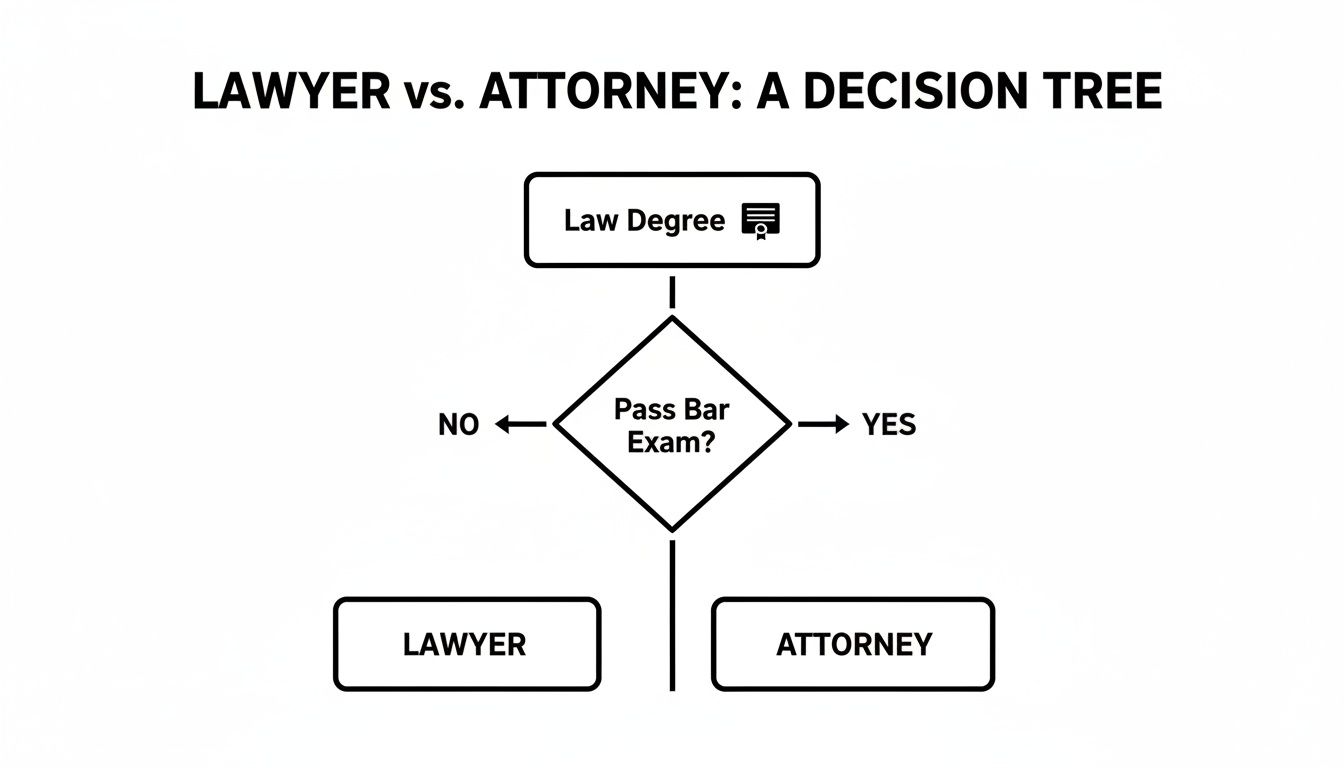
The key takeaway is that passing the bar exam is the non-negotiable step that transforms a lawyer’s potential into an attorney’s authority.
When Legal Representation Is Non-Negotiable
Engaging someone who isn’t a licensed attorney for tasks requiring one can have disastrous consequences, from voided contracts to forfeited legal rights. The unauthorized practice of law isn’t just a bad idea—it’s illegal and exposes you to significant risk.
Consider these clear-cut scenarios where only an attorney will do:
- Court Proceedings: Only a licensed attorney can argue your case before a judge, file motions, and manage the complexities of litigation. This applies across the board, from criminal defense and civil lawsuits to sensitive family court matters.
- Official Legal Advice: An attorney is ethically and legally bound to provide advice that serves your best interest. This protection, including the sacred attorney-client privilege, is a cornerstone of our legal system. You can explore the protections offered by attorney-client privilege in our detailed guide.
- Executing Binding Documents: Whether it’s a multi-million-dollar real estate transaction, a corporate merger, or a complex generational trust, an attorney’s signature and oversight are what validate the process and make it official.
Hiring a professional for legal representation isn’t just about credentials; it’s about securing a fiduciary who is legally and ethically bound to protect your interests. An attorney has this duty—a lawyer does not.
The Role of Non-Practicing Lawyers
So, where does that leave lawyers who are not practicing attorneys? Their legal education is still incredibly valuable in many professional settings where they aren’t required to represent clients directly. These roles often include:
- Legal Consulting: Providing general analysis on business strategy or policy without crossing the line into specific legal advice.
- Academia: Working as law professors or researchers, contributing to legal scholarship and shaping the next generation of legal minds.
- Policy Advising: Helping shape legislation and policy within government agencies or non-profit organizations.
- Compliance Officers: Ensuring a corporation adheres to a labyrinth of industry regulations.
The growth of the legal profession in the U.S. has solidified the attorney’s central role. The number of lawyers grew from 542,205 in 1980 to over 1.1 million by 2005, with a staggering 75% working in private practice as licensed attorneys handling complex client matters. This trend underscores the market’s demand for authorized representation, especially as litigation has become more complex and costly.
Before you hire anyone for a legal matter, always ask this simple question: “Are you a licensed attorney in good standing with the state bar?” It’s your first and most important line of defense.
Connecting with Vetted Attorneys Through Haute Lawyer

Knowing the difference between a lawyer and an attorney is the first step. For high-net-worth individuals, entrepreneurs, and families, what comes next is far more critical: finding the right one to represent your interests.
When the stakes are this high, a standard directory search simply won’t cut it. This is precisely where a curated, invitation-only network provides an undeniable advantage.
The Haute Lawyer Network was created to cut through the noise and simplify this high-stakes vetting process. We grant exclusive access to an elite group of licensed attorneys who have already been carefully screened for professional excellence, unimpeachable ethical standing, and proven leadership in their fields. This isn’t just about checking a box for credentials; it’s about confirming a consistent history of success.
More Than a Directory—An Ecosystem of Excellence
Think of Haute Lawyer as more than just a list of names. It’s a curated ecosystem that showcases the legal world’s top minds through high-authority editorial features and premium brand positioning. This approach resonates with a discerning clientele that expects exceptional quality in every aspect of their professional lives.
Our platform gives attorneys visibility that actually mirrors their level of expertise, connecting them directly with an audience that recognizes and values their caliber. It’s our way of ensuring that when you explore our network, you are reviewing professionals who are not only licensed attorneys but are also recognized authorities in their practice areas.
For discerning clients, the assurance of quality is paramount. A curated platform like Haute Lawyer removes the guesswork by presenting only pre-vetted, top-tier attorneys who have met a stringent standard of excellence.
This process ensures the professional you engage is an attorney in the truest sense of the word—licensed, respected, and ready to advocate for your interests. You can learn more by exploring our guide on how to find an attorney who is the right fit for your unique needs. By connecting with our network, you are taking the most direct path to securing proven legal talent.
Common Questions Answered
Even after clarifying the fundamental concepts, certain practical questions always seem to surface. Here are direct answers to the most common queries we see, designed to give you the clarity needed to make sound decisions.
Can a Person with a Law Degree Give Me Legal Advice?
Absolutely not. While someone with a law degree certainly understands legal concepts, they are not licensed to practice law. Providing specific counsel tailored to your situation is a regulated activity, and doing so without a license is considered the “unauthorized practice of law”—an illegal act in every U.S. state.
A law school graduate might offer general information as a consultant or policy advisor. However, they cannot form an attorney-client relationship, represent you in court, or advise you on a specific legal strategy. For protected, actionable counsel, you must engage a licensed attorney.
What Does the Title Esquire or Esq. Mean?
The title “Esquire,” often abbreviated as “Esq.,” is a formal honorific used in the United States to signify that an individual is a licensed attorney. It’s a professional designation that confirms the person has not only earned a law degree but has also passed a state bar exam and is legally authorized to practice law.
You would never attach “Esq.” to the name of someone who only holds a law degree. Seeing this title after a name on a business card or in an email signature is a reliable signal that you are dealing with a practicing attorney-at-law.
The “Esq.” title is more than just professional jargon; it’s a clear and immediate indicator of an individual’s legal authority to represent clients. It confirms they have met the rigorous state requirements to act as an attorney.
Do I Need an Attorney Licensed in My Specific State?
Yes, and this is a non-negotiable requirement. Bar admission is granted on a state-by-state basis for a critical reason: laws vary significantly between jurisdictions. An attorney licensed to practice in California, for example, cannot simply represent a client in a New York legal matter without securing special permission from the court.
This temporary permission, known as pro hac vice admission, is granted for a single, specific case. For any ongoing representation, your attorney must be fully licensed in the state where your legal issue resides. One of the very first questions you should ask any potential counsel is, “Are you licensed to practice in [Your State]?”
Verifying their license and confirming they are in good standing with that state’s bar association is a crucial step. It protects you from the serious risks of unauthorized practice and ensures your representative is accountable to local professional and ethical standards.
How Can I Verify if Someone Is a Licensed Attorney?
Fortunately, verifying an attorney’s credentials is a straightforward process. Every U.S. state maintains a bar association with a public online directory of all attorneys licensed to practice there. You can typically search for an individual using their name or bar number.
These directories provide mission-critical information, including:
- License Status: Confirming if their license is active, inactive, or has been suspended.
- Good Standing: Indicating whether they are in full compliance with all bar requirements.
- Disciplinary History: Revealing any public records of ethical violations or disciplinary actions.
This simple check is a vital part of your due diligence before engaging any legal professional. Platforms like Haute Lawyer add another layer of assurance by pre-vetting every attorney in their network, ensuring they not only meet but exceed the high standards of professional excellence and are in good standing with their respective state bars.
Finding a legal professional who is not just a licensed attorney but a recognized leader in their field is crucial. The Haute Lawyer Network simplifies this process by connecting you with a curated selection of pre-vetted attorneys who have demonstrated exceptional skill and integrity. Explore our network to find the right legal expert for your needs at https://hauteliving.com/lawyernetwork.