
When you’re facing a divorce, one of the first and most pressing questions is always the same: *What is this going to cost me?The average cost of a divorce in the U.S. hovers around $11,300, but that number is just a starting point. An amicable, uncontested split might only set you back $4,100, while a high-conflict case involving disputes over alimony or custody can easily climb past $15,000.
Understanding the Financial Reality of Divorce

The financial side of divorce can feel like staring down a long, uncertain road. Getting a handle on the key variables is the first step toward taking control. Think of it this way: a simple, uncontested divorce is like a straight shot on an open highway. It’s predictable and efficient. A contested divorce, however, is more like navigating a winding mountain pass full of unexpected turns and obstacles.
The single biggest driver of divorce costs is conflict. Every disagreement, every argument, every issue that has to be fought over translates directly into billable hours for legal professionals. Your final invoice is a direct reflection of the level of contention between you and your spouse.
The Spectrum of Divorce Costs
To give you a clearer picture, let’s break down the financial commitments based on the level of cooperation and the legal path you choose. The numbers tell a stark story about how quickly costs escalate when disagreements take over.
According to 2025 divorce cost statistics, the average divorce without alimony disputes comes in around $7,800. But once alimony becomes a point of contention, that average jumps to $15,900—a clear sign of the complexity and negotiation that contested issues demand.
Your level of cooperation is the most powerful tool you have for managing costs. The more you and your spouse can agree on outside of a courtroom, the more money you both keep in your pockets.
Here’s a quick look at what you can generally expect to pay based on the method you choose to resolve your divorce.
Estimated Divorce Costs by Method
This table breaks down the average cost ranges for the most common divorce resolution methods, highlighting how your approach directly impacts the final price tag.
| Divorce Type | Average Cost Range | Key Characteristics |
|---|---|---|
| DIY / Uncontested | $500 – $4,100 | Both parties agree on all major terms. Minimal attorney involvement is needed, making it ideal for simple cases with no children or significant assets. |
| Mediation | $3,000 – $8,000 | A neutral third-party mediator facilitates negotiations. It’s less adversarial, more private, and often faster than going to court. |
| Litigation (Contested) | $7,800 – $25,000+ | Each spouse retains their own attorney to argue their case in court, where a judge makes the final decisions. Costs escalate rapidly with disputes, discovery, and trial prep. |
Ultimately, the final price tag on your divorce isn’t a fixed number. It’s the direct result of the choices you and your spouse make. By understanding these financial realities from the start, you can better prepare for the road ahead and make decisions that protect your financial future.
Breaking Down the Bill: What You Actually Pay For
That final number on a divorce settlement can feel staggering, but it’s not some mysterious figure pulled from thin air. Think of it like a contractor’s invoice for a major home renovation—the total cost is built from distinct line items for labor, materials, and specialized services.
Understanding each of these components is the first step toward getting a handle on your budget and preventing some major financial surprises down the road.
The Core Expense: Attorney Fees
The biggest and most unpredictable expense will almost always be your attorney’s fees. When you hire a lawyer, you’re essentially putting their expertise on a meter, and that meter typically runs in two distinct ways.
Most divorce attorneys start with an upfront payment called a retainer. This is best understood as a down payment for future legal work, like pre-loading a debit card for your case. Your lawyer bills their time against this retainer as they handle calls, draft documents, and prepare for court.
Once that retainer is spent, you’ll usually be billed monthly at your attorney’s hourly rate. A 2025 analysis found the national average sits around $270 per hour, though this can swing dramatically based on your location and the lawyer’s experience. Every single phone call, email, court appearance, and document revision is tracked and billed, making your lawyer’s time the single most critical resource to manage.
The most effective way to control your legal spending is to be organized. Every minute you save your attorney by having your documents in order and your questions prepared is real money that stays in your bank account.
Beyond your lawyer’s time, the legal system has its own set of mandatory, non-negotiable fees. These are often the very first checks you’ll have to write.
- Court Filing Fees: This is the administrative cost to officially open your divorce case with the court. It usually runs between $100 to over $400, depending on your state.
- Service Fees: Your spouse must be formally notified that you’ve filed for divorce. This formal delivery, known as “service of process,” is often done by a sheriff or private process server and costs anywhere from $50 to $150.
The Expert Network: When You Need Specialists
While your attorney quarterbacks the legal strategy, complex divorces often require a team of specialists to provide clarity on specific issues. Each expert adds a layer of precision to your case—and another significant line item to your overall bill.
Hiring these professionals is like bringing in a master plumber or a structural engineer during that home renovation. They have critical skills your general contractor (your lawyer) doesn’t possess. Their expertise is absolutely essential for untangling complicated finances and ensuring every asset is valued correctly.
Here are some of the most common experts you might need on your team:
- Forensic Accountants: These are the financial detectives of the legal world. They trace money, uncover hidden assets, and make sense of convoluted financial histories—invaluable if you suspect your spouse isn’t being fully transparent.
- Property Appraisers: To fairly divide a family home or other real estate, you need to know exactly what it’s worth on the open market. A professional appraiser provides an official valuation for negotiations or court.
- Business Valuators: If a business is part of the marital estate, a specialist must be hired to determine its true value. This is a highly complex process and is non-negotiable for achieving a fair division of assets.
- QDRO Specialists: Retirement accounts like a 401(k) can’t just be split down the middle. They require a specific legal document called a Qualified Domestic Relations Order (QDRO). For a closer look at this process, you can learn how to split a 401(k) in a divorce in our detailed guide.
Choosing Your Path to Resolution
The road you take to finalize your divorce is one of the single most important decisions you’ll make. It directly impacts not just the final cost of divorce but your emotional health and the future of your co-parenting relationship.
Think of it as choosing between three very different routes to the same destination. Each has its own terrain, speed limit, and, of course, tolls. The three main paths are traditional litigation, cooperative mediation, and the team-based collaborative divorce model. Understanding the landscape before you start the journey is essential.
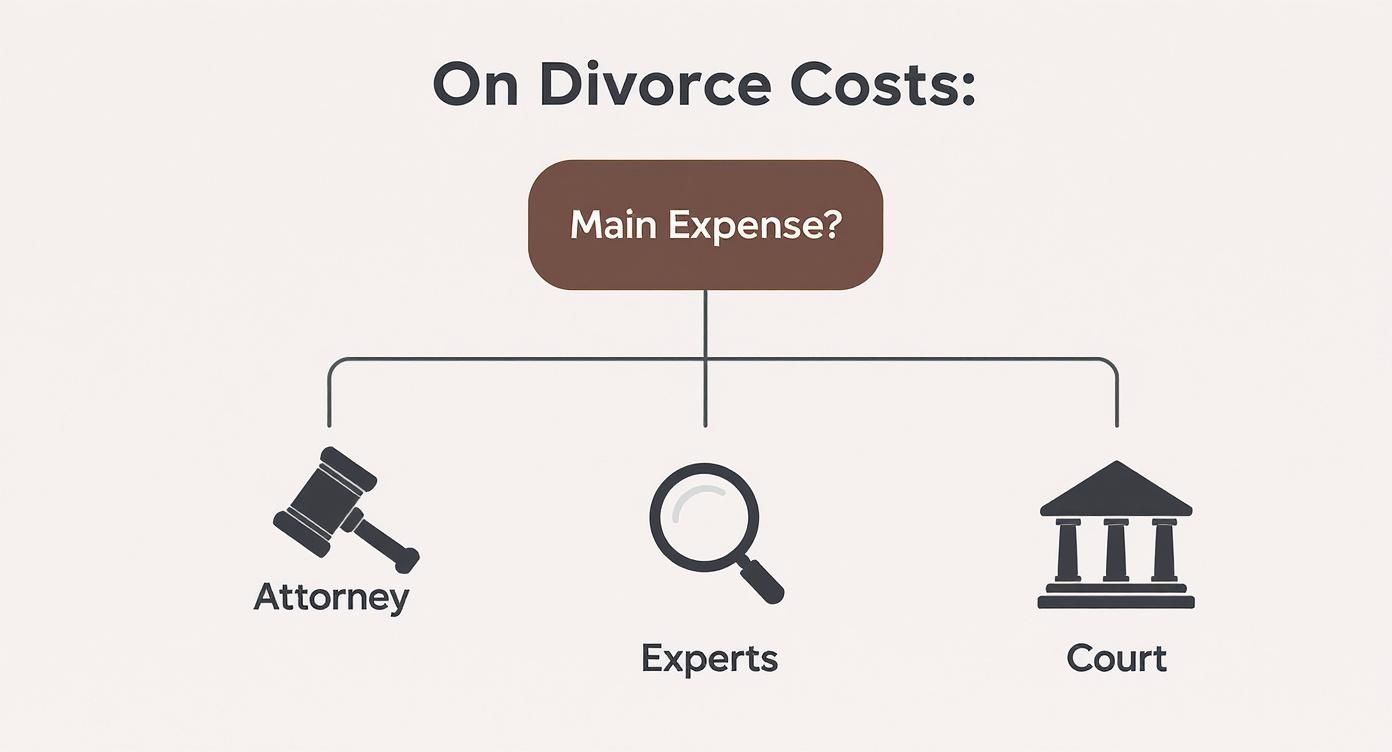
As you can see, your total bill is built on attorney fees, expert costs, and court expenses. The level of conflict between you and your spouse is the accelerator that determines how high each of those costs will climb.
Litigation: The Courtroom Battle
Litigation is what most people imagine when they hear the word “divorce.” It’s the classic, adversarial process where you and your spouse each hire lawyers to fight your case in front of a judge, who ultimately makes the binding decisions for you.
This path is almost always the most expensive and emotionally taxing. The process is bogged down by formal legal procedures, depositions, discovery, and multiple court hearings that can culminate in a full-blown trial. Every disagreement becomes a battle, sending legal fees soaring and often destroying any chance of a functional co-parenting relationship.
Sometimes litigation is unavoidable, especially in cases involving domestic abuse, hidden assets, or a spouse who simply refuses to negotiate. But make no mistake: it means handing over control of your family’s future to a stranger in a black robe.
Mediation: The Cooperative Negotiation
Mediation offers a completely different philosophy. In this scenario, you and your spouse jointly hire a single, neutral professional—the mediator—whose entire job is to help you have a productive conversation and negotiate your own agreement.
The mediator doesn’t take sides, give legal advice, or make any decisions for you. They are a guide, helping you identify the key issues, explore potential solutions, and find common ground. The process is completely confidential and voluntary, putting the power to decide your future back in your hands.
- Cost-Effective: Because you’re splitting the cost of one professional and avoiding the courtroom drama, mediation is drastically less expensive than litigation.
- Time-Efficient: Mediated divorces often wrap up in a few months, not years.
- Preserves Relationships: The cooperative spirit of mediation is invaluable for preserving a respectful co-parenting dynamic, which is priceless if you have children.
Collaborative Divorce: The Team-Based Approach
Collaborative divorce is a unique hybrid model. It gives you the support of your own individual attorney while maintaining a firm commitment to stay out of court. You, your spouse, and your specially trained collaborative lawyers all sign a binding contract to resolve every issue through a series of structured meetings.
The secret sauce is the “disqualification agreement.” If the process fails and one of you decides to go to court, both lawyers are fired and must withdraw from the case. This creates a powerful financial incentive for everyone to stay at the table and find a solution. The team often includes neutral financial experts and child specialists as well.
This process provides far more legal and emotional support than mediation but avoids the combative nature of litigation. The right path is the one that best fits your family’s unique situation.
To give you a clearer picture, here’s a side-by-side comparison of how these three methods stack up against each other.
Comparing Divorce Resolution Methods
| Factor | Litigation (Court) | Mediation | Collaborative Divorce |
|---|---|---|---|
| Control | A judge makes the final decisions. | You and your spouse control the outcome. | You and your spouse control the outcome. |
| Cost | Highest cost, often $50,000+ per person. | Lowest cost, typically $5,000 – $10,000 total. | Moderate cost, typically $25,000 – $50,000 total. |
| Timeline | Longest, often 18-36 months or more. | Shortest, often 3-6 months. | Moderate, often 6-12 months. |
| Privacy | Public record. | Completely private and confidential. | Completely private and confidential. |
| Attorneys | Adversarial; one for each spouse. | Neutral mediator; consulting attorneys optional. | Collaborative attorneys; one for each spouse. |
| Co-Parenting | Often damages the relationship severely. | Helps preserve a functional relationship. | Designed to protect the co-parenting relationship. |
Ultimately, choosing your path wisely is the first and most critical step in controlling the final cost of your divorce. For a more detailed breakdown, you can explore the key differences in divorce mediation vs litigation to see which approach might better serve your family’s needs.
The Long-Term Economic Impact of Divorce

The financial story of divorce doesn’t end when the final check clears. The immediate cost of divorce is really just the down payment on a much longer economic journey. Understanding these lasting ripple effects is the first step toward building a secure, independent future.
For most, the biggest shock is the sudden shift from a two-income household to a one-income reality. It can feel like your financial engine has been cut in half while your core expenses—housing, utilities, transportation—stay the same or even increase. This almost always forces a significant, and often jarring, drop in your standard of living.
This financial reset can hit the lower-earning spouse or a stay-at-home parent especially hard, particularly if they’re re-entering the workforce after a long absence. Rebuilding a career and clawing back to financial stability takes time, patience, and a solid game plan.
Your New Financial Baseline
Your post-divorce life operates on a completely new financial baseline. Forget the immediate legal bills; a whole host of ongoing and often unbudgeted costs will pop up, shaping your economic reality for years to come.
Many people get blindsided by the “hidden” expenses that emerge after the ink is dry on the divorce decree. These aren’t part of the formal settlement but are direct consequences of splitting one household into two.
Getting real about these future expenses is crucial for realistic budgeting:
- Setting Up a New Household: Think security deposits, utility connection fees, furniture, and all the basic household items you once shared. It adds up fast.
- Increased Childcare Costs: As a single parent, you may need more childcare coverage just to manage work and personal responsibilities.
- Therapy and Support: The emotional toll is real. Budgeting for therapy for yourself or your kids isn’t an indulgence; it’s a smart investment in long-term well-being.
- Career Setbacks: The time and stress of a divorce can tank your job performance or even force a career pause, leading to lost income and missed opportunities.
A Deeper Look at the Numbers
The economic fallout from divorce is profound and statistically significant. For families with children, the income hit can be severe. Research shows that formerly middle-income families can see up to a 50% drop in their household income post-divorce—a shift that sends shockwaves through their financial stability.
The financial disparity between genders post-divorce is a well-documented reality. Women, particularly those with children, often face a steeper economic decline and a longer road to recovery.
This financial strain isn’t distributed evenly. One recent study highlighted that about 27% of recently divorced women reported household incomes below $25,000, compared to just 17% of men in the same boat. This data underscores the unique vulnerabilities many women navigate as they transition to a single-income life. You can explore more findings about divorce costs and financial impacts to grasp the full scope of these challenges.
Adjusting to a New Lifestyle
This new financial reality almost always demands a major lifestyle adjustment. What was once easily affordable within a two-income budget may now be completely out of reach. It can be an emotional gut-punch, but it’s a necessary part of creating a sustainable financial future.
This adjustment period is all about making conscious, sometimes tough, choices about spending and saving:
- Revisiting Your Budget: Your pre-divorce budget is now obsolete. You must create a new, detailed budget based on your solo income. It’s non-negotiable.
- Downsizing: This might mean moving to a smaller place, driving a more modest car, or cutting back on discretionary spending like vacations and dining out.
- Long-Term Financial Planning: Divorce completely scrambles your retirement plans. You may need to ramp up savings contributions or push back your retirement timeline to compensate for divided assets.
Acknowledging these long-term economic impacts isn’t about dwelling on the negative. It’s about empowering yourself with knowledge to make smarter decisions, set realistic expectations, and proactively build a new foundation for financial security and independence.
Actionable Strategies to Reduce Divorce Costs
While you can’t eliminate the cost of divorce, you have far more control over the final number than you might realize. The most powerful tool for managing expenses isn’t aggressive legal tactics—it’s preparation, organization, and a commitment to cooperation whenever possible.
Think of your attorney’s time as a ticking clock. Every minute they spend chasing down a bank statement you could have provided, or clarifying details you failed to organize, is money straight out of your pocket. By taking charge of the process, you ensure every billable hour is spent on strategy, not administrative legwork.
Prepare Before You Pay
Your first meeting with an attorney isn’t just a consultation; it’s a prime opportunity to save money right from the jump. Walking in prepared can save you hundreds, if not thousands, of dollars. Before you even schedule that meeting, dedicate serious time to assembling your financial life.
This means putting together a comprehensive file of every critical document. Your job is to hand your attorney a clear financial picture from day one, not make them play detective.
Start gathering these essentials:
- Financial Statements: Pull at least one year’s worth of statements for every single bank account, credit card, and investment portfolio.
- Tax Returns: Bring the last three to five years of your joint tax returns. These are the financial roadmap of your marriage.
- Proof of Income: Collect recent pay stubs for both you and your spouse if you have access to them.
- Property Documents: Have copies of deeds, mortgage statements, and vehicle titles ready to go.
- Debt Information: Compile statements for all outstanding loans—mortgages, car loans, student debt, and personal loans.
Being organized is the single best investment you can make in your divorce. An hour of your time spent gathering documents can easily save an hour of your attorney’s time, which could be a $300 savings right there.
Choose Cooperation Over Conflict
Conflict is the fuel that makes the engine of divorce costs run hot. Every disagreement, no matter how small it seems, can quickly escalate into a costly dispute involving formal letters, contentious phone calls, and motions filed with the court. You have to pick your battles.
Before digging in your heels, ask yourself a critical question: Is the financial and emotional cost of this fight worth more than the item itself? Arguing over a $500 piece of furniture can easily cost $1,000 in legal fees. It’s simple math, but emotion often gets in the way.
Define Your Priorities Early
To sidestep unnecessary conflict, you need absolute clarity on your non-negotiables from the very beginning. What are the one or two outcomes that truly matter most? Is it staying in the family home? Securing a specific parenting schedule? Protecting a particular retirement account?
When you know your absolute priorities, you can afford to be more flexible on less critical issues. This strategic approach to negotiation saves an immense amount of time and money by focusing your legal firepower where it will have the greatest impact on your future. It keeps you from getting bogged down in emotionally charged but financially insignificant fights that only serve to drive up costs.
By communicating these priorities clearly to your legal team, you empower them to build a more efficient and targeted strategy from the start.
Financial Complexities in a High-Net-Worth Divorce
When significant wealth is on the table, a divorce stops being a simple personal separation and becomes a complex financial restructuring. The standard cost of divorce can skyrocket as the focus shifts from a straightforward division of assets to strategic wealth preservation. For high-net-worth individuals, the stakes are exponentially higher and the financial terrain is far more treacherous.
This isn’t about splitting a checking account and the family home. It’s about unwinding a complex web of sophisticated investments, closely-held business interests, and unique assets that demand specialized expertise to value correctly. The entire process starts to look less like a legal dispute and more like a corporate de-merger.
Assembling Your Financial Special Ops Team
In a high-stakes divorce, your attorney is the general, but they can’t win the war alone. They need a team of specialists to execute the strategy, and the most critical player is often the forensic accountant. Think of them as a financial detective brought in to create a precise, transparent, and defensible picture of the complete marital estate.
Their role is absolutely essential for several key tasks:
- Business Valuation: Putting an accurate, court-defensible number on the value of a family-owned business, a professional practice, or partnership interests.
- Tracing Hidden Assets: Following complex money trails to uncover undisclosed accounts, secret investments, or offshore holdings that one party might try to conceal.
- Analyzing Complex Compensation: Valuing hard-to-pin-down assets like deferred compensation packages, stock options, and restricted stock units (RSUs).
- Lifestyle Analysis: Conducting a detailed review of marital spending to justify—or contest—claims for substantial spousal support.
A high-net-worth divorce isn’t just about dividing what’s obvious; it’s about making sure every single asset is found, accurately valued, and fairly considered. A failure here can lead to financial losses that dwarf the cost of the experts themselves.
Navigating Unique and Illiquid Assets
Beyond stocks and real estate, high-value estates often include assets that are notoriously difficult to value and even harder to divide. These illiquid assets require creative solutions and expert appraisals to ensure a fair split without forcing a fire sale that destroys their value.
Negotiations might involve figuring out how to handle items such as:
- Private equity and venture capital investments
- Fine art collections or rare wine and cars
- Interests in complex family trusts or inheritances
- Luxury vehicles, yachts, or private aircraft
Each of these assets presents its own unique challenge. For instance, dividing a major art collection requires more than just an appraisal; it demands strategic decisions about which pieces to sell versus which to keep, all while navigating significant tax implications. For a closer look at the steps involved, our guide on the high-net-worth divorce process offers critical insights.
Ultimately, successfully navigating a high-net-worth divorce requires a proactive, team-based approach from day one. Choosing legal counsel with proven, demonstrable experience in high-stakes financial cases is paramount. The right team doesn’t just manage the division of assets; they work to preserve your wealth, manage risk, and secure your financial foundation for the future. The initial investment in top-tier legal and financial experts is often the single most important decision you can make to protect a lifetime of work and investment.
Common Questions About Divorce Costs
Navigating the financial maze of a separation brings up a whirlwind of questions. The uncertainty can feel overwhelming, but getting clear, direct answers is the first step toward regaining control. Let’s tackle some of the most pressing questions people have about the cost of divorce.
Can My Spouse Be Ordered to Pay My Attorney Fees?
In some circumstances, yes. A judge might order one spouse to cover the other’s legal bills, especially if there’s a significant income disparity between them. The goal here is to level the playing field, ensuring both sides have access to fair legal representation, not just the higher earner.
This can also happen if one party’s conduct intentionally drives up the legal spend. For example, if a spouse is caught hiding assets or blatantly refuses to comply with court orders, a judge might penalize them by making them pay for the time and money wasted. Just remember, this is never a guarantee; it depends entirely on your state’s laws and the specific facts of your case.
Does Having Children Make a Divorce More Expensive?
Almost without exception, yes. A divorce involving minor children is inherently more complex and, therefore, more expensive. The process demands significant legal work to resolve critical issues that simply don’t exist in a child-free separation.
These extra steps translate directly into higher legal fees:
- Creating Parenting Plans: Crafting detailed schedules for custody and visitation requires meticulous negotiation and precise legal drafting.
- Calculating Child Support: This isn’t just a quick calculation; it’s a formal process involving financial disclosures and the strict application of state-specific formulas.
- Resolving Custody Disputes: If parents can’t agree, costs can escalate dramatically. This brings in court hearings, expensive custody evaluations, and sometimes the appointment of a legal representative for the children, known as a guardian ad litem.
Is an Online Divorce a Good Way to Save Money?
An online or “DIY” divorce can seem like a great deal, but it’s only a viable option for the absolute simplest cases. Think of it this way: it’s for couples with no minor children, no shared real estate, no joint debts, no retirement accounts to divide, and who are in 100% agreement on every single detail.
For anyone with a house, a 401(k), or even minor disagreements, the risks of a DIY divorce are substantial. A mistake in the legal paperwork can create massive financial and legal headaches years down the road, costing far more to fix than hiring a professional would have from the start.
How Can I Pay for a Divorce If I Have No Money?
This is an incredibly common and stressful situation, particularly for a non-working or lower-earning spouse. Thankfully, there are several avenues to explore when you need to fund your legal representation but don’t have immediate access to cash.
The first step is to be upfront with an attorney about your financial constraints during an initial consultation. Many lawyers understand this dynamic and can offer solutions. Options might include using a credit card, borrowing from family, or liquidating a small, non-essential asset. Some attorneys even offer flexible payment plans.
In many cases, your lawyer can file a motion asking the court to order your spouse to pay for your legal fees upfront, directly from marital funds. This ensures you can secure proper representation right from the beginning of your case, without being at a financial disadvantage.
Finding the right legal counsel is the single most critical step in protecting your financial future during a divorce. The Haute Lawyer Network is a curated directory of premier attorneys selected for their excellence and experience, especially in complex financial and family law matters. Connect with a top-tier legal professional who can provide the guidance you need by exploring the network.