
A child support order isn’t set in stone. Think of it more like a living document, one that’s designed to adapt when major life changes happen. If you’ve gone through a significant shift in your finances or family situation, you might be able to adjust your payments. Bringing in a child support modification lawyer is the best way to get through the legal maze and land on a new amount that’s both fair and legally sound.
Understanding When You Can Modify Child Support
Picture your original child support order as a financial snapshot. It was calculated based on your income, the other parent’s income, and what your child needed at that specific moment. But life moves on. Just like you’d have to rework your household budget after a big promotion or a sudden layoff, a child support order needs to reflect these new realities.
The legal system gets this. Courts don’t expect a parent who was just laid off to keep paying the same amount as when they were fully employed. The whole point of a modification is to bring the support order back in line with the current circumstances, making sure the child’s needs are met without placing an impossible burden on a parent.

The “Substantial Change” Standard
You can’t just walk into court and ask for a change because you feel like it. You have to prove that a “substantial change in circumstances” has occurred. This legal phrase is the key that unlocks the door to a modification. While the exact definition varies from state to state, it generally means a significant, ongoing, and often unexpected event that makes the current order unfair or unworkable.
Common situations that usually clear this bar include:
- An involuntary job loss or a major cut in work hours.
- A big promotion or salary jump for either parent.
- A shift in the child’s needs, like a new medical diagnosis or soaring educational expenses.
- A major change in the parenting time schedule, where one parent now has the child for far more (or fewer) nights.
Act fast. This is critical. In most states, a modification only takes effect from the date you file the paperwork with the court, not from when your circumstances actually changed. If you wait, you could lose out on months of fair payments you can never get back.
The laws around these changes are always evolving. For instance, over the past 20 years, states like Illinois and even countries like Australia have updated their rules to better account for how much time a non-custodial parent spends with their child, which directly impacts the support calculation. These modern legal frameworks often make it easier for parents to request a review when life genuinely changes. If you want to dig deeper, you can explore more about the evolution of these child support models to see how the legal landscape is shifting.
Quick Guide To Substantial Changes In Circumstances
It can be tough to know if your situation legally qualifies for a modification. This quick guide breaks down some of the most common reasons people seek a change and whether it’s a good idea to get a lawyer involved.
| Type of Change | Common Examples | Is a Lawyer Recommended? |
|---|---|---|
| Income Fluctuations | Involuntary job loss, new higher-paying job, disability, or a significant pay cut. | Yes. An attorney can ensure income is calculated correctly and presented effectively. |
| Parenting Time Shifts | A parent moves closer and takes on more overnights; the child primarily moves in with the other parent. | Yes. This often requires recalculating support from scratch and modifying custody orders. |
| Changes in Child’s Needs | New medical diagnosis, increased healthcare insurance costs, or new childcare or tuition expenses. | Yes. A lawyer helps document these new expenses and prove they are necessary. |
| Cost of Living Increase | While general inflation isn’t usually enough, some states allow for periodic reviews. | Maybe. Consult a lawyer to see if your state’s laws permit a review based on this factor alone. |
Ultimately, while some situations are clear-cut, many fall into a gray area. Having an experienced lawyer look at the specifics of your case is the only way to know for sure if you have a strong argument for a change.
Why You Need an Expert Child Support Modification Lawyer
Going it alone on a child support modification might feel like a savvy way to cut costs, but it’s a gamble that rarely pays off. Think of the family court system like a high-stakes negotiation with its own set of unwritten rules. You could read the manual, but an experienced negotiator knows how to read the room, anticipate the other side’s moves, and protect you from costly mistakes. A child support modification lawyer is that seasoned professional in your corner.
Their job isn’t just about filing the right forms. They’re your strategist, your advocate, and your financial guardian, ensuring your interests are protected at every single stage.
Protecting Your Financial Future
The biggest risk in a DIY modification is a simple miscalculation. Child support formulas look straightforward on the surface, but they’re filled with nuances—what legally counts as “income,” which deductions are allowed, and how parenting time is credited. One honest mistake can lock you into overpaying by thousands over the years or leave you with far less than your child deserves.
A specialist knows exactly how to navigate this financial minefield. They understand how to properly account for bonuses, commissions, or self-employment income and factor in crucial costs like health insurance and daycare. This precision is what leads to a fair support order that reflects your actual financial reality.
More importantly, they know how to build a case that a judge will actually listen to. Proving a “substantial change in circumstances” takes more than just a recent pay stub. It requires weaving a compelling financial story backed by the right evidence, such as:
- Tax returns and W-2s to show a clear income shift
- Proof of a diligent, but unsuccessful, job search after a layoff
- Medical records detailing a child’s new and expensive health needs
- Receipts showing a major increase in educational or extracurricular costs
An attorney presents this evidence in a way that leaves no doubt, making your case airtight.
The Power of Skilled Negotiation
The child support system is a massive bureaucracy. In 2023, it served approximately 12.7 million children, yet only 65% of the total support owed was actually collected. This isn’t just a statistic; it shows how many parents hit roadblocks. In fact, about 35% report running into problems with child support agencies. With nearly 90% of all custody-related cases settling outside of a courtroom, having a skilled negotiator is non-negotiable. You can explore the full family law statistics from Clio to see just how critical this is.
This is where a child support modification lawyer makes all the difference. They become a professional buffer, stripping the emotion out of the conversation so you can get to a fair resolution. They’ve seen every argument, heard every excuse, and know how to counter unfair demands from a position of legal strength.
A handshake deal to change payments is unenforceable and dangerous. The original court order remains legally binding until a judge signs a new one. An informal agreement can fall apart at any time, leaving the paying parent liable for “missed” payments plus interest.
Your lawyer ensures any new agreement is properly drafted, filed, and signed by a judge, making it an official, legally binding court order. They transform a potentially explosive conflict into a structured, professional negotiation, delivering a secure and dependable outcome.
The Step-By-Step Child Support Modification Process
Trying to modify a child support order on your own can feel like navigating a maze blindfolded. The rules are complex, the stakes are high, and one wrong move can set you back months or lead to an outcome that isn’t fair. But with an experienced child support modification lawyer, that complicated maze transforms into a clear, step-by-step path toward a new, legally sound support order.
The legal system is built on process for a reason—it ensures both parents get a fair hearing and that the final decision is grounded in facts, not feelings. From your first conversation with an attorney to a judge’s final signature, every step serves a purpose.
Kicking Off The Legal Journey
It all starts with the initial consultation. This isn’t just a meet-and-greet; it’s the strategy session where the entire foundation for your case is laid. You’ll explain the “substantial change in circumstances” that prompted the modification, and your attorney will give you a frank assessment of where you stand legally.
To make this first meeting as productive as possible, you need to come prepared. This family law attorney consultation guide is an excellent resource for organizing your documents and thoughts beforehand.
After that initial meeting, your lawyer gets the ball rolling with a few critical actions:
- Gathering Evidence (Discovery): This is where you and your legal team build the factual bedrock of your case. You’ll pull together pay stubs, tax returns, bank statements, and any other document that paints a clear picture of the financial shift.
- Filing the Motion: Your attorney then drafts the official “Motion to Modify Child Support.” This legal document is filed with the court that issued your original order, formally notifying the judge and the other parent of your request for a change.
- Serving the Other Parent: Legally, the other parent has to be officially notified of the motion. This is called “service of process,” and it’s a non-negotiable step that ensures they have a chance to respond. Your lawyer manages this to guarantee it’s done by the book.
This infographic breaks down the core functions of a modification lawyer into three key phases.
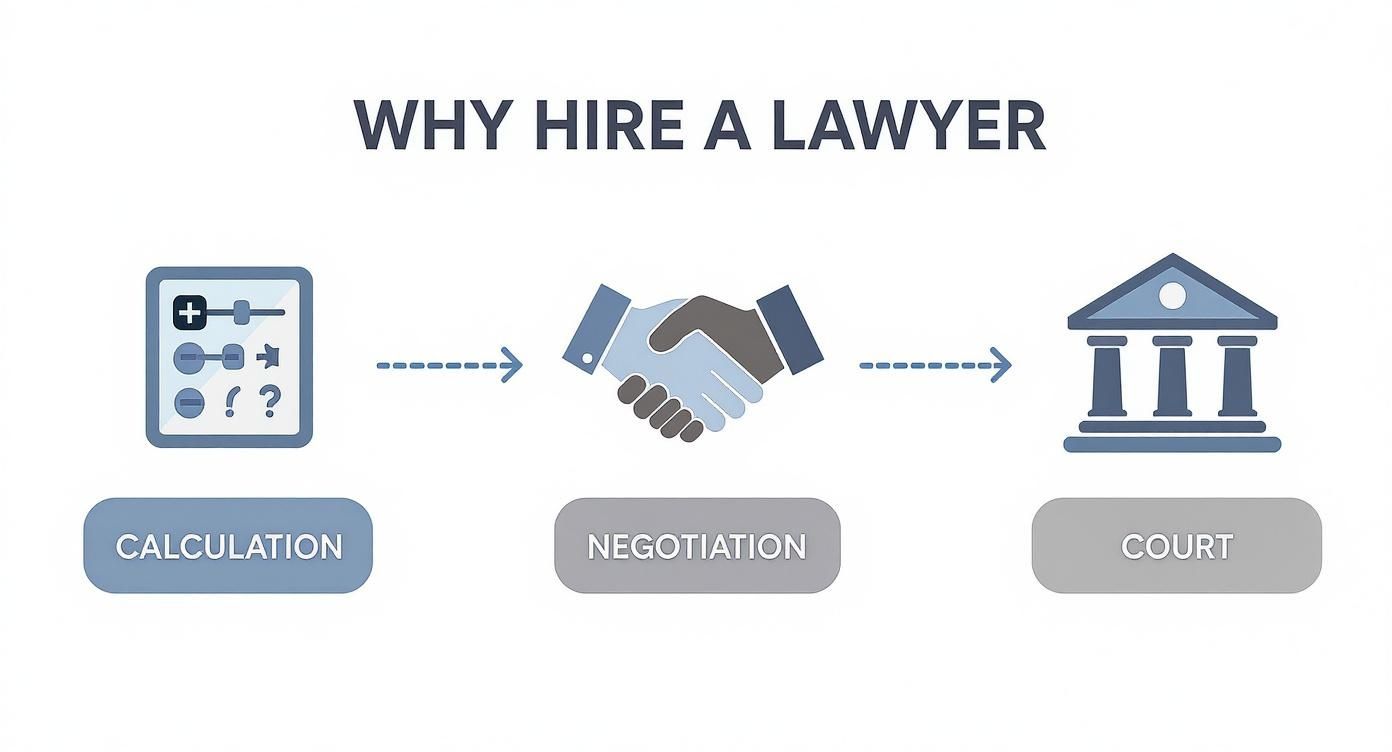
As you can see, an attorney’s role is about precise financial analysis, skilled negotiation, and expert court representation—all working together to achieve your goal.
Negotiation And Finalizing The Order
With the paperwork filed and served, the focus shifts to finding a resolution. The reality is, nearly 90% of these cases are settled out of court. This is where a sharp negotiator in your corner becomes absolutely essential. Your lawyer will communicate directly with the other parent’s attorney to work toward an agreement that both sides can accept.
Mediation is a common and highly effective tool at this stage. A neutral third-party mediator facilitates a structured conversation, helping you and the other parent find common ground and craft a compromise that puts the child’s best interests first.
If you reach an agreement, your lawyer drafts a “stipulated order.” This document spells out the new child support terms, is signed by both parents, and is then sent to the judge for final approval.
But what if you can’t agree? The last resort is a court hearing. Here, your lawyer presents all the evidence, argues the legal points of your case, and questions witnesses. After hearing both sides, the judge makes the final call and issues a new, legally binding child support order. This new order completely replaces the old one and is enforceable by law.
Common Scenarios That Justify a Modification
Life rarely stays the same, and a child support order that made perfect sense a few years ago can become completely unworkable today. The law gets this. It’s why the legal standard of a “substantial change in circumstances” exists. But what does that really mean? We’re not talking about a small cost-of-living raise or a few new bills. We’re talking about major life events that fundamentally reshape a family’s financial reality or living arrangements.
Pinpointing these triggers is the first step. A child support modification lawyer will dive into the specifics of your case, but seeing your own situation in these common examples can bring some much-needed clarity. These are the most frequent reasons parents decide it’s time to legally update their support orders.

Significant Changes In Income
This is, by far, the biggest driver behind modification requests. But courts don’t just look at the dollar amount—they look at the why behind it. A layoff is treated very differently from a promotion.
- Involuntary Job Loss: If the parent paying support gets laid off or their hours are slashed through no fault of their own, it’s almost always considered a substantial change. The key word is “involuntary.” Quitting a high-paying job to dodge payments is a non-starter, but a legitimate layoff—backed by proof that you’re actively looking for new work—is a solid foundation for a downward modification.
- A Major Promotion or New Job: On the flip side, if either parent lands a much better job, gets a huge raise, or receives a massive bonus, it can trigger an upward modification. The logic is simple: the child should benefit from a parent’s improved financial situation, just as they would if the family were still together.
Major Shifts In Parenting Time
Child support formulas are directly tied to the number of overnights a child has with each parent. So, when the parenting schedule undergoes a dramatic change, the original payment amount often stops making sense.
Think about it this way: a non-custodial parent who used to live an hour away and had the kids every other weekend moves into the same school district. Now, they have the children for an extra 50 nights a year. Their direct costs for groceries, utilities, and activities have shot up. This kind of shift is a classic reason to reduce the formal support payment, since they are now shouldering more of the day-to-day financial load. You’ll just need to clearly document the new schedule for the court.
New Needs Of The Child
A child’s needs can change in an instant. The original support order was based on their life at that moment, but new challenges can introduce major, ongoing costs that nobody planned for.
The core principle of child support is to provide for the child’s well-being. When a child develops a new, costly need—whether medical, educational, or developmental—the support order must evolve to meet that need.
Some of the most common examples include:
- A New Medical Diagnosis: A child developing a chronic illness like asthma or diabetes can suddenly mean thousands in new annual expenses for medications, specialist appointments, and medical gear.
- Specialized Educational Needs: If a child is diagnosed with a learning disability that requires expensive private tutoring or even a specialized school, it creates a new financial reality that has to be shared.
- Increased Childcare Costs: A parent’s work schedule might change, forcing a permanent switch from part-time after-school care to a much more expensive full-time daycare provider.
These situations are emotionally and legally tangled. For parents trying to navigate it all, finding child custody legal advice you can trust is often the key to protecting their child’s future.
Other Qualifying Life Events
While income and parenting time are the big two, other life changes can also be enough to justify a modification. For example, a parent’s remarriage doesn’t mean their new spouse is on the hook for child support. However, it can change the parent’s overall financial picture by altering household expenses and disposable income, which a judge might take into account. Likewise, when alimony payments end or an older child “ages out” of the system, it often triggers a recalculation for the remaining children.
How to Choose the Right Modification Lawyer
Picking a lawyer to handle your child support modification isn’t just about hiring an attorney; it’s about finding a strategic partner for a high-stakes financial negotiation. Think of it this way: you wouldn’t ask your family doctor to perform open-heart surgery. While a general family law attorney knows the basics, you need a specialist who has navigated these exact waters time and time again.
Your goal is to find a lawyer who lives and breathes modification cases. This kind of deep focus means they know the local judges, the other side’s likely tactics, and the best way to frame your specific situation. A generalist understands the law, but a specialist knows how to win.
Key Qualities to Look For
Before you even book a meeting, do your homework. A lawyer’s reputation, online reviews, and professional standing speak volumes. Don’t get distracted by a slick website; look for real proof of their track record in child support matters.
Once you’ve narrowed it down, zero in on these areas during your initial talks:
- Specific Experience: Get straight to the point. Ask them how many modification cases they’ve handled in the past year and what the general outcomes were.
- Negotiation Philosophy: The vast majority of these cases are settled outside of a courtroom. You need to know if their style is aggressive and combative or more collaborative and focused on problem-solving.
- Communication Style: Nothing is more stressful than being left in the dark. Ask them how often you’ll get updates and who will be your main point of contact. Good communication is non-negotiable.
Finding a lawyer who truly gets your goals is everything. For more on what makes a great attorney-client fit, learning how to find a family lawyer you can trust offers a great roadmap for building that critical relationship.
Essential Questions for Your Consultation
Treat the first consultation like an interview—because it is. You’re hiring them for an incredibly important job, so ask direct, pointed questions that get to the heart of their expertise. A skilled and confident lawyer will have no problem answering them clearly.
A lawyer’s response is just as telling as the answer itself. Be wary of vague promises or evasive language. You need a realist who gives you an unvarnished assessment based on the facts.
Walk into that meeting prepared with a list. Here are a few questions you absolutely must ask:
- “Based on my situation, what’s your initial strategic approach?” This is a direct test of their ability to think on their feet.
- “What are the biggest challenges or roadblocks you see in my case?” A seasoned lawyer can spot potential problems a mile away.
- “Can you walk me through your fee structure and give me an honest estimate of the total cost?” Get total financial transparency from day one to avoid any nasty surprises.
- “What’s your game plan if my ex is uncooperative or dishonest?” This question quickly separates the veterans from the rookies, revealing their experience with high-conflict cases.
Navigating Complex International Modifications
When parents live in different countries, modifying child support is no longer a simple local court matter. It becomes a complex puzzle of international law, where different legal systems, languages, and currencies collide. Think of it like trying to use a US plug in a European outlet—it just doesn’t work without the right adapter.
A standard family lawyer, while an expert in state law, isn’t equipped for this. These cases require a child support modification lawyer with specific experience in cross-border disputes. They understand the intricate frameworks governing how one country recognizes and enforces the family court orders of another. This is where the legal landscape gets incredibly complicated.
Understanding International Legal Frameworks
The first major hurdle is determining which country even has the authority—or jurisdiction—to modify the order. It’s not always the court that issued the original decree. For example, if a child support order came from a Florida court but the paying parent now lives and works in Germany, which court gets to make changes? The answer often lies in international agreements.
Two key instruments a specialist will navigate are:
- The Hague Convention on the International Recovery of Child Support: This global treaty creates a streamlined process for enforcing support orders across borders.
- The Uniform Interstate Family Support Act (UIFSA): While mainly for US state-to-state cases, UIFSA also has provisions that connect with countries that have similar agreements with the United States.
These frameworks provide the roadmap, but it takes a lawyer who’s traveled this road before to interpret it correctly.
A Real-World Example in Action
Imagine a mother in Florida needs to increase child support from her ex-husband, who just took a high-paying job in Germany. Her lawyer can’t just file a standard motion in the local Florida courthouse and expect results. An attorney experienced in these matters would first analyze the Hague Convention and US-German agreements to map out the best strategy.
The core issue in international modifications is enforcement. A new court order is useless if it cannot be legally enforced in the country where the paying parent resides and earns their income.
This process involves translating documents, converting currencies to calculate income, and communicating with foreign legal authorities. It’s a logistical and legal marathon that is nearly impossible to run without an expert guide.
The United States has reciprocal child support agreements with over 20 countries, including Germany, the UK, and Australia, but major differences in law can still create significant hurdles. Discover more insights about international child support enforcement on mckinleyirvin.com. Hiring a child support modification lawyer with a track record in international cases isn’t just a recommendation; it’s a necessity.
Common Questions About Modifying Child Support
When life throws you a curveball, navigating the child support modification process can bring up some very specific, practical questions. Getting the right answers is the first step toward protecting your financial stability and, most importantly, your child’s well-being. Here are a few of the most pressing issues people bring to a child support modification lawyer.
How Quickly Should I File After My Income Changes?
Immediately. This isn’t something you can put off. In almost every state, a modification is not retroactive to the day your income actually changed—it only counts from the date you formally file the request with the court.
Waiting even a few months can create a serious financial hole. If your income dropped, you are still legally on the hook for the higher, original amount for every month you delayed. That debt can’t be wiped away later. A lawyer ensures you file promptly to lock in the new effective date.
Is a Verbal Agreement to Change Payments Enough?
Absolutely not. A casual “handshake deal” with your ex to change payments is unenforceable and incredibly risky, no matter how well you get along. Until a judge signs a new court order, the original one is the only one that matters in the eyes of the law.
No matter how amicable your relationship is, an informal agreement provides zero legal protection. If the other parent changes their mind or your relationship sours, you could be held in contempt of court and ordered to pay back every dollar “missed” under the original order, often with steep interest penalties.
Will My New Spouse’s Income Affect My Child Support?
Generally, a new spouse’s income isn’t thrown directly into the child support calculation. After all, they have no legal obligation to support a child from your prior relationship.
However, their income can have a significant indirect impact. It changes your household’s overall financial picture, which a court might see as freeing up more of your personal income for support. The laws on this vary dramatically from state to state, making it a critical issue to review with an experienced child support modification lawyer who knows your local court’s tendencies.
Finding the right legal guidance is crucial for navigating these complex family law issues. The Haute Lawyer Network connects you with premier, vetted attorneys who specialize in family law and can provide the expert representation you need. Learn more about our curated network at https://hauteliving.com/lawyernetwork.