
Let’s get one thing straight: the old idea that courts automatically side with mothers in custody battles is a relic of the past. Today, the law is clear—a father’s rights are legally equal to a mother’s. Every decision boils down to a single, guiding principle: the best interests of the child. Gender simply doesn’t enter the equation.
The Modern View of Fathers’ Custody Rights

The world of family law has gone through a massive shift. The outdated “tender years” doctrine—a legal presumption that young children were always better off with their mothers—has been thrown out in all 50 states. Courts now operate on a gender-neutral standard, recognizing that fathers are just as capable of providing a stable, loving home.
This guide is built to give you a clear-eyed view of your legal standing. We’re going to tear down the persistent myths, break down the legal jargon that matters, and give you real, actionable strategies to protect your relationship with your child. The goal is to arm you with the confidence that comes from making proactive, informed decisions.
Understanding Your Fundamental Rights
Before you can strategize, you need to understand the building blocks of any custody arrangement. These two concepts are the foundation of every parenting plan and define exactly what your rights and responsibilities will be.
- Legal Custody: Think of this as your seat on the “board of directors” for your child’s life. It’s the right to make the big-picture decisions—education, healthcare, and religious upbringing.
- Physical Custody: This is about where your child lays their head at night. It determines the day-to-day schedule and who is responsible for routine care.
A court can award these jointly to both parents or solely to one. But the trend is unmistakable: judges increasingly favor shared parenting whenever possible. In fact, joint custody arrangements shot up from just 13% before 1985 to 34% by the early 2010s, a clear signal of the judiciary’s preference for keeping both parents actively involved. You can explore more about the rising role of single fathers and custody trends.
To help you distinguish between these crucial terms, here’s a simple breakdown.
Legal Custody vs Physical Custody At a Glance
| Custody Type | What It Means | Key Decisions Involved | Common Arrangements |
|---|---|---|---|
| Legal Custody | The right to make major life decisions for your child. | Education (school choice), non-emergency healthcare, religious instruction, and general welfare. | Often awarded jointly, even if physical custody is not 50/50. |
| Physical Custody | The right and responsibility to have your child live with you. | Daily care, supervision, meals, transportation, and creating a primary home environment. | Can be sole, primary (one parent has more than 50% time), or joint (50/50). |
Understanding this distinction is the first step toward building a strong case.
The single most important factor in any custody case is the “best interests of the child.” This is the universal standard that guides every judicial decision, focusing on the child’s safety, stability, and overall well-being above all else.
This guide will serve as your roadmap for proving that your active involvement is vital to your child’s well-being. We’ll cover everything from the kind of evidence that actually matters to a court to the practical steps for navigating the legal maze, ensuring you are fully prepared for the road ahead.
What Courts Look For in Custody Decisions

When a judge weighs a custody decision, their focus isn’t on fairness between the parents. Their entire world revolves around a single, powerful principle: the best interests of the child. This isn’t just a feel-good phrase; it’s a concrete legal standard that guides every choice the court makes.
Think of it as the court building a case for the child’s future. They need to see which parent provides the most stable foundation for a healthy, happy life. It’s far less about who has the bigger paycheck and far more about who has consistently provided emotional security, routine, and unwavering support.
One of the most compelling arguments you can make is simply showing up. A judge will meticulously review who was the primary caregiver—or if that role was genuinely shared—with the goal of causing the least amount of disruption to the child’s life.
The Foundation of Stability and Safety
Before a court considers anything else, it must be satisfied that the child will be physically and emotionally safe. A judge will scrutinize each parent’s living situation to confirm it’s a secure environment, completely free from harm, instability, or neglect. This is the non-negotiable starting point for any custody award.
This evaluation dives deep, looking for any history of domestic violence, substance abuse, or criminal behavior. Even a single DUI can trigger serious questions about a parent’s judgment and their ability to keep a child safe. The court isn’t just looking for convictions; it’s searching for patterns of behavior that could put a child at risk.
The court’s primary duty is to protect the child. Any evidence suggesting a parent cannot provide a consistently safe and stable home will heavily influence the outcome of a custody case, often trumping all other factors.
To build a compelling case for being the stable parent, you must demonstrate consistency. Show the court you have a safe home, a reliable daily schedule, and a solid plan for childcare. This proves foresight and responsibility—two qualities that carry immense weight in a custody battle.
Demonstrating Your Parental Fitness
Parental fitness extends far beyond providing food and a roof. It’s about your proven ability to meet a child’s developmental, emotional, and psychological needs. The court assesses each parent’s capacity to offer guidance, discipline, and unconditional support.
This means putting several key areas of your parenting under the microscope:
- Emotional Connection: The court wants to see a genuine bond. Hard evidence of your involvement—from helping with homework to attending parent-teacher conferences and doctor’s appointments—is invaluable.
- Willingness to Co-Parent: A judge will almost always favor parents who can communicate respectfully and cooperate for their child’s sake. Showing you can rise above personal conflict is a significant strategic advantage.
- Meeting Daily Needs: This is the nuts and bolts of parenting. Documenting your role in getting your child to school, managing appointments, and handling day-to-day logistics provides tangible proof of your deep involvement.
A child’s preference is also considered, especially if they are mature enough to articulate a reasoned opinion, typically around age 12 or older. While their wishes aren’t the final word, a judge will absolutely listen and give them significant weight.
The Power of the Status Quo
Courts are inherently conservative; they avoid making drastic changes to a child’s established routine whenever possible. This makes the “status quo”—the parenting arrangement that existed before the court battle began—a powerful factor. If you were a deeply involved, hands-on father, the court is more likely to want that to continue.
This is precisely why moving out of the family home without a temporary custody order can be a catastrophic mistake. It can inadvertently create a new reality where you are less involved, making it much harder to argue for more parenting time later. Many fathers wonder about their odds, and the key is to maintain your active role from day one. You can explore a deeper analysis of the chances of a father getting 50/50 custody in our detailed guide.
Ultimately, your actions before and during the custody process write the story the judge will read. By relentlessly focusing on stability, safety, and your consistent, documented involvement, you give the court everything it needs to see your indispensable role in your child’s life.
How to Document Your Parental Involvement
In a high-stakes custody case, what you say you do as a father matters far less than what you can prove. While you know you’re a dedicated and involved parent, a family court judge only knows what the evidence shows them. This is where meticulous documentation becomes your most powerful ally.
Think of it as building an airtight case for your role in your child’s life. Vague claims like, “I’m a very hands-on dad,” are easily dismissed. A detailed portfolio of your parenting, however, transforms your assertions into undeniable facts the court can’t ignore.
Start Your Parenting Journal Today
The single most effective tool you can use is a daily parenting journal. This isn’t a place for venting your frustrations; it’s a logbook of your actions and a timeline of your involvement. The key is consistency. Find a system that works for you—a dedicated notebook, a calendar app, or a simple spreadsheet—and stick with it.
Your entries must be factual, specific, and dated. The goal is to paint a crystal-clear picture of your day-to-day engagement with your children.
What to track in your journal:
- Daily Routines: Note who handles wake-ups, breakfast, school lunches, homework help, and bedtime stories.
- Appointments: Log every doctor, dentist, and therapy visit you attend. Record the date, time, and purpose.
- School and Extracurriculars: Document parent-teacher conferences you attend, school plays you watch, and every practice or game you drive to.
- Financial Contributions: Keep a record of every expense you cover outside of formal child support, from new shoes to school supplies or activity fees.
This detailed logbook becomes an invaluable asset, providing a tangible record that proves your central role in your child’s world.
Preserve Every Communication
Every text message, email, and app conversation with the other parent is potential evidence. These records can powerfully demonstrate your willingness to co-parent, your proactive efforts to coordinate schedules, and your unwavering focus on your child’s needs.
Never delete these communications. Get into the habit of taking screenshots or using apps designed to save and organize conversations chronologically. This digital paper trail creates an objective record of your interactions, which can be critical for establishing your credibility and showing the court you’re the more reasonable party.
Key Takeaway: A judge is always looking for the parent who fosters a positive co-parenting relationship. Your documented communication should paint a picture of you as cooperative, child-focused, and mature—not someone trying to “win” arguments.
Gather Your Witnesses and Proof
Beyond your personal records, third-party validation carries immense weight in court. These are the people who see your parenting in action. Start compiling a list of potential witnesses who can speak to your character and the strong bond you share with your child.
Your list might include:
- Teachers and School Staff: They can verify your involvement in your child’s education.
- Coaches and Activity Leaders: These individuals can confirm your commitment to your child’s passions.
- Neighbors, Friends, and Family: They offer firsthand accounts of your day-to-day life and the nurturing home you provide.
Pair your witnesses with physical proof. Photos and videos of you and your child—at holiday gatherings, school events, or just enjoying a weekend together—can be surprisingly effective. Receipts for clothes, toys, or school-related items serve as small but significant pieces of corroborating evidence. The data shows modern fathers are deeply involved; for example, dads with kids under 18 spend about 1.02 hours daily on direct care and help. Documenting this is how you prove you’re one of them. Find out more about the findings on modern fatherhood and time use.
Navigating the Custody Process Step by Step
Staring down a child custody case can feel overwhelming, like standing at the bottom of a mountain with no clear path to the top. It’s natural to feel that way. But the process isn’t a single, monolithic event—it’s a series of steps. Understanding them turns anxiety into a clear-headed, strategic approach.
The journey starts when one parent files a petition, which officially kicks off the legal case. From there, the road can take several turns, and your legal strategy will determine which route is best for you and your child.
The Three Paths of Custody Resolution
Forget what you’ve seen in movies. Not every custody dispute ends in a dramatic courtroom showdown. In reality, most cases are resolved long before a judge bangs a gavel. You can think of it as having three main avenues to a final agreement.
- Direct Negotiation: This is the most informal path. You and the other parent, typically guided by your attorneys, work to hammer out an agreement on your own. This route offers the greatest control and flexibility.
- Mediation: Here, a neutral third-party mediator joins the conversation. Their job isn’t to make decisions for you but to facilitate a productive dialogue, helping you find a middle ground you can both accept.
- Litigation: When all else fails, you end up in court. This is the formal legal process where a judge hears evidence from both sides and makes the final call. It’s the most adversarial and expensive option, but sometimes it’s unavoidable.
Many legal experts prefer mediation as a starting point. It’s a private, collaborative setting that helps preserve a functional co-parenting relationship—something that is always in your child’s best interest. In fact, studies show that parents are far more likely to stick to mediated agreements because they had a direct hand in creating them.
Key Milestones in a Custody Case
No matter which path you take, you’ll encounter several key legal milestones. Knowing what’s coming helps you stay prepared.
First up are temporary orders. These are the court’s initial rulings on parenting time and financial support that stay in place while the case moves forward. Following these orders to the letter is critical. They set a precedent, and a judge who sees you successfully handling the temporary schedule is more likely to view that arrangement as a stable, long-term solution.
Next is the discovery phase. This is the formal process of gathering evidence. Your lawyer will request documents, send written questions (interrogatories), and may take depositions to build the strongest case for your fitness and involvement as a father.
Documenting your role as a parent is a massive part of this. This simple process makes it manageable.
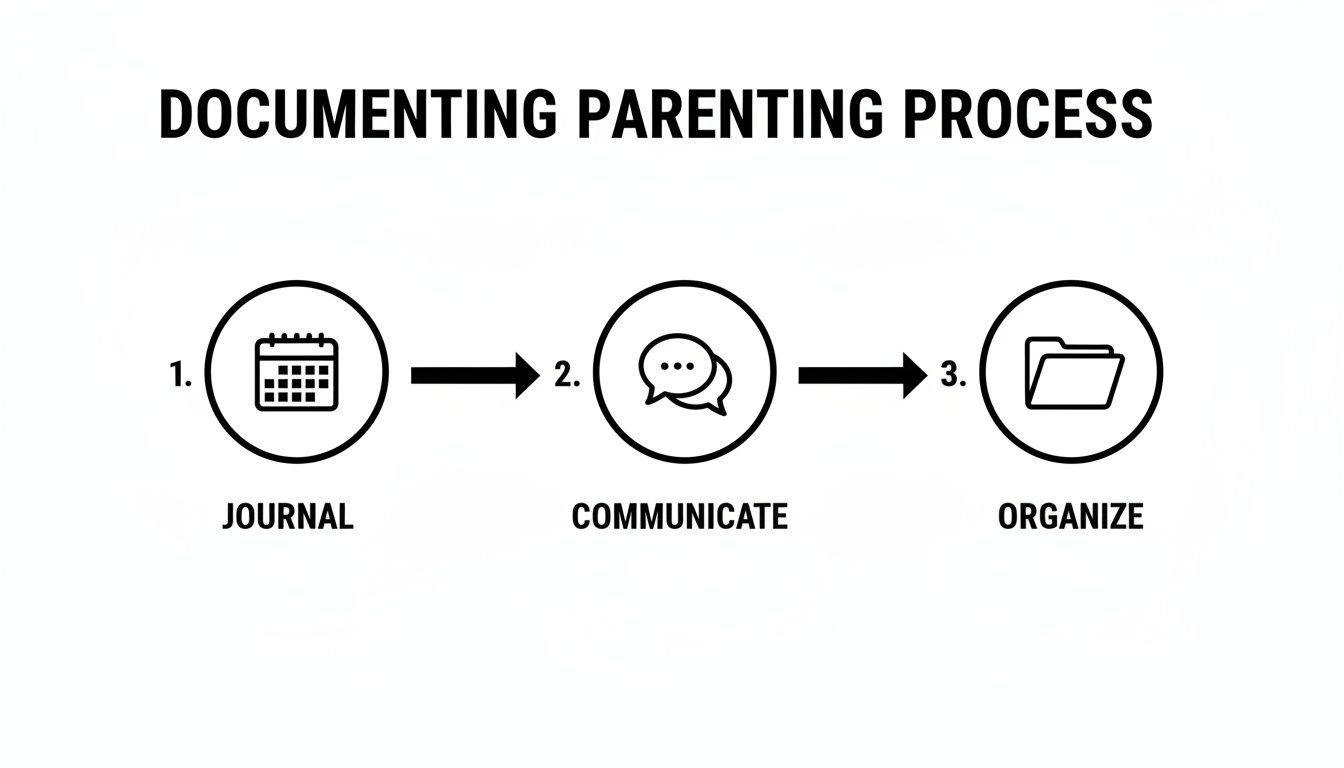
This three-step method—journaling your daily involvement, carefully saving communications, and organizing all your proof—builds a powerful portfolio that demonstrates your commitment.
If you still can’t reach an agreement, the case will proceed to hearings and possibly a full trial. This is where all your preparation pays off. Your attorney will present your evidence, cross-examine witnesses, and argue the law on your behalf. For fathers, understanding how to prepare for a custody hearing can be a game-changer.
Your attorney is more than a legal representative; they are your strategic partner. Whether negotiating a settlement, guiding you through mediation, or fighting for you in court, their expertise is essential to navigating each phase effectively.
The ultimate goal is a clear, comprehensive final custody order that truly serves your child’s needs. By understanding this step-by-step process, you can make informed decisions and work proactively with your counsel to secure the best possible future for your family.
Understanding Child Support and Financial Duties
When it comes to custody, conversations about money get heated fast. It’s easy for emotion and misinformation to take over, but for fathers, it’s critical to see child support for what it is: a legal framework to ensure a child’s financial stability, not a penalty against one parent. The court’s goal is a fair, predictable calculation that serves the child’s best interests.
This obligation isn’t one-sided; it stems from the core legal principle that both parents are financially responsible for their child. To get there, courts start with state-specific guidelines, often called “child support formulas.” These are largely driven by two key numbers: each parent’s income and how much time the child spends in each home.
How Child Support Is Calculated
That initial formula is just the starting line. A final child support order is far more nuanced, built to reflect the real-world costs of raising a child. Think of the income-based calculation as the foundation of a house; several other critical costs are then layered on top to create a complete and fair financial picture.
Judges will almost always factor in these additional expenses:
- Healthcare Costs: Who covers the child’s health insurance premiums? Out-of-pocket medical costs, like co-pays for doctor visits or braces from the orthodontist, are also split between the parents.
- Childcare Expenses: If a parent needs daycare or after-school care to be able to work, those costs are almost always included in the support calculation.
- Educational Needs: This can cover everything from private school tuition, if that was the family norm, to expenses for tutoring or specialized learning support.
Ultimately, the court wants to maintain the child’s standard of living as much as possible. If a child was used to certain activities, camps, or educational opportunities before the separation, the judge will try to build a support order that allows that stability to continue.
When Fathers Receive Child Support
One of the most damaging myths in family law is that child support is a one-way street where fathers always pay. That is completely false. The right to receive child support is tied to custody, not gender. If a father has primary or sole physical custody, he is legally entitled to receive child support from the mother.
The law is gender-neutral. The parent who has the child most of the time—and therefore shoulders the majority of the day-to-day expenses—is the parent who typically receives support. Interestingly, these child support statistics from the Annie E. Casey Foundation show that while custodial fathers are less likely to live in poverty (11%) compared to custodial mothers (27%), they are also less likely to have a formal child support order in place (41% vs. 51% for mothers). This gap often comes down to a lack of awareness or a failure to pursue what is legally theirs, highlighting the need for skilled legal advocacy.
A child support order is a legal tool that protects your child’s financial security. For custodial fathers, securing this order is not just a right—it’s a crucial step in ensuring you have the resources needed to provide the best possible care for your child.
Life is rarely static. A job loss, a major promotion, or a child developing new, expensive needs are all legitimate reasons to revisit a support order. It’s vital to understand that an official modification is the only way to legally change your payments. You can get a clearer picture by reading our guide on how a child support modification lawyer can update your order. Going through the court is the only way to protect yourself and ensure the new amount is legally enforceable.
Common Mistakes Fathers Should Avoid

Protecting your rights as a father often comes down to knowing what not to do. The initial stages of a separation are a minefield of high emotions, making it far too easy to react in ways that can sabotage your case down the road. One wrong move can create a negative narrative that’s incredibly difficult to undo in court.
Think of it this way: during a custody dispute, you’re living under a microscope. Every text, every decision, every social media post is potential evidence. By understanding the common pitfalls, you can navigate this turbulent time with the foresight and stability a judge needs to see, keeping the focus where it belongs: on your child.
Abandoning the Family Home Prematurely
One of the most critical errors a father can make is moving out of the family home before a temporary custody order is in place. Leaving to cool things down might feel like the responsible choice, but a family court judge may see it as abandonment.
When you move out, you unintentionally help establish a new “status quo” where you are no longer part of your child’s daily routine. This can make it exponentially harder to argue for a 50/50 arrangement later, as judges are often reluctant to disrupt a child’s new normal—one you inadvertently helped create.
Critical Advice: Do not change your living situation without first speaking to an attorney and getting a temporary parenting plan signed by a judge. This legally protects your time and prevents the other parent from framing your departure as disinterest.
Letting Emotions Dictate Your Communication
Angry texts, accusatory emails, and hostile voicemails are a gift to the opposing counsel. It’s tempting to fire back in the heat of the moment, but that digital footprint is permanent. It becomes Exhibit A, showcasing an inability to co-parent effectively.
A judge is looking for the parent who can rise above the conflict for the sake of the child. Keep every communication strictly business-like, calm, and focused on logistics. If a conversation gets heated, disengage. It’s always better to say nothing than to send a message you’ll later regret.
Overlooking the Impact of Social Media
Your social media accounts are not private diaries; they are public exhibits waiting to be scrutinized. Complaining about your ex, posting about the case, or even sharing photos from a night out with friends can be twisted to portray you as unstable or irresponsible.
Adopt these simple rules to safeguard your case:
- Go Dark: The safest strategy is to stop posting on all social media platforms until your custody case is fully resolved.
- Audit Your History: Scour your old posts, photos, and tags. Delete anything that could possibly be taken out of context, especially pictures involving alcohol, parties, or new romantic interests.
- Maintain Absolute Silence: Never discuss any aspect of your case online. Venting about the judge, the process, or the other parent demonstrates poor judgment and will almost certainly be used against you.
Steering clear of these unforced errors proves you have the maturity and emotional discipline a family court values above almost anything else.
Common Questions About A Father’s Custody Rights
When it comes to child custody, fathers often face a minefield of questions and misinformation. The path forward can feel unclear, but understanding your legal position is the first step toward securing your rights and your child’s future. Here are direct answers to some of the most pressing concerns we see.
What if I Was Never Married to My Child’s Mother?
This is one of the most common and critical hurdles for unmarried fathers. Simply being named on the birth certificate, surprisingly to many, doesn’t automatically grant you legal rights. Before you can even ask a court for custody or visitation, you must legally establish paternity.
Think of establishing paternity as the key that unlocks the courthouse door. It’s the formal, legal recognition of your fatherhood. Once paternity is confirmed—either through a mutual, signed acknowledgment or a court-ordered DNA test—the law sees you no differently than a married father. At that point, you gain the standing to file for a formal custody order that defines your rights and responsibilities.
Can a Custody Order Be Changed?
Yes, but it’s not a simple process. Courts understand that life isn’t static; circumstances change. This is why custody orders can be changed through a legal process called a modification.
However, a judge won’t entertain a modification just because you’re unhappy with the current schedule. You must prove that there has been a substantial and material change in circumstances since the last order was put in place. What does that mean in the real world?
- One parent has to relocate for work, significantly impacting the current schedule.
- Legitimate concerns arise about the child’s safety or environment in the other parent’s care.
- The child gets older, and their needs, schedule, or even their own preference (in some states) have significantly changed.
The guiding star for any judge is always the child’s best interests. Your desire for more time isn’t enough; you have to show how the proposed change will actively benefit your child’s well-being.
A critical piece of advice: A casual text or verbal agreement to change the schedule holds no legal weight. To be enforceable, any modification must be approved by a judge and filed with the court.
What if the Other Parent Is Uncooperative?
Dealing with a difficult co-parent can be incredibly frustrating, but how you respond is crucial. The key is to stay strategic, not emotional. Start by meticulously documenting every single time the other parent fails to follow the court order—every missed visit, every refusal to communicate, every violation.
Keep all your communication strictly business-like and focused on the child. Angry texts or emails will only hurt your case. If the violations become a pattern, your attorney can step in and file a motion for enforcement. A judge has the power to impose penalties, order make-up parenting time, or in severe cases, even modify the custody order if the uncooperative behavior harms the child.
Protecting your rights and your child’s future in these situations requires sophisticated legal guidance. The attorneys in the Haute Lawyer Network are recognized for their exceptional skill in high-stakes family law matters. Connect with a top-tier professional who can provide the strategic advocacy you deserve.
Find a Premier Child Custody Attorney on Haute Lawyer Network