
Let’s be honest: that dense, 50-page business plan they taught you to write in law school is practically useless in today’s legal market. It’s a static document, a one-time chore that gets filed away and never sees the light of day again. In a world of constant technological shifts and evolving client demands, it’s a recipe for failure.
You need a dynamic growth playbook—not a dusty binder on a shelf. This is an active, adaptable tool designed to help you build a thriving practice by solidifying your brand and targeting the right high-value clients.
Why Traditional Business Plans Fail Modern Law Firms
The old-school approach simply can’t keep pace. Client expectations are higher than ever, new legal technologies are reshaping how we work, and the competitive landscape is being redefined by hyper-specialized firms. A plan written just a year ago is likely already irrelevant. We explore this in more detail in our guide on treating your law firm as a business.
The Shift to a Dynamic Growth Playbook
A modern business plan isn’t a document; it’s a living, breathing framework for growth. It’s an agile strategy designed to evolve with your firm and the market, forcing you to think strategically about what truly drives success.
This means integrating tech shifts, clarifying your unique brand positioning, and defining exactly who your ideal client is—and who they are not.
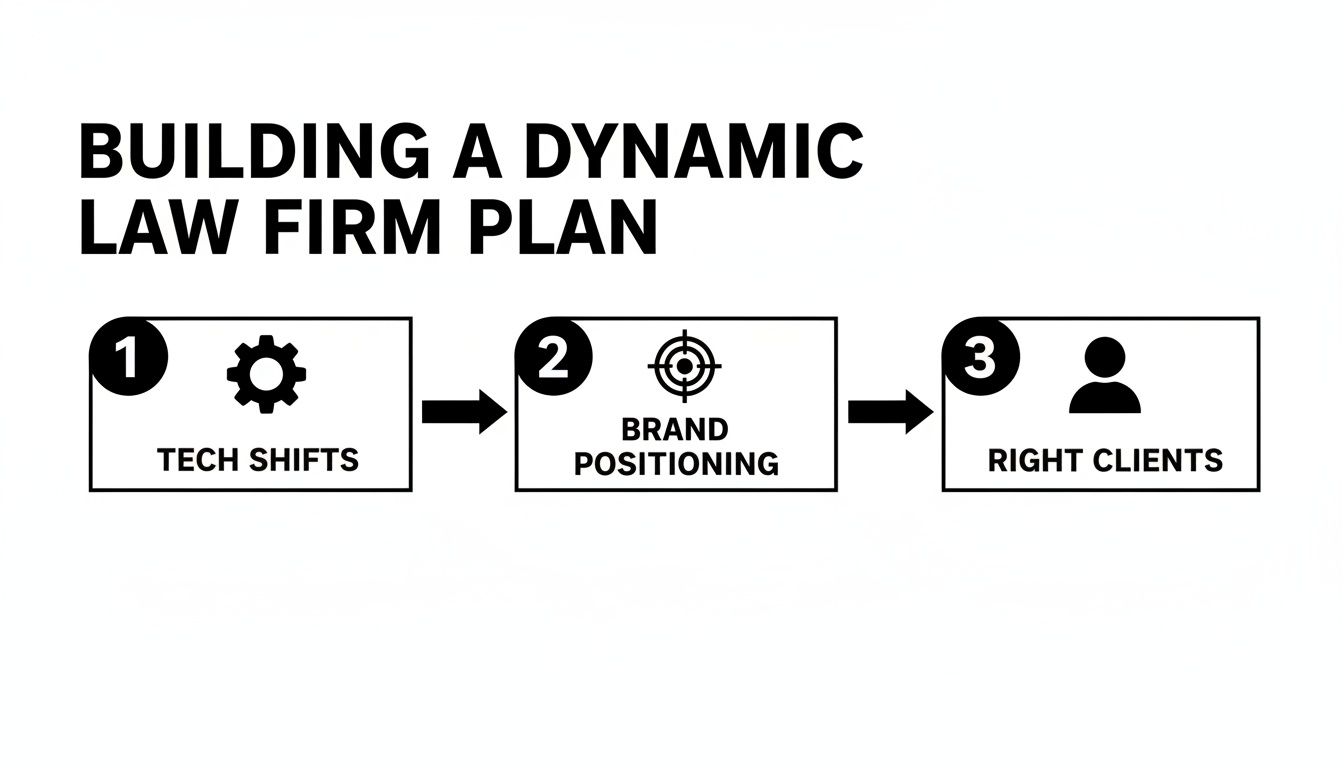
As you can see, a successful plan is a continuous cycle: adapt to new technology, refine your position in the market, and relentlessly focus your client acquisition efforts.
Capitalizing on Market Volatility
The legal market is more fluid than it has ever been. This volatility creates enormous opportunities for agile firms that are positioned to act decisively. The data tells a compelling story.
In the US legal market, demand recently surged by an average of 2.5% in a single year, even peaking at 4.4% mid-year. This was the strongest growth seen since the Global Financial Crisis, underscoring why an adaptable plan is so critical for lawyers looking to capitalize on market swings.
This volatility isn’t just about overall growth; it’s about who captures it. Smaller and midsize firms saw nearly 5% growth in the latter half of 2025, while many larger firms lagged behind. Why? Because clients started moving work to more specialized, cost-effective providers.
This trend highlights a crucial point: a well-crafted business plan isn’t about predicting the future. It’s about building a firm that doesn’t just react to change but anticipates it, identifies the openings, and seizes those opportunities before the competition even knows they exist.
Defining Your Niche to Attract High-Value Clients
In the crowded legal marketplace, trying to be a “jack of all trades” is a surefire way to get lost in the noise. When you’re a generalist, you’re not an expert. You end up competing on price, chasing any lead that comes through the door, and struggling to stand out. The most powerful business plans are built on the opposite premise: specialization.
Rejecting the generalist model is the first step toward building a truly profitable firm.

When you specialize, you do more than just narrow your services—you amplify your authority. Becoming the go-to expert in a specific legal arena lets you attract a higher caliber of client. These are the clients actively seeking deep knowledge, not just a lawyer who can file paperwork. This focus allows you to build a brand that makes you the only logical choice for a select group of people.
Identifying Your Profitable Niche
Choosing a niche isn’t just a business decision; it’s a strategic one that blends your passion, your skills, and what the market actually needs. The sweet spot is where what you love to do intersects with a problem a specific group of clients is desperate to solve.
First, look inward. What area of law genuinely excites you? Which complex problems do you actually enjoy untangling? That genuine interest is what will fuel your drive to become a true authority.
Next, you have to validate it against the market. A passion for an obscure area of law with almost no potential clients is a hobby, not a business. Look for underserved markets or growing industries where new legal complexities are emerging. For instance, the recent legal chaos surrounding non-compete agreements tied to incentive plans has created urgent demand for expert counsel. That’s a niche.
Your ideal niche lies where your professional passion meets a clear market need. It’s not just about what you can do, but what you can do better than anyone else for a specific group of people who are willing to pay for that expertise.
Crafting Your Ideal Client Profile
Once you’ve zeroed in on a niche, you need to get laser-focused on who you serve. This goes far beyond simple demographics. An ideal client profile, often called a client persona, is a detailed portrait of the exact person or business you want as a client.
Get specific about these attributes:
- Industry: Are they in tech, healthcare, or real estate? A firm specializing in IP for SaaS startups serves a completely different world than one handling estate planning for multi-generational manufacturing businesses.
- Business Stage: Are you targeting early-stage startups scrambling for funding or established corporations navigating complex regulatory minefields? Their legal needs, budgets, and how they make decisions are worlds apart.
- Pain Points: What specific legal challenges are keeping them up at night? Your entire value proposition needs to be a direct answer to these fears.
- Values: What do they look for in a lawyer? Aggressive litigators, discreet counselors, or innovative problem-solvers?
Creating this detailed profile lets you tailor everything—your services, your marketing, even your website’s tone—to attract the right people and actively repel the wrong ones.
Developing a Compelling Value Proposition
Your value proposition is the clear, simple answer to the question: “Why should I hire you instead of any other lawyer?” It’s a promise of specific value, not a fluffy mission statement packed with buzzwords. It has to come from a deep understanding of your niche and your ideal client’s biggest problems.
Look at the difference:
- Weak Proposition: “We provide high-quality legal services for businesses.”
- Strong Proposition: “We help venture-backed fintech startups navigate regulatory compliance and secure intellectual property so they can scale faster and with less risk.”
The second one has power. It’s specific, it speaks directly to a defined audience (fintech startups), and it solves their core problems (compliance, IP, and scaling). Every single part of your business plans for lawyers should be built to deliver on this central promise, ensuring your firm doesn’t just survive but thrives on the high-value clients you’re perfectly positioned to serve.
Building a Client Acquisition Machine
Look, exceptional legal skill is only half the game. I’ve seen brilliant lawyers struggle because they didn’t have a predictable way to bring in the right clients. This part of your plan is about moving past hope as a strategy and building a reliable client acquisition machine that consistently delivers high-value cases.
A solid strategy isn’t just about blasting your name everywhere. It’s a thoughtful blend of digital outreach and powerful, relationship-based networking. The goal isn’t just to get more leads; it’s to attract the right ones—clients whose problems you are uniquely built to solve and who see the immense value in your specific expertise. This is where all that hard work defining your niche really starts to pay off.
Crafting a Content Strategy That Builds Authority
Content is the engine that drives modern client acquisition. It’s how you prove your expertise, build trust, and attract your ideal client before you ever even speak with them. A sharp content plan is an absolute cornerstone of any serious business plans for lawyers.
Stop writing generic blog posts about broad legal topics. Instead, create content that speaks directly to the specific anxieties and goals of your ideal client.
- Solve Their Problems: If you represent tech startups, don’t just write about “IP Law.” Write an in-depth guide on the five most common IP mistakes founders make during their seed funding round.
- Answer Their Questions: If your niche is high-net-worth estate planning, create a sharp video explaining how the latest trust law changes will impact their family’s legacy.
- Showcase Your Expertise: Develop case studies (with client permission and anonymized data, of course) that walk through a complex problem, detailing your strategic approach and the successful outcome you achieved.
This isn’t just marketing; you’re positioning yourself as an indispensable authority, not just another lawyer on a list. It’s a fundamental part of a successful marketing plan for attorneys that prioritizes value over sheer volume.
The Power of Strategic Partnerships and Curated Networks
While great content builds your inbound funnel, strategic relationships are the accelerator. Aligning yourself with other top-tier professionals who serve the same clientele creates a powerful referral network. Think about the accountants, financial advisors, or venture capitalists who are in front of your ideal clients every single day.
Building a client acquisition machine means you never have to wonder where your next case is coming from. It’s a systematic, multi-channel approach that combines digital authority with real-world relationships to create a steady flow of ideal clients.
Beyond those one-on-one partnerships, curated networks offer unparalleled access to exclusive circles. These platforms are specifically designed to connect elite professionals with a high-net-worth audience that is otherwise incredibly difficult to reach through traditional advertising.
Leveraging Elite Platforms for Maximum Visibility
For lawyers targeting a premium clientele, being seen in the right places is everything. This is where platforms like the Haute Lawyer Network become a critical asset. These aren’t your typical legal directories; they are curated media ecosystems that provide powerful branding and direct access to the clients you want.
The numbers back this up. MyCase data from 2023 shows a clear ROI on digital visibility, with customized intake forms capturing over 58,000 leads and converting a solid 17.6% into paying clients. For Haute Lawyer members, this visibility gets amplified through curated profiles on HauteLiving.com—a site indexed in Google News for superior SEO authority—and editorial features that place your brand alongside icons like Rolls-Royce and Louis Vuitton. You can dig deeper into the legal market trends in this comprehensive report.
This strategic placement is about positioning, not just marketing. When your name and expertise appear next to globally recognized luxury brands, it sends an immediate, powerful signal to your target market about the caliber of your practice. It’s a precision-targeted approach designed to land the cases that build both your reputation and your bottom line.
Designing Your Firm’s Operational Blueprint
Delivering a premium legal service is a lot like a stage performance. Your clients only see the polished final act, but behind the curtain, a flawless operational engine has to be running tirelessly. This part of your business plan is the blueprint for that engine. It gets into the nitty-gritty of your people, processes, and technology—the infrastructure that turns legal expertise into a scalable, profitable firm.
A solid operational plan is what separates firms that grow from those that grow efficiently. It’s where you address the tough questions, like how you’ll handle a rising caseload without sacrificing quality or burning out your team. This is where you map out the day-to-day realities of running a modern law practice.

Don’t mistake this for a purely internal document. This blueprint is a core component of your firm’s value. It shows potential partners, investors, or even key hires that you have a clear, sustainable vision for success.
Structuring Your Team for Peak Efficiency
Your staffing model is the heart of your operational plan. This is about more than just hiring lawyers; it’s about building a balanced team where everyone is operating at their highest and best use. Start by defining the core roles needed to deliver your specialized services and support the client relationships you’re building.
Think carefully about the ideal ratio of attorneys to support staff. A common pitfall is underinvesting in paralegals and administrative help, which forces highly-paid attorneys to spend valuable time on non-billable tasks. A well-structured plan prevents this by outlining clear responsibilities, maximizing everyone’s productivity.
For instance, a boutique M&A firm might structure its team this way:
- Lead Partner: Focuses on high-level strategy, key client relationships, and final negotiations.
- Associate Attorney: Handles the heavy lifting of due diligence, drafting primary documents, and managing deal flow.
- Paralegal/Legal Assistant: Manages closing checklists, organizes data rooms, and handles routine client communications.
This tiered structure creates leverage, allowing the firm to take on more complex matters without over-extending its senior talent.
Integrating the Right Legal Technology
In today’s market, technology isn’t an add-on; it’s the central nervous system of an efficient firm. Your business plans for lawyers must outline a specific tech stack designed to streamline workflows, not complicate them. The right tools can dramatically reduce administrative drag and boost profitability.
Your plan should pinpoint software solutions for a few critical areas:
- Case & Practice Management: A central hub for all client information, documents, deadlines, and communications.
- Billing & Invoicing: Tools that automate time tracking and invoicing to improve cash flow. Our attorney time tracking software guide covers this in depth.
- Client Communication Portals: A secure, professional way to share updates and documents with clients.
The goal isn’t to buy every new piece of software that hits the market. It’s about strategically selecting tools that solve specific operational bottlenecks and free up your team to focus on high-value legal work.
Winning the Dual Race for Talent and Tech
Modern law firm leaders are navigating a ‘dual arms race’—one for top-tier talent and another for effective technology. Recent data shows that even as firm spending soared—with tech up 9.7% and compensation jumping 8.2%—profitability still grew. This is a clear indicator that smart investments pay off.
With nearly half of legal professionals now using AI for daily tasks, integrating these tools is no longer optional. You can review the full breakdown of these market shifts in this in-depth legal market report.
Your operational blueprint has to include a realistic budget for both. That means allocating funds not just for software subscriptions but also for the competitive salaries and benefits that attract and retain the best people. Thoughtfully planning these investments is how you build a firm that is not just skilled, but truly scalable.
Financial Projections That Actually Make Sense
Let’s be honest: this is the section that makes most lawyers break out in a cold sweat. Financial planning is where lofty ambitions slam into the hard reality of numbers. It can feel intimidating, but this is precisely where your firm’s vision becomes tangible, measurable, and—most importantly—achievable.
We’re going to demystify the numbers and build a living financial document that guides smart, data-driven decisions. This isn’t about becoming a CPA overnight. It’s about creating realistic models that empower you to plan for sustainable growth instead of just reacting to your bank balance month-to-month. A solid financial projection tells the story of your firm’s future.

We’ll cover the essentials: startup costs, your profit and loss statement, and cash flow. But more critically, we’ll move beyond basic bookkeeping to identify the key performance indicators (KPIs) that truly signal a thriving practice.
Estimating Your Startup and Operational Costs
Before a single dollar of revenue comes in, you need an honest accounting of what it will cost to open your doors and keep the lights on. Too many lawyers underestimate these figures, creating a cash flow crisis before they’ve even signed their first client.
You need to break your costs into two distinct categories:
- One-Time Startup Costs: These are the initial investments to get the firm off the ground. Think business registration fees, office furniture, initial website design, and setting up your trust account.
- Recurring Monthly Expenses: These are your ongoing operational costs. This bucket includes rent, malpractice insurance, legal research software subscriptions (Westlaw, LexisNexis), marketing retainers, and salaries.
Be ruthlessly detailed. Small, overlooked expenses like bank fees or professional association dues add up quickly. The goal is to create a realistic budget that prepares you for the financial realities of running your own practice.
Building Your Profit and Loss Statement
Your Profit and Loss (P&L) statement is a powerful forecasting tool. It projects your firm’s profitability over a specific period—typically the first one to three years. The formula is refreshingly simple: Revenue – Expenses = Profit (or Loss).
To build an accurate P&L, you need to make some educated assumptions about revenue. Start by estimating the number of clients you can realistically serve each month and your average fee per client. Be conservative here. It’s always better to under-promise and over-deliver.
The P&L forces you to confront the financial viability of your firm head-on. If your projected expenses are consistently swallowing your revenue, you’ll see immediately that you need to adjust your pricing, your client acquisition strategy, or your cost structure.
Tracking the KPIs That Truly Matter
A healthy bank balance is a good start, but it doesn’t tell the whole story. The most successful firms track specific KPIs that provide a real-time pulse on the health of their business. These metrics are what allow you to move from reactive accounting to proactive, strategic management.
Your financial plan isn’t just a document for a lender; it’s your primary decision-making tool. The right KPIs will tell you where your firm is strong, where it’s leaking money, and where your greatest opportunities for growth lie.
Some of the most critical KPIs for a modern law firm include:
- Client Acquisition Cost (CAC): How much do you spend on marketing and sales efforts to land one new client?
- Realization Rate: What percentage of the time you bill is actually collected from clients? A low rate might signal issues with your billing process or client satisfaction.
- Profit Per Partner (PPP): A key measure of the firm’s overall financial efficiency and success.
Monitoring these numbers allows you to make precise, surgical adjustments. A high CAC might mean re-evaluating your marketing channels. A low realization rate is a clear sign to tighten up your invoicing and collections process.
While large firms have seen profit growth, it has come with skyrocketing costs. An analysis showed that profits per lawyer in Am Law 100 firms rose 53.7% since 2019, but this was chased by sharp increases in spending on technology (9.7%), knowledge management (10.5%), and lawyer compensation (8.2%). You can find more details in this in-depth analysis of the 2026 legal market. This highlights the delicate balance between revenue and expenses every firm must manage. Your financial plan is the tool that helps you strike that balance perfectly.
Essential KPIs for Your Law Firm Business Plan
Tracking metrics is non-negotiable for building a resilient firm. The right KPIs provide a clear, unbiased look at your firm’s performance, moving you from guesswork to data-backed strategy. Below are the foundational metrics you should have on your dashboard from day one.
| KPI | How to Calculate It | Why It Matters |
|---|---|---|
| Client Acquisition Cost (CAC) | Total Marketing & Sales Spend ÷ New Clients Acquired | Tells you the exact cost to acquire a new client, revealing the efficiency of your marketing efforts. |
| Realization Rate | (Billed Hours Collected ÷ Total Billable Hours Worked) x 100 | Measures the percentage of billed work you actually get paid for. A low rate points to billing or collection issues. |
| Utilization Rate | (Billable Hours Logged ÷ Total Hours Worked) x 100 | Shows how much of your team’s time is spent on revenue-generating activities. |
| Profit Margin | (Net Profit ÷ Total Revenue) x 100 | The ultimate measure of profitability. It shows what percentage of revenue is left after all expenses are paid. |
| Average Case Value | Total Revenue from Closed Cases ÷ Number of Closed Cases | Helps you understand which types of cases are most profitable and where to focus your marketing. |
| Cash Flow | Cash Inflows – Cash Outflows | The lifeblood of your firm. Positive cash flow ensures you can meet operational expenses and invest in growth. |
These KPIs are your firm’s vital signs. By monitoring them consistently, you can diagnose problems before they become critical and identify opportunities to improve profitability and operational efficiency.
Common Questions About Law Firm Business Plans
Even with the best templates and guides, questions always pop up when the rubber meets the road. It’s natural to hit a few snags when you move from theory to actually building a growth plan for your firm.
We’ve compiled the most common questions we hear from lawyers knee-deep in this process. Our goal is to give you direct answers that will help you sharpen your strategy and build a plan that actually works.
How Often Should I Update My Law Firm Business Plan?
Your business plan should never become a relic gathering dust on a shelf. Think of it as a living document—the active GPS for your firm’s growth.
A full, top-to-bottom strategic review should happen annually. This is your chance to step back, reassess your big-picture goals, see how the market has shifted, and set new priorities for the year ahead.
But you can’t just set it and forget it for 12 months. A quarterly check-in is essential to stay nimble. This rhythm lets you make small but crucial course corrections—maybe adjusting your ad spend or tweaking the client intake process—before a minor issue snowballs into a major problem.
What Is the Biggest Mistake Lawyers Make in Their Plans?
Hands down, the single biggest pitfall is creating a plan that’s long on vision but painfully short on execution. Too many lawyers draft beautiful mission statements and ambitious revenue targets but completely fail to build a detailed, actionable client acquisition strategy.
A brilliantly written plan is just a work of fiction if it doesn’t answer one critical question in granular detail: “Where will my next 10 ideal clients come from?”
It’s easy to write down a number. It’s much harder to map out the specific, repeatable steps you will take every single month to attract, nurture, and sign the clients needed to hit that number. A truly effective plan dedicates most of its pages to the tactical mechanics of marketing, networking, and sales.
How Long Should a Law Firm Business Plan Be?
There’s no magic page count. Anyone who tells you otherwise is selling something. Focus, clarity, and utility matter far more than length. A direct, well-researched plan of 15-25 pages is almost always more powerful than a rambling 50-page document padded with generic market data.
Your business plan is a tool for making decisions, not a test of endurance. Keep it concise enough that you and your team will actually refer to it. If a section doesn’t guide a specific action, ask yourself if it really needs to be there.
Remember, the main audience is you. It has to be a practical guide you can grab to keep your firm on course.
Can I Write My Own Plan or Should I Hire Someone?
You, the firm’s leader, must be the primary author. The entire document is an extension of your vision and your goals. Outsourcing the core strategy is a recipe for a disconnected plan that you’ll never feel true ownership of.
That said, don’t write it in a vacuum. Bringing in outside expertise to challenge your assumptions is an invaluable part of the process.
- A Mentor or Business Coach: They can pressure-test your strategy and point out the blind spots you can’t see yourself.
- A Financial Advisor or CPA: Essential for validating your financial models and making sure your projections are grounded in reality.
- A Marketing Consultant: Can provide a much-needed reality check on whether your client acquisition plan is actually viable.
Think of yourself as the general leading the charge, but with a trusted board of advisors fortifying your strategy.
This kind of proactive planning is more critical than ever. With the alternative legal services market exploding from $7.37 billion in 2022 to a projected $23 billion by 2028, firms without a clear plan will be left behind. To understand more about this market evolution, you can explore the key findings on data-driven legal providers. A solid plan is what will position your firm to thrive in this new environment.
Ready to elevate your firm’s brand and attract the high-value clients you deserve? The Haute Lawyer Network provides the visibility, authority, and connections you need to stand out. Join a curated network of elite attorneys and position your practice alongside the world’s most respected luxury brands. Learn more and apply to join the Haute Lawyer Network today.