
The best SEO for lawyers isn’t about chasing generic keywords. It’s a targeted strategy designed to attract high-value clients by combining hyper-local optimization with authority-building content that answers their specific, complex questions. This approach transforms your firm’s website from a digital brochure into its single most powerful client acquisition engine.
Why SEO Is Your Firm’s Most Powerful Client Magnet
Forget cold calls, networking events, and glossy print ads. Today, your most valuable clients aren’t waiting for a referral—they’re online, actively searching for elite legal counsel. A sophisticated SEO strategy is the modern rainmaker, creating a direct pipeline to the exact cases you want by positioning your firm as the premier authority in your practice area.
When a high-net-worth individual or a business executive faces a serious legal issue, their search behavior is distinct. They don’t just type “lawyer near me.” Their queries are discreet, specific, and signal both urgency and complexity. Think “complex business litigation attorney in Austin” or “securing international assets during divorce.” A winning SEO plan is built to capture that exact intent.
Moving Beyond Simple Lead Generation
Effective SEO for law firms isn’t about getting more traffic; it’s about attracting the right traffic. It accomplishes several critical functions that paid ads simply can’t replicate:
- Establishes Credibility: A top ranking on Google is a powerful signal of trust. It immediately tells a potential client that your firm is a recognized leader.
- Filters for Quality: By targeting niche, high-intent keywords, you pre-qualify your leads. The people who find you are already looking for the specialized services you provide.
- Builds a Long-Term Asset: Unlike an ad that vanishes the moment you stop paying, a strong organic presence is a durable asset. It grows in value over time, delivering a steady stream of qualified inquiries.
This simple diagram illustrates the powerful journey a potential client takes online, from their initial search to the moment they connect with your firm.
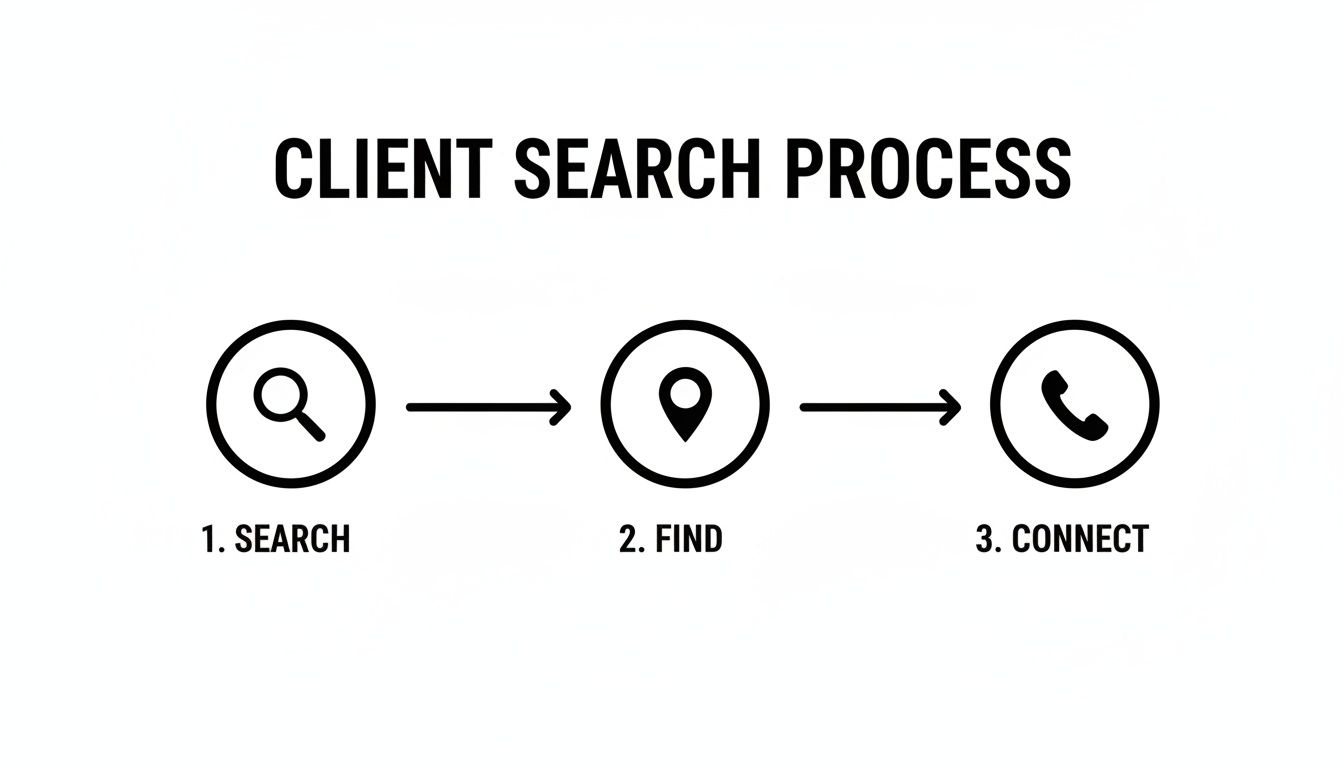
Being visible during that initial “Search” phase is non-negotiable. It’s where credibility is first established and where clients make their initial shortlist.
The Undeniable Dominance of Search
The sheer scale of search makes a digital presence mandatory. Google now processes over 8.5 billion searches every single day, making it the primary channel where clients find legal help. The data is clear: an incredible 93% of all web traffic for law firms starts on a search engine. If you don’t rank, you’re invisible to the overwhelming majority of your market.
Furthermore, with 46% of all Google searches having local intent, the battle for client acquisition is won or lost right in your backyard.
Modern Marketing Channels For Law Firms Compared
To put this in perspective, here’s a quick comparison showing why organic SEO delivers superior long-term value for attracting qualified legal clients.
| Marketing Channel | Typical Client Quality | Cost Structure | Long-Term Asset Value |
|---|---|---|---|
| Organic SEO | High (Pre-Qualified Intent) | Upfront & Ongoing Investment | High (Grows Over Time) |
| Paid Search (PPC) | Varies (Broad to Specific) | Pay-Per-Click (Stops When Paid) | Low (No Lasting Value) |
| Print/Broadcast Ads | Low (Untargeted) | High Upfront Cost | None (Campaign-Based) |
| Referrals | High (Trust-Based) | Relationship Investment | High (But Unpredictable) |
While referrals will always be valuable, SEO is the only channel that creates a predictable, scalable, and ever-growing asset for your firm.
A powerful digital footprint has become the new standard for credibility in the legal profession. If a potential high-value client can’t find you online, you effectively don’t exist in their world.
Ultimately, investing in the best SEO for lawyers isn’t just a marketing line item; it’s a fundamental business development strategy. By understanding the essential attorney marketing strategies, you can build a system that consistently attracts premium cases and solidifies your firm’s reputation as a top-tier practice.
Finding Keywords That Attract Premium Cases
To land the right clients, you have to get inside their heads. You need to understand the precise language they use when searching for your very specific expertise. Often, the difference between a low-value lead and a career-defining case is just a few carefully chosen words typed into a Google search bar.
Casting a wide net with generic terms like “lawyer near me” is a recipe for a high volume of low-quality inquiries. Real SEO for elite law firms is about precision. We’re targeting sophisticated individuals with complex problems, and they use specific, long-tail keywords that signal serious intent and financial capacity. These are the “money” keywords that directly reflect the value of the cases you want.
Beyond Basic Legal Terms
This requires a mental shift. Stop thinking about broad legal categories and start thinking about the specific, high-stakes problems your ideal clients are facing. It’s less about your practice area and more about their immediate pain point.
For instance, a firm seeking high-value divorce cases shouldn’t be targeting “family law attorney.” That’s far too broad. Instead, the focus should be on phrases like:
- “High-net-worth divorce lawyer in Miami”—This specifies both the client’s financial standing and their location.
- “International asset protection during divorce”—This points directly to a complex, cross-border legal need.
- “Business valuation for divorce proceedings”—This is a clear indicator that the client has significant commercial assets at stake.
These phrases get searched far less often, but the person behind that search is almost always a highly qualified lead ready to retain elite counsel. It’s a focused approach that makes sure your marketing dollars are spent attracting the clients who can truly move the needle for your practice.
Uncovering Competitor Keywords
One of the smartest ways to build out your keyword list is to see what’s already working for your top competitors. You don’t need to reinvent the wheel. You can simply refine it.
Powerful SEO platforms like Ahrefs and Semrush give you a direct window into your competitors’ digital playbook. You can plug in a competing firm’s website and see the exact organic keywords that are driving traffic to their practice area pages and blog posts. This kind of reverse-engineering is invaluable.
This screenshot from Ahrefs’ Keywords Explorer shows an analysis for a term like “high asset divorce attorney,” revealing its search volume and difficulty.
This data helps you find the sweet spot—keywords with healthy search volume that aren’t impossibly competitive to rank for. By identifying these proven terms, you can build a keyword map that guides your entire content strategy, from service pages to authoritative articles.
The goal isn’t just to find keywords with high search volume. The goal is to find keywords with high client value. A term with only 20 searches a month can be exponentially more valuable than one with 2,000 if it brings in the right type of case.
Mapping Keywords to the Client Journey
A potential client’s search behavior evolves. They go from vaguely researching a problem to actively looking to hire an attorney. Your keyword strategy needs to meet them at every single one of those critical moments.
This means categorizing your keywords based on what the user is trying to accomplish.
- Informational Intent (Top of Funnel): In this early stage, a person is just trying to understand their problem. They might search for “what constitutes a breach of fiduciary duty” or “how are assets divided in a Florida divorce.” Creating in-depth guides that answer these questions establishes your firm as a credible expert right from the start.
- Commercial Intent (Middle of Funnel): Now, the searcher is evaluating their options. They’re looking for the best solution, not just any solution. Keywords here often include modifiers like “best,” “top,” or direct comparisons, such as “best trust and estate litigation firms” or “comparing chapter 7 vs chapter 13 bankruptcy.”
- Transactional Intent (Bottom of Funnel): This is the final decision stage. The user is ready to hire someone. Searches become highly specific and often include a location, like “schedule consultation with a tax attorney in Aspen” or “Miami corporate lawyer for M&A.” Your core practice area pages and contact pages must be perfectly optimized for these terms to capture the lead.
When you build a keyword strategy that addresses each stage of this journey, you create a powerful system for nurturing potential clients—from their very first question to the moment they decide to retain your firm.
Designing Your Website to Convert Visitors into Clients

Think of your website as your digital office. A potential high-value client might discover you through a perfectly executed search, but if your site is slow, confusing, or feels amateur, they’re gone in seconds. A technically pristine website is the bedrock of the best seo for lawyers because it accomplishes two things: it helps search engines understand your expertise and gives visitors an experience that builds immediate trust.
This isn’t about flashy design—it’s about performance and psychology. The moment a user lands on your site, they’re making a subconscious judgment about your firm’s credibility. A seamless, professional experience signals competence and meticulous attention to detail. These are precisely the qualities every sophisticated client demands from their legal counsel.
The Foundation of a High-Performing Legal Website
Technical SEO can sound complex, but the goal is simple: make your website effortless for both Google and humans to use. Google’s business is providing the best answers, and a huge part of that is sending users to sites that work flawlessly.
It’s like building a custom home. You can have the finest interior finishes, but if the foundation is cracked, the entire structure is compromised. For your website, that foundation rests on a few non-negotiable elements:
- Mobile-First Design: Google now indexes and ranks websites based primarily on their mobile version. If your site isn’t perfectly functional and easy to navigate on a smartphone, your rankings will suffer dramatically.
- Fast Load Speeds: Every second is critical. A site taking longer than three seconds to load will see a significant number of visitors simply leave. Premium hosting and optimized images are essential for keeping potential clients engaged.
- Secure Connection (HTTPS): A secure site protects user data and is a confirmed ranking signal. An “https” in your URL is a basic, non-negotiable sign of professionalism that both search engines and clients expect.
These aren’t just items for a marketing agency’s checklist. They are fundamental to creating the positive user experience that directly influences your ability to turn a visitor into a consultation.
Crafting Pages That Convert
With a solid technical foundation in place, the focus shifts to the pages that do the heavy lifting: your practice area and attorney bio pages. These are your most valuable digital assets. They must be structured not only to rank for critical keywords but also to persuade a potential client that you are the solution they need.
Your attorney bio is often the last page a potential client visits before deciding to contact you. It’s not a résumé; it’s an opportunity to connect on a human level and showcase the specific expertise that makes you the right choice for their case.
An effective practice area page does more than list services. It tells a story, addresses the client’s specific pain points, and unequivocally positions your firm as the authority.
An equally compelling attorney bio should highlight qualifications, showcase successful outcomes (ethically, of course), and feature a professional headshot. This blend of proven expertise and personality builds the trust required for a client to feel confident picking up the phone.
Speaking Google’s Language with Schema Markup
To gain a real competitive edge, you need to make it incredibly easy for Google to understand exactly what you do. This is where schema markup comes in. Think of it as a special vocabulary you add to your site’s code that acts as a translator, explicitly telling search engines what your content means.
For law firms, two types of schema are particularly powerful:
- LegalService Schema: This markup identifies your firm as a legal service provider, specifying your distinct practice areas, the geographic regions you serve, and other key details.
- Attorney Schema: This is applied to individual bio pages to spotlight each attorney, their specialties, and their credentials.
Implementing this markup helps your firm appear in “rich results,” like featured snippets or knowledge panels, making your search listings far more prominent and clickable. It’s a sophisticated step that sends a clear signal of authority directly to the search engine—a crucial component of the best SEO for lawyers aiming to dominate a competitive market.
Winning Local Clients with Google Business Profile

For most law firms, the battle for high-value cases is won street by street, not coast to coast. When prospective clients face an urgent legal problem, they aren’t looking for a firm across the country; they’re searching for local expertise. Right now.
This reality makes your Google Business Profile (GBP) one of the most powerful client acquisition tools in your arsenal. It’s not just a digital business card. It’s your firm’s interactive storefront, often the very first impression you make.
Dominating the local “map pack”—that coveted box of three businesses at the top of local search results—can deliver a more immediate and consistent stream of qualified leads than almost any other SEO tactic.
Optimizing Your Profile for Maximum Impact
A bare-bones GBP listing with just your firm’s name, address, and phone number (NAP) is a recipe for getting lost in the noise. To compete, you have to treat your profile as a dynamic hub that actively engages and informs potential clients.
The key is to fill out every single section with meticulous, keyword-rich detail.
- Primary Category: Don’t settle for the generic “Law Firm.” Be specific. Choose “Personal Injury Attorney” or “Family Law Attorney” to attract the right kind of search.
- Services: List every distinct service you offer. Instead of a broad “Corporate Law” entry, detail the specifics: “Contract Negotiation,” “Mergers & Acquisitions,” and “Business Formation.”
- Detailed Description: Craft a compelling, 750-character description of your firm. Weave in your top keywords and geographic service areas naturally to tell Google—and potential clients—exactly who you are and what you do.
This level of detail is what separates top-ranking firms from the rest. It gives Google’s algorithm the precise signals it needs to match you with highly relevant local searches.
Leveraging GBP Features to Build Trust
A fully optimized profile is just the beginning. The most effective firms use GBP’s advanced features to turn their listing into an active marketing channel, sending strong positive signals to Google and clients alike.
Google Posts are like mini-updates that appear directly on your profile. Get in the habit of using them weekly to share:
- Case Results (Anonymized): Announce a successful verdict or settlement to showcase your expertise and build credibility.
- Firm News: Highlight a new partner, a community sponsorship, or a recent award to humanize your firm.
- Educational Content: Offer a quick answer to a common legal question and link back to a comprehensive article on your website.
The GBP Q&A section is a goldmine for controlling the narrative. Proactively add and answer the questions you know clients have, like “What do I need for an initial consultation?” or “How are your fees structured?” This addresses concerns before a prospect even has to ask.
The Critical Role of Client Reviews
Reviews are the ultimate social proof in local search. A consistent stream of positive, five-star reviews is a massive ranking factor and heavily influences a potential client’s decision to contact you.
Managing your firm’s digital reputation isn’t optional; it’s a core business function that directly impacts client trust. Digging into the fundamentals of lawyer reputation management is essential for building a five-star presence that attracts high-value clients.
Finally, amplify your local authority with local citations. A citation is any online mention of your firm’s name, address, and phone number. Getting your firm listed accurately and consistently across high-authority legal directories like Avvo, FindLaw, and Justia, as well as local business registries, reinforces your geographic relevance to search engines.
This network of consistent data solidifies your local authority and is a cornerstone of the best SEO for lawyers in any competitive market.
Building Authority with High-Value Content and Backlinks
A technically sound website and a well-optimized Google Business Profile will get you in the game. But to truly dominate search results and attract the clientele you’re after, your firm must become an undeniable authority. This is where a sophisticated approach to content and backlinks separates the leading firms from the rest of the pack.
It’s about far more than just having a blog; it’s about becoming the definitive resource for your specific legal niche. When Google sees your site provides the most comprehensive, expert-level answers to complex questions, it rewards you with top rankings.
Adopting the Pillar and Cluster Model
One of the most effective ways to organize and showcase this expertise is through the pillar-cluster content model. Think of it like authoring a definitive book on a core legal topic.
The pillar page is the book itself—a comprehensive, long-form guide covering a major practice area, such as “The Complete Guide to High-Asset Divorce in Florida.” It’s designed to touch on all the essential subtopics your clients are searching for.
The cluster content then acts as the individual chapters, taking a deep dive into each of those subtopics. These are shorter, more focused articles like “Valuing a Business in a Florida Divorce” or “Protecting Separate Property and Inheritances.” Crucially, each cluster article links back up to the main pillar page, creating a powerful web of interconnected content that signals deep expertise to both users and search engines.
This structure really works because it allows you to:
- Target Broad and Specific Keywords: The pillar page can rank for high-volume terms, while the cluster articles capture very specific, long-tail searches that indicate strong intent.
- Organize Your Expertise: It provides a clear, logical framework for your site’s content, dramatically improving the user experience.
- Build Internal Links: The strategic linking between pillar and cluster pages distributes authority across your entire website, lifting the performance of all related pages.
As you build out your content, exploring the various facets of content marketing for legal firms can spark additional ideas for topics that truly resonate with your ideal clientele.
High-Authority Content Ideas For Law Firms
Your content needs to move well beyond generic legal definitions. To attract discerning clients, you must answer their sophisticated questions with substance and depth.
The table below outlines a few high-value content formats that are proven to establish authority and attract the right kind of attention.
| Content Type | Primary Goal | Target Audience | Example Topic |
|---|---|---|---|
| In-Depth Legal Guides | Establish Topical Authority | Individuals Researching a Complex Problem | “Navigating SEC Investigations for Corporate Executives” |
| Case Studies (Anonymized) | Demonstrate Proven Results | Potential Clients Evaluating Firms | “How We Secured a Favorable Outcome in a Multi-State Trust Dispute” |
| Executive Briefings | Attract C-Suite & Business Owners | High-Net-Worth Business Leaders | “Q2 Legal Update: Key Considerations for Tech Founders” |
| “How-To” Process Articles | Answer Procedural Questions | Clients Unsure of the Legal Process | “The Step-by-Step Process of Probate in California” |
Ultimately, this kind of content serves as the foundation for earning the trust of both potential clients and other authorities online.
Earning Backlinks That Signal Trust
Great content is the bait, but backlinks are what reel in top rankings. A backlink is simply a link from another website to yours. In Google’s eyes, a link from a respected, relevant source acts as a powerful vote of confidence in your firm’s expertise.
Not all links are created equal, though. A link from a low-quality directory is worthless. The real goal is to earn high-authority editorial links—links that are given freely because your content or expertise is genuinely valuable.
Think of it this way: A single backlink from a respected publication like The Wall Street Journal or a major industry trade journal is worth more than hundreds of links from generic legal directories. It’s a powerful trust signal that is impossible to fake.
Achieving this caliber of link requires a proactive approach.
Proactive Strategies for High-Quality Link Building
Instead of just publishing content and hoping for the best, you have to create opportunities to earn these valuable links. This is where digital public relations comes into play.
- Guest Writing for Business Journals: Offer to write an insightful article for a respected business or finance publication that your target clients read. This positions you as a leading expert and almost always includes a link back to your bio or firm website.
- Becoming a Source for Journalists: Services like HARO (Help a Reporter Out) connect journalists with expert sources on a deadline. Providing a timely, sharp quote can land you a mention—and a powerful link—in major news outlets.
- Legal Community Engagement: Actively participate in legal forums or contribute to continuing legal education (CLE) materials online. This can lead to natural links from bar associations, law schools, and other respected legal organizations.
This dual focus on creating exceptional content and earning authoritative backlinks is a long-term investment, but the payoff is immense. Law firms report an average 526% return on investment from SEO efforts within just three years, with business law practices seeing an even more impressive 642%. The data confirms it: organic search, which drives 52.6% of all website traffic, is the most powerful and profitable client acquisition channel available. To see a full breakdown of these figures, you can explore detailed legal marketing statistics on Andava.com.
Answering The Tough Questions About Law Firm SEO
Diving into search engine optimization can feel like deciphering a foreign language. With endless information out there, it’s only natural to have questions about the process, the investment, and what it all means for your firm’s bottom line. Here are some direct, no-nonsense answers to the questions we hear most from attorneys.
How Long Does This Actually Take to Work?
This is always the first question, and the answer isn’t a simple one. SEO is a long-term play, but that doesn’t mean you’re left in the dark for a year.
For most law firms in competitive markets, you can expect to see meaningful traction within 6 to 12 months. By “meaningful,” I mean first-page rankings for valuable, high-intent keywords that start bringing in qualified calls and form submissions.
That said, you don’t have to wait half a year to see signs that things are moving in the right direction. Early wins often show up much sooner.
- Months 1-3: This is the foundational stage. We’re fixing technical glitches on your site, getting your Google Business Profile dialed in, and you should start seeing better visibility in local map searches.
- Months 4-6: Your first big content pieces should begin ranking for less competitive, long-tail keywords. This is when you’ll notice a real uptick in organic traffic and the first few leads start trickling in from these efforts.
Think of SEO as an investment that compounds over time. The authority you build in year one creates a powerful foundation for growth that will far outlast and outperform any short-term ad campaign.
Can I Just Do This Myself, or Do I Need to Hire Someone?
While you could certainly learn the fundamentals of SEO, the legal space is one of the most brutal and competitive online arenas. Getting the best SEO for lawyers requires more than just technical skill—it demands a deep understanding of client intent for different practice areas, strict adherence to legal marketing ethics, and a massive time commitment.
Let’s be realistic. For most busy attorneys, the hours required to properly research keywords, write authoritative content, build high-quality links, and manage technical site health just aren’t there.
A much better approach is to get a firm grasp of the basics. This empowers you to ask intelligent questions and partner confidently with a specialized legal SEO agency. They can execute a winning strategy on your behalf, freeing you up to do what you do best: practice law.
What’s a Realistic Budget for a Competitive Campaign?
SEO investment for law firms isn’t a one-size-fits-all product. The right budget depends entirely on your geography, how competitive your practice area is, and your firm’s ambitions for growth.
But to give you a general benchmark:
- A firm in a smaller city or a less crowded niche might invest $2,500 – $5,000 per month.
- For a practice in a major metro like New York or Los Angeles, targeting high-value cases like personal injury or corporate law, a budget of $7,000 – $15,000+ per month is much more typical.
It’s critical to stop thinking of this as a “marketing cost” and start seeing it as an investment in a revenue-generating asset. A well-executed SEO campaign can bring in the kind of high-value cases that pay for the entire year’s investment many times over, delivering a proven ROI that most other channels can’t touch.
How Do I Know If It’s Actually Working? (Measuring ROI)
Measuring the return on your SEO investment goes way beyond tracking keyword rankings or website visits. Those are vanity metrics. What really matters are the numbers that directly impact your firm’s revenue.
To calculate a true ROI, you have to connect your SEO efforts to actual client acquisition. It’s about moving from high-level data to concrete business outcomes that prove SEO is a powerful engine for your firm’s growth.
A clear and effective measurement framework boils down to three core metrics:
- Organic Leads: The total number of new inquiries from organic search. This must include both contact form submissions and, crucially, phone calls tracked with a dedicated call-tracking number.
- Lead-to-Client Conversion Rate: The percentage of those organic leads that sign on as paying clients.
- Average Case Value: The average revenue your firm generates from a single client that came from your SEO efforts.
When you multiply these three numbers, you get the actual revenue generated by your campaign. Compare that figure to your monthly investment, and you have a clear, undeniable picture of your SEO ROI.
Ready to elevate your firm’s visibility and attract the high-value clients you deserve? The Haute Lawyer Network is a curated, invitation-only network that connects the nation’s top attorneys with an elite audience through Haute Living’s powerful media ecosystem. Unlike standard directories, we offer premier branding, editorial features, and unparalleled exposure to a high-net-worth clientele. Discover how our targeted approach can become the cornerstone of your marketing strategy by exploring our network at https://hauteliving.com/lawyernetwork.