
Trying to pin down the average retainer fee for a lawyer is a bit like asking for the price of a car—it depends entirely on the model. That said, for most common legal situations, you can expect the initial retainer to fall somewhere between $2,000 and $5,000.
This upfront payment isn’t the final bill. Think of it as a down payment that secures your lawyer’s services and gets the ball rolling on your case.
What Is a Typical Lawyer Retainer Fee
Imagine you’re commissioning a custom piece of furniture. You wouldn’t expect the craftsman to start ordering materials and clearing their schedule without a deposit. You pay an upfront fee to reserve their time, cover initial costs, and formalize the engagement. That payment ensures your project becomes a priority.
A lawyer’s retainer works in much the same way. It guarantees their availability and compensates them for the time they’ll immediately dedicate to you—time they might otherwise have spent on another client’s case. As your attorney works—drafting documents, making calls, or preparing for court—they bill their hourly rate against this prepaid fund.
Common Retainer Fee Benchmarks
While there’s no universal price tag, you can get a good idea of what to expect by looking at industry benchmarks. Across major markets in the U.S. and UK, a standard legal issue will often require an initial retainer of $1,000 to $5,000.
For example, family law matters, which can be emotionally charged and time-intensive, frequently start in the $2,000–$5,000 range. In contrast, a more straightforward business formation might only require a $1,000 retainer to get started. If you want to dive deeper, Clio’s detailed guide offers more insight into retainer fee variations.
This chart gives you a quick visual comparison for two very different legal fields.
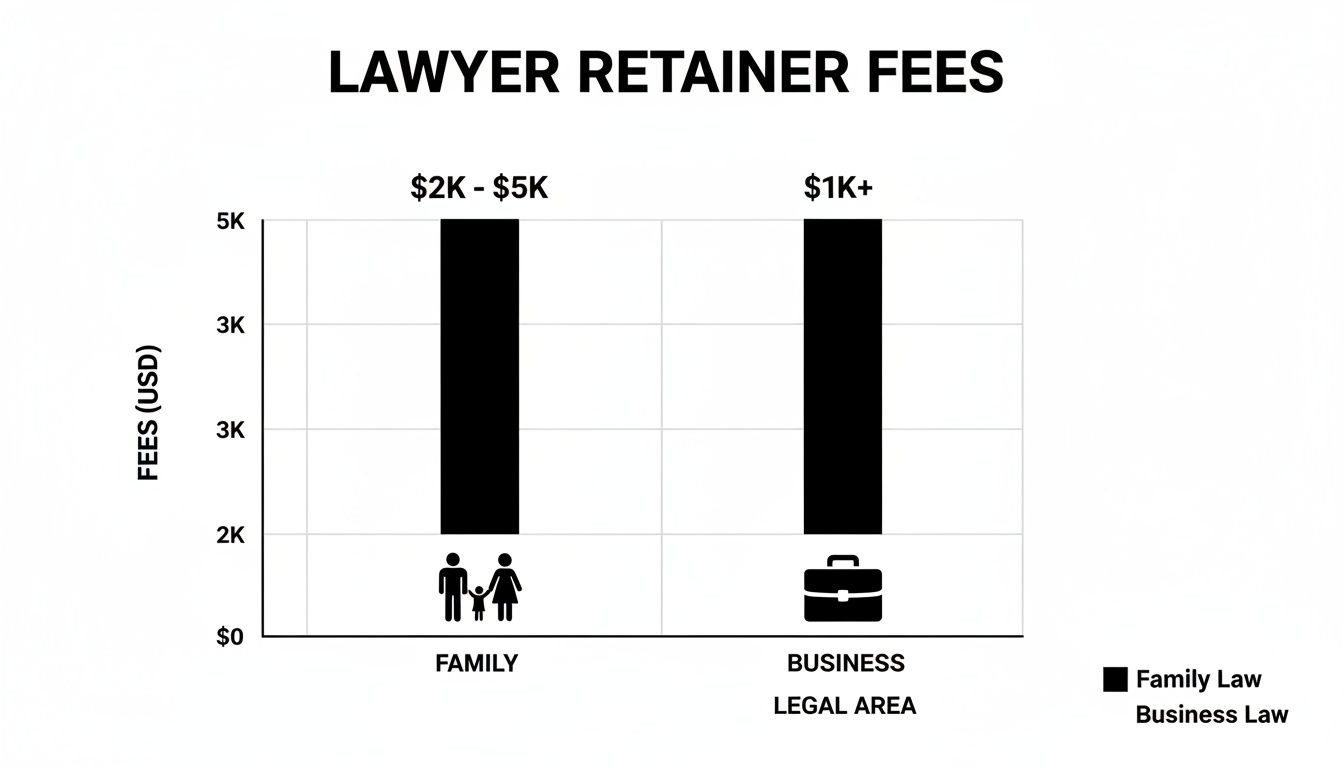
As you can see, family law cases typically demand a higher initial payment. The higher upfront cost reflects the expected complexity and the significant number of hours needed right at the outset of the case.
Key Takeaway: A retainer is not the total cost of legal representation. It’s an initial deposit. Your final bill could be higher or lower, depending on the twists and turns your case takes.
To give you a clearer picture of how this plays out across different legal specialties, the table below breaks down some estimated ranges. This should serve as a solid starting point for what you might expect.
Estimated Retainer Fee Ranges by Common Practice Area
This table provides a quick reference for typical retainer fee ranges across various common legal fields, helping you benchmark potential costs.
| Practice Area | Typical Low-End Retainer | Typical High-End Retainer | Notes |
|---|---|---|---|
| Family Law | $2,500 | $7,500 | Can be higher for contentious divorces with custody disputes. |
| Criminal Defense | $2,000 | $10,000+ | Misdemeanors are on the lower end; felony cases are significantly higher. |
| Business Formation | $1,000 | $3,500 | For services like LLC formation and initial contract drafting. |
| Personal Injury | Varies (Often Contingency) | Varies (Often Contingency) | Most personal injury lawyers work on a contingency basis, not retainers. |
| Estate Planning | $1,500 | $5,000 | Covers drafting wills, trusts, and power of attorney documents. |
Remember, these figures are estimates. The actual retainer you’re quoted will depend on the specifics of your case, your location, and the attorney’s own experience and fee structure.
Breaking Down the Different Types of Retainer Agreements
Not all legal retainers are structured the same. Thinking the term “retainer” is one-size-fits-all is like assuming all vehicles are sedans. Just as you have trucks, SUVs, and sports cars for different purposes, retainers come in several forms, each designed for a specific legal need and financial situation.
Understanding these models is the first step to confidently discussing your options with a prospective attorney. Let’s unpack the most common structures so you know exactly what you’re paying for.

The Classic Retainer: A Prepaid Debit Card
The most familiar model is the classic retainer, often called a security retainer. Think of it as a prepaid debit card for your lawyer’s time. You deposit a lump sum—say, $5,000—into a protected client trust account. As your lawyer logs hours on your case, they draw their fees from that balance.
If your attorney works for five hours at $400 per hour, they bill $2,000 against your retainer, leaving a $3,000 balance. Critically, the lawyer only “earns” that money after the work is done. Any unused funds are returned to you when your case concludes, making it a highly transparent arrangement.
Key Insight: Under a classic retainer model, the funds remain your property until the lawyer performs the work and invoices against them. This structure is governed by strict ethical rules to protect your money.
The Evergreen Retainer: A Self-Reloading Account
For complex, long-term legal battles that can span months or years, the evergreen retainer is common. This structure operates like a subscription that auto-renews to ensure your legal team is always funded and ready to act. You start with an initial retainer and agree to maintain a minimum balance.
Here’s how it works:
- Initial Deposit: You pay a starting retainer of $10,000.
- Minimum Threshold: Your agreement specifies the balance cannot drop below $2,500.
- Billing Cycle: After the first month, your lawyer bills $8,000 in fees, leaving $2,000.
- Replenishment: Since the balance fell below the threshold, you deposit another $8,000 to bring it back to the original $10,000.
This system prevents billing delays from stalling progress on your case and provides financial predictability for both sides. To see how these terms are formalized, you can learn more about what is in a retainer agreement.
The Flat-Fee Retainer: An All-Inclusive Price
A flat-fee retainer is precisely what it sounds like—a single, fixed payment that covers a well-defined legal project from start to finish. It’s like buying an all-inclusive ticket for a specific journey. You know the total cost before the work even begins.
This model is perfect for predictable legal tasks with a clear scope. Common examples include:
- Drafting a standard will or trust.
- Handling an uncontested divorce.
- Managing a straightforward real estate closing.
- Filing a trademark application.
The biggest advantage here is cost certainty. You don’t have to watch the clock on hourly billing, and the attorney is incentivized to work efficiently, as their fee is locked in regardless of the hours spent.
The True Retainer: Securing Exclusive Access
Finally, there’s the true retainer, a less common arrangement reserved for securing access to a high-demand legal expert. This isn’t a down payment for future work. Instead, you are paying a premium simply to guarantee that lawyer’s availability and—just as importantly—to prevent them from being hired by your opponent.
Think of it as paying a VIP fee to keep a top specialist on call exclusively for you. Because this fee compensates the lawyer for turning away other potential clients, it is typically considered earned upon receipt and may be non-refundable. This crucial detail must be spelled out clearly in your agreement, as it’s a major departure from other retainer models.
Key Factors That Influence Your Lawyer’s Retainer Quote
Ever wonder why one lawyer quotes a $2,000 retainer for your case while another, just down the street, asks for $10,000? This isn’t random. That number is the result of a careful calculation, weighing the risk, effort, and expertise your legal issue demands.
Getting past the sticker shock requires understanding what drives these quotes. Once you know the key variables, you can make a much smarter decision about who to bring onto your team.

Experience and Specialization Matter
A lawyer’s background is probably the single biggest factor. Think of it this way: you could hire a general handyman to fix your plumbing, or you could call a master plumber who specializes in historic homes. The master plumber costs more per hour, but they bring a depth of knowledge that solves the problem faster and prevents future issues.
It’s the same in law. A seasoned trial attorney with a deep focus on intellectual property litigation will command a much higher retainer than a general practitioner fresh out of law school. You’re not just paying for their time; you’re paying for their proven track record, their strategic foresight, and their ability to navigate traps a generalist might never see coming.
The Complexity of Your Case
Not all legal problems are built the same. A simple, uncontested divorce follows a fairly predictable path, which translates into a lower, more predictable retainer. But a high-asset divorce involving business valuations, international assets, and a contentious custody battle is an entirely different beast.
The more complex the situation, the higher the retainer. It’s a direct reflection of the hours the legal team anticipates needing for critical tasks right from the start.
- Discovery: Sifting through thousands of documents, emails, and financial records.
- Depositions: The time-intensive process of questioning witnesses and the opposing party under oath.
- Legal Research: Digging into obscure case law and specific statutes that could make or break the case.
- Motions and Filings: Drafting and arguing countless legal documents before a judge.
The initial retainer is essentially the attorney’s best estimate of the upfront work required to get control of this complexity.
Real-World Example: Someone forming a basic single-member LLC might see a retainer quote of around $1,500. In contrast, a group of founders launching a tech startup—requiring sophisticated operating agreements, investor provisions, and IP protections—could easily face a $15,000 retainer. The legal workload is just fundamentally different.
Geographic Location Sets the Baseline
Just like a house in Manhattan costs more than one in Omaha, legal fees are heavily influenced by geography. An attorney practicing in a major metro area like New York City or San Francisco has massive overhead—prime office rent, competitive staff salaries, and higher marketing costs.
Those operational expenses are baked directly into their hourly rates and, by extension, their retainer fees. It’s not uncommon for a lawyer in a high-cost city to charge $600 per hour for the same work an equally skilled lawyer in a smaller town might do for $250. To see a more detailed breakdown, you can learn more about how much a lawyer costs based on these and other market factors.
Firm Size and Reputation
The prestige and scale of a law firm also play a huge role. A large, globally recognized firm with a history of landmark victories charges a premium for its brand. That reputation isn’t just for show; it can be a powerful strategic advantage in negotiations and litigation.
On the other hand, a solo practitioner or a small boutique firm has less overhead and can often offer more competitive pricing. They might not have the big corporate name, but they can provide highly personalized service. This difference becomes especially stark at the top end of the market, where partner rates at elite U.S. firms now average $2,400–$2,500 per hour. This can push retainers for high-level corporate work into the $10,000–$100,000 range for even limited engagements.
The Urgency of the Matter
Finally, timing is everything. If you walk in with a legal emergency—like a temporary restraining order hearing scheduled for the next morning—an attorney has to drop everything else. This “ER service” comes at a premium.
That urgency forces a complete reshuffling of their workload and requires immediate, intense focus. A higher retainer reflects the cost of that disruption and the immediate prioritization of your case over all others.
The following table breaks down how these different factors can push your retainer fee up or down.
How Different Factors Impact Retainer Fee Calculations
| Influencing Factor | Impact on Retainer Fee | Example Scenario |
|---|---|---|
| Attorney Experience | Increases | Hiring a board-certified trial lawyer with 30 years of experience vs. a junior associate. |
| Case Complexity | Increases | A multi-state business dispute with complex discovery vs. a simple breach of contract case. |
| Geographic Location | Varies (Increases in Major Cities) | An attorney in downtown Los Angeles will have higher overhead and rates than one in a small town. |
| Firm Size/Prestige | Increases | A large, top-ranked international law firm vs. a solo practitioner working from a home office. |
| Urgency | Increases | Needing an emergency injunction filed overnight vs. a legal matter with a flexible timeline. |
| Predictability of Work | Decreases | A flat-fee uncontested divorce with a clear scope vs. open-ended, unpredictable litigation. |
As you can see, the final number is a blend of these practical business realities. Understanding them is the first step toward finding the right counsel at a price that makes sense for your specific situation.
How to Navigate Retainer Agreements and Negotiations
When an attorney sends over a retainer agreement, it can feel like you’re signing a dense legal contract before your case has even started. But this document isn’t something to fear—it’s your roadmap. It establishes the rules of engagement and is the best tool you have for ensuring total transparency with your legal counsel.
Think of the retainer agreement as the constitution for your legal representation. It should clearly define the scope of the work, detail the fee structure, and explain exactly how you’ll be billed. Your job is to read it, understand it, and ask questions until every term is crystal clear.
Key Questions to Ask Before You Sign
Before you commit, it’s critical to get answers to a few fundamental questions. Having this conversation upfront prevents costly misunderstandings down the road and ensures you and your lawyer are perfectly aligned. This is how you avoid any surprises about how the average retainer fee for a lawyer is actually applied to your specific case.
Come to the conversation prepared to discuss these points:
- Scope of Services: “What specific legal services does this retainer cover? What would be considered out-of-scope and billable as an additional fee?”
- Billing Practices: “How is your time tracked? Will I get itemized monthly statements showing exactly how my retainer is being used?”
- Communication: “Who is my main point of contact? Are calls, emails, and meetings billed against the retainer?”
- Refunds and Unused Funds: “Under what circumstances is the retainer refundable? What happens to any leftover funds when my case concludes?”
These aren’t confrontational questions; they’re essential business inquiries. Any reputable attorney will welcome them and give you straight answers. For a more comprehensive checklist, consider these additional questions to ask a lawyer before hiring them.
Client Protection Alert: One of the most critical questions you can ask is, “Will my retainer be held in a client trust account?” The answer must be yes. Ethical rules require lawyers to keep client funds separate from their firm’s operating accounts, safeguarding your money until it is officially earned.
Negotiating Your Retainer Fee and Terms
Many clients don’t realize that a retainer agreement isn’t always a take-it-or-leave-it deal. While an attorney’s hourly rate is often set in stone, other parts of the fee structure may be open to discussion, particularly if you have a strong case or the potential for a long-term professional relationship.
Don’t be afraid to open a respectful conversation about the terms. You might be able to negotiate:
- The Initial Retainer Amount: If the upfront payment is a hurdle, ask if the attorney would consider a smaller initial retainer with the understanding you’ll need to replenish it sooner.
- A Payment Plan: Some firms are willing to break the initial retainer into two or three manageable installments, which can ease the immediate financial burden.
- The Evergreen Threshold: For evergreen retainers, you might be able to negotiate a lower minimum balance that needs to be maintained, which can improve your cash flow.
The key is to be transparent about your financial situation and approach the negotiation as a collaborative partner.
The Rise of Retainers as a Standard Practice
If paying a lawyer a retainer feels like a new concept, it’s worth knowing it has become an increasingly standard part of the legal industry. The predictability it offers is a win-win: law firms can better manage their cash flow, and clients can budget more effectively for legal costs.
Recent industry data confirms this shift. Benchmarking surveys show that retainers are now a common billing method. For instance, one corporate market survey found that about 36% of in-house legal departments use retainers, up from 29% the prior year. Meanwhile, surveys of law firms themselves report that roughly 60–67% offer retainers as a standard option. You can discover more insights about this growing trend toward retainers on Legal Dive.
Ultimately, a well-drafted retainer agreement is the bedrock of a successful attorney-client relationship. By asking the right questions and understanding your options, you can move forward with confidence, knowing exactly what to expect.
Exploring Alternatives to Traditional Retainer Fees
While retainers are a standard part of the legal world, they aren’t the only way to fund your case. For many situations, an alternative fee arrangement (AFA) can offer far more predictability and flexibility. Understanding these options helps you find a payment structure that actually aligns with your financial reality and the unique demands of your legal matter.
A retainer isn’t always the best fit. Sometimes the scope of work is highly unpredictable, and other times it’s incredibly straightforward. Recognizing this, the legal industry has evolved several other models to better serve clients.

Contingency Fees: The Ultimate Pay-for-Performance Model
Perhaps the most well-known alternative is the contingency fee. This arrangement is the backbone of personal injury, medical malpractice, and other cases where a monetary settlement is the end goal.
Instead of paying anything upfront, you agree to give your lawyer a percentage of the final amount you win. This share typically ranges from 33% to 40% and is only paid if your case succeeds.
Key Takeaway: With a contingency fee, the law firm assumes the financial risk. If you don’t win, you owe no attorney fees, though you may still cover court costs and other direct expenses.
This model perfectly aligns your lawyer’s incentives with your own—they get paid only if you do. It opens the doors of the courthouse to people who have a strong case but simply lack the funds for a traditional retainer.
Flat Fees: Predictability for Defined Projects
For legal tasks with a clear beginning and end, a flat fee (or fixed fee) is an excellent choice. You pay one single, predetermined price for a specific service, no matter how many hours the lawyer actually spends on it.
This approach gives you total cost certainty, which is a massive relief for anyone trying to stick to a budget. It completely removes the anxiety of watching the clock on hourly billing.
Common legal services offered on a flat-fee basis include:
- Estate Planning: Drafting a will, trust, or power of attorney.
- Business Formation: Setting up a new LLC or corporation.
- Uncontested Divorce: Handling all the paperwork for an amicable split.
- Trademark Registration: Filing an application with the U.S. Patent and Trademark Office.
With a flat fee, you’re buying a defined outcome, not just renting an attorney’s time.
Subscription Services: Ongoing Counsel for Businesses
A newer and increasingly popular model, especially for small and medium-sized businesses, is the legal subscription service. Think of it like having a lawyer on call, but for a predictable monthly cost.
You pay a fixed monthly fee for access to an attorney for a set number of hours or for a specific menu of services, like contract reviews, compliance advice, or drafting demand letters.
This model is a game-changer for businesses that need regular legal guidance but aren’t large enough to hire a full-time in-house counsel. It transforms legal services from a reactive, unpredictable expense into a manageable operational cost. This allows you to handle small issues before they explode into expensive legal battles, giving you both peace of mind and financial stability.
Common Questions About Lawyer Retainer Fees
Even with a grasp of the different retainer models, it’s perfectly normal to have questions about how these agreements function in the real world. Below are straightforward answers to the most common questions clients have when entering a retainer agreement.
Are Retainer Fees Refundable?
In most cases, yes. The majority of retainers are structured as security retainers, which act as a deposit for work that hasn’t been performed yet. Think of it like pre-paying for a service—the money is technically still yours until the lawyer earns it by billing their time against it. If your case is resolved and there’s still money in your trust account, your lawyer is legally required to return it.
However, a less common arrangement known as a true retainer is sometimes non-refundable. This type of fee is paid solely to secure an attorney’s availability, meaning they may have turned away other potential clients to guarantee they could represent you. Your fee agreement must explicitly state whether the retainer is refundable or not.
What If My Retainer Runs Out?
This happens frequently, especially in complex or drawn-out legal matters. Once your initial retainer is depleted, your attorney will usually switch to billing you monthly for their work at the agreed-upon hourly rate.
Some firms prefer an evergreen retainer model to prevent work stoppages. With this setup, your agreement will stipulate that you must replenish the retainer balance whenever it drops below a certain threshold. This ensures your legal representation continues without interruption, but you should always clarify this process before signing.
Pro Tip: Always request regular, detailed invoices from your lawyer. This transparency allows you to see exactly how your funds are being used and helps you anticipate when a replenishment might be needed, eliminating any unwelcome billing surprises.
Can I Negotiate a Retainer Fee?
Absolutely. While a top attorney’s hourly rate is often set in stone, the retainer amount and its payment structure are frequently negotiable. Your ability to negotiate will depend on the firm’s policies, the specifics of your case, and your own approach to the conversation.
For instance, you might propose breaking the initial retainer into two or three installments to make the upfront cost more manageable. A frank, respectful discussion about your budget and financial constraints can often result in a creative solution that works for both you and the law firm.
Does a Higher Retainer Mean a Better Lawyer?
Not necessarily. A high retainer is typically a reflection of other factors—the lawyer’s years of experience, the anticipated complexity of the case, the firm’s prestige, or the prevailing market rates in a major city like New York or Los Angeles. The average retainer fee for a lawyer is just a benchmark, not a definitive measure of quality.
The “best” lawyer for you is one who possesses the specific expertise your situation demands and with whom you can build a strong rapport. Don’t let price be your sole criterion. Instead, focus on finding an attorney whose skills, strategy, and communication style align with your needs.