
When you’re dealing with the financial side of a workplace injury, one question always comes up: are workers’ comp settlements taxable?
Let’s cut right to the chase. In almost every case, your workers’ compensation settlement is not taxable by the IRS or your state. It’s best to think of it not as a paycheck, but as a fund to help you recover what you lost.
Why Your Settlement Is Almost Always Tax-Free

The government’s reasoning here is simple: your settlement is restorative, not an income boost. The money is meant to reimburse you for your health and lost earning ability—not to give you a windfall. This principle is a cornerstone of the entire workers’ compensation system, designed to give you a hand without creating a new tax headache.
Historically, the IRS has treated these benefits much like it treats long-term disability payments, which helps cement their non-taxable status. It doesn’t matter if you receive weekly checks or a single lump-sum payment; the rule stays the same. You typically won’t get a W-2 or 1099 for these benefits, which is another clear sign they aren’t considered taxable income. Learn more about the truth of taxes on workers’ comp settlements.
Key Takeaway: The IRS doesn’t tax workers’ compensation because the funds are designed to make you financially whole after an injury, not to make you rich.
What Parts Are Tax-Free
Most of what’s in a typical settlement is covered by this tax-free protection. The two biggest components are:
- Medical Payments: Any money specifically for your medical bills—from hospital stays and surgeries to physical therapy—is completely non-taxable.
- Lost Wages (Indemnity): The portion that compensates you for the paychecks you missed while you were out of work is also tax-exempt.
But it’s not always so cut-and-dry. While the bulk of your settlement is safe, there are a few exceptions that can make certain parts taxable. Knowing the difference is key to managing your finances after you settle.
Here’s a table to quickly break down what’s usually taxed and what isn’t.
Taxable vs Non-Taxable Settlement Components
| Settlement Component | Taxable Status | Why It’s Not (Or Is) Taxed |
|---|---|---|
| Medical Expenses | Non-Taxable | Reimburses you for direct costs of the injury. |
| Lost Wages | Non-Taxable | Compensates for income lost due to the injury. |
| Punitive Damages | Taxable | Meant to punish the employer, not restore a loss. |
| Interest on Award | Taxable | Considered investment income earned on the settlement. |
This quick guide should help you see how the IRS views the different parts of your award. Understanding this distinction is the first step in protecting your settlement money.
Why the IRS Generally Considers Your Settlement Tax-Free
To understand why the answer to “are workers’ comp settlements taxable?” is almost always “no,” you have to see it from the IRS’s perspective. The government doesn’t view your settlement as a paycheck or a windfall. It’s treated as reimbursement—financial first aid meant to put you back in the position you were in before the injury.
Think of it this way: if a hailstorm wrecks your roof and your insurance pays for the repairs, you wouldn’t call that payment “income.” You’re just being made whole again. Workers’ compensation is built on that exact same principle. The money is there to repair the financial damage your workplace injury caused.
This restorative purpose is why the core of your settlement is shielded from taxes. The entire system is designed to provide relief, and slapping a tax bill on that relief would defeat the purpose. In fact, IRS Publication 525 is clear: amounts you receive for an occupational sickness or injury are fully tax-exempt if they are paid under a workers’ compensation act.
The Building Blocks of a Tax-Free Settlement
Your settlement isn’t just one lump sum; it’s a combination of different types of compensation, each with a specific, non-taxable job. The funds are carefully allocated to cover the distinct losses you’ve suffered.
The main tax-free components almost always include:
- Medical Expense Reimbursement: Any part of the settlement that covers your medical bills is non-taxable. This includes everything from surgeries and physical therapy to prescription drugs and hospital stays.
- Lost Wage Compensation: Often called indemnity benefits, this portion replaces the paychecks you missed while you couldn’t work. Because it’s meant to substitute your after-tax take-home pay, the IRS doesn’t tax it a second time.
- Awards for Permanent Physical Harm: If your injury resulted in a permanent disability, like the loss of a limb or permanently reduced mobility, the compensation for that loss is also tax-free.
By classifying these benefits as non-taxable, the government ensures the financial support you receive goes directly toward your recovery and stability, not into federal coffers.
This framework protects injured workers when they’re most vulnerable. It makes sure the funds intended to help you get back on your feet—physically and financially—aren’t chipped away by an unexpected tax liability.
While this is the standard rule, there are critical exceptions to be aware of. But the foundational principle is simple: your settlement is for restoration, not revenue. This is the key reason why workers’ comp settlements are not taxable in the vast majority of cases across the United States.
Uncovering the Exceptions That Trigger Tax Liability
While the golden rule is that workers’ compensation is generally tax-free, the devil is truly in the details. Certain exceptions can sneak up on you, creating a surprise tax bill if you’re not prepared. These issues pop up when a settlement includes money for things the IRS doesn’t consider direct payment for a physical workplace injury.
Think of your settlement as a financial first-aid kit. Most of it—like the bandages and antiseptic for your physical injuries—is completely tax-free. But if the kit also contains things like interest payments or punitive damages, the IRS views those items differently and will tax them.
When Interest Payments Become Taxable Income
Settlements can sometimes drag on for months or even years. If the insurance company is ordered to pay interest on top of your award because of that delay, the IRS considers that interest taxable income. Their logic is simple: the interest isn’t for your injury, but rather money your settlement earned while you were waiting.
For example, let’s say you’re awarded a $90,000 settlement. Because of a long delay, you also receive an extra $2,000 in interest. That $2,000 has to be reported on your tax return as income. The original $90,000 award, however, stays completely tax-free.
This visual breakdown really clarifies how different parts of a settlement are treated.
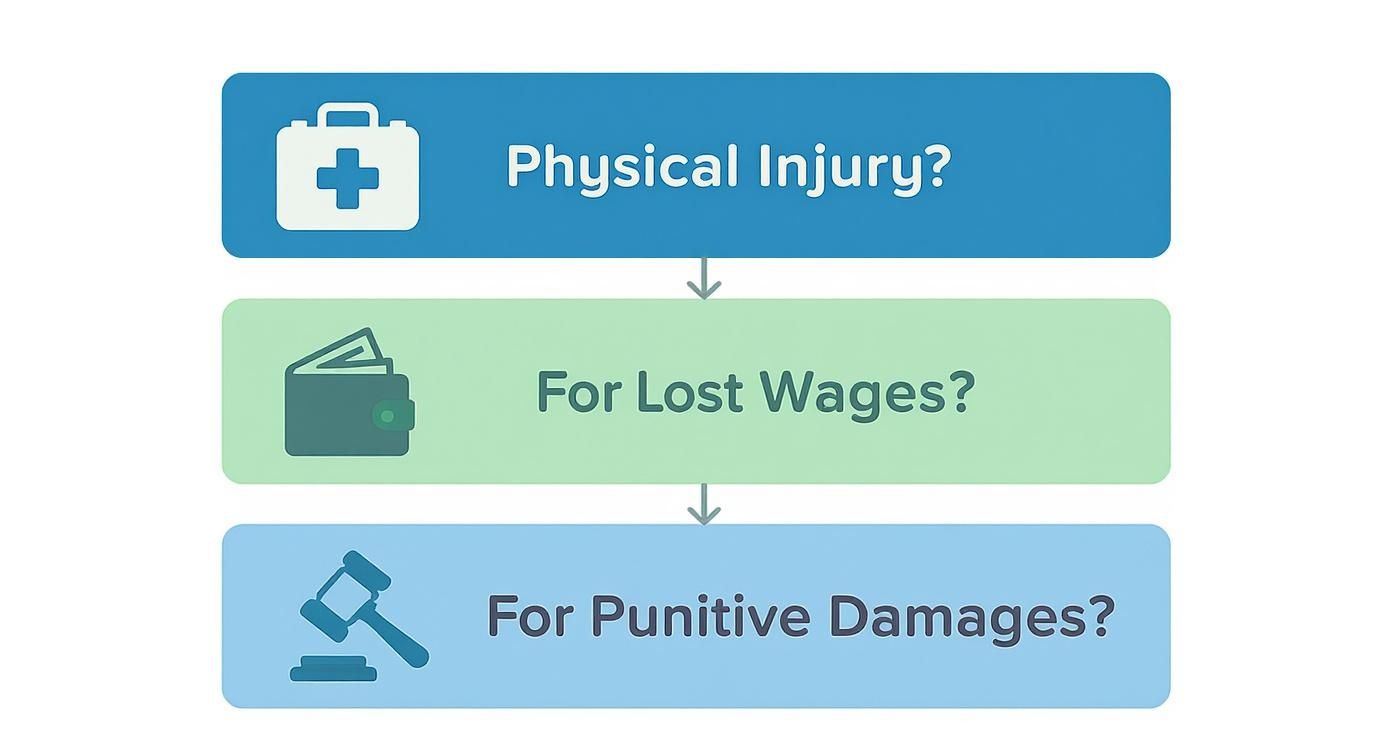
As you can see, everything hinges on what the money is for. Funds meant to cover physical harm are treated very differently from those intended to punish the employer.
The Tax Consequences of Punitive Damages
Another major exception you need to know about is punitive damages. These aren’t meant to compensate you for your losses; they’re designed to punish an employer for truly reckless or egregious behavior. The IRS sees these payments as a financial windfall, not a way to make you whole again.
Because punitive damages go far beyond simple compensation, they are always fully taxable. If your settlement agreement specifically carves out an amount for punitive damages, you’ll owe taxes on that portion.
Emotional Distress and Its Tax Implications
Compensation for emotional distress is a bit of a gray area, and the tax rules depend entirely on its link to your physical injury.
- Non-Taxable: If your emotional distress stems directly from a physical injury—like anxiety caused by chronic pain after a fall—any money for it is generally tax-free.
- Taxable: If you receive money for emotional distress that is not tied to a physical injury—say, from workplace harassment that didn’t cause any physical harm—that part of the settlement is taxable.
The IRS draws a very clear line here: if a physical injury is the root cause, the related emotional suffering compensation is tax-exempt. If it’s not, it’s considered taxable income.
The Social Security Disability Offset Rule
Now for what is easily the most complex exception: the tangled web between workers’ comp and Social Security Disability Insurance (SSDI). The Social Security Administration can reduce your SSDI benefits if your combined workers’ comp and SSDI payments climb above 80% of what you earned before your injury. It’s called a “workers’ comp offset.”
Here’s the kicker: the slice of your workers’ comp settlement that triggers this reduction in your SSDI benefits can become taxable. Why? Because the IRS views that portion of your settlement as a replacement for what would have been taxable SSDI income. It’s a rule designed to prevent you from “double-dipping” in tax-free benefits, and it often requires a skilled attorney to structure the settlement agreement to minimize this tax hit.
While the primary rule of thumb is that workers’ comp is tax-free, these specific exceptions can have a major financial impact. The table below breaks down the most common taxable elements you might encounter.
Common Taxable Exceptions in Workers Comp Settlements
| Exception Type | Is It Taxable? | Why the IRS Considers It Taxable | Example Scenario |
|---|---|---|---|
| Interest Payments | Yes | Interest is considered investment income earned on the settlement amount, not compensation for the injury itself. | Your $100,000 settlement was delayed, and the court awarded you an additional $3,000 in interest. The $3,000 is taxable. |
| Punitive Damages | Yes | These are meant to punish the employer, not compensate you for a loss, so the IRS treats them as a financial gain. | An employer knowingly exposed workers to a hazardous chemical. You receive $50,000 for your injury and $200,000 in punitive damages. The $200,000 is taxable. |
| Emotional Distress (No Physical Injury) | Yes | If the emotional distress is not a direct result of a physical injury, the compensation is not exempt under the personal injury rule. | You receive a settlement for emotional distress caused by workplace harassment that did not result in any physical harm. That amount is taxable. |
| SSDI Offset | Potentially | The portion of your settlement that reduces your SSDI benefits is taxed because it replaces what would have been taxable SSDI income. | Your workers’ comp settlement causes your monthly SSDI benefit to be reduced by $500. An equivalent portion of your settlement may become taxable. |
Navigating these exceptions is critical for protecting the full value of your settlement. Misunderstanding these rules can lead to an unexpected and costly bill from the IRS long after your case is closed.
How Settlement Wording Can Protect Your Money

The words in your workers’ compensation agreement aren’t just legal formalities—they have a direct and powerful impact on your financial bottom line. The difference between a well-structured settlement and one that’s hastily drafted can mean thousands of dollars lost to the IRS.
It all comes down to a process called allocation. Think of it as itemizing a receipt. Instead of one lump sum, allocation meticulously labels what every dollar is meant to cover. By specifically earmarking funds for non-taxable purposes, you create a clear, defensible record that protects your money from taxation.
A vague settlement simply stating a total figure is a red flag for the IRS. It invites them to question the purpose of the funds and assume portions are taxable. A detailed, allocated agreement leaves no room for doubt.
The Power of Specific Language
Your attorney’s job is to draft language that clearly defines the purpose of every dollar. This means breaking down the settlement into its fundamental, non-taxable parts.
- Medical Expenses: The agreement must specify the exact amounts set aside for all past, present, and future medical care related to your injury.
- Lost Wages: It should clearly state the portion that reimburses you for the income you lost while unable to work. This is a direct repayment, not taxable income.
- Permanent Disability: If your injury resulted in a permanent physical impairment, the funds designated for this must be explicitly labeled.
Meticulously allocating your settlement isn’t about outsmarting the IRS. It’s about providing a transparent, accurate breakdown that aligns with federal tax law. This proactive step ensures your settlement is as tax-efficient as possible.
Workers’ compensation is a lifeline for millions. Between 2017 and 2019, the number of covered workers grew by 2.8%, highlighting its critical role. The tax-free nature of these benefits is designed to ensure the financial support intended for your recovery reaches you in full.
Avoiding Taxable Traps Through Wording
Strategic wording is especially vital when navigating potential tax traps, such as the Social Security offset. An experienced attorney can structure the language to spread the settlement payout over your life expectancy.
This technique, often called “Lump Sum Spread” or “Amortization” language, can dramatically reduce or even eliminate the offset’s impact. It’s a sophisticated move that protects both your SSDI benefits and your settlement from being unnecessarily taxed.
Ultimately, you and your legal team have significant control over this final document. Asking the right questions is crucial to protecting your interests. For more guidance, review these essential personal injury lawyer questions to ask. Taking this simple step can prevent you from paying taxes on a settlement you rightfully deserve.
State Laws and Federal Consistency: Who Calls the Shots?
When you’re trying to figure out the tax rules for your workers’ comp settlement, it helps to see the IRS as the ultimate authority. The core principle—that your benefits are non-taxable because they’re meant to make you whole again—is a federal one. This creates a predictable standard across all 50 states, from California to North Carolina.
This nationwide consistency gives injured workers a solid baseline. You can rest assured that the fundamental tax-free status of your medical and lost wage benefits won’t suddenly change if you move. While state laws handle the nitty-gritty of your claim, like benefit amounts and eligibility, they don’t get to override federal tax law.
State Rules vs. Federal Tax Law
Even though the IRS has the final say on your tax bill, state regulations are still a huge part of your claim’s journey. Think of it this way: the state decides how much money you get and how you get it, but the federal government decides if that money gets taxed.
Here’s a simple breakdown of how they work together:
- Federal Law (IRS): This is the top dog. The IRS dictates whether any portion of your settlement is considered taxable income.
- State Law: This is the on-the-ground manager. Your state’s laws govern the entire claims process, set the maximum benefit amounts, and define what legally counts as a workplace injury.
Thankfully, their goals align on the most important point: the core benefits are non-taxable. This prevents a confusing mess of conflicting rules. It’s also why good legal advice always covers both state-level claim strategy and the federal tax implications. For guidance from seasoned professionals, you can find experts in labor and employment law.
A Consistent Global View
This isn’t just an American idea. Most developed countries treat workers’ compensation benefits the same way, shielding them from taxes to avoid adding financial insult to injury. This global consensus reinforces the logic behind the U.S. system.
The European model, for example, has widely influenced reforms in other regions, emphasizing tax-free benefits to ensure workers receive the full financial support they need during recovery.
Historically, a small fraction of claims—about 12%—drive a huge portion of the total costs. This statistic highlights why comprehensive, tax-free benefits are so critical to a system that actually works. The shared understanding worldwide is clear: the point of these funds is to help people heal, not to create a new source of tax revenue.
Common Questions About Workers Comp Settlement Taxes
Once you’ve gone through the settlement process, a new set of practical questions often pops up. After covering the core IRS rules and exceptions, it’s time to tackle some of the most common concerns injured workers have. Think of this as a quick Q&A to clear up any lingering confusion and help you feel confident about where you stand.
We’ll dig into everything from how you get paid to the jolt of getting an unexpected tax form in the mail. Let’s make sure you have the real-world answers you need.
Does the Payout Method Affect My Taxes?
It’s a frequent question: does getting a single lump-sum payment change the tax situation compared to receiving structured payments over time? For tax purposes, the short answer is no. The fundamental, non-taxable nature of your workers’ comp benefits stays the same regardless of the payout schedule.
So, whether it’s one big check or a series of smaller ones, the money allocated for your medical expenses and lost wages is still tax-exempt.
There is one important wrinkle, though. A structured settlement is sometimes invested in an annuity that earns interest. While the principal payments from the settlement itself remain tax-free, any interest income that annuity generates is generally considered taxable. This is a critical detail to review with a financial advisor.
What if I Receive a 1099 Tax Form?
Getting a Form 1099 for your workers’ comp settlement is enough to cause a panic, especially since the main benefit isn’t supposed to be reported as income. This usually only happens if a specific part of your settlement is taxable—like interest payments (1099-INT) or punitive damages (1099-MISC).
Important: Do not ignore a 1099 form. The IRS gets a copy too, and failing to address it is a surefire way to trigger an audit.
If a 1099 shows up in your mailbox, here’s what to do:
- Contact the Payer: Your first call should be to the insurance company or whoever sent the form. If you believe it was sent in error, ask them to issue a correction immediately.
- Consult a Professional: Get in touch with a tax advisor who has experience with workers’ comp cases. They can confirm whether the form is correct and help you figure out the next steps.
- Report and Adjust: You might have to report the amount on your tax return but then subtract it on another line with a clear explanation, showing the IRS why it qualifies as non-taxable income under workers’ compensation law.
Can I Deduct Attorney Fees from My Taxes?
Since the vast majority of your workers’ compensation settlement isn’t considered taxable income, the IRS won’t let you deduct the legal fees you paid to get it. The logic is simple: you can’t deduct expenses that were used to obtain tax-exempt money.
The only real exception is if a portion of your settlement is taxable. For example, if you won punitive damages, you may be able to deduct the percentage of your attorney’s fees that went toward securing that specific taxable award. This is a complicated calculation and is exactly the kind of situation where you need professional tax advice. Navigating these nuances often requires top-tier legal guidance, which makes it crucial to understand how to find a lawyer who specializes in these complex matters.
Does Returning to Work Make My Settlement Taxable?
Absolutely not. Your employment status after your case is closed has zero impact on the taxability of the settlement funds you’ve already been paid. The tax treatment is locked in at the time of the settlement, based entirely on what the money was meant to cover—like past medical care and wages you already lost.
Your future career is a completely separate financial chapter. Any wages you earn when you go back to work will be subject to normal income taxes, of course, but that won’t ever retroactively change the tax-free status of your workers’ comp settlement.
When facing the complexities of workers’ compensation law and its tax implications, having an elite legal professional in your corner is invaluable. Haute Lawyer Network connects you with a curated selection of the nation’s most respected attorneys, ensuring you receive premier guidance. Elevate your legal strategy and find the expert representation you deserve today.