
When an eviction judgment is handed down, it’s easy to feel like the fight is over. But for many tenants, it’s not the final word. Choosing to appeal an eviction is your right to ask a higher court to take a second look at the original judge’s decision, scrutinizing it for significant legal errors.
This isn’t just about disagreeing with the outcome. It’s a formal, time-sensitive legal proceeding, and the first step is understanding what an appeal truly is—and what it isn’t.
What It Really Means to Appeal an Eviction

Many tenants fall into the trap of thinking an appeal is a second chance to tell their story or introduce evidence they forgot the first time. It’s not. The appellate court won’t rehear the case from scratch.
Think of the appellate judges as referees reviewing the game tape. Their sole job is to determine if the trial court judge made a mistake in applying the law or following legal procedure during your original hearing.
This distinction is everything. An appeal has to be built on a real, identifiable legal mistake, not just a gut feeling of unfairness. Arguing that “the judge didn’t believe me” will get you nowhere. Arguing that the judge ignored a key statute about proper eviction notices, however, gives you a legitimate foundation for an appeal.
Eligibility and the Race Against Time
So, who can appeal? Any party in the original case who is dissatisfied with the final judgment has the right to file. While this is almost always the tenant, a landlord could technically appeal if the judge ruled against them on a critical legal issue.
The biggest hurdle, however, isn’t eligibility—it’s the clock.
Appellate deadlines are brutally short and non-negotiable. Depending on your jurisdiction, you could have as few as 10 to 30 days from the date the judgment was signed to get your initial paperwork filed. Miss that deadline by even a single day, and you’ve likely lost your right to appeal for good, no matter how strong your case is.
An appeal isn’t a do-over; it’s a review. The appellate court is focused on how the decision was made, not just the final outcome. Your success hinges on identifying a specific legal or procedural error from the first trial.
The Key Stages of an Eviction Appeal
Knowing the road ahead is critical. While the specifics differ state by state, the journey to appeal an eviction generally follows a standard set of milestones. Understanding them helps demystify the process and shows the level of commitment required.
- Filing the Notice of Appeal: This is your opening move. It’s the formal document that informs the court and your landlord that you are officially challenging the judgment.
- Requesting a Stay of Enforcement: This is a separate, but absolutely vital, request. A “stay” asks the court to halt the physical eviction—the lockout—while your appeal is pending. Without a stay, the landlord could have you removed even while your appeal is active.
- Paying Bonds and Fees: You’ll face court filing fees and, in most cases, an “appeal bond.” This bond often requires you to pay your monthly rent directly to the court, which holds the money to protect the landlord financially during the appeal.
- Preparing the Appellate Brief: This is the heart of your appeal. It’s a formal, written argument detailing the trial court’s legal errors, supported by citations to specific laws and relevant case precedents.
- Oral Argument: In some appeals, your attorney (or you, if you’re representing yourself) gets a short window to argue the case in person before a panel of appellate judges and answer their questions.
Each of these steps is governed by its own complex set of rules. An appeal is a serious legal undertaking, far more technical than the initial eviction hearing. Grasping this reality is the first step in deciding if this challenging path is the right one for you.
Do You Have Valid Grounds for an Appeal?
Let’s get one thing straight: winning an appeal isn’t about getting a second chance to tell your story. It’s about proving the first court made a serious legal mistake—what lawyers call a “reversible error.” This is an error so significant that it very likely changed the outcome of your case.
Simply feeling the judge was unfair, biased, or didn’t believe you won’t get you anywhere. Those arguments are almost impossible to prove and rarely form the basis of a successful appeal. You have to move past the frustration and pinpoint a concrete, objective mistake in how the law was applied or how the hearing was run.
Distinguishing Grievance from Legal Error
Before you invest the time and money, you must learn the difference between a personal grievance and a legitimate, appealable issue. A strong appeal is built on a solid legal foundation, not emotion.
Imagine a tenant is evicted for not paying rent. They feel the judge didn’t care about their story of recently losing a job. That’s a grievance. But what if the landlord’s eviction notice demanded the wrong amount of rent—a clear violation of state law—and the judge completely ignored that fatal defect? That’s a potential legal error. The entire focus shifts from what feels fair to what the law actually requires.
Think of a successful appeal like a a game’s instant replay. You aren’t arguing about which team played better; you’re pointing to a specific moment where the referee missed a crucial call that changed the game’s result.
Common Categories of Appealable Errors
While the specifics of every case differ, most valid grounds for an appeal fall into a few key buckets. Knowing these can help you look back at your own eviction hearing for potential mistakes.
- Misapplication of the Law: This is when the judge gets the law wrong. For instance, they might miscalculate the notice period your landlord was required to give you under your state’s “notice to quit” statute, making the entire eviction invalid from the start.
- Improper Handling of Evidence: Courtrooms have strict rules about what evidence is and isn’t allowed. A judge might have made a reversible error if they let the landlord use improper evidence (like hearsay from a neighbor) or, conversely, refused to let you present a critical document that should have been admitted.
- Procedural Errors: The court system runs on procedure. A fatal error could be that the court never had proper jurisdiction over your case, you weren’t legally served with the lawsuit, or the final judgment itself contains a major clerical mistake that impacts your rights.
- Abuse of Discretion: This is the toughest one to prove. It means arguing the judge’s decision was so unreasonable or arbitrary that no rational judge would have made the same call. It’s a very high standard to meet.
It’s critical to be realistic. The odds in an appeal can be tough. In England and Wales during the 2022–2023 court year, about 27% of tenants facing final possession orders tried to appeal or change the order. Of those, only 15–20% actually succeeded in overturning the eviction or getting more time. These numbers show just how challenging it is, and the data also reveals that having legal help dramatically improves a tenant’s chances. You can read more about these housing court statistics and what they mean for tenants.
When an Argument Is Too Weak to Pursue
Not every mistake is grounds for an appeal. The appellate court is only looking for “prejudicial” or “harmful” errors. A minor typo on a court form that didn’t actually affect anyone’s legal rights is considered a “harmless error”—it’s not enough to get a decision reversed.
Even more importantly, you can’t introduce new evidence. An appeal is strictly limited to the “record” from the original trial court. That includes all the documents, exhibits, and testimony that were presented to the first judge. You don’t get to bring in a new witness or a document you forgot to bring the first time around. Your entire case must be built on proving a mistake was made based on what already happened. This is a critical reality check you must perform on your own case.
Meeting Deadlines and Filing Your Initial Paperwork
When you’re appealing an eviction, the clock is your worst enemy. It doesn’t matter how solid your legal arguments are—if you miss a deadline, your case is likely over before it even begins. The entire appeals process is built on a series of strict, unforgiving timelines that kick in the second the judge signs that eviction order.
Your first, and most important, deadline is for the Notice of Appeal. This is the formal document that kicks off the entire process. Most jurisdictions give you an incredibly tight window, often just 10 to 30 days, to get this filed with the trial court clerk. The exact timeframe varies wildly by state, so you have to confirm your local rule immediately.
The Critical Request for a Stay of Enforcement
Here’s a common and devastating mistake: thinking that filing the Notice of Appeal automatically stops the eviction. It doesn’t. Your landlord can still legally move forward with a lockout while your appeal is pending unless you get a specific court order called a Stay of Enforcement. This is probably the most urgent step of all.
A stay effectively freezes the eviction order. To get one, you must file a separate motion, usually right alongside your Notice of Appeal. In it, you’ll need to convince the judge that pausing the eviction is necessary and fair. The court’s main concern here is making sure the landlord isn’t left high and dry financially while the appeal plays out, which brings us to the next hurdle.
Key Takeaway: Filing a Notice of Appeal starts your case, but only a Stay of Enforcement can stop a lockout. You must request the stay immediately or you could be evicted while your appeal is still active.
This visual shows how the core elements of an appeal—legal error, evidence review, and procedural correctness—form the foundation of your case.
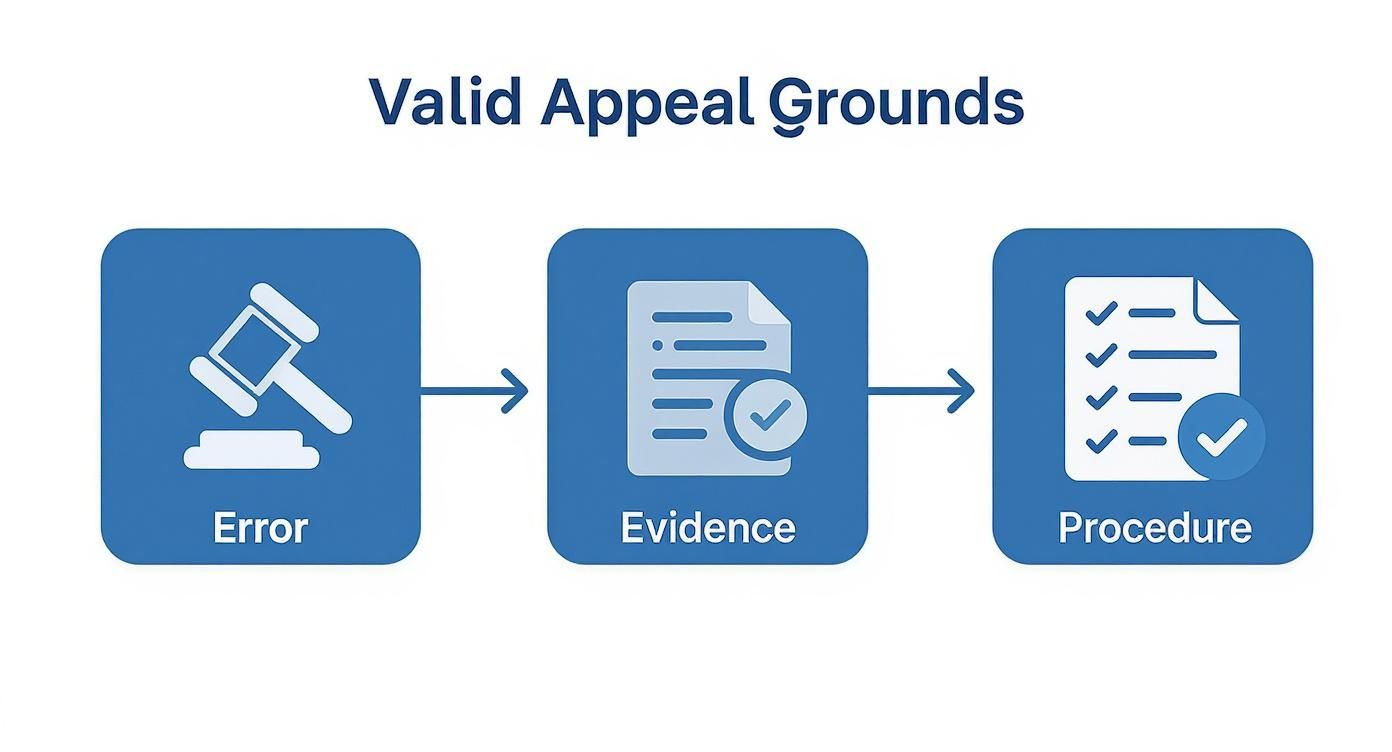
Each of these grounds requires you to point to specific mistakes made during the original hearing, as detailed in the court record.
Understanding the Financial Requirements
Appealing an eviction isn’t free, and failing to pay the required costs on time can sink your case just as fast as a missed deadline.
Here are the most common financial roadblocks you’ll face:
- Filing Fees: Courts charge a fee just to file the Notice of Appeal. If you can’t afford it, you can apply for a fee waiver (often called an in forma pauperis petition) by showing the court proof of your financial hardship.
- Appeal Bond: This is the big one. To get that crucial stay, courts almost always demand you post an appeal bond. This is a financial guarantee for the landlord.
- Transcript Costs: You’ll need an official transcript of the eviction hearing, which can run several hundred dollars depending on how long the hearing was.
The appeal bond is where most tenants get stuck. It usually means you have to deposit your monthly rent with the court for every month the appeal is pending. This money sits in an escrow account. If you win, you get it back. If you lose, it goes straight to the landlord to cover the rent they missed out on.
Eviction Appeal Timeline and Key Actions
The moments after an eviction judgment are a blur, but you have to act with precision. This table breaks down the immediate actions, their typical deadlines, and why each one is so critical to giving your appeal a fighting chance.
| Action Item | Typical Deadline | Purpose and Key Considerations |
|---|---|---|
| Verify Local Deadlines | Immediately | Rules vary by court. Call or visit the clerk’s office right away to get the exact deadlines for the Notice of Appeal and Stay. |
| File Notice of Appeal | 10-30 Days from Judgment | This is the official start of your appeal. Missing this deadline is almost always fatal to your case. |
| File Motion for Stay | Same Day as Notice | This is your request to pause the eviction. Filing it late risks a lockout while your case is pending. You must show the judge why you should be allowed to stay. |
| Post Appeal Bond | Set by Judge | This is the financial guarantee for the landlord, often equal to monthly rent. You may need to request a waiver or reduction if you can’t afford it. |
| Order Court Transcript | Immediately after Filing | The appellate court needs the official record to review what happened. Delays in ordering it can jeopardize your entire appeal schedule. |
Think of these first few weeks as a series of gates. If you fail to get through one in time, all the subsequent gates will be closed to you. Meticulous organization is non-negotiable.
Navigating Local Court Rules and Procedures
Every courthouse operates in its own little world, with its own forms, procedures, and unwritten rules. What works in one county might be completely wrong in the one next door. You cannot rely on general advice—you have to get the specific requirements from the clerk of the court that issued the eviction order.
Be obsessive about the details. Ask the clerk if they have a checklist. Find out how many copies of each document you need, who has to be served (your landlord and their lawyer), and the exact method of service required. The timelines for these initial filings are unforgiving, operating with the same finality as a state’s statute of limitations—miss a date, and your case is over. To see how these critical deadlines function in other legal contexts, you can check out this overview of the statute of limitations by state.
Simple procedural mistakes, like filing in the wrong office or failing to properly notify the landlord, are some of the most common reasons appeals get thrown out. Double-checking every detail isn’t just a good idea; it’s a matter of survival.
How to Build Your Case and Draft the Appellate Brief
With the initial filings behind you and (hopefully) a stay of eviction secured, the real intellectual heavy lifting of your appeal begins. This is where you pivot from meeting procedural deadlines to building the substantive, logical argument that shows the appellate court exactly where the trial judge made a legal misstep.
The entire appeal is built upon the foundation of the “record on appeal.” This is the complete, official collection of everything from the original eviction case: every motion, every exhibit, every order, and every word spoken in court. The appellate judges are strictly limited to this record—they cannot consider any new evidence or testimony. Your first job is to get this record assembled.
The Court Transcript: Your Most Critical Piece of Evidence
The single most important part of that record is the court transcript. This is the word-for-word account of your eviction hearing, and without it, you’re fighting blind. How can you prove the judge misinterpreted a statute if you can’t show the appellate court the judge’s exact words?
It’s your responsibility to contact the official court reporter from your hearing and order this transcript. Be prepared for the cost, which can run from a hundred to several hundred dollars, but it’s an absolute necessity. The transcript is where you will find the concrete proof needed to anchor your legal arguments.
Structuring Your Appellate Brief
The appellate brief is the formal, written argument you submit to the higher court. Think of it as your one and only chance to tell your full story, backed by law and evidence. It’s a highly structured legal document that methodically explains the facts, identifies the trial court’s errors, and uses legal precedent to argue why the eviction was wrong.
While specific formatting rules vary by jurisdiction, nearly all briefs contain these core sections:
- Statement of the Case: A neutral, factual summary of the case’s journey through the trial court, from the initial complaint to the final judgment.
- Statement of Facts: This is where you tell the story, but with a critical rule: every single fact you state must be supported by a citation pointing to a specific page in the court transcript or a document in the record.
- Questions Presented: These are the precise legal questions you’re asking the appellate court to resolve. For example: “Did the trial court commit reversible error by accepting a notice to quit that failed to meet the statutory 14-day requirement?”
- Argument: The heart of your brief. Here, you break down each legal error, connect it to the evidence in the record, and cite relevant statutes and past court decisions (case law) to prove your point.
A winning brief doesn’t just complain that the outcome was unfair. It systematically proves, using the record and the law, exactly how and why the trial court’s decision was legally incorrect.
Crafting a Persuasive Argument
Building a compelling argument isn’t about emotion; it’s about constructing a logical chain that leaves the appellate judges with no other choice but to agree with you. For each error you’re claiming, you must show three things: what the correct law is, how the trial judge’s action or ruling violated that law, and why that error was “prejudicial”—meaning it actually harmed your case and likely led to the wrong outcome.
This requires serious legal research to find statutes and previously decided appellate cases that mirror your situation. These precedents are what appellate courts use to ensure the law is applied consistently. Mastering legal research and writing is a highly specialized skill, which is why understanding how to draft a legal brief that wins is so crucial.
A well-drafted brief is the cornerstone of your effort to appeal an eviction. It is your opportunity to lay everything out with clarity, accuracy, and persuasive force.
Why an Attorney Can Make or Break Your Appeal

You absolutely have the right to represent yourself—known as proceeding pro se—but heading into an eviction appeal without a lawyer is a gamble with incredibly high stakes. The appellate court is a completely different world from the housing or small claims court where your case started. It’s a maze of rigid procedural rules where a single misstep can get your entire case thrown out.
Unlike the first hearing, where you might have had some leeway to just tell your story, the appellate process is unforgiving. Arguments are made through meticulously crafted legal briefs, not spoken testimony. To have any chance of success, you need to conduct sophisticated legal research, pinpoint reversible errors in the trial record, and present them in a highly structured, persuasive document that cites specific statutes and case law.
The Value of Appellate Experience
An experienced attorney doesn’t just bring legal knowledge to the table; they bring a specialized skillset fine-tuned for the unique environment of an appellate court. They know the critical difference between simply disagreeing with the judge and identifying a genuine, appealable legal error.
Here’s what a seasoned lawyer can do:
- Spot Subtle Errors: They are trained to comb through court transcripts and evidence to find mistakes a layperson would almost certainly miss, like a judge misapplying a specific legal standard or improperly admitting certain evidence.
- Conduct Real Legal Research: Lawyers have access to legal databases and the training to find binding precedents that support your case—the absolute cornerstone of any winning appeal.
- Draft a Compelling Brief: Writing an appellate brief is an art form. It demands a specific structure, tone, and method of argumentation that is completely foreign to non-lawyers.
- Navigate Procedural Traps: From obscure filing deadlines to precise document formatting, an attorney ensures your appeal isn’t dismissed on a technicality before a judge even reads your arguments.
The numbers don’t lie. A study on eviction outcomes in New York City found that while 80% of unrepresented tenants were evicted, that number plummeted to just 12% for tenants with a lawyer. That statistic alone shows the massive impact of professional guidance.
Key Insight: The appellate court isn’t there to decide if the trial judge’s decision was “fair.” It only reviews whether the decision was legally correct. An attorney’s job is to prove, using the court’s own strict rules and language, that it wasn’t.
Finding Affordable Legal Help
The cost of an attorney is a major hurdle for many people facing eviction. But don’t assume you can’t afford help without exploring your options first. There are several avenues for affordable legal assistance that can make professional representation a reality.
Start by searching for local legal aid societies or non-profits that focus on landlord-tenant law. These organizations often provide free or low-cost legal services to eligible low-income tenants. Local bar associations also run referral services that can connect you with attorneys who offer free initial consultations or work on a sliding scale based on your income.
Finally, some private attorneys specializing in tenant rights might offer flexible payment plans. As you start your search, it’s critical to understand how to choose the right attorney for your case to find someone with the specific experience needed to win an eviction appeal.
Common Questions About Appealing an Eviction
When you’re facing the fallout of an eviction judgment, the path forward is rarely clear. The legal system is filled with procedural traps and confusing jargon, especially when it comes to appeals. Let’s cut through the noise and address the most pressing questions tenants have when considering this critical next step.
Can I Introduce New Evidence in My Appeal?
This is the single most common misunderstanding about the appeals process, and the answer is almost always a hard no. An appeal isn’t a second trial or a chance to present the case you wish you had. It’s a review, not a do-over.
The appellate court is firewalled from anything that wasn’t presented to the first judge. Its job is to review the existing “record on appeal”—every document, every piece of testimony, every exhibit from your original hearing—and hunt for legal errors. Did the judge misapply the law? Did they ignore a crucial piece of evidence that was already presented? That’s the entire focus. You can’t bring in a last-minute witness or a rent receipt you forgot at home the first time.
While a vanishingly rare exception exists for “newly discovered evidence,” the bar is incredibly high. You’d have to prove the evidence was not only decisive but also physically impossible to find before your trial ended. For all practical purposes, the case you built in the trial court is the only case you have.
What Happens if I Win My Eviction Appeal?
A victory at the appellate level feels monumental, but it doesn’t automatically mean the case is over and you’ve won for good. The outcome depends entirely on what the higher court decides went wrong in the original trial.
Here are the most likely scenarios following a successful appeal:
- Reversal: This is the best possible outcome. The appellate court completely vacates, or voids, the original eviction judgment. The eviction order is nullified, and you have effectively won.
- Remand for a New Trial: More commonly, the higher court finds a significant legal error that tainted the first hearing. It then “remands” the case—sends it back down to the trial court—for a brand new trial, with instructions to avoid making the same mistake twice.
- Remand with Instructions: In some cases, a full new trial isn’t needed. The court might send the case back with a narrow order, such as instructing the trial judge to recalculate damages or to properly consider a motion that was incorrectly denied.
Key Takeaway: Winning an appeal resets the board. Whether it’s a complete reversal or a second chance at trial, you’re put in a far stronger negotiating position. A victory gives you powerful leverage to either win the case outright on remand or settle with the landlord on favorable terms.
What if I Cannot Afford the Appeal Bond or Filing Fees?
The financial realities of an appeal can be just as daunting as the legal ones. The court system has mechanisms to help, but you have to act fast and follow the rules precisely.
Court filing fees are the first hurdle. If you can’t afford them, you can file an application for a fee waiver, often known by its Latin name, in forma pauperis. This requires you to submit detailed financial information proving your hardship. If the judge approves it, you can proceed without paying the court’s fees.
The appeal bond is a much bigger obstacle. To get a “stay of eviction”—which stops the landlord from locking you out while the appeal is pending—courts often require you to post a bond, which usually means paying your monthly rent to the court. This protects the landlord from lost income. If you can’t post the bond, the lockout can proceed even while your appeal is being heard.
Some states allow judges to reduce or waive the bond for indigent tenants, but it’s never automatic. You must file a specific motion with the court, backed by strong evidence of your financial situation. Tackling these costs head-on is one of the very first things you must do to successfully appeal an eviction, because missing these deadlines can end your case before it even starts.
Navigating the complexities of an appeal requires precision and expertise. The Haute Lawyer Network connects you with a curated selection of top-tier attorneys who possess the specialized knowledge to handle intricate legal challenges like eviction appeals. Find the legal excellence you need at https://hauteliving.com/lawyernetwork.