The core difference between an annulment and a divorce is simple but profound. An annulment declares a marriage was never legally valid in the first place, treating it as if it never happened. A divorce, on the other hand, legally dissolves a marriage that was valid. This distinction changes everything about the legal process and its aftermath.
Annulment vs Divorce at a Glance

While both processes lead to two people going their separate ways, they are built on entirely different legal foundations. An annulment isn’t just a “faster” divorce—it’s a distinct legal action with a much higher burden of proof. To get an annulment, you must prove the marriage was invalid from the very beginning based on specific, legally defined grounds.
This isn’t just a modern legal quirk; the concept has deep historical and religious roots. While a divorce acknowledges a valid union existed and then ended, an annulment asserts that no lawful union ever took place. This is especially significant in certain faiths, like the Catholic Church, where American cases make up a staggering 49% of all Catholic annulment proceedings worldwide. You can find more data about marriage dissolution trends and statistics.
Void vs Voidable Marriages
To understand the grounds for an annulment, you have to know the difference between “void” and “voidable” marriages.
- Void Marriages: These were never legal, period. They are invalid from the start because they violate fundamental laws, such as bigamy (one spouse was already married) or incest (the spouses are too closely related).
- Voidable Marriages: These are considered legally valid until a court officially declares them annulled. The grounds here usually involve issues around consent or capacity, like fraud, duress (being forced to marry), or mental incapacity at the time of the wedding.
A common myth is that a very short marriage automatically qualifies for an annulment. This is false. The length of the marriage has absolutely no legal bearing on eligibility; only the presence of specific legal grounds matters.
Divorce, by contrast, doesn’t require proving the marriage was invalid. Most states now offer “no-fault” divorce, where the only requirement is to state that the marriage is “irretrievably broken.” It’s a much more straightforward path for couples who have simply grown apart.
Quick Comparison Annulment vs Divorce
For a clear summary, this table breaks down the fundamental differences between these two legal actions.
| Criteria | Annulment | Divorce |
|---|---|---|
| Legal Effect | Declares the marriage was never legally valid. | Legally ends a valid marriage. |
| Grounds | Requires specific proof (e.g., fraud, bigamy, duress). | Typically “no-fault” (irretrievably broken). |
| Legal Status | Parties revert to their “single” pre-marital status. | Parties are legally recognized as “divorced.” |
| Burden of Proof | High. Requires evidence proving invalidity from the start. | Low. Often requires only one spouse’s testimony. |
Ultimately, the choice between these two paths depends entirely on the specific facts of your marriage and whether it meets the strict criteria for an annulment in your state.
Understanding the Legal Grounds for Each Path

Whether you pursue an annulment or a divorce, you can’t just walk into court and ask for it. You need a legally recognized reason, or “grounds,” to proceed. This is where the two paths diverge dramatically, reflecting the fundamental difference between erasing a marriage and ending one.
The burden of proof falls much more heavily on the person seeking an annulment. You must present concrete evidence that the marriage was invalid from the moment you said “I do,” based on very specific, and often hard-to-prove, legal criteria.
Grounds for an Annulment
Annulment grounds are narrowly defined and fall into two distinct legal categories: void and voidable marriages. The specifics vary by state, but the core principles are consistent across the country. A key detail here is that the length of the marriage is irrelevant; the court is only concerned with the circumstances at the exact moment the vows were exchanged.
Void Marriages
A void marriage is one that was illegal from its inception. Legally, it never existed, whether a court declares it so or not. The most common grounds are:
- Bigamy or Polygamy: One spouse was already legally married to another person.
- Incest: The spouses are too closely related by blood, as defined by state law (e.g., parent-child, siblings, or in some states, first cousins).
These marriages are considered a violation of public policy, making them invalid automatically.
Voidable Marriages
A voidable marriage, on the other hand, is considered valid until one of the spouses takes legal action to have it annulled. These cases typically involve a defect in consent or capacity that existed when the marriage began.
Common grounds include:
- Fraud: One party deceived the other about something essential to the marriage itself. This isn’t about small lies; it has to be a significant deception, like concealing an inability to have children, hiding a serious criminal record, or misrepresenting one’s identity.
- Duress or Force: Someone was coerced or threatened into marrying against their will. Their consent was not freely given.
- Mental Incapacity: A spouse was unable to understand the nature and responsibilities of marriage at the time of the ceremony, often due to severe mental illness or intoxication.
- Underage Marriage: One or both spouses were below the legal age of consent and lacked the necessary parental or court permission.
- Physical Incapacity: One spouse has an incurable condition (like impotence) preventing them from consummating the marriage, and the other party was unaware of this before marrying.
Proving these grounds requires more than just testimony. You’ll need substantial evidence—documents, witness statements, medical records—to convince a judge that the marriage was invalid from the very start.
Grounds for a Divorce
Unlike the strict, narrow criteria for an annulment, the grounds for divorce have become far more straightforward. Today, every state in the U.S. offers some form of “no-fault” divorce, which has completely changed the landscape of marital dissolution.
No-Fault Divorce
This is by far the most common way to end a marriage. In a no-fault divorce, neither spouse has to prove the other did anything wrong. You simply state that the marriage is over due to reasons like:
- Irreconcilable Differences
- Irretrievable Breakdown of the Marriage
- Incompatibility
This modern approach removes blame from the equation, allowing couples to dissolve their union without getting into a messy, public fight over who was at fault.
Fault-Based Divorce
Though less common today, some states still permit fault-based divorce. Here, one spouse alleges that the other’s misconduct directly caused the marriage to fail. Traditional grounds include:
- Adultery
- Cruelty (physical or emotional)
- Abandonment or Desertion
- Habitual Drunkenness or Drug Abuse
- Imprisonment for a felony
While filing on fault grounds can sometimes influence decisions on alimony or asset division, it also requires proving the allegations in court. This inevitably makes the process longer, more expensive, and far more emotionally draining than a no-fault proceeding.
Comparing Timelines and Legal Procedures
When you’re weighing an annulment against a divorce, the legal roadmap and expected timeline for each are worlds apart. Both end a marriage, but the journeys are fundamentally different.
An annulment is an intense, front-loaded legal battle. The challenge isn’t about waiting for a deadline to pass; it’s about gathering an mountain of evidence to prove the marriage was invalid from the start, all while racing against a strict statute of limitations.
Divorce, on the other hand, usually follows a more predictable path, especially in no-fault cases. The timeline is less about proving wrongdoing and more about fulfilling procedural steps, negotiating terms, and respecting state-mandated waiting periods.
The Annulment Process: A Race Against Time
For an annulment, the clock starts ticking the moment you discover the grounds for it. Unlike a divorce that can be filed at any point, annulments have firm deadlines. For example, if you discover you were married under fraudulent circumstances, some states give you as little as 90 days to one year to file your petition after learning the truth. Miss that window, and the option is gone for good.
The process is demanding:
- Intensive Evidence Gathering: This is where the real work happens. You need indisputable proof—witness testimony, official documents, medical records—that proves the legal grounds for annulment existed at the time you got married.
- Filing a Petition: You submit a formal petition to the court, laying out the specific legal grounds and presenting the evidence you’ve collected.
- Serving the Other Spouse: Your spouse must be legally notified that you have initiated the annulment proceedings.
- Court Hearing: Both parties will present their case. It’s up to a judge to decide if you’ve met the high burden of proof required to nullify the marriage.
The entire annulment timeline hinges on building an airtight case before the statute of limitations runs out. If you miss this deadline, divorce becomes your only path forward.
The Divorce Process: A Structured Progression
The divorce process is generally more straightforward and less about proving a specific fault. While every case is different, the stages are fairly consistent. The biggest factor influencing the timeline is often the mandatory waiting period, a “cooling-off” period required by many states that can range from a few weeks to over a year.
A standard divorce moves through these stages:
- Filing the Petition: One spouse files a petition for dissolution of marriage.
- Discovery Phase: Both sides exchange all relevant financial information—assets, debts, income—and details concerning any children.
- Negotiation or Mediation: Spouses and their attorneys work to settle key issues like property division, spousal support, and child custody.
- Final Decree: If you reach an agreement, it’s submitted to a judge for approval. If not, the case heads to trial.
For a clearer sense of what to expect, you can learn more about the factors that influence how long a divorce takes in our detailed timeline guide.
Key Procedural Milestones: A Side-by-Side Look
This table breaks down the critical differences in the legal journey, helping you set realistic expectations for the time and effort each path demands.
| Procedural Stage | Annulment | Divorce (No-Fault) |
|---|---|---|
| Initial Filing | Must be filed within a strict statute of limitations after discovering the grounds. | Can be filed at any time while married. |
| Evidence | Requires substantial proof that the marriage was invalid from the beginning. | Requires minimal proof, often just a statement that the marriage is irretrievably broken. |
| Waiting Period | Generally no mandatory waiting period; the court’s calendar dictates the timeline. | Most states impose a mandatory “cooling-off” period before the divorce can be finalized. |
| Court Involvement | Always requires a court hearing where a judge must rule on the validity of the grounds. | Often settled out of court through mediation if both parties agree on all terms. |
| Final Outcome | A decree of nullity is issued, legally stating the marriage never existed. | A divorce decree is issued, legally terminating a valid marriage. |
Ultimately, the choice comes down to weighing a swift but evidence-heavy process against a more procedurally straightforward—but potentially longer—one.
Analyzing the Financial and Parental Impact
When a marriage dissolves, the fallout goes far beyond the legal status of two people. The financial and parental consequences of an annulment versus a divorce are profound, reshaping the futures of everyone involved—especially any children. While both paths end a union, they begin from entirely different starting points when it comes to assets, debts, and family structure.
The entire premise of an annulment is to legally erase the marriage, treating it as if it never existed. This has major implications for how finances are handled. In principle, the court aims to put both parties back in the financial position they were in before the marriage. This usually means each person leaves with the assets and debts they brought into the union.
But real life is rarely that clean, and courts know it.
Dividing Assets and Debts
Even with an annulment, judges have the power to ensure a fair outcome. This is especially true if a couple acquired property together or if one party was financially dependent on the other. A judge can still order an equitable division of assets and debts that were accumulated while the couple lived together under the genuine belief they were married.
Divorce, however, is built on the foundation that a valid marriage did exist. Because of this, dividing marital property is a central part of the process. States typically follow one of two models:
- Community Property: States like California and Texas view all assets and debts acquired during the marriage as jointly owned (50/50). These are divided equally.
- Equitable Distribution: Most states use this model. A judge divides marital property in a way they deem fair, which doesn’t always mean a 50/50 split. The length of the marriage, each spouse’s income, and their respective contributions are all weighed.
Key Takeaway: An annulment tries to restore pre-marital financial status but allows for equitable division to prevent an unjust result. A divorce legally requires the division of all property acquired during the marriage.
The Role of Spousal Support
One of the sharpest financial distinctions between annulment and divorce is spousal support, or alimony. Since an annulment declares the marriage was never legally valid, there is generally no legal basis for awarding spousal support. You can’t be ordered to support someone to whom you were never legally married.
Divorce is the complete opposite. Spousal support is a common tool used to provide financial help to a lower-earning or non-earning spouse. Courts look at numerous factors to decide if support is needed and for how long. The complexity of certain assets, like retirement accounts, often requires skilled legal guidance. For those with significant retirement savings, it’s critical to understand how to properly split a 401(k) during a divorce.
Protecting Children’s Rights in Both Scenarios
Whether parents choose annulment or divorce, the court’s number one priority is the well-being of any children from the relationship. The legal status of the parents’ marriage has zero impact on a child’s rights and needs.
In both proceedings, the court will establish clear parental rights and responsibilities. This means a judge will issue legally binding orders for:
- Paternity: The court legally establishes who the child’s parents are.
- Child Custody and Visitation: A parenting plan is created to outline legal and physical custody, dictating who makes major decisions and where the child lives.
- Child Support: The court orders financial support to ensure the child’s needs are met, calculated based on state guidelines and parental income.
The process for deciding these matters is virtually identical for both annulments and divorces. The law guarantees that a child from a relationship that is later annulled has the exact same rights to financial support and a relationship with both parents as a child of divorced parents. This is an absolute legal protection.
Ending a marriage is a complex event, a reality reflected in national statistics. In the U.S., while the overall divorce rate was 2.5 per 1,000 people in 2021, a deeper look shows that 41% of first marriages end in divorce. That number climbs to a staggering 73% for third marriages. You can review more detailed findings on American divorce statistics and facts on wf-lawyers.com. This data reinforces just how important it is to understand the legal and financial ramifications of your choices, whether you pursue a divorce or the less-traveled road of an annulment.
Choosing the Right Path for Your Situation
Deciding between an annulment and a divorce isn’t just a legal maneuver; it’s a conclusion drawn from the unique facts of your marriage. The right path depends entirely on whether your situation meets the strict legal grounds for an annulment or if dissolving a valid marriage through divorce is the only appropriate route. Real-world scenarios offer the clearest lens for understanding this critical distinction.
Think of a marriage where one person concealed a deal-breaking fact, like a pre-existing marriage or an inability to have children after promising to start a family. That scenario is rooted in fraud and points directly toward an annulment. In sharp contrast, a couple who finds their values have diverged after several years would pursue a no-fault divorce. The marriage was valid, but it has simply broken down.
This visual decision tree helps illustrate how the specific circumstances of your separation point you toward either an annulment or a divorce, and how each path affects assets and children.
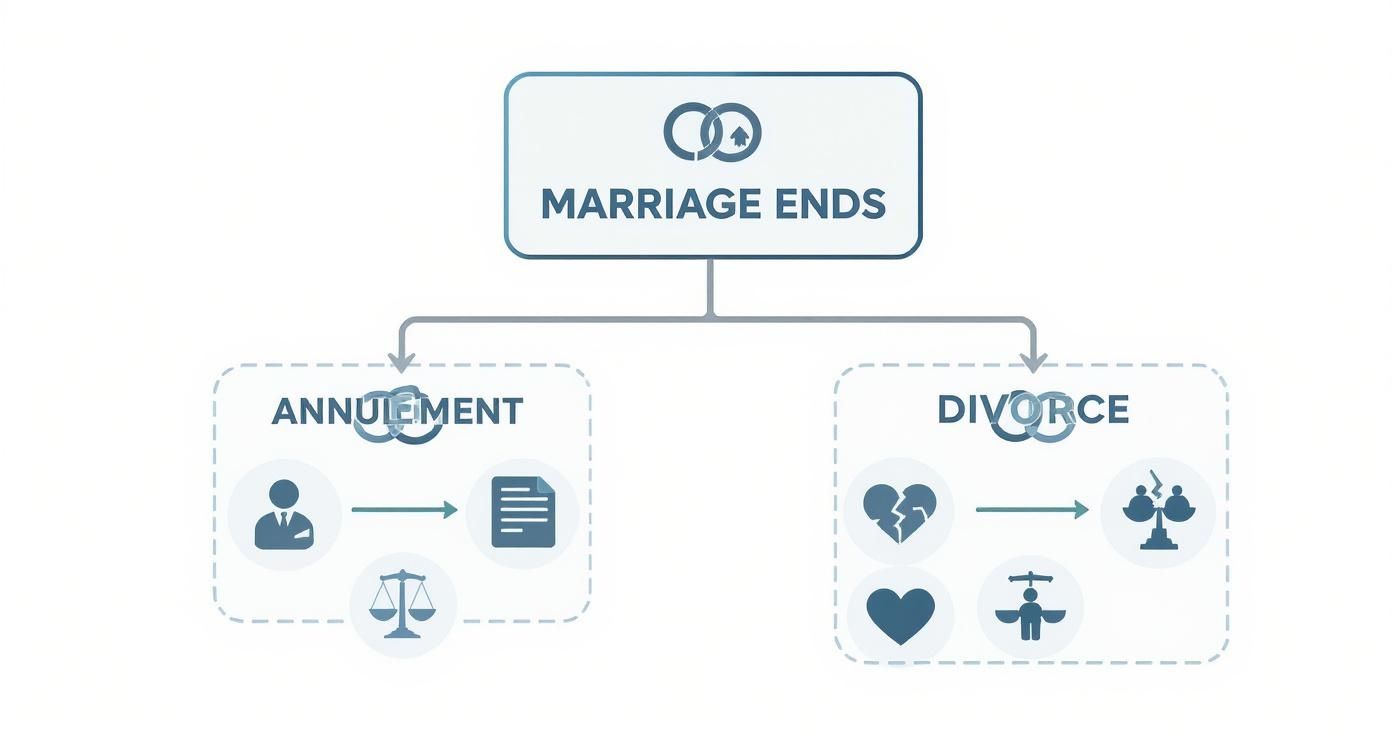
This graphic drives home a crucial point: whether you end your marriage with a declaration of nullity or a divorce decree, the court’s primary obligation to protect any children involved remains unchanged.
Special Considerations for High-Net-Worth Individuals
For high-net-worth individuals, the choice between annulment and divorce carries significant financial weight, especially concerning prenuptial agreements and inherited assets. An annulment can, in theory, restore both parties to their pre-marital financial state—an appealing concept when substantial wealth is on the line.
If a prenuptial agreement exists, an annulment could potentially render it void, as the contract was based on a marriage the court has now declared never legally existed. This can be a double-edged sword. While it might protect assets intended to be kept separate, it could also open the door to unexpected claims if the prenup contained specific waivers that are now nullified.
In a divorce, a valid prenuptial agreement typically dictates the division of assets. In an annulment, the court starts from the premise of returning parties to their original financial standing, but it can still divide property acquired during the void marriage to ensure a fair and equitable outcome.
Furthermore, inherited assets and family trusts may be better protected through an annulment if they can be clearly distinguished from any assets co-mingled during the voided marriage. A divorce, on the other hand, often requires a more complicated forensic process of tracing how separate property might have become marital property over time.
A Practical Decision-Making Checklist
To bring clarity to your decision, work through these key questions. Your answers will help you organize your thoughts before speaking with an attorney.
- Do Legal Grounds for Annulment Exist? Review your state’s specific grounds (fraud, bigamy, duress, etc.). Can you provide concrete proof that one of these conditions was present at the exact moment of your marriage?
- What is the Statute of Limitations? Have you missed the deadline to file for an annulment in your state? If so, divorce is your only legal option.
- What is Your Desired Financial Outcome? Are you seeking to simply restore your pre-marital financial status, or do you need to divide assets and debts accumulated during the marriage? Remember, spousal support is generally not available in an annulment.
- Are There Children Involved? While the court protects children in both scenarios, the process may feel different. Discuss with an attorney how the narrative of an annulment versus a divorce might impact your family dynamic.
- What are Your Personal or Religious Beliefs? For some, religious or personal convictions make an annulment a more palatable choice, as it erases the marriage from a legal standpoint.
Understanding the legal landscape is essential, and it’s worth noting how differently marriage dissolution is handled globally. For instance, Luxembourg has the highest divorce rate in the world at 87%, while India has the lowest at just 1%. You can explore more fascinating facts about international divorce laws on GoldbergJones-OR.com.
These global differences highlight how cultural and legal frameworks shape the process of ending a marital union. Answering these questions provides a solid foundation for a productive conversation with a legal professional who can offer guidance tailored to your specific circumstances.
When to Consult a Family Law Attorney

While any marital dissolution is complex, pursuing an annulment elevates the need for professional legal counsel from a recommendation to a necessity. The burden of proof is incredibly high, and the deadlines are strict. Attempting this on your own is exceptionally risky.
The moment you believe you have grounds for an annulment—or if you’re facing a contentious divorce—is the moment to engage an attorney. You need an expert in your corner before the situation deteriorates.
Signs You Need Legal Counsel Now
Certain scenarios are clear indicators that you must retain legal counsel immediately. Trying to navigate these situations alone can lead to devastating financial and personal consequences. Don’t delay if you’re facing any of the following:
- Disputes Over Assets or Debts: In high-net-worth cases especially, distinguishing between separate and marital property requires sophisticated financial analysis.
- Child Custody Disagreements: A family law attorney is non-negotiable for structuring a parenting plan that protects your rights and secures your children’s well-being.
- An Uncooperative Spouse: If your spouse is stonewalling, hiding assets, or becoming hostile, a lawyer can compel action through formal legal channels.
- Intricate Financial Portfolios: Assets like business ownership, private equity investments, and complex trusts introduce layers of complexity that demand specialized legal knowledge.
The most critical mistake is waiting too long. Evidence can be lost, and the statutes of limitation for an annulment can expire, closing that door forever.
Your initial meeting with an attorney is a crucial first step. Prepare for it. Organize your financial documents, timeline of events, and a list of questions. To get the most out of this consultation, it helps to review a resource like Your Family Law Attorney Consultation Guide to know what to expect and what to ask.
Finding the right legal partner means finding someone who understands not just the law, but your unique circumstances and financial picture. An experienced attorney provides the strategic guidance required to navigate the critical annulment vs divorce decision and achieve a favorable outcome.
Frequently Asked Questions
The end of a marriage is complicated, and the choice between an annulment and a divorce often brings up a host of practical questions. Let’s clear up some of the most common concerns.
Why Choose an Annulment Over a Divorce?
An annulment is often sought for deeply personal or religious reasons. Since the process declares a marriage legally nonexistent from the very beginning, it can align with certain beliefs that consider divorce morally unacceptable.
From a legal standpoint, the motivation is straightforward: the marriage was invalid from the start due to specific grounds like fraud, duress, or bigamy. If you can prove one of these grounds, an annulment essentially erases the marriage from the public record, which many people prefer over the formal status of “divorced.”
Which Is Better: Annulment or Divorce?
Neither path is inherently “better”—the right choice is dictated entirely by the facts of your situation. A divorce is the only legal route to end a valid marriage, and it provides a clear, established framework for dividing property and determining support. It’s far more common because the grounds, like “irreconcilable differences,” are much easier to meet.
An annulment is only an option if you can prove the marriage was invalid at its inception. While it nullifies the marriage as if it never happened, it also typically eliminates any claim to spousal support, a crucial difference in the annulment vs divorce calculus.
The most common ground for an annulment is fraud or misrepresentation. This covers situations where one spouse actively concealed a critical fact—like a secret criminal record, massive undisclosed debt, or the inability to have children when that was a core part of the marital agreement.
Can a Short Marriage Be Annulled Automatically?
This is a pervasive myth. The length of a marriage has zero legal bearing on whether it qualifies for an annulment. A marriage that lasts only a day cannot be annulled unless you can prove that grounds like fraud or duress were present at the time of the ceremony.
Conversely, a marriage that lasted decades could, in theory, be annulled if a ground like bigamy—one spouse was already married—is discovered late in the game.
Do Annulments Address Child Custody and Support?
Yes, absolutely. A child’s rights are completely independent of their parents’ marital status. If a couple has children and their marriage is annulled, the court still has the authority and obligation to issue orders for paternity, custody, visitation, and child support.
The process for establishing these parental responsibilities is identical to what happens in a divorce, ensuring the children’s well-being is always protected.
The complexities surrounding annulment and divorce demand sophisticated legal guidance. The attorneys in the Haute Lawyer Network are vetted for their excellence and are equipped to handle the nuances of high-stakes family law cases. Connect with a leading attorney in your area to protect your interests by visiting the Haute Lawyer Network.