
When a lawyer gets it wrong, the consequences ripple outward. It’s not just about a single case or a single client. Legal ethics issues—those professional tripwires ranging from conflicts of interest to outright financial misconduct—can derail a career, shatter a client’s life, and chip away at the public’s faith in the entire justice system.
Understanding these core duties is the first step toward building an honorable and resilient legal practice.
Why Legal Ethics Are the Bedrock of Justice
Don’t think of legal ethics as just a stuffy rulebook. It’s the very foundation of the legal profession, the blueprint that ensures the entire structure of justice remains sound. Without it, the system would buckle under the weight of self-interest and public mistrust.
At its core, practicing law ethically means constantly balancing duties owed to three distinct groups: your clients, the courts, and society itself. Each of these relationships presents its own unique minefield of potential dilemmas.
Core Duties and Responsibilities
Staying on the right side of the ethical line starts with mastering a few non-negotiable principles.
- Duty of Competence: This is more than just knowing the law. It means having the skill, knowledge, and preparation to handle a client’s matter effectively—and, just as importantly, knowing when to say “no” if you don’t.
- Duty of Loyalty: Your client’s best interest must be your North Star. This means steering clear of any conflicts that could arise from your personal interests, other clients, or third-party pressures. It’s where many of the trickiest ethical puzzles emerge.
- Duty of Confidentiality: This is a sacred pact. A lawyer is forbidden from revealing information related to a client’s case without their express permission. This duty is even broader than the attorney-client privilege and is what makes honest communication possible.
Unfortunately, the public sees a massive gap between these ideals and reality. This growing trust deficit is putting immense pressure on the profession. Gallup’s 2023 Honesty and Ethics poll painted a grim picture, with only 16% of Americans rating lawyers’ honesty as high or very high. That’s a historic low, underscoring the systemic challenges practitioners are up against. You can explore additional insights on the future of law and public perception.
The practice of law is not a business. It is a profession in which duty to public service, not money, is the primary consideration. – Louis Brandeis, Former Associate Justice of the Supreme Court of the United States
Before we dive deeper, let’s simplify these core responsibilities. Think of them as the four pillars holding up your entire practice.
The Four Pillars of Ethical Legal Practice
This table breaks down the fundamental duties that form the basis of ethical lawyering, providing a quick reference for the core concepts discussed in this guide.
| Ethical Pillar | Core Principle Explained | Common Dilemma Example |
|---|---|---|
| Competence | A lawyer must provide skilled and knowledgeable representation. This includes staying current on legal developments and technology. | Taking on a complex patent case with no prior intellectual property experience. |
| Loyalty | An attorney must act solely in the client’s best interest, free from any conflicting personal or professional interests. | Representing both the buyer and seller in a real estate transaction. |
| Confidentiality | A lawyer cannot reveal any information related to the representation of a client without their informed consent. | Discussing sensitive case details with a friend, even without naming the client. |
| Diligence | A lawyer must act with reasonable promptness and dedication in pursuing a client’s objectives. | Repeatedly failing to return a client’s calls or missing critical court deadlines. |
Keeping these four pillars in mind is crucial. Sticking to these principles isn’t just about avoiding a slap on the wrist from the bar association; it’s about honoring the oath you took. This guide will be your map for navigating the complex ethical landscape, helping you spot and solve the real-world dilemmas modern lawyers face every single day.
Navigating Conflicts of Interest in Your Practice
Of all the ethical minefields a lawyer can face, conflicts of interest are among the most treacherous. A seemingly small oversight can quickly detonate into a full-blown professional crisis.
Think of it this way: you can’t be a ship’s captain trying to sail for two different ports at once. The duty of undivided loyalty to your client is absolute. Get it wrong, and you could be looking at disqualification, fee forfeiture, and serious disciplinary action from the bar.
These conflicts aren’t always a blatant case of representing both sides in a lawsuit. They can creep in when your duty to one client clashes with your duty to another, or when your own personal, financial, or professional interests threaten to cloud your judgment. The real danger is that your ability to represent a client effectively gets compromised, even subconsciously.
The Different Faces of Conflicts
The first step to avoiding these traps is knowing what they look like. Conflicts generally fall into three buckets, and you need to know which one you’re dealing with to handle it correctly.
- Simultaneous Conflicts: This is the most obvious kind. You’re representing two current clients whose interests are directly opposed. The classic example is trying to represent both the plaintiff and the defendant in the same case—a clear, non-waivable conflict.
- Successive Conflicts: Here, the problem is with a former client. A successive conflict arises when you take on a new client whose interests are materially adverse to someone you used to represent. The big risk is misusing confidential information you learned during that prior relationship.
- Personal Conflicts: These issues stem from your own life—your financial holdings, business deals, or personal relationships. For instance, you absolutely cannot represent a client who is negotiating against a company where you own a significant chunk of stock.
This simple decision tree helps visualize the first questions to ask when you sense a potential ethical issue. It all starts with one question: could your actions cause harm?
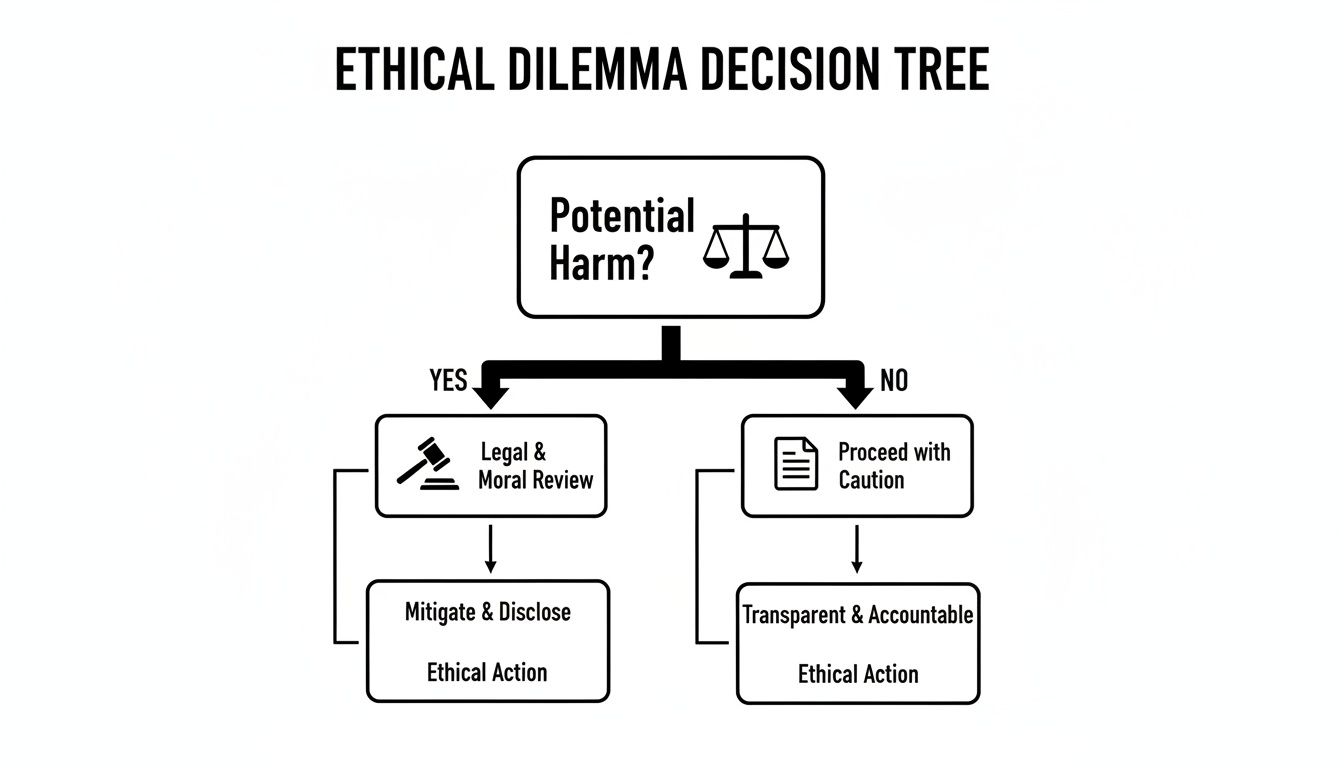
As the flowchart shows, the mere potential for harm is what elevates a situation from a simple business choice to a matter requiring serious ethical analysis.
Imputed Disqualification and Ethical Screens
One of the sneakiest parts of conflict rules is imputed disqualification. You’ve probably heard the phrase, “if one lawyer is conflicted, the whole firm is conflicted.” It means exactly that. One attorney’s conflict can knock the entire firm out of a case, all to protect client loyalty and confidentiality.
But it’s not always a dead end. In certain situations, particularly with lawyers who have moved between firms, an ethical screen can save the day. This is basically a procedural wall built around the conflicted lawyer to ensure they have zero access to any information or discussions about the case.
An ethical screen is not a get-out-of-jail-free card. It must be timely and robust, including written policies, restricted access to files, and sworn affidavits from the screened attorney. Courts scrutinize these screens carefully.
Imagine a mid-sized firm lands a new tech startup as a client for a big merger. The problem? A newly hired associate used to work for the firm representing the company being acquired. The firm must immediately put up a screen, blocking that associate from all case files, emails, and meetings about the merger to avoid getting disqualified.
The Hot Potato Doctrine
Here’s a tactic that ethics boards absolutely despise: trying to drop a small, less profitable client just so you can take on a bigger one whose interests conflict with the first. This is called the “hot potato doctrine,” and it’s a flagrant violation of your duty of loyalty. You simply cannot fire one client to resolve a conflict that you created.
For any modern law practice, a rock-solid conflict-checking system isn’t just a good idea—it’s non-negotiable. It has to be a core part of your client intake process, capable of checking for adverse parties, corporate parents and subsidiaries, and key individuals. Making conflict resolution a cornerstone of how you run your firm is the only way to protect your clients, your reputation, and your license.
Client Confidentiality in the Digital Age
Of all the duties a lawyer owes a client, confidentiality is arguably the most sacred. It’s the bedrock of trust that lets clients share their most sensitive information without fear. But in our hyper-connected world, that bedrock is under constant assault from new and evolving threats, turning one of the oldest ethical duties into a modern high-wire act.
Protecting client secrets isn’t about locking a filing cabinet anymore. Today, a single misplaced email or a moment of carelessness on public Wi-Fi can trigger an irreversible breach. The duty to maintain confidentiality now extends deep into a firm’s digital life, making cybersecurity a core ethical obligation.

The Anatomy of a Modern Breach
Picture this all-too-common scenario: a senior associate is burning the midnight oil, finalizing a confidential strategy memo for a high-stakes negotiation. Rushing to send it to the team, they rely on their email’s auto-fill feature. One disastrous click later, the memo—packed with privileged analysis—lands in the opposing counsel’s inbox.
The panic is immediate. The damage isn’t just theoretical; it’s a real-time crisis requiring frantic “clawback” attempts and a potentially humiliating disclosure to both the client and the court. This kind of inadvertent disclosure is a leading cause of confidentiality breaches and can completely tank a client’s case. It’s a stark reminder of how quickly simple human error can spiral into a complex ethical nightmare.
This duty is closely related to, but different from, a key legal doctrine. To grasp the full picture of your obligations, it’s worth understanding what attorney-client privilege is and how it specifically shields communications made for seeking legal advice.
Navigating Digital Danger Zones
Modern legal practice is full of digital tools that promise efficiency but quietly introduce new vulnerabilities. To uphold their ethical duties, attorneys have to be vigilant in several key areas.
- Cloud Storage: Using services like Dropbox or Google Drive for client files is convenient, but it means handing confidential data to a third party. You absolutely must vet the security protocols of any cloud provider and confirm their terms of service align with your ethical duties.
- Third-Party Vendors: Law firms lean on outside vendors for everything from e-discovery and transcription to IT support. Each one represents a potential weak link in the confidentiality chain. Your firm is on the hook ethically for ensuring these partners have robust security measures in place.
- Client Communication Portals: Emailing clients is standard, but it’s not always secure. Secure client portals create an encrypted space for sharing documents and messages, dramatically cutting the risk of interception or accidental disclosure compared to regular email.
A lawyer has an ethical obligation to take reasonable steps to protect a client’s confidential information from inadvertent disclosure. What counts as “reasonable” isn’t set in stone; it evolves as technology—and its associated risks—changes.
Building a Digital Fortress
A proactive defense is the only viable strategy here. Reacting to a breach is already too late. Building a culture of digital security has become a fundamental part of modern legal practice.
Here are the practical steps every firm should be taking:
- Implement Strong Policies: Develop clear, written policies for data handling, email use, remote work security, and using personal devices for work. No ambiguity allowed.
- Conduct Regular Training: Your team is your first line of defense. Consistent training on spotting phishing scams, using strong passwords, and understanding confidentiality rules is non-negotiable.
- Invest in Technology: Use encryption for all sensitive data, whether it’s in transit (like emails) or at rest (on servers and laptops). Deploy multi-factor authentication everywhere possible to add a critical layer of security.
- Create an Incident Response Plan: Know exactly what to do if a breach happens. Your plan should detail the steps for containment, investigation, client notification, and fixing the problem to prevent it from happening again.
Upholding client confidentiality isn’t just a job for the IT department. It is a core ethical responsibility for every single legal professional. By understanding the risks and taking deliberate, proactive steps to guard that information, you protect your clients, your firm, and the very integrity of the profession.
The Ethical Minefield of Technology and AI in Law

Technology is no longer a helpful add-on for a law firm; it’s the central nervous system. This shift has brought incredible efficiencies, but it’s also opened up a complex web of ethical traps that every lawyer needs to navigate with extreme care.
From fending off sophisticated cyber threats to understanding the real limits of artificial intelligence, the duty of technological competence has never been more vital. Attorneys are now on the hook not just for knowing the law, but for understanding the tools they use to practice it.
This isn’t just about avoiding a malpractice claim. It’s about making sure new tech strengthens—rather than erodes—core duties like confidentiality, competence, and zealous advocacy.
The Rise of AI and the Duty of Competence
Generative AI has stormed the legal world, promising to draft documents, run research, and analyze contracts in a fraction of the time it takes a person. But while the potential is huge, the ethical risks are just as significant.
The most glaring risk is “AI hallucinations,” where a tool confidently spits out fabricated information, including completely fake case citations. A lawyer relying on that output without checking every detail isn’t just failing their duty of competence; they’re risking court sanctions for filing false documents. Professional judgment is the only backstop.
The Federal Bar Association’s Legal Industry Report 2025 shows a clear tension here. While 31% of US legal professionals are now using generative AI, firm-wide adoption lags at just 21%. That gap comes down to deep-seated worries over ethics and accuracy, showing a healthy dose of caution from firms managing their risk.
Relying on an AI tool without understanding its limitations is like citing a legal precedent without ever reading the case. The ultimate responsibility for the accuracy and integrity of the work product always rests with the lawyer.
The only ethical way to use these tools is with a “human-in-the-loop.” An attorney must actively supervise, review, and validate anything an AI produces before it touches a client matter. Think of it as a powerful paralegal, not a replacement for your legal brain. For a closer look at these tools, our guide on how artificial intelligence is revolutionizing legal practice offers more perspective.
Social Media and Cybersecurity Threats
AI isn’t the only tech creating ethical headaches. The everyday tools we use, like social media, are also loaded with potential tripwires.
- Inadvertent Legal Advice: A casual answer to a question on LinkedIn or Facebook could easily be interpreted as legal advice, accidentally creating an attorney-client relationship you never intended.
- Confidentiality Breaches: Sharing a “war story” from a case, even if you think it’s anonymous, can reveal confidential client details. It’s a serious ethical breach waiting to happen.
- Advertising Rules: Your professional profiles and posts are considered advertising, meaning they have to comply with strict state bar rules that are surprisingly easy to violate.
Finally, cybersecurity remains a massive ethical responsibility. The duty to protect client secrets now means having reasonable and robust digital security. A data breach isn’t just an IT issue; it’s a profound ethical failure. This requires lawyers to stay current on threats and build a digital fortress around their client data.
The Real Consequences of an Ethical Breach
When a lawyer stumbles over an ethical line, the consequences are never minor or private. It triggers a formal, often punishing, process that can dismantle a career built over decades. This isn’t about scare tactics; it’s about understanding the real-world gravity of maintaining professional diligence.
The process kicks off when a client, opposing counsel, or even a judge files a grievance with the state bar association. This is far more than a strongly worded complaint—it’s the starting gun for a formal investigation into potential legal ethics issues. The bar’s disciplinary counsel steps in, acting much like a prosecutor to review evidence and determine if a rule was actually broken.
If the evidence looks solid, the matter often proceeds to a formal hearing that feels a lot like a trial. The attorney is forced to defend their conduct before a disciplinary board. This ordeal can drag on for months, sometimes years, casting a dark cloud over their entire professional life.
The Spectrum of Sanctions
Disciplinary actions aren’t a one-size-fits-all affair. They are carefully calibrated based on the seriousness of the misconduct, the damage done, and whether the attorney has a history of prior issues. The penalties can range from a slap on the wrist to the professional equivalent of a death sentence.
A minor, unintentional slip-up might earn a private reprimand—a confidential letter that stays off the public record. More significant violations, like dropping the ball on a client’s case, could result in a public censure. This is an official, public announcement of the misconduct that creates a permanent stain on their professional reputation.
For more severe breaches, the sanctions climb sharply:
- Suspension: The attorney’s law license is temporarily revoked, sometimes for months, sometimes for years. Getting it back isn’t automatic; it often requires passing ethics exams or completing specific educational courses.
- Disbarment: This is the ultimate penalty. It’s a permanent revocation of the attorney’s license to practice law. A disbarred attorney is no longer a lawyer and faces a nearly impossible uphill battle to ever be readmitted.
An ethical violation rarely happens in a vacuum. The very same actions that lead to a bar complaint—like missing critical deadlines or mishandling client funds—are often the exact grounds for a civil malpractice lawsuit, forcing the attorney to fight a war on two fronts.
From Ethical Breach to Malpractice Claim
It’s a massive mistake to see bar discipline and a civil lawsuit as separate problems. They are fundamentally intertwined. A state bar finding that an attorney violated an ethical rule becomes a powerful piece of evidence for the client in a subsequent malpractice case.
Think about these all-too-common scenarios:
Example 1: The Commingled Funds: An attorney, tight on cash, “borrows” from a client’s trust account, swearing they’ll pay it back before anyone notices. This is a cardinal sin in legal ethics. Once discovered, it triggers immediate disciplinary action—almost certainly a long suspension or disbarment—and opens the door for a malpractice claim for breach of fiduciary duty.
Example 2: The Neglected Case: A lawyer is drowning in cases and starts missing court deadlines and dodging client calls. The case is ultimately thrown out because of their neglect. The client files a grievance, which leads to a public censure or suspension for lack of diligence. At the same time, the client sues the lawyer for malpractice to recover the money they should have won.
These examples show how one single failure can unleash a devastating chain of professional and financial ruin. The disciplinary process isn’t just about punishing one lawyer; it’s about protecting the public and preserving the integrity of the justice system itself.
Building an Ethical Practice to Avoid Common Pitfalls
The best defense against a legal ethics issue is a good offense. Instead of waiting for a problem to surface, the smartest firms build a resilient practice designed to prevent ethical lapses from ever happening in the first place. This means creating a culture where integrity is the default, not an afterthought.
It all starts by writing your own rulebook—a clear, accessible guide that codifies your firm’s ethical standards. This internal document should leave no room for guesswork, outlining everything from client intake procedures to your firm’s official stance on using new technology.
Establishing Airtight Internal Systems
Your first line of defense is a set of robust internal processes. Think of these systems less as administrative hurdles and more as your primary risk management tools, built to spot potential ethical landmines before you step on them.
Three systems are non-negotiable:
- Rigorous Conflict Checking: Your conflict-checking process has to be exhaustive and mandatory for every single new matter. It needs to do more than just a surface-level scan; it must dig deep into current clients, former clients, and even the personal and financial interests of your attorneys.
- Clear Communication Protocols: Set firm-wide expectations for how you talk to clients. This means defining reasonable response times, committing to regular case updates, and documenting every significant piece of advice in writing.
- Secure Client Intake Procedures: Your intake process needs to be methodical. Fee agreements must be crystal clear, the scope of representation has to be precisely defined, and potential conflicts should be flagged from the moment a potential client walks in the door.
These foundational systems turn abstract principles into concrete, daily actions. They create a predictable environment where doing the right thing is simply the easiest path to take.
Cultivating a Culture of Ethical Excellence
Beyond formal rules, it’s the firm’s culture that truly makes the difference. Leadership has to set the tone, demonstrating through their own actions that ethical considerations always come first. This means creating an environment of open dialogue where a junior associate feels just as comfortable asking for guidance on a tough ethical call as a senior partner does.
The moment an attorney hesitates to ask a question for fear of looking inexperienced, you’ve created an ethical vulnerability. True strength lies in collaborative problem-solving, not in pretending to have all the answers.
Regular training is another critical piece of the puzzle, especially as the ground shifts under our feet. The rapid rise of AI, for example, is a perfect illustration. In a recent global survey, a staggering 92% of legal professionals said they expect AI in dispute resolution to pose a major ethical challenge, citing deep concerns over bias and a lack of transparency. You can read more in the 2025 Future of Legal Services Global Heatmap Survey Report. Firms must get ahead of this with clear usage policies and ongoing education.
Ultimately, building an ethical practice isn’t a one-time project; it’s a constant commitment. It demands strong systems, visible leadership, and a culture that champions integrity above all else. While these internal protocols are essential, don’t forget your external presence. Check out our guide on effective attorney social media marketing to make sure your online brand is a true reflection of your firm’s high standards.
Answering The Tough Questions on Legal Ethics
Even the most experienced attorneys run into ethical gray areas. Below are some of the most common and pressing questions that come up in day-to-day practice, along with straightforward guidance on how to navigate them.
What’s the First Move if I Spot a Potential Conflict of Interest?
Stop everything. Before another document is drafted or another call is made, halt all substantive work on the file immediately. Your primary responsibility is to wall off the potential conflict before it gets any more entangled in the matter.
From there, turn to your firm’s internal ethics playbook and get the designated ethics partner or senior counsel in the loop right away. Document every single action you take, and start the process of disclosing the situation to all affected clients. Only with their fully informed, written consent can you even consider moving forward.
Can I Really Represent Two Clients in the Same Lawsuit?
While it’s not strictly forbidden, it’s a minefield. Jointly representing clients in litigation is one of the riskiest moves an attorney can make. You should only even think about it if you have a rock-solid, reasonable belief that you can provide diligent and competent representation to each party without compromising the other.
Beyond that, the representation can’t be legally prohibited, the clients’ claims can’t be directly adverse, and—this is the big one—each client has to give informed consent, locked down in writing. Be warned: if their interests diverge even slightly down the road, you’ll almost certainly have to withdraw from representing both, leaving them scrambling for new counsel.
A potential conflict of interest isn’t a business risk you can “manage”—it’s a fundamental ethical barrier. The duty of undivided loyalty to your client is absolute and non-negotiable.
Are My Conversations with a Client Truly Always Confidential?
Almost always, yes, but there are a few critical, razor-thin exceptions. The sacrosanct shield of attorney-client privilege vaporizes if the communication is intended to help a client commit a future crime or fraud.
Furthermore, if a client makes a credible threat to cause imminent death or serious bodily harm, most state bar rules not only permit but may actually require you to disclose that specific threat to prevent the tragedy. Confidentiality is the bedrock of our profession, but it doesn’t outweigh the duty to protect innocent lives.
Elevate your brand and connect with an elite clientele. Haute Lawyer Network offers unparalleled visibility and prestige by showcasing top attorneys through Haute Living’s trusted luxury media platform. Learn more and apply to join our curated network.