The going rate for a good mediator can run anywhere from $200 to over $1,000 per hour, with a full-day session easily costing several thousand dollars. But looking at that number as a pure expense is the wrong way to think about it. The real value is seeing it as a strategic investment—one that buys you a faster, more controlled path to resolution.
Framing the Cost of a Mediator as a Strategic Choice

Hiring a mediator isn’t just another line item on a legal bill. Think of it more like bringing in a specialized consultant for a critical project. Just as you’d hire a top-tier financial advisor to navigate a complex merger, you invest in a mediator’s expertise to guide a dispute efficiently and, just as importantly, privately.
Their fee gets you a structured, confidential process designed to sidestep the astronomical costs and public spectacle of litigation. It’s a tool for financial predictability and risk management, transforming a chaotic, multi-year court battle into a focused, solution-oriented engagement.
The Core Billing Models Explained
Before you can budget for mediation, you need to understand how mediators charge for their time. Most fee structures fall into one of three buckets, each suited for different kinds of disputes. Getting a handle on these is the first step toward making a smart financial decision.
Here’s a quick summary of the most common billing models you’ll encounter. This will help you anticipate potential costs and figure out which approach makes the most sense for your case.
Typical Mediator Fee Structures at a Glance
| Fee Model | Typical Price Range (USD) | Best Suited For |
|---|---|---|
| Hourly Rate | $200 – $1,000+ per hour | Straightforward disputes; cases where the total time commitment is uncertain. |
| Flat Fee (Per-Diem) | $1,500 – $10,000+ per day/half-day | Complex, multi-party negotiations; situations where budget predictability is a priority. |
| Retainer | Varies (often covers first few hours/day) | High-demand mediators; cases requiring significant upfront preparation and document review. |
Knowing these structures helps you compare your options and find a mediator whose billing style aligns with your needs and budget.
Why This Matters for You
Understanding these fee models lets you compare mediators on an apples-to-apples basis. A simple two-party dispute might be perfect for an hourly rate, while a complex business negotiation with multiple stakeholders could benefit from the certainty of a flat fee.
The true value of mediation isn’t just in the dollars saved compared to a trial, but in the control, privacy, and speed it provides. It’s an investment in a quicker, more dignified resolution.
The goal here is to demystify the money side of things so you can focus on what really matters: finding a resolution. When you learn how these costs are calculated, you shift from asking “how much does this cost?” to “what’s the best value for my situation?” That proactive mindset puts you in control right from the start.
Breaking Down Mediator Billing Models
Knowing a mediator’s headline price is just the starting point. To really understand what mediation will cost, you have to dig into how they charge for their time and expertise. Each billing model has its own logic, and the one you choose will shape your final invoice in very different ways.
Think of it like hiring a contractor for a home renovation. You might pay an hourly rate for a small, unpredictable fix, but you’d want a fixed price for a well-defined project like a full kitchen remodel. The right choice depends entirely on the scope, the complexity, and how much budget certainty you need.
The Nuances of Hourly Rates
The most common way mediators bill is by the hour. It sounds straightforward, but the clock starts running long before everyone is sitting in the same room. A mediator’s billable time is more than just the session itself.
Billable time almost always includes:
- Preparation: All the time spent reviewing case files, legal briefs, and other documents submitted by each side.
- Pre-mediation Calls: Conducting separate calls with each party and their lawyers to get a feel for the dynamics and core issues.
- Session Time: The hours spent actively mediating, whether it’s a half-day or a full-day engagement.
- Follow-up: Time spent drafting settlement agreements or communicating with the parties after the session to nail down the final details.
This model gives you flexibility, especially when it’s tough to predict how long a resolution will take. The key is to get clarity upfront on how the mediator tracks and bills for every minute of their work.
Flat-Fee and Per-Diem Arrangements
For anyone who needs budget certainty, a flat-fee or per-diem (per day) model is the way to go. This approach bundles all the mediator’s work—prep, session time, and basic follow-up—into a single, agreed-upon price. It’s a popular choice for complex commercial disputes or high-asset divorces where everyone knows significant preparation is non-negotiable.
A flat fee takes the guesswork out of the final bill. It lets everyone know their exact financial commitment from day one, which can reduce arguments over invoices and keep the focus where it belongs: on resolving the dispute.
When you’re looking at a flat fee, always ask for a clear breakdown of what’s included. Things like extensive document review or multiple post-mediation follow-ups can sometimes land outside the initial agreement and trigger extra charges.
A contentious business partnership dissolution, for example, is a perfect fit for a per-diem rate. The partners know they are buying one full day of dedicated effort, which pushes them to use that time efficiently and avoid the anxiety of a running hourly meter.
Understanding Additional Fees and Policies
Beyond the main billing model, a few other standard financial terms can impact your total cost. These aren’t hidden fees, but they are crucial parts of any professional service agreement that you need to watch out for.
- Administrative Fees: Some mediators and larger firms charge a one-time administrative fee to cover the logistics of case setup, scheduling, and clerical work. This is especially common in institutional mediation.
- Retainers: A retainer is an upfront payment that secures the mediator and locks in your date. It usually covers the first block of hours or the entire flat fee. You can learn more about what a retainer fee covers to get a better handle on this common practice.
- Cancellation Policies: Mediators invest a lot of time preparing, and a last-minute cancellation represents a total loss of income for that day. As a result, most have firm cancellation policies, often requiring you to pay the full fee if a session is canceled within a certain window, like 7-14 days.
For a global perspective, institutions like the International Chamber of Commerce (ICC) offer benchmarks for major disputes. They reported an average total cost of $26,000 for proceedings in 2021. This figure often includes a non-refundable filing fee and deposits from each party to cover both administrative costs and the mediator’s fees.
What Drives the Price Tag of a Mediator
Ever wondered why one mediator quotes a price that seems miles apart from another’s? It’s not arbitrary. The fee reflects a specific blend of expertise, market dynamics, and the sheer complexity of your dispute. Think of it like hiring a top surgeon—you aren’t just paying for the procedure, but for the years of training and a proven track record that gives you the best shot at a successful outcome.
A mediator’s cost is directly tied to the value they bring to the table. Understanding the key factors that shape their fee allows you to look past a simple hourly rate and see it for what it is: a strategic investment in resolution.
Experience and Reputation
A mediator’s professional background is the single biggest driver of their cost. A seasoned professional with a 25-year track record settling high-stakes corporate disputes will naturally command a much higher fee than someone newly certified and handling their first few cases. That price difference is built on thousands of hours spent mastering the art of conflict resolution.
This experience translates directly into efficiency. An expert mediator can cut through the noise, identify the core issues, and guide everyone toward a resolution much faster. In the end, their higher hourly rate could actually save you money. Their reputation acts as its own form of currency—parties are investing in a trusted neutral known for navigating intense dynamics with a steady hand.
Specialized Expertise
Just like doctors, mediators specialize. A generalist might be perfect for a straightforward small claims case, but a complex intellectual property dispute requires someone who speaks the language of patents and trade secrets fluently. That kind of niche expertise comes at a premium.
Here are a few areas where specialization really moves the needle on cost:
- High-Asset Divorce: Requires a deep understanding of complex financial instruments, business valuations, and incredibly sensitive family dynamics.
- Intellectual Property (IP): Demands familiarity with patent law, copyright infringement, and technology licensing agreements.
- Complex Commercial Litigation: Involves intricate contract law, multi-party negotiations, and high financial stakes that need a sophisticated touch.
- Construction Disputes: Calls for specific knowledge of construction contracts, lien laws, and the technical side of building projects.
When you hire a specialist, you’re paying for them to get up to speed in minutes, not days. They already understand the unique pressures of your world.
The Complexity and Stakes of the Dispute
The nature of the dispute itself is a critical factor. A higher fee often reflects the case’s complexity and the amount of money on the line. A simple two-party contract disagreement over $25,000 is a completely different ballgame than a multi-million dollar corporate dissolution with multiple partners and years of messy financial records.
The mediator’s fee scales with the level of risk and responsibility they are asked to manage. A dispute that could save or sink a company naturally warrants a higher investment in a top-tier professional.
Complex cases demand far more prep time. Mediators have to review mountains of documents and hold multiple pre-mediation calls just to get their arms around the issues. The higher the stakes—financially or emotionally—the more skill is required to manage the negotiation, making the mediator’s role that much more valuable.
Geographic Location
Finally, where you are matters. Like most professional services, mediator rates are heavily influenced by the local market. A top mediator in a major legal hub like New York City or Los Angeles will almost always charge more than a practitioner in a smaller city.
This difference is driven by a few realities:
- Higher overhead costs in major metropolitan areas.
- Greater demand for high-quality dispute resolution services.
- A larger pool of attorneys and clients accustomed to premium professional rates.
For instance, elite commercial mediators in Chicago might charge upwards of $800-$1,200 per hour. A similarly qualified professional in a mid-sized Midwestern city might be closer to $400-$600 per hour. Knowing these regional differences helps set realistic expectations from the very beginning.
Comparing Mediation Costs by Case Type and Location
Talking about mediator costs in the abstract doesn’t really help anyone. To get a real feel for the numbers, you have to ground them in specific situations. Think of it like buying a car—the price for a basic sedan is worlds apart from a luxury SUV. It’s the same with mediators; fees are shaped by what the case demands and the going rate in your city.
The single biggest cost driver is the type of dispute. A messy business conflict involving intellectual property rights and a dozen stakeholders is going to require a mediator with deep, specialized knowledge, and they’ll command a premium rate for it. On the other hand, a more straightforward two-party family matter, while emotionally intense, usually falls into a more moderate price range.
Cost Breakdowns for Common Dispute Types
To actually budget for this, you need to see some real numbers. Of course, every case has its own quirks, but looking at industry benchmarks gives you a solid starting point.
- High-Net-Worth Divorce: These cases are rarely simple. You’re dealing with complex asset division, business valuations, and sensitive custody arrangements. Mediators who specialize here typically charge $400 to $900+ per hour. A full mediation process could run anywhere from $7,500 to $25,000, and sometimes much more if things get complicated.
- Business and Commercial Conflicts: Disputes over broken contracts, partnership breakups, or shareholder fights demand a mediator with serious business savvy. You should expect hourly rates from $500 to over $1,200. For multi-day sessions where the financial stakes are high, total costs often land between $10,000 and $50,000+.
- Employment Disputes: Cases centered on wrongful termination, discrimination, or harassment claims often fall in the $300 to $700 per hour range. A typical full-day mediation might cost between $4,000 and $10,000. In many of these situations, the employer ends up covering most or all of the fee.
- Intellectual Property (IP) Matters: Disputes over patents, trademarks, or copyrights require an incredible amount of specialized expertise. Mediators in this niche are among the most expensive, with rates frequently starting at $800 per hour and easily topping $1,500. Total costs here can climb into the tens of thousands very quickly.
To give you a clearer picture, here’s a table outlining what you might expect for different kinds of disputes.
Estimated Mediation Costs by Dispute Type
This table offers a comparative look at typical mediator rates and total session costs across common legal disputes, helping you set realistic budget expectations.
| Type of Dispute | Typical Hourly Rate (USD) | Estimated Total Cost (USD) |
|---|---|---|
| High-Net-Worth Divorce | $400 – $900+ | $7,500 – $25,000+ |
| Business/Commercial Conflict | $500 – $1,200+ | $10,000 – $50,000+ |
| Employment Dispute | $300 – $700 | $4,000 – $10,000 |
| Intellectual Property (IP) | $800 – $1,500+ | $15,000 – $75,000+ |
| General Civil/Contract | $250 – $600 | $2,500 – $8,000 |
These figures underscore how the mediator’s required expertise directly influences the final cost. The more specialized the field, the higher the investment.
The image below breaks down the three core elements that build a mediator’s final price tag: their experience, the case’s complexity, and the market they work in.
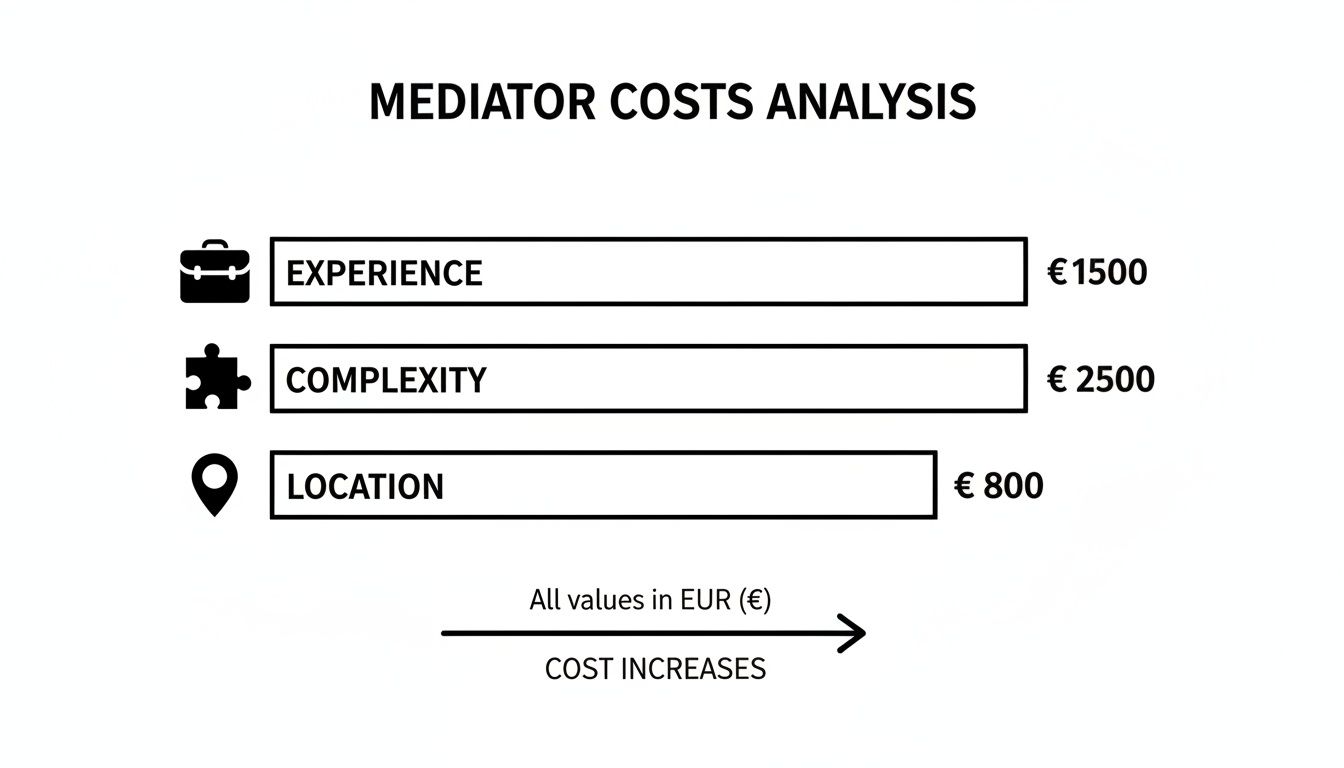
This really drives home the point that a mediator’s fee isn’t just one number; it’s a blend of their professional background, the specific challenges of your case, and local market rates.
Geographic Impact on Mediator Fees
Don’t underestimate the role your location plays. Major legal and business hubs like New York City or San Francisco have a much higher cost of living and a greater density of high-stakes litigation, which naturally pushes professional service fees up.
A top-tier mediator in one of those cities might charge 30-50% more than an equally qualified professional in a smaller market like Phoenix or Charlotte. This isn’t arbitrary; it’s a direct reflection of local economics and the prevailing rates for elite legal talent in that area.
The bottom line is this: budgeting for a mediator has to be a local exercise. National averages are a fine starting point, but you absolutely need to get quotes from mediators in your specific jurisdiction to plan your finances accurately.
The entire US Mediation Services industry brings in $566.7 million in revenue, and for good reason. Typical hourly rates of $200-$500 are a bargain compared to the $500-$1,000 charged by litigation attorneys. This pricing structure allows parties to settle for just 20-50% of what a full-blown trial would cost.
For a high-net-worth client, a divorce that could easily cost $50,000+ in court might get resolved for $5,000-$10,000 in mediation. Attorneys use this data to show clients how mediation not only saves a fortune but also protects their privacy and gets them a resolution much faster. For a deeper dive, you can explore more insights on mediation industry benchmarks from IBISWorld.
By understanding these different factors, you can search for a mediator with a realistic budget in mind and a clear idea of the value you should get for your money. The goal is to find the right expertise at a price that makes perfect strategic sense for your dispute and your location.
Mediation as an Investment vs. Litigation as a Cost
Thinking of a mediator’s fee as a simple line-item expense is like looking at the price of a blueprint and ignoring the skyscraper it helps you build. It’s the wrong frame.
The right way to see it is this: mediation is a strategic investment in efficiency, certainty, and control. Litigation, on the other hand, is a sprawling, unpredictable cost that multiplies under the surface. When you choose litigation, the attorney’s retainer is just the down payment. The real expense is a financial iceberg, with the most dangerous parts lurking unseen.
The Hidden Expenses of Litigation
A court battle quickly becomes a financial black hole. Beyond the staggering legal bills—which often eclipse the entire cost of mediation within months—you’re hit with an onslaught of other unavoidable expenses.
- Court Costs and Filing Fees: Every motion filed and every administrative action taken comes with a price tag.
- Expert Witness Fees: Need a financial analyst or a forensic accountant? These specialists can charge thousands of dollars per day for their analysis and testimony.
- Discovery Costs: The process of exchanging information sounds simple, but it involves costly depositions, document production, and e-discovery, each with massive labor and tech costs attached.
- Business Disruption: This is often the most damaging cost of all. Time spent in depositions, hearings, and trial prep is time stolen from running your business or living your life. Productivity plummets, opportunities are missed, and the emotional drain is devastating.
Two Paths: A Tale of Business Disputes
Let’s look at two nearly identical partnership disputes. Both involve a disagreement over the company’s future direction and a potential buyout.
Company A chooses litigation. The partners spend the next 18 months locked in a bitter court fight. By the time it’s over, they’ve paid a combined $150,000 in legal fees, expert witness costs, and discovery expenses. The public nature of the lawsuit damages their company’s reputation, and the constant stress fractures their professional network. In the end, a judge orders a resolution that leaves neither partner satisfied.
Company B invests in mediation. They hire an experienced commercial mediator for a full-day session, costing them a total of $8,000. After ten hours of focused, constructive negotiation, they hammer out a creative buyout agreement that preserves their professional relationship and protects the company’s brand. The entire process is confidential, swift, and completely within their control.
Litigation is a process where you hand over control of your time, your money, and your ultimate outcome to the court system. Mediation is an investment that keeps that control exactly where it belongs—with you.
Beyond the Balance Sheet: The Invaluable Returns
The real ROI of mediation goes far beyond just the direct financial savings. The non-monetary benefits are often where the greatest value is found. You are investing in:
- Confidentiality: Disputes are handled privately, protecting personal reputations and sensitive business information from becoming a public record.
- Control: You and the other party—not a judge—craft the final agreement. This allows for flexible and creative solutions that a court could never order.
- Relationship Preservation: Mediation is designed to be collaborative, not adversarial. For those hoping to maintain family or business relationships post-dispute, this is a priceless advantage. You can see this principle in action by comparing divorce mediation vs litigation.
This cost-effective approach isn’t just a local trend; it’s a global standard. Take the World Intellectual Property Organization (WIPO), for example. Its fee schedule for a dispute under $250,000 includes a flat $250 administrative fee and indicative mediator fees of just $2,500. This model scales efficiently, allowing elite attorneys to save their clients massive sums—potentially 70-90% compared to a full-blown trial—while reinforcing their status as pragmatic, results-oriented advisors. You can learn more about WIPO’s mediation fee structure to see how it works.
Ultimately, the cost of a mediator isn’t just a number on an invoice. It’s an investment in a faster, smarter, and more financially sound resolution.
Actionable Strategies for Managing Mediator Fees

Knowing the numbers behind mediation is one thing; actively managing them is a whole different ballgame. A proactive approach is the only way to squeeze every ounce of value from your investment and avoid any ugly financial surprises down the line. It’s about treating this process with the same sharp focus you’d apply to any significant business deal.
It all starts with the mediator’s fee agreement. Think of this document as your roadmap—you need to scrutinize every single detail before signing anything. Go past the headline hourly rate or per-diem fee and hunt for the specifics on what is, and more importantly, what isn’t, included in the price.
Before you commit, a few critical questions need clear answers. A little diligence upfront can save you thousands and prevent a world of headaches later.
Key Questions to Ask Before Signing
- How is preparation time billed? Does a flat fee cover a set number of hours for reviewing documents? If it’s hourly, what’s the realistic estimate for prep?
- What are the exact terms of your cancellation policy? Get the hard deadline and know the financial penalty for pulling out or rescheduling.
- Are there any administrative or case management fees? These are common enough, but they absolutely must be disclosed upfront, not buried in the fine print.
- How are follow-up communications handled? You need to know if drafting the settlement memo or making post-session calls is included or if that meter is still running.
Once you have this information, you can start to identify where you might have some room to negotiate. While a top-tier mediator’s hourly rate is likely set in stone, other terms can be surprisingly flexible.
You might, for instance, propose a “fee cap” on preparation time to lock in some cost certainty. The allocation of costs between parties is another common point of discussion. While a 50/50 split is the standard, one party might agree to shoulder a larger share to get the other to the table. It happens more than you think.
Think of mediation as a focused project with a clear budget. Establish your financial limits from the outset and track expenses just as you would for any other professional engagement. This discipline keeps the process grounded and goal-oriented.
Ultimately, the single most effective way to control costs is to show up completely prepared. The more organized you and your attorney are, the less time the mediator has to waste getting up to speed. To dig deeper into this, you can learn more about how to prepare for mediation and make every minute count. Efficient preparation directly translates to a lower final bill, turning your investment into a swift, cost-effective resolution.
Key Questions About Mediator Costs
When you’re preparing for mediation, the financial side of things can be just as important as the legal strategy. Let’s break down the common questions that come up about what a mediator really costs.
Who Actually Pays for the Mediator?
In almost every case, both parties agree to split the mediator’s bill right down the middle. This 50/50 split is the industry standard for a good reason—it reinforces that the mediator is a neutral third party and ensures everyone has equal skin in the game.
Of course, this isn’t set in stone. In some employment disputes, an employer might offer to cover the entire fee to show good faith. In other scenarios, one party might agree to pay a larger share simply to get the other side to the table. No matter the arrangement, it absolutely must be spelled out in writing before the first session begins.
Are Mediator Fees Refundable If We Don’t Settle?
Generally, no. You’re not paying a mediator for a guaranteed result; you’re paying for their time, their specialized skill set, and their management of the negotiation process itself. The fee covers everything from their initial prep work to conducting the mediation and any follow-up that’s required.
A mediator’s job is to facilitate a productive negotiation. Even if a final agreement isn’t signed that day, making real progress by narrowing down the issues is a significant win that often leads to a resolution later.
Always check the mediator’s fee agreement before signing. It will clearly outline their policy on retainers, cancellations, and refunds.
How Can I Find a Great Mediator Without Overpaying?
Finding the right balance between cost and quality is critical. Don’t just look at the hourly rate. The best place to start is by asking for recommendations from your attorney or other professionals you trust.
A highly experienced mediator with a higher rate might get a complex case resolved in a single day. A less experienced, cheaper mediator could take multiple sessions, which ends up costing you far more in both time and money.
To find the right fit, you need to ask the right questions:
- What is your direct experience with disputes exactly like mine?
- Can you walk me through your typical process and settlement rates?
- For smaller cases, look into community dispute resolution centers. They often provide qualified mediators on a sliding-scale fee basis.
Ultimately, the smartest move is to focus on the value a mediator brings, not just their price tag.
At Haute Lawyer Network, we connect clients with elite legal professionals who understand the nuances of high-stakes disputes. Our curated network features attorneys skilled in leveraging mediation for efficient, confidential, and cost-effective resolutions. Explore our network to find a legal expert who can guide you through the process with confidence and strategic insight. Learn more and find your attorney on the Haute Lawyer Network.