
Before you spend a dime on advertising or publish a single article, the most successful law firms lay a foundation. It’s all about building a brand that speaks directly to a specific kind of client—the one who recognizes true expertise and won’t hesitate to pay for it. Get this part right, and every marketing dollar you spend will work ten times harder.
Building a Brand That Attracts High-Value Clients

This isn’t about designing a logo or writing a bland mission statement. It’s about carving out a distinct, defensible position in a ridiculously crowded market.
Start by running a sharp competitive analysis. Don’t just make a list of rival firms. Dig deeper. Where are the gaps in their messaging and service? If every competitor’s website is filled with the same stock photos and vague promises of “results,” that’s your opening.
Defining Your Unique Value Proposition
Your unique value proposition (UVP) is the absolute core of your brand. It’s the clear, concise answer to a potential client’s most urgent question: “Why should I hire your firm over all the others?”
A powerful UVP isn’t about claiming to be “the best.” It’s about being the only logical choice for a specific client with a specific, high-stakes problem.
For example, a family law practice targeting HNW clients shouldn’t lead with “aggressive representation.” That’s generic. Instead, a message like “discreet, strategic counsel for complex asset division” hits the mark. It speaks directly to that client’s need for privacy and sophisticated financial protection.
To craft a compelling UVP, you need to nail down:
- Your Target Audience: Get specific. Not just “businesses,” but “founder-led tech companies navigating Series A funding.”
- Client Pain Points: What keeps them awake at night? Your messaging must address their biggest fears and ambitions head-on.
- Your Distinctive Solution: What do you bring to the table that no one else does? This might be a proprietary process, hyper-specialized expertise, or a truly white-glove client experience.
Your brand is the promise you make to your clients. Your marketing is how you deliver on it. Every ad, every article, and every interaction must reinforce your core message of trust, expertise, and premium outcomes.
Crafting Messaging That Connects
With a sharp UVP in hand, you can translate it into compelling messaging for your website, your social media presence, and even your in-person networking. Use the language your ideal clients use. Speak to their values.
High-value clients, for instance, typically respond to messages that emphasize strategy, discretion, and proven results—not aggressive tactics or bargain-basement fees.
This messaging is the thread that ties your entire marketing strategy together. When it’s done right, your firm is no longer seen as a commodity service provider. You become a trusted advisor. This initial branding work isn’t just a preliminary step; it’s the strategic engine that makes everything else possible. For more on this, see how to network effectively with high-value clients to ensure your message lands perfectly when you’re face-to-face.
Your Digital Front Door: A High-Converting Website and SEO Plan

Think of your firm’s website as its most influential rainmaker, not a passive digital business card. It’s the first—and often last—impression a potential client will have. A slow, confusing, or dated site sends a clear signal of sloppiness, which is the very last message any discerning client wants to receive.
The real goal isn’t just to have a website. It’s to own a high-performance asset that converts precisely targeted traffic into qualified, high-value consultations. This demands a two-pronged approach: an impeccable, sophisticated user experience for your visitors and a rock-solid technical foundation built for search engine dominance.
Building Authoritative Service Pages That Rank
Every single practice area deserves its own dedicated service page. These aren’t just brief overviews; they must be comprehensive, in-depth resources designed to answer a potential client’s most urgent questions on a specific legal matter.
Step into your ideal client’s shoes. Someone searching for a “complex asset division lawyer” is in a completely different frame of mind than someone Googling a generic “family law attorney.” Your content has to speak directly to their sophisticated concerns, addressing the nuances that matter to them—privacy, asset protection, and strategic, discreet negotiation.
To get these pages to rank, focused keyword research is non-negotiable.
- Target high-intent keywords: These are phrases signaling a user is ready to hire, like “LLC formation attorney for tech startups” or “estate planning for HNW families.”
- Weave in long-tail keywords: Think of more specific, less competitive phrases such as “how to protect intellectual property during a merger.”
- Structure content for busy people: Use clear headings (H2s, H3s) and short paragraphs. High-net-worth individuals don’t have time to wade through walls of text.
The secret is to create content that is genuinely useful, putting your deep expertise on full display. A powerful service page builds trust long before a potential client ever considers picking up the phone. For a deeper dive, our guide on the best SEO for lawyers provides more advanced tactics.
Mastering the Technical Side of SEO
Compelling content is critical, but it’s useless if your website fails Google’s technical audit. Technical SEO ensures search engines can effortlessly crawl, index, and understand your site’s content, forming the very foundation of any successful marketing strategy for law firms.
This has become table stakes in the legal industry. In fact, SEO is the top investment priority for law firms globally, with 45% of legal professionals allocating their marketing budgets here—eclipsing both PPC (30%) and social media (10%). Considering that 75% of clients check out multiple law firm websites before ever making contact, first-page visibility isn’t a luxury; it’s a matter of survival. This strategic focus highlights why a flawless technical foundation is so crucial.
Key technical elements include:
- Site Speed: Pages must load in under three seconds. Anything slower is a liability, leading to higher bounce rates and penalties from Google.
- Mobile Experience: Your site has to be perfect on a smartphone. The vast majority of initial legal searches now happen on mobile devices.
- Structured Data: Also known as schema markup, this is specialized code that helps Google understand the context of your content—your firm’s location, practice areas, and attorney profiles—which can lead to richer, more prominent search results.
A technically sound website is the bedrock of your digital presence. It ensures your thought leadership and expertise are actually discovered by the high-value clients searching for your services.
Designing for Conversion
Attracting the right traffic is only half the battle. Your website’s design and layout must instinctively guide visitors toward the one action that matters: contacting your firm. This is the art and science of conversion rate optimization (CRO).
Every page needs clear, compelling calls-to-action (CTAs). Ditch the generic “Contact Us.” Instead, use specific, action-oriented language like “Schedule a Confidential Consultation” or “Request a Private Case Evaluation.”
Finally, weave trust signals throughout the entire site. Prominently feature client testimonials, detailed case studies, prestigious awards, and media mentions. These elements provide the social proof needed to reassure potential clients they are absolutely making the right choice.
Establishing Authority with Content and PR

High-value clients and sophisticated businesses aren’t looking for a generalist lawyer on Google. They’re searching for recognized authorities—the attorneys whose names appear in industry journals, who are quoted on the news, and who write the definitive analysis on complex legal shifts.
Your firm’s expertise is its most powerful asset, but it’s completely invisible until you decide to amplify it. This is where a sharp, strategic approach to content and public relations becomes a non-negotiable part of your marketing strategy for law firms. We’re not talking about generic blogging. We’re talking about building a thought leadership engine that turns your internal knowledge into external credibility.
Building Your Thought Leadership Platform
A real thought leadership platform is built on substantive, insightful content that hits on the exact concerns of your ideal clients. The goal isn’t to churn out SEO articles for the sake of it; it’s to create assets that cement your reputation as the go-to expert in your niche.
Start by mapping out the complex, high-stakes questions your best clients are actually asking. Instead of a basic article on “What is estate planning?”, a firm targeting HNW families should produce an in-depth white paper like “Strategies for Mitigating Capital Gains on Intergenerational Wealth Transfers.” That’s the difference.
Your primary content pillars could include:
- In-Depth Articles: Move beyond the 101-level basics. Analyze recent court rulings, dissect new legislation, or offer a contrarian viewpoint on a common industry practice.
- White Papers & Guides: Develop comprehensive resources on topics your clients deeply care about. This kind of content becomes a high-value asset you can promote for months, not days.
- Expert Commentary: Make it a practice to comment on breaking news relevant to your field. This positions you as a timely, informed source that understands the immediate implications of market shifts.
True thought leadership isn’t about having an opinion on everything. It’s about having a well-researched, insightful perspective on the few things that matter most to your ideal clients. This focus builds trust and attracts the right kind of attention.
Getting Published in Google News and Beyond
Creating brilliant content is just step one. The real leverage comes from getting that content seen by the right people, and that means placing it in publications they already read and trust. Securing a feature in a reputable business journal or a mention in a major news outlet provides a level of third-party validation that no self-published blog post can ever match.
One of the most powerful, and often overlooked, channels is Google News. Getting your website indexed requires a technically sound site and a consistent output of high-quality, newsworthy content. Unlike standard search, Google News prioritizes timeliness and authority—perfect for firms that can provide expert commentary on current events.
This is where public relations becomes indispensable. A targeted PR effort is about much more than sending out press releases. It’s about building real relationships with the journalists and editors who cover your practice area. You can find more practical guidance on this in our guide to content marketing for legal firms.
Turning Your Attorneys into Media Assets
The end game is simple: position your attorneys as the first call for journalists covering a story in your field. When a major financial regulation changes or a landmark case is decided, reporters need credible experts to provide context and quotes—fast.
To make this happen, you need a proactive media relations plan:
- Develop a Media List: Identify the key journalists, editors, and producers covering your niche at local, national, and trade publications. Know who they are and what they write about.
- Craft Your Pitches: Don’t just ask for coverage. Offer journalists a specific story idea, a unique data point, or a compelling expert take on a developing issue. Give them something valuable.
- Be Responsive: When a reporter reaches out, you have to be available and prepared. That means offering concise, insightful commentary on a tight deadline. Speed and substance win.
By consistently executing this strategy, you transform your attorneys from legal service providers into sought-after experts. This elevated status not only attracts high-value clients but also creates a powerful, defensible brand that competitors simply can’t replicate.
Fueling Growth with Paid Media and Referral Networks
While organic strategies like SEO and thought leadership are the bedrock of long-term brand authority, a truly effective marketing strategy for law firms needs channels that deliver high-intent leads right now. This is where a dual-engine approach—combining precision-targeted paid media with a robust referral network—creates unstoppable momentum.
Think of paid advertising less like a billboard and more like a scalpel. Platforms like Google Ads and LinkedIn Marketing Solutions let you bypass the slow burn of organic growth and put your firm directly in front of an ideal client the moment they realize they need your expertise. It’s about speed and predictability, two things content marketing alone can’t always guarantee.
Precision Targeting with Paid Advertising
The secret to winning with paid media isn’t a massive budget; it’s obsessive targeting. The days of casting a wide, expensive net are over. Today, you can zero in on potential clients with startling accuracy.
For instance, a corporate law firm can run a LinkedIn campaign targeting ads directly to individuals with job titles like “General Counsel” or “CEO” at companies of a specific size, within a select industry, and located in a precise zip code. Every dollar is spent reaching a decision-maker, not just a random professional.
Google Ads is all about capturing immediate intent. You can bid on exact phrases that signal someone is actively looking to hire an attorney, such as “litigation attorney for shareholder disputes” or “high-net-worth divorce lawyer near me.” This gets you in front of prospects who have already diagnosed their problem and are now shopping for the solution.
Paid media shines when it’s used to intercept intent. While SEO is like building a landmark that people eventually find, paid ads are like placing a direct, well-lit path to your door for those who are already looking for it.
The Art of a High-ROI Paid Campaign
Executing a paid campaign that actually makes money requires more than just launching ads. Paid search often commands 20-40% of a modern firm’s marketing budget for these quick wins. Yet, while 78% of firms are spending money here, a staggering 82% are unhappy with the ROI. That signals a massive disconnect between execution and strategy.
Part of the problem? The most successful campaigns recognize that 61% of inbound inquiries still come via a phone call, often triggered by these very ads, making sophisticated call tracking non-negotiable. You can learn more about these critical pivots in our guide to law firm marketing trends.
To avoid the common money pits, your campaigns must have:
- Compelling Ad Copy: Your ad must speak directly to the user’s specific problem and offer a clear, compelling reason to click.
- Optimized Landing Pages: The page they land on after clicking must be a seamless extension of the ad’s promise, driving them toward one clear action, like “Schedule a Confidential Consultation.”
- Meticulous Tracking: You have to track more than clicks. You need to track conversions—form submissions, phone calls, and ultimately, signed retainers. It’s the only way to calculate your true return on ad spend (ROAS).
Building a Powerful Referral Ecosystem
Beyond digital ads, the most valuable leads often come from a source that costs nothing but time and relationship equity: referrals. High-value clients don’t search Google for their most trusted advisors; they ask their other trusted advisors.
Cultivating a powerful referral network isn’t about collecting business cards at networking events. It’s about building a symbiotic ecosystem. The most effective programs are built on strategic alliances with professionals who serve the same elite clientele but offer different services.
Key Referral Partners for Law Firms:
- Wealth Managers & Financial Advisors
- Certified Public Accountants (CPAs)
- Family Office Directors
- Private Bankers
- Insurance Brokers specializing in high-net-worth policies
The relationship has to be a two-way street. Don’t just ask for business; create a reliable system for sending qualified business back to your partners. This reciprocity transforms a simple contact into a strategic alliance. Schedule regular check-ins, share valuable market insights, and make it incredibly easy for them to introduce you. A warm introduction from a trusted advisor is the most powerful—and profitable—lead you will ever get.
Your 12-Month Marketing Action Plan
A brilliant strategy is just a document until you execute on it. This is where the theoretical meets the tangible, turning ambitious goals into a series of clear, manageable steps.
Breaking the year down into distinct quarters prevents overwhelm and ensures foundational work is completed before you start scaling more advanced tactics. Think of this roadmap as a framework for disciplined execution. Each phase builds on the last, creating a compounding effect that drives sustainable, long-term growth for your firm.
Quarter 1: The Foundation
The first 90 days are dedicated entirely to building your essential infrastructure. You wouldn’t build a skyscraper on a weak foundation, and the same is true for your marketing. This quarter is about getting your internal house in order so that every future visitor has a world-class digital experience.
Your primary focus is on refining your brand and perfecting your digital presence.
- Brand and Messaging Solidification: Finalize your Unique Value Proposition (UVP) and key talking points. Make sure every attorney and staff member can articulate precisely what makes the firm different.
- Website Audit and Optimization: Run a thorough audit of your website, looking at speed, mobile experience, and user navigation. This is the time to implement technical SEO fixes and update service page content to align with your new messaging.
- Essential Content Creation: Develop foundational assets that build immediate trust, like attorney bios that tell a story, compelling case studies, and a clear “Our Process” page.
Key Metric for Q1: Website Conversion Rate. The goal isn’t traffic yet; it’s ensuring the traffic you eventually get will convert. A small increase from 1% to 2% effectively doubles the value of all your future marketing spend.
Quarter 2: Authority and Audience Building
With a high-performing website in place, Q2 shifts to generating targeted, organic traffic. Here, you’ll begin establishing your firm’s attorneys as recognized authorities in your niche. The focus is on content that attracts your ideal HNW client and starts building an audience you own.
This phase is all about creating value before you ask for anything in return.
- Launch Thought Leadership Content: Start consistently publishing high-value articles, white papers, or video commentary. Focus on quality over quantity, targeting the specific, high-stakes legal questions your ideal clients are asking.
- Initiate SEO and Link Building: Kick off a disciplined SEO campaign focused on your core practice area keywords. This includes targeted outreach to secure backlinks from reputable industry websites and publications.
- Build Your Email List: Implement a valuable lead magnet on your site—maybe a downloadable guide or checklist—to begin capturing email addresses from interested prospects.
This timeline shows how different growth channels layer on top of each other, starting with a strong organic base.
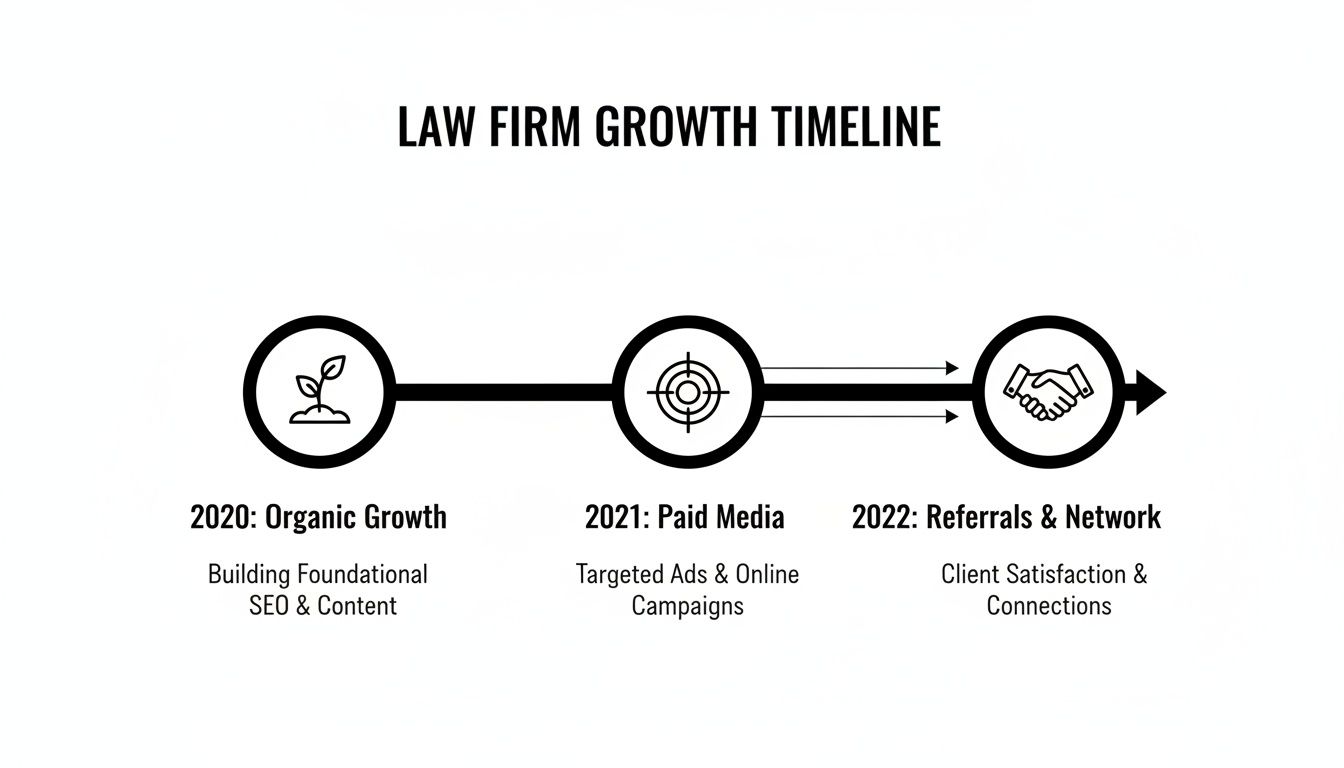
As you can see, while organic growth is foundational, paid media and referrals are accelerators that can be layered in once the core systems are firing on all cylinders.
Quarter 3: Amplification and Outreach
Now that you have a steady stream of organic traffic and a growing audience, it’s time to amplify your message. Quarter 3 introduces paid media and proactive public relations to accelerate lead generation and build brand credibility on a much wider scale.
This is where you strategically spend money to get your message in front of a highly targeted audience.
- Launch Targeted Paid Campaigns: Start with a modest budget on platforms like LinkedIn or Google Ads. Focus on one or two high-intent keywords or a very specific audience to test performance and gather data.
- Begin Proactive PR: Identify key journalists and publications in your niche. Start building relationships by offering expert commentary on relevant news stories. The goal is to secure your first media mention or feature.
- Nurture Your Email List: Send your first monthly insights newsletter to the list you started building in Q2. Provide immense value and stay top-of-mind.
Quarter 4: Optimization and Relationships
The final quarter is all about refinement and deepening relationships. Using the data from Q3, you’ll optimize your campaigns for better performance and shift focus to cultivating your most profitable lead source: referrals.
This is the phase of smart iteration and long-term relationship building.
- Analyze and Optimize Paid Spend: Review the performance data from your initial campaigns. Double down on what’s working—the ads and keywords driving qualified leads—and cut what isn’t. No more guessing.
- Formalize Your Referral Program: Identify 5-10 key strategic partners (think accountants, wealth managers, or family office advisors). Schedule meetings to formalize a two-way referral relationship, ensuring you are also providing them with immense value.
- Plan for the Year Ahead: Review all marketing KPIs from the year. Use this data to set clear, informed goals and budgets for the following 12 months, turning this cycle into a repeatable growth engine.
This actionable plan provides a clear sequence for your marketing efforts. Here’s how it might look in a high-level calendar format.
Sample 12-Month Law Firm Marketing Calendar
| Quarter | Primary Focus | Key Activities | Success Metric |
|---|---|---|---|
| Q1 | Foundational Setup | Brand messaging, website optimization, core content creation. | Website conversion rate improvement. |
| Q2 | Organic Growth | Thought leadership content, SEO & link building, email list growth. | Organic traffic growth, keyword rankings. |
| Q3 | Targeted Amplification | Launch paid media campaigns (LinkedIn/Google), initiate PR outreach. | Cost Per Lead (CPL), media mentions. |
| Q4 | Refinement & Scale | Optimize ad spend, formalize referral partnerships, plan next year. | Return on Ad Spend (ROAS), qualified referrals. |
By following this quarterly structure, you can systematically build a powerful marketing engine that attracts, engages, and converts high-value clients for your law firm.
Your Top Law Firm Marketing Questions, Answered
When building a growth strategy for a law firm, the same practical questions always come up: How much should this cost? How do we know if it’s working? How can we possibly compete with the giants?
Getting these answers right is the difference between a marketing budget that feels like an expense and one that becomes a powerful engine for growth.
How Much Should a Law Firm Spend on Marketing?
There’s no magic number, but the industry benchmark sits between 2% and 10% of gross revenue. Where your firm lands on that spectrum depends entirely on your goals.
A brand-new firm, or one making an aggressive push into a new practice area, needs to build momentum from scratch. That often means investing closer to 10-15% of revenue. On the flip side, a deeply established firm that runs on a powerful referral network might only need 2-5% to maintain its position.
The most important shift is to stop seeing marketing as a cost and start treating it as an investment. Define your target client acquisition cost (CAC) first. For instance, if you know a high-value client is worth acquiring for $5,000, you can build a realistic budget designed to hit that number.
The focus should always be on the return on investment (ROI), not the raw spend. A $10,000 investment in SEO that brings in $100,000 of new business is a win; a $2,000 ad campaign that generates zero qualified leads is a waste.
The smartest firms use a blended approach:
- Foundational Investments: Think SEO and brand building. These are long-term plays that create compounding value and establish your firm’s authority over time.
- Growth Accelerators: Paid media, like Google Ads, can drive a predictable stream of qualified leads almost immediately, filling the pipeline while your organic presence matures.
This two-pronged strategy ensures you’re building a valuable asset for the future without ignoring the revenue opportunities of today.
What Are the Most Important KPIs to Track?
Forget vanity metrics. Website traffic and social media likes don’t pay the bills. To truly measure the health of your marketing, you have to track the Key Performance Indicators (KPIs) tied directly to your firm’s bottom line.
These are the metrics that actually matter:
- Cost Per Qualified Lead (CPQL): This shows you exactly what it costs to get a potential client—one who actually fits your ideal profile—to pick up the phone or fill out a form. It cuts through the noise.
- Client Acquisition Cost (CAC): This is the ultimate number. It’s the total marketing and sales cost to bring a new, signed client through the door. Knowing your CAC is non-negotiable for profitable growth.
- Lead-to-Client Conversion Rate: Of the qualified leads you generate, how many actually become clients? This metric puts your intake process and initial consultation under the microscope.
- Website Conversion Rate: What percentage of your website visitors take a meaningful action? This is a direct reflection of how well your site’s design, copy, and calls-to-action are performing.
- Organic Search Rankings for Key Terms: You need to know where you stand on Google for the high-intent keywords that drive your most profitable cases. This is a leading indicator of your future organic lead flow.
- Client Lifetime Value (CLV): How much revenue does the average client generate over their entire relationship with your firm? Understanding CLV puts your CAC in context and tells you exactly how much you can afford to invest in acquiring new business.
Tracking these KPIs is how you move from guessing to knowing, empowering you to put your marketing dollars where they will have the greatest impact.
How Can a Small Firm Compete With Large Firms?
You can’t outspend them. So you have to outsmart them.
The small firm’s greatest advantages are focus, agility, and specialization. While a massive firm dilutes its message to appeal to everyone, a boutique firm can become the undisputed authority in a specific niche. Don’t try to be the go-to firm for everything; aim to be the only firm someone thinks of for a very specific problem.
This hyper-focus allows you to create content and messaging that resonates deeply with a select audience, addressing their precise pain points in a way a generalist firm never could.
Your agility is your superpower. You can test new strategies, pivot on a dime, and adopt new tactics far faster than a large firm bogged down by bureaucracy.
Most importantly, build the personal brands of your attorneys. This isn’t about just having a LinkedIn profile; it’s about strategic positioning:
- Publishing targeted thought leadership where your ideal clients will see it.
- Securing editorial features in niche industry publications they read.
- Speaking at exclusive events where your ideal clients congregate.
Joining a curated network can also level the playing field. Platforms like ours give you the branding, visibility, and SEO authority of a much larger organization for a fraction of the cost, allowing you to compete on prestige and expertise, not ad spend.
At Haute Lawyer Network, we connect top-tier attorneys with the high-net-worth clients who need them. Our platform elevates your brand by aligning it with the trusted authority of Haute Living, providing the visibility and credibility you need to stand out. Discover how our curated network can become your firm’s most powerful marketing asset at https://hauteliving.com/lawyernetwork.