
When you engage an attorney for a serious matter, you aren’t just hiring them for an hour of their time; you’re securing their commitment, focus, and availability for the road ahead. This is where a legal retainer fee comes into play. It’s an upfront payment that formalizes the relationship and reserves your lawyer’s expertise, ensuring they prioritize your case.
Think of it less as a final bill and more as a down payment. You’re essentially pre-paying for a block of their future services.
How a Legal Retainer Actually Works
This initial payment isn’t just handed over to the lawyer to spend as they wish. Instead, the funds are deposited into a dedicated trust account, a special bank account kept separate from the law firm’s operating funds.
As your attorney begins working on your behalf—conducting research, making calls, drafting documents, or representing you in court—they will track their billable hours. Periodically, they’ll draw from the trust account to pay for their time and any related costs, providing you with a detailed invoice that shows exactly how your funds were used.
Clarifying the Scope of a Retainer
The primary purpose of a retainer is to get the ball rolling without delay and guarantee your lawyer is available when you need them. However, it’s a common misconception that this initial fee covers everything. The truth is, the specifics of what’s included depend entirely on the retainer agreement you sign.
A retainer fee acts as a commitment from the client, reserving the professional’s time and services for future work. It secures a professional’s future services, often used to reserve their availability.
For a deeper dive into the contract itself, you can explore the key components in our guide on what a retainer agreement entails.
What Is Typically Covered vs. Excluded
Setting clear expectations from the start is crucial. While every legal matter has its own unique demands, most retainer agreements follow a predictable pattern. A recent industry report from LawPay noted that average retainers often range from $1,973 to $4,015, depending on the legal specialty, primarily securing the attorney’s services and covering their initial hours.
To help you understand where your money goes, here’s a quick reference table.
Retainer Fee Quick Reference What Is Typically Covered
This table summarizes the common services and costs that a standard legal retainer usually covers versus those that might be billed separately. Always confirm these specifics in your own agreement.
| Category | Typically Covered | Often Excluded |
|---|---|---|
| Professional Time | Attorney’s billable hours for research, strategy, and communication. | Fees for third-party expert witnesses (e.g., forensic accountants, medical experts). |
| Support Staff | Time spent by paralegals and other legal support staff on your case. | Costs for specialized third-party services like private investigators or process servers. |
| Administrative Costs | Routine office expenses like photocopying, postage, and local courier services. | Major travel expenses, such as airfare and hotel accommodations for out-of-town depositions or court appearances. |
| Court & Filing Fees | Standard fees required to file initial documents with the court system. | Significant litigation costs like deposition transcripts, trial exhibit creation, or jury consultant fees. |
Ultimately, your retainer agreement is the definitive guide. It’s essential to read it carefully and ask questions about any costs that aren’t explicitly mentioned before you sign. This proactive step can prevent surprising bills down the line and ensure a transparent, effective relationship with your legal counsel.
Exploring the Different Types of Retainer Agreements
Not all retainer fees are created equal. Just as different legal challenges demand unique strategies, retainer agreements come in several flavors, each tailored to specific client needs and the demands of the case. Getting a handle on these models is the first step to understanding what your fee covers and making the right choice for your situation.
The most common types serve very different functions, from a simple down payment to securing a lawyer’s undivided attention. Choosing the right one sets clear expectations from the start, building a solid foundation for the attorney-client relationship.
Security Retainers: The Down Payment Model
Think of a security retainer like a security deposit on a rental property. You provide the law firm with an advance payment, which they are legally required to hold in a separate trust account. It’s important to remember: this money is still yours.
As your attorney gets to work—drafting documents, showing up to meetings, or making critical phone calls—they bill their hourly rate against those funds. The firm only transfers money from the trust account to its own operating account after the work has been done and you’ve been invoiced. If your case wraps up and there’s still money left in the account, that balance comes right back to you. This is by far the most common type of retainer, and its transparency is what makes it so popular.
General Retainers: Securing Exclusive Access
A general retainer is a completely different animal. Instead of pre-paying for future work, you’re paying a fee to guarantee a lawyer’s availability and loyalty over a set period. It’s like having an expert on standby, exclusively for your team.
Imagine you’re steering a fast-growing tech company through choppy waters. By paying a law firm a general retainer, you ensure they’re ready to jump on urgent matters at a moment’s notice. Critically, this type of agreement often includes a “conflict of interest” clause, meaning the firm is barred from representing any of your competitors. This fee is typically considered “earned upon receipt” and may not be refundable, because what you’re buying is access and exclusivity, not a block of hours.
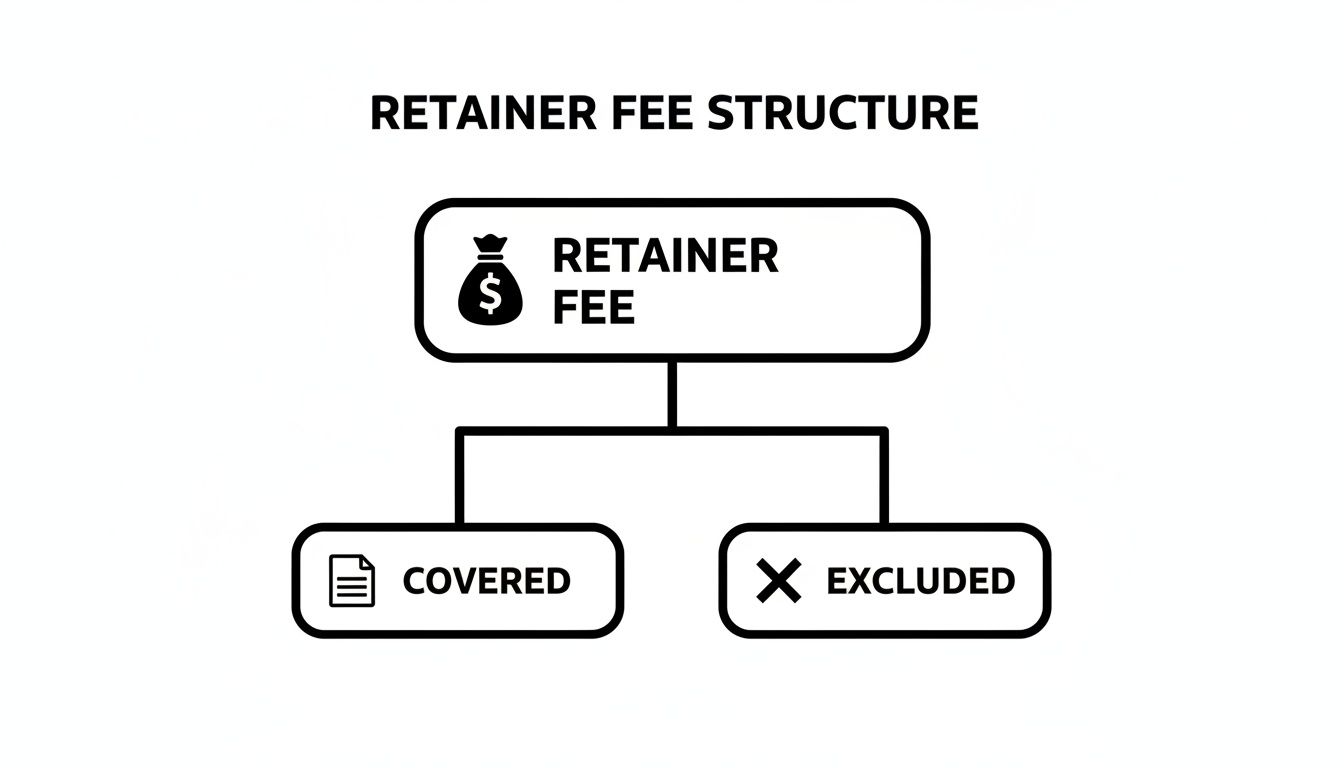
This visual distinction underscores how vital it is to clarify in your agreement which services are covered by the fee and which might require a separate payment.
Evergreen Retainers: The Auto-Refill System
For long-haul legal battles like ongoing business litigation or a complex family law case, the evergreen retainer is often the structure of choice. The entire model is designed to make sure legal work never grinds to a halt because of a funding gap. It’s essentially an auto-refill system for your legal fund.
Here’s how it works:
- You begin with an initial security retainer, just like the standard model.
- Your agreement will specify a minimum balance that must be kept in the trust account (for instance, $2,500).
- As your lawyer bills against the retainer, the balance naturally drops.
- If the balance falls below that pre-agreed minimum, you are required to deposit more funds to bring it back up to the original level.
This structure ensures continuous, uninterrupted legal support—something that’s absolutely critical in cases that can stretch out for months or even years. It also gives the law firm the confidence to dedicate its resources without worrying about chasing payments.
An evergreen retainer clause is a key feature for ongoing business matters. It ensures continuous support by requiring the client to replenish the retainer funds once the balance falls below a specified minimum.
This model is part of a bigger shift toward what the industry calls alternative fee arrangements (AFAs). Recent research shows that while 38% of corporate counsel use traditional retainers, 46% are now using capped fees and 37% use blended rates. This trend is even more pronounced in large corporations with over $20 billion in revenue, where 72% use periodic retainers for their legal needs. You can explore more about these legal fee trends and how they impact corporate decisions. Knowing these options exist gives you more power to negotiate an agreement that fits both your legal needs and your financial reality.
Where Your Money Goes: A Breakdown of Billable Items

When you pay a retainer, you aren’t just handing over a lump sum and hoping for the best. You’re funding a specific set of activities and resources dedicated to your case, and understanding exactly what that covers is crucial for a transparent relationship with your legal team. Let’s pull back the curtain on a typical legal invoice.
Your retainer primarily covers two major categories: professional fees (the time spent by legal experts) and hard costs (direct expenses paid to third parties on your behalf). Think of it like building a custom home: you pay for the architect’s and builders’ time, but you also cover the actual cost of lumber, nails, and permits.
Professional Fees: The Value of Expertise
The largest portion of your retainer will almost always go toward the billable hours of the legal professionals working on your case. This isn’t just your primary attorney. A modern law firm operates as a team, with different members contributing based on their skills and cost-effectiveness.
Here’s who is typically billing time against your retainer:
- Attorneys: This is the most significant expense. Their time is spent on high-level work—legal research, strategy development, drafting motions and contracts, negotiating with opposing counsel, and representing you in court.
- Paralegals and Legal Assistants: These team members are essential for efficiency. They handle vital tasks like organizing case files, preparing documents, and managing discovery at a much lower hourly rate than an attorney.
- Junior Associates: A firm will often assign younger attorneys to handle more routine research or initial document drafts. This strategy can save you money, as their hourly rates are well below those of senior partners.
Firms meticulously track their time, often in increments as small as six minutes (0.1 hours). This detailed approach ensures you only pay for the exact time spent advancing your case. Managing this process is a core part of modern legal practice, as detailed in this helpful attorney time tracking software guide.
Hard Costs: Tangible Case Expenses
Beyond billable hours, your case will involve a variety of direct, out-of-pocket expenses. These are often called “hard costs” because they are tangible charges the law firm pays to third parties on your behalf. Your retainer is used to cover these costs as they arise.
A detailed invoice should clearly separate professional fees from hard costs. This transparency allows you to see not only who worked on your case but also what external resources were required to move it forward.
Common hard costs include:
- Court Filing Fees: Every formal action, from filing the initial complaint to submitting a motion, requires a fee paid directly to the court system.
- Expert Witness Fees: In complex cases like medical malpractice or financial litigation, specialists are often hired to provide testimony. These experts charge significant fees for their analysis and time.
- Deposition Costs: This covers court reporters who create official transcripts of witness testimony and videographers who record the sessions.
- Service Fees: Formal legal documents must be officially “served” to opposing parties by a professional process server.
- Discovery Costs: This can involve paying for third-party e-discovery platforms to manage large volumes of electronic documents or hiring forensic experts.
- Administrative Expenses: While some firms absorb minor costs, many will bill for significant expenses like large-scale photocopying, messenger services, and travel.
By understanding this breakdown, you can read your monthly invoices with confidence. Each line item, whether it’s 0.3 hours spent drafting an email or a $150 court filing fee, connects directly to an action taken to protect your interests.
How to Read and Understand Your Retainer Agreement

Your retainer agreement is far more than a simple formality; it’s the blueprint for your entire professional relationship with your attorney. This document turns verbal promises into binding commitments and sets the ground rules for everyone involved.
Signing one without fully understanding its terms is like buying a property without reading the deed. You’re inviting confusion, unexpected costs, and serious frustration down the road. To protect your interests, you have to dissect this contract before you put pen to paper, looking past the dense legal jargon to see how each clause impacts you in the real world.
Decoding the Scope of Representation
The single most critical clause in any retainer agreement is the “Scope of Representation.” Think of this as the job description for your lawyer. It defines the precise boundaries of their duties, clearly stating which legal tasks are covered and—just as important—which are not.
This section should spell out the specific legal matter, whether it’s handling a complex business acquisition, managing divorce proceedings, or providing ongoing corporate counsel. Vague language is a red flag. If the scope for a real estate transaction doesn’t specify whether it includes pursuing zoning variances, that’s a separate engagement waiting to happen. A well-defined scope prevents “scope creep,” where extra work piles up, leading to surprise bills and friction.
Understanding Billing Practices and Rates
You need absolute transparency when it comes to billing. The agreement must provide a crystal-clear breakdown of how your money is managed, including the specific hourly rates for every professional who might touch your case—from senior partners to paralegals.
Look closely at these details:
- Hourly Rates: Know what you’re paying for each person’s time.
- Billing Increments: Most firms bill in small chunks of time, often 0.1 hours (six minutes). Understand exactly how they track their work.
- Invoice Frequency: Will you get a bill every month or at other intervals?
- Payment Deadlines: Be clear on when payments are due for any charges beyond the initial retainer.
This clause is your financial safeguard. It ensures you know not only what the retainer fee covers initially but also how future costs will be calculated and communicated, preventing sticker shock from unexpected invoices.
The Replenishment and Refund Clauses
For any ongoing legal work, the “Replenishment Clause” is crucial. Often called an evergreen retainer clause, this provision outlines the terms for topping up your retainer funds. It will specify a minimum balance your trust account must maintain.
Once your balance dips below that floor, you’ll be required to deposit more funds to bring it back to the agreed-upon level. This keeps the engagement moving forward without interruption.
On the flip side, the “Refund Policy” explains what happens to any unused funds when your case concludes. For most security retainers, the unearned portion of your fee is fully refundable. The agreement should state this clearly, detailing the process for finalizing the bill and returning your remaining balance. Understanding these two clauses ensures there are no surprises about your financial obligations or what happens when the work is done.
How Retainers Work in Real-World Scenarios

Understanding retainers in theory is one thing, but seeing how they play out in high-stakes situations is where the real clarity comes in. The type of retainer, its size, and what it covers will shift dramatically based on the legal challenge at hand. A fast-paced corporate deal requires a completely different financial structure than a sensitive, long-term family matter.
Let’s look at three distinct scenarios. We’ll examine a startup founder navigating a crucial funding round, a family managing a complex multi-generational estate, and a high-profile executive facing a sudden employment dispute. Each case shows how the right retainer model provides critical strategic value when the stakes are high.
Scenario 1: The Startup Securing Series A Funding
A tech founder is deep in the trenches of securing her company’s first major round of investment—a $10 million Series A. The process is a whirlwind of due diligence, term sheet negotiations, and a mountain of complex paperwork. Time is absolutely of the essence; any legal delay could jeopardize the entire deal.
Her legal team is essential for drafting and reviewing investment agreements, negotiating shareholder rights, and ensuring regulatory compliance. The work is intense but has a defined endpoint: the closing of the funding round.
- Retainer Type Used: Security Retainer with an Evergreen Clause.
- Amount: $25,000 initial retainer.
- Structure: The firm bills its hourly rates against this $25,000. Critically, the agreement includes an evergreen clause requiring the balance to be topped up whenever it drops below $7,500. This ensures there are never funding gaps that could stall progress during crucial negotiation phases.
In this situation, the retainer covers every legal activity directly tied to the funding round. This model ensures the legal team can move at the speed of the business deal without stopping to chase invoices.
Scenario 2: The High-Net-Worth Family Estate Plan
A family with significant assets—including multiple properties, international investments, and a thriving business—needs to establish a comprehensive estate plan. Their goal is to create trusts, wills, and succession plans that protect their wealth for generations while minimizing significant tax liabilities. This isn’t a one-off project; it’s an ongoing advisory relationship.
Their legal needs are multifaceted, involving sophisticated asset protection strategies, trust administration, and periodic reviews as family dynamics or financial circumstances change. The family needs a trusted advisor on call.
- Retainer Type Used: General Retainer.
- Amount: $15,000 per quarter.
- Structure: This is a flat, non-refundable fee paid every three months. It’s considered “earned upon receipt” and, most importantly, secures the law firm’s availability and guarantees them priority access. It also creates a critical conflict-of-interest barrier, preventing the firm from representing anyone with opposing interests.
In this context, the family isn’t just pre-paying for a block of hours. They are paying for exclusive access to a senior partner’s expertise and the peace of mind that comes with having dedicated counsel ready at a moment’s notice.
This retainer covers ongoing consultations, minor document updates, and general strategic advice. A major new project, like litigating a contested will, would fall outside this scope and be billed separately.
Scenario 3: The Executive Employment Dispute
A C-suite executive at a public company is abruptly terminated and presented with a severance package. She believes the termination was wrongful and that the offer is far too low. She needs an experienced employment lawyer to negotiate a better settlement—a process that could resolve quickly or escalate into a prolonged, contentious dispute.
The legal work involves a deep dive into her employment contract, assessing the strength of her claim, and engaging in sensitive, high-level negotiations with her former employer’s powerful legal team.
- Retainer Type Used: Hybrid Security and Flat-Fee Retainer.
- Amount: $10,000 initial security retainer.
- Structure: This initial $10,000 covers the first 25 hours of the attorney’s time for case evaluation, document review, and the first rounds of negotiation. If the matter is resolved within this phase, any unused funds from the retainer are returned to her. If it escalates, the fee structure may shift to a contingency basis for litigation.
This hybrid approach creates a predictable cost for the initial, most uncertain phase of the dispute. It allows the executive to secure top-tier legal representation immediately without committing to an open-ended hourly billing arrangement from day one.
Retainer fees aren’t one-size-fits-all. The structure is always tailored to the complexity, duration, and stakes of the legal matter. Below is a table that illustrates how these fee structures adapt across different legal scenarios.
Retainer Fee Structures by Legal Scenario
| Legal Scenario | Typical Retainer Range | Common Retainer Type | Primary Covered Services |
|---|---|---|---|
| Simple Divorce (Uncontested) | $3,500 – $7,500 | Security Retainer | Document drafting, court filings, basic negotiation |
| Complex Corporate Litigation | $50,000 – $250,000+ | Evergreen Retainer | Discovery, depositions, motion practice, trial prep |
| DUI Defense (First Offense) | $5,000 – $15,000 | Flat-Fee Retainer | All court appearances, plea negotiations, legal research |
| High-Net-Worth Estate Planning | $15,000 – $50,000+ | General or Flat-Fee | Trust creation, tax planning, succession strategy |
| Startup Seed Funding Round | $10,000 – $30,000 | Security Retainer | Term sheet review, due diligence, shareholder agreements |
As you can see, the retainer directly reflects the anticipated workload and the level of expertise required. A straightforward case may use a simple security retainer, while a multi-year litigation battle requires a robust evergreen structure to maintain momentum.
Common Questions About Legal Retainer Fees
The financial side of hiring a lawyer doesn’t have to be intimidating. Getting clear, direct answers to the most common questions about retainers is the first step toward feeling in control and building a strong partnership with your counsel.
Is a Retainer Fee Refundable If the Case Ends Early?
In most situations, yes. If you’ve paid a standard security or advance retainer, your attorney is only entitled to the fees they have actually earned. Any unused portion is returned to you.
The exception is a “general retainer,” which is a fee paid simply to secure an attorney’s availability and prevent them from representing your opposition. This type of fee is often considered earned the moment it’s paid and is usually non-refundable. Your agreement will specify the exact policy.
What Is the Difference Between a Retainer and a Flat Fee?
The distinction comes down to what you’re buying: time or an outcome.
A retainer is essentially a down payment for an attorney’s time. The firm bills its hourly rate against the funds you’ve deposited, which is ideal for complex cases where the total time commitment is unpredictable.
A flat fee, on the other hand, is a single, all-inclusive price for a predictable, well-defined service, like drafting a standard will. You’re paying for a specific outcome, providing complete cost certainty from the start.
Can You Negotiate the Retainer Fee Amount?
Absolutely. While a firm’s hourly rates are typically set, the amount of the initial retainer deposit is often open for discussion. This is especially true if the case is unusually complex, you have an existing relationship with the firm, or other unique circumstances apply.
Don’t hesitate to have an open conversation about fees. A good attorney wants an arrangement that feels fair to everyone involved, as it establishes a foundation of trust. You can also prepare for this conversation by understanding how the average retainer fee for a lawyer is calculated.
Your retainer agreement is a foundational document. Never hesitate to ask for clarification or discuss adjustments before you sign. A transparent financial understanding is critical for a successful attorney-client partnership.
What Happens If Legal Costs Exceed the Retainer?
If the work on your case uses up the initial retainer, your attorney will require you to replenish the funds. Most fee agreements contain an “evergreen” clause that obligates you to maintain a certain minimum balance in your trust account.
When your balance drops below this threshold, the firm will issue an invoice to bring it back up to the required level. This system ensures your legal team can continue working on your behalf without any costly interruptions.
When facing high-stakes legal challenges, securing elite counsel is the first step toward a successful outcome. The Haute Lawyer Network is a curated directory of the nation’s top attorneys, vetted for their expertise and excellence. Connect with a leading legal professional who understands your needs by exploring our network today.