
If you suspect a will is invalid, particularly in a high-net-worth estate where the financial stakes are enormous, your first moves are absolutely critical. This isn’t just about feeling wronged; it’s about methodically building a legal case that meets strict court requirements. Acting quickly and strategically can make all the difference.
The first call you should make is to a probate litigation attorney. These are not your typical estate planning lawyers; they are trial attorneys who specialize in will contests. They can give you an immediate, clear-eyed assessment of your situation and help you protect your interests before any assets are distributed.
Your First Moves When Contesting a Will
Moving from suspicion to a formal legal challenge requires a calculated approach. You need to establish your right to contest the will and identify the specific legal arguments you’ll use to invalidate it.
Understanding Your Legal Right to Challenge
Before a court will even listen to your arguments about why a will is flawed, you have to prove you have a legal right to be there in the first place. This concept is known as standing. Without it, your case is dead on arrival.
Generally, you’ll have standing if you fall into one of these categories:
- An heir-at-law: This is someone who would have inherited from the estate if there were no will at all, according to state law. Think spouses, children, or parents.
- A beneficiary in a previous will: If you were named in an earlier version of the will but were cut out or had your share reduced in the final one, you likely have standing to challenge it.
- A named beneficiary in the current will: Even if you’re still in the will, you can contest it if you believe your inheritance was improperly reduced because of something like fraud or coercion.
Simply being a disappointed friend or a distant relative who expected something isn’t enough. The court requires you to have a direct and provable financial stake in the outcome.
The entire process boils down to three core phases: evaluating your claim, preserving the estate’s assets, and then filing the formal litigation.
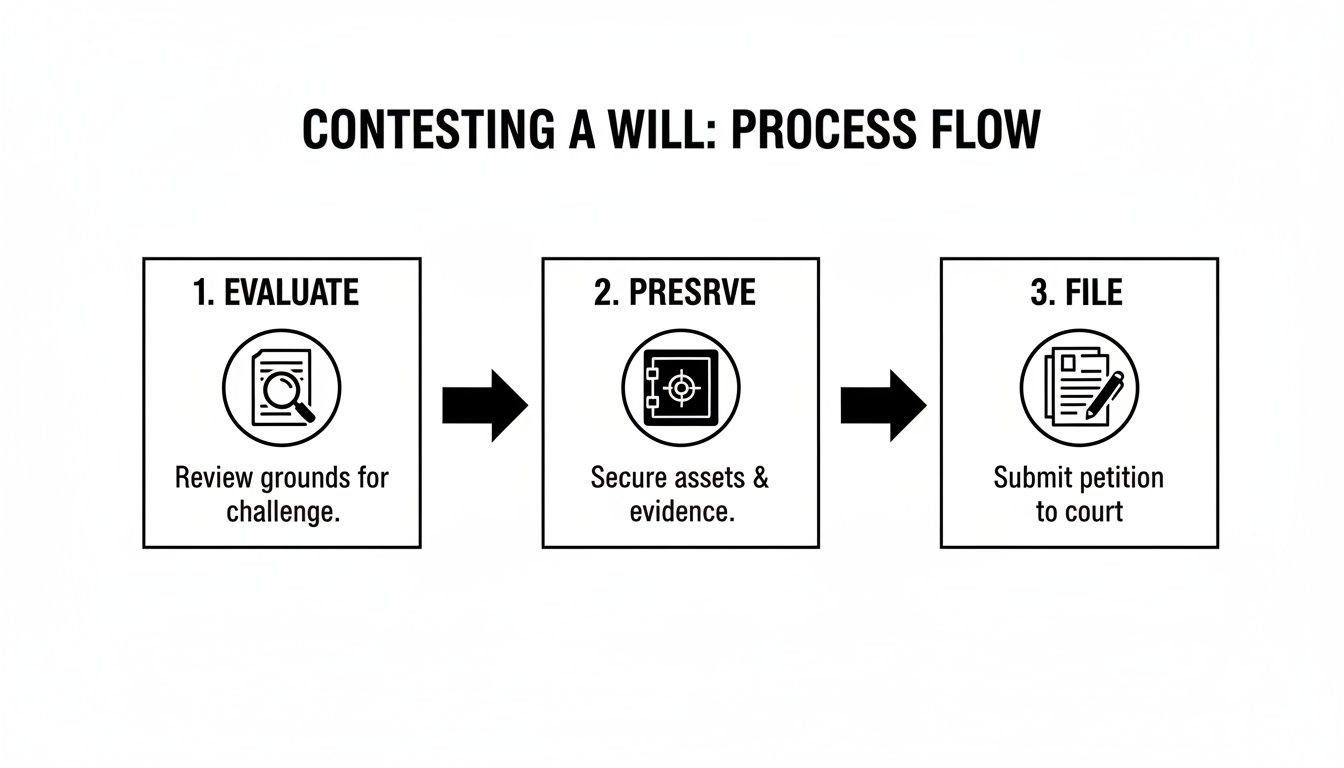
This simple diagram highlights the proper sequence. A successful will contest starts with a thorough evaluation, followed by immediate action to protect the estate before you ever step foot in a courtroom.
Identifying Valid Grounds for a Contest
Once you’ve established standing, the next hurdle is proving you have valid legal grounds to challenge the will. The court isn’t interested in family drama or feelings of unfairness. It only cares about whether the will is legally sound.
To help you understand what the court is looking for, here’s a breakdown of the most common legal arguments used to invalidate a will.
Common Legal Grounds for a Will Contest
| Legal Ground | What It Means in Practice | Types of Evidence to Look For |
|---|---|---|
| Lack of Testamentary Capacity | The person signing the will (the testator) was not of sound mind. They didn’t understand what they owned, who their family was, or what signing the will meant. | Medical records (dementia, Alzheimer’s), prescriptions for mind-altering drugs, testimony from doctors or caregivers, emails or letters showing confusion. |
| Undue Influence | The testator was manipulated or coerced by someone, usually a person in a position of trust. Their free will was completely overcome. | Isolation of the testator from family, a new acquaintance suddenly inheriting everything, suspicious financial transactions, testimony from friends or family about the influencer’s controlling behavior. |
| Improper Execution | The will wasn’t signed or witnessed according to the strict rules of your state. For example, it might be missing the required number of witness signatures. | The will document itself, testimony from the witnesses (if they can be found), or an opinion from a probate attorney on state-specific signing requirements. |
| Fraud or Forgery | The signature was forged, or the testator was tricked into signing a document they didn’t realize was their will (fraud in the execution). | Handwriting expert analysis, evidence that the testator was tricked, testimony from witnesses who can attest to the fraudulent circumstances. |
Identifying which of these grounds applies to your situation is the foundation of your case.
The burden of proof is entirely on you, the challenger. You must present clear and convincing evidence to back up your claim, which is why it’s so critical to preserve records and identify witnesses from day one.
This isn’t just a niche issue. Recent data from England and Wales shows a 34% increase in contested wills over the past five years. Experts there estimate that as many as 10,000 additional challenges happen outside of formal court proceedings each year. These numbers reveal a growing willingness to question estate plans that seem suspicious, a trend you can read more about in recent probate statistics.
Gathering the Evidence to Build Your Case
Suspecting a will is invalid is one thing; proving it in court is another challenge entirely. A successful will contest is won with cold, hard evidence—not emotion or suspicion. This is where you and your legal team shift from theory to fact-finding, building a compelling narrative that can withstand intense legal scrutiny.

Think of yourself as a detective. Your mission is to uncover documents, locate witnesses, and piece together a timeline that proves your grounds for the challenge are valid. This process, known in legal circles as discovery, is methodical and demands persistence.
Uncovering Medical and Financial Records
Often, the most powerful evidence is locked away in official documents. Your attorney will use legal tools like subpoenas to compel third parties—hospitals, banks, financial advisors—to release records that are absolutely crucial to your case.
For claims of lack of testamentary capacity, medical records are the gold standard. We’re looking for things like:
- Diagnoses of cognitive decline, such as dementia or Alzheimer’s.
- Hospitalization records from the time the will was signed.
- Prescription lists for medications known to cause confusion or impair judgment.
When alleging undue influence, the story is usually told through financial documents. Sudden, unexplained changes in financial behavior are a major red flag. Key evidence includes bank statements, investment records, and property deeds that might show suspicious transfers or withdrawals directly benefiting the alleged influencer.
Remember, the burden of proof rests on your shoulders. It is up to you to present clear and convincing evidence that the will does not reflect the testator’s true wishes. A strong paper trail is your most powerful weapon.
Identifying Credible Witnesses
While documents provide objective facts, witnesses provide the human context that brings your case to life. A credible witness can offer firsthand accounts of the testator’s state of mind, behavior, and relationships in the period leading up to the will’s creation.
Your legal team will help identify and interview potential witnesses who can provide compelling testimony. These individuals often include:
- Family and friends who can speak to the testator’s mental clarity or the controlling behavior of an influencer.
- Caregivers or healthcare providers who observed the testator’s daily condition and cognitive abilities.
- Financial advisors or prior attorneys who noticed unusual changes or expressed concerns about the testator’s decision-making.
The testimony from these individuals can corroborate the evidence found in medical or financial records, creating a much stronger, more persuasive case.
Special Considerations for High-Net-Worth Estates
Challenging a will in a high-net-worth (HNW) estate introduces another layer of complexity. The assets are often far more intricate, involving business entities, trusts, and sophisticated investment vehicles that can be used to obscure the true financial picture.
In these situations, your legal team will likely bring in specialized experts.
- Forensic Accountants: These professionals are experts at tracing money through complex financial structures. They can analyze business records, uncover hidden assets, and identify irregular transactions that point to undue influence or fraud.
- Valuation Experts: When assets include businesses, art collections, or unique real estate, these experts can provide an accurate valuation, which is critical for demonstrating the financial impact of a questionable will.
The stakes are higher in HNW contests, and the opposition is often well-funded. Having a team with experience in these complex financial matters is non-negotiable.
This level of scrutiny is becoming more common as significant wealth transfers from one generation to the next. High-net-worth families often face disputes where grounds like fraud or forgery are claimed. While outright court victories are rare—often under 10%—the strength of the evidence frequently forces a favorable settlement. Strategic timing and premier legal representation are essential. You can explore more about the future of contentious probate on Title Research. This insight underscores why assembling a robust evidentiary case is the most critical step you can take.
Navigating Critical Deadlines and Legal Filings
Once you’ve confirmed you have the right to challenge a will and started gathering your initial evidence, the clock starts ticking—loudly. The legal system runs on strict, unforgiving timelines. When it comes to contesting a will, missing a deadline isn’t a minor hiccup; it’s almost always a fatal blow to your case.
The moment a will is submitted to the court for probate, a countdown begins. This period is set by the statute of limitations, a law defining the absolute final date for filing a legal challenge. If you miss that window, you lose your right to contest the will forever, no matter how compelling your evidence might be.

This isn’t a soft guideline. It’s a hard stop. A court will throw out a claim filed even one day late, with no exceptions.
The Absolute Importance of the Statute of Limitations
The deadline to contest a will varies dramatically from one state to another. Some jurisdictions might give you years, but others offer a shockingly brief window—sometimes just a few months after the will is admitted to probate. In California, for example, a challenger typically has just 120 days from the day the court formally accepts the will.
Because these timelines are so different and often so short, you have to move quickly. You can get a general sense of the rules by reviewing an overview of the statute of limitations by state, but this is not a substitute for professional advice. Only a local probate litigator can tell you the exact deadline for your specific case.
To initiate the challenge, your attorney will file a formal document, often a petition or a “caveat,” with the probate court. This is the official notice to the court and all other interested parties that you are formally contesting the will’s validity. This document will also lay out your legal grounds for the challenge, whether it’s undue influence, lack of capacity, or another valid reason.
The most common mistake people make is waiting until they have a perfect, airtight case before they even call a lawyer. The right move is to hire counsel immediately. They can file the necessary paperwork to meet the deadline, preserving your right to fight while you continue to build your case.
Understanding the No-Contest Clause
One of the most intimidating things you can find in a will is a no-contest clause, sometimes called an in terrorem clause. This is a provision that says if any beneficiary challenges the will and loses, they forfeit whatever inheritance they were supposed to receive.
It’s a powerful tactic meant to discourage lawsuits. But it’s not always the brick wall it appears to be.
Many states have passed laws to weaken the power of these clauses. In a number of jurisdictions, a no-contest clause can’t be enforced if the person bringing the challenge had “probable cause.” In simple terms, this means that if you had a reasonable, evidence-based belief that your claim was legitimate, you likely won’t be disinherited even if you don’t win the case.
This turns your decision into a high-stakes strategic calculation. You and your attorney must carefully weigh the strength of your evidence against the risk of walking away with nothing.
State-by-State Will Contest Deadlines (Examples)
The window to contest a will is not uniform across the country. As the table below illustrates, the statute of limitations can range from a few short months to several years, making immediate consultation with a local attorney absolutely critical.
| State | Typical Deadline After Probate is Opened | Key Consideration |
|---|---|---|
| California | 120 days | One of the shorter deadlines, requiring very prompt action. |
| Florida | 90 days after notice of administration is received | The clock starts when you receive formal notice, not just when probate opens. |
| New York | Typically 6 months from when the will is admitted | Varies based on when citations are issued. |
| Texas | 2 years | A much longer timeframe, but waiting can still weaken a case. |
| Illinois | 6 months | A strict deadline that begins once the will is officially admitted to probate. |
This is just a small sample to show how much the rules can differ. Never assume you have plenty of time; verify the exact deadline in your state with an experienced probate litigator.
- Scenario A: The Calculated Risk Imagine you were left a small inheritance in a will, but you have very strong evidence that your elderly parent was pressured into signing it. Your attorney believes you have clear probable cause. In this situation, challenging the will is a calculated risk that is likely worth taking, as the no-contest clause is less of a threat.
- Scenario B: The Empty Threat Now, imagine you were written out of the will entirely. The no-contest clause has zero power over you because you have nothing to lose. For you, the decision to proceed has nothing to do with the clause and everything to do with the strength of your evidence.
Navigating a no-contest clause is a strategic chess move that requires expert legal guidance. It also underscores why having a strong evidentiary foundation before you file is so important—probable cause is your primary shield against forfeiture.
When to Settle and When to Fight
The idea of a dramatic courtroom showdown is powerful, but the reality of challenging a will is often far more strategic and private. Winning doesn’t always mean a judge banging a gavel in your favor. More often, a successful outcome is achieved through quiet, calculated negotiation long before a trial ever begins.https://www.youtube.com/embed/b5N4hhTK4xQ
This is especially true in high-net-worth disputes where privacy, cost-effectiveness, and the preservation of what’s left of family relationships are paramount. A public court battle can expose sensitive family and financial details—something most affluent families would rather die than see happen. This is exactly why the vast majority of will contests are resolved through private settlements.
The Strategic Advantages of Settlement
Choosing to settle isn’t a sign of weakness; it’s a smart, business-like decision. The benefits of avoiding a drawn-out court fight are immense, especially when complex assets and delicate family dynamics are at play.
- Confidentiality: Court proceedings are public record. A settlement keeps your family’s financial details and personal conflicts out of the spotlight.
- Cost Savings: Litigation is incredibly expensive. Attorney fees, expert witness costs, and court fees can quickly diminish the very inheritance you’re fighting for.
- Certainty of Outcome: A trial is always a gamble, no matter how strong your case looks on paper. A settlement gives you control, letting you agree to a guaranteed outcome rather than leaving it in a judge’s hands.
- Preserving Relationships: A courtroom battle can permanently sever family bonds. Mediation and negotiation offer a less adversarial, more constructive path forward.
The numbers bear this out. While data on private settlements is hard to come by, court statistics only show the tip of the iceberg. In the UK, for instance, a mere 122 probate contests went to trial in 2023. Yet, legal experts estimate that as many as 10,000 will challenges are initiated annually, with the overwhelming majority resolving privately.
Research shows these disputes jumped 34% over five years, partly driven by rising dementia cases and increasingly complex family structures. You can see more on these trends in the UK will and probate consumer research on PR Newswire.
Navigating the Mediation Process
One of the most effective routes to a settlement is mediation. This isn’t a free-for-all argument; it’s a structured negotiation where a neutral, third-party mediator helps all sides communicate and find common ground. It’s crucial to understand that a mediator doesn’t take sides or make decisions. Their only job is to facilitate a resolution everyone can live with.
Your attorney’s role here is pivotal. They’ll prepare a “mediation statement”—a powerful document summarizing your case, showcasing your strongest evidence, and laying out your legal arguments. During the session, your lawyer becomes your advocate, negotiating on your behalf and giving you unvarnished advice on the offers on the table.
The goal is to hammer out a formal agreement that becomes a legally binding contract. If you want to dive deeper, you can learn more about what is a settlement agreement in our detailed guide.
A successful mediation requires a shift in mindset. You’re no longer trying to prove you’re “right.” Instead, you’re focused on finding a practical, acceptable compromise that avoids the immense risk and cost of a trial.
Evaluating Settlement Offers
Deciding whether to accept an offer is one of the toughest calls you’ll make. It demands a cold, clear-headed evaluation of risk versus reward, stripping away the emotion of the situation.
Your attorney is your guide here, helping you analyze any offer by weighing it against several key factors:
- The raw strength of your evidence.
- The potential costs of continuing to fight.
- The realistic probability of success if you go to trial.
- The emotional and personal toll of a prolonged legal battle.
Ultimately, the decision of when to fight and when to settle is yours alone. But by understanding the strategic power of negotiation and preparing for the process, you can make an informed choice that protects your interests and, just as importantly, helps you move forward.
Finding the Right Probate Litigator
Challenging a will, especially when significant family assets are on the line, is not a path you should ever walk alone. The single most important decision you’ll make—one that will likely determine the outcome—is your choice of attorney. This is no time for a generalist or the family lawyer who handled a real estate closing. You need a probate litigator, a trial attorney who lives and breathes the aggressive, complex world of inheritance disputes.
Think of it this way: you wouldn’t ask your family doctor to perform open-heart surgery. You need a specialist who understands the unique evidentiary rules for proving undue influence or lack of capacity and who isn’t afraid to take a case to trial if a fair settlement can’t be reached.
What to Look For in an Attorney for High-Net-Worth Estates
When an estate includes closely-held businesses, layered trusts, or significant investment portfolios, the criteria for your legal counsel become far more demanding. A standard probate lawyer simply won’t have the financial acumen to trace assets or dissect the sophisticated estate planning maneuvers used in high-net-worth families.
Your ideal attorney should have a specific blend of skills:
- A Proven Litigation Track Record: How many will contests have they actually taken to trial? An attorney with a reputation for being trial-ready often gets the best settlement offers because the other side knows they won’t just fold.
- Experience with Complex Financials: They must be fluent in the language of business valuations, intricate financial statements, and trust accountings. Experience working alongside forensic accountants is a massive advantage.
- Deep Knowledge of Trust Law: High-net-worth estates are rarely just a simple will. They almost always involve trusts, and your lawyer must be an expert in how these instruments intersect with probate court.
- Discretion and Professionalism: High-profile estate battles demand an attorney who understands the critical importance of confidentiality and can manage the delicate, often volatile, dynamics of a family in crisis.
Key Questions to Ask During Your Consultation
The initial consultation is your interview. Arrive prepared with direct questions designed to gauge their actual expertise, not just their sales pitch.
- What percentage of your practice is dedicated specifically to probate litigation?
- Can you describe your experience with cases involving grounds similar to mine, like undue influence or lack of capacity?
- Based on this initial conversation, what are the primary strengths and weaknesses you see in my case?
- Who exactly at your firm will be handling the day-to-day work, and what is their experience level?
- How do you keep clients informed on strategy and progress?
Their answers will tell you everything you need to know about their legal skill, communication style, and whether they are the right partner for this fight.
Understanding the Fee Structures
Legal fees in will contests can be structured in a few ways. It’s crucial you understand the arrangement completely before signing anything.
| Fee Structure | How It Works | Best For |
|---|---|---|
| Hourly | You pay the attorney for every hour they work, plus case expenses. | Cases where the outcome is highly uncertain or if you prefer to finance the litigation directly. |
| Contingency | The attorney receives a percentage—typically 30-40%—of your recovery, but only if you win. | Strong cases where you lack the significant upfront cash required for hourly fees. |
| Blended/Hybrid | A combination of a lower hourly rate and a smaller contingency fee percentage. | Balances the risk for both you and the attorney, often making it a good middle-ground option. |
Always demand a written fee agreement and clarify which expenses (like expert witness fees or court costs) you are responsible for, win or lose.
Leveraging Curated Legal Networks
Finding an elite attorney with this precise skill set is a challenge. A generic online search is a gamble, cluttered with paid ads and unverified claims. This is where curated legal networks provide tremendous value.
Platforms like Haute Lawyer, for instance, pre-vet attorneys to ensure they meet a high standard of professional excellence and have a proven track record in high-stakes disputes.
This screenshot shows how curated networks connect users with top-tier legal professionals in a trusted, high-end environment. Instead of sifting through countless generic profiles, you are presented with a selection of proven experts who are recognized leaders in their fields. If you’d like to understand more about the specific criteria for selecting legal representation for high-value cases, you can explore this guide on how to find a good lawyer for high-value cases. Choosing the right legal partner is the first and most critical step in your fight for a just inheritance.
Your Top Questions About Challenging a Will, Answered
Even when you know the steps, the idea of challenging a will can feel like navigating a minefield. Below, I’ve broken down some of the most pressing questions that come up, giving you the straightforward answers you need to think clearly about what’s next.

How Long Do I Have to Challenge a Will?
This is, without a doubt, one of the most critical questions—and the answer depends entirely on state law. Once a will is officially admitted to probate, the clock starts running. The window to file a contest can be alarmingly brief, sometimes as short as 90 to 120 days.
If you miss this deadline, known as the statute of limitations, you are permanently barred from bringing a claim. It doesn’t matter how strong your case is. This is why you must speak with an experienced probate litigator in your state immediately to confirm your exact timeline.
Can I Challenge a Will if I Was Completely Left Out?
Yes, absolutely. In fact, people who have been completely disinherited often have the least to lose by launching a challenge, particularly if the will has a no-contest clause.
A no-contest clause is designed to intimidate beneficiaries who are already set to receive something. If you were left with nothing, the clause is an empty threat—it has no leverage over you. Your ability to move forward hinges on just two things: having legal standing and valid grounds for the contest.
A common misconception is that you need to be named in the will to challenge it. The key is having ‘standing’—meaning you would have inherited under a prior will or state law if the current will is invalidated.
What Is the Difference Between Undue Influence and Lack of Capacity?
While these two grounds are often intertwined, they are legally distinct. Nailing down the difference is essential for building a coherent case.
- Lack of Testamentary Capacity: This is all about the testator’s mental state. The argument here is that they weren’t of sound mind when they signed the will. Think dementia, a severe illness, or the disorienting effects of heavy medication that prevented them from understanding what they were signing.
- Undue Influence: This focuses on the manipulative actions of another person. The claim is that a bad actor used coercion and psychological pressure to overpower the testator’s free will, essentially forcing them to create a will that benefited the manipulator.
It’s entirely possible for someone to have full mental capacity but still fall victim to undue influence. Your attorney will analyze the evidence to determine which argument gives you the strongest position.
What Are My Chances of Winning a Will Contest?
If you look at raw trial statistics, the numbers can be discouraging. The success rate for winning a will contest outright in court is often cited as being under 10%. But that figure is deeply misleading.
Why? Because it completely ignores the vast majority of cases that are resolved through a private settlement agreement. The real goal isn’t always a dramatic courtroom victory; it’s about securing a favorable settlement. By building a strong, evidence-backed case, you create credible litigation risk for the other side. That leverage is what forces a negotiation and, ultimately, a successful outcome.
Navigating the complexities of a will contest requires exceptional legal skill, especially when high-value assets are at stake. The Haute Lawyer Network connects you with a curated selection of the nation’s top probate litigators, each vetted for their professional excellence and proven success in high-stakes disputes. Find the elite representation you need to protect your rightful inheritance at https://hauteliving.com/lawyernetwork.