A deposition is where you give sworn testimony—a formal, recorded question-and-answer session that happens outside a courtroom. Think of it as a fact-finding mission where attorneys gather critical information long before a case ever sees a trial.
Unpacking the Deposition Process
Imagine a deposition as a structured interview where your firsthand knowledge is the central subject. It’s a cornerstone of the discovery phase—the stage in a lawsuit where both sides are required to exchange information. The primary goal is for the opposing counsel to hear the facts of the case from your perspective, size you up as a potential witness, and officially lock in your story.
This is far from a casual conversation. Every answer you give is under oath, carrying the same legal weight as testimony in open court. Because this process is so foundational to legal strategy, you can find more context in our overview of what litigation is and how depositions fit into the bigger picture.
For a quick reference, here’s a breakdown of the key components.
The Deposition at a Glance
| Element | Description |
|---|---|
| Purpose | To gather sworn testimony from witnesses and parties before a trial. |
| Participants | The deponent (person testifying), attorneys for all parties, a court reporter, and sometimes a videographer. |
| Setting | Typically held in an attorney’s conference room, not a courtroom. |
| Format | A question-and-answer session led by the opposing counsel. |
| Record | Testimony is recorded word-for-word by a court reporter, creating an official transcript. It may also be videotaped. |
| Legal Status | Testimony is given under oath and is legally binding. |
This process ensures that all parties have a clear understanding of the facts and evidence before deciding on their next steps.
Why Depositions Are So Influential
The testimony gathered in a deposition has a massive impact on a case’s trajectory. Since an estimated 90% of civil cases in the U.S. settle before ever reaching a trial, what happens in the deposition room often decides the final outcome. Attorneys use the information gathered to:
- Assess Case Strength: Both sides get a candid preview of the evidence and witness testimony, exposing the strengths and weaknesses of their arguments.
- Drive Settlements: A powerful or damaging deposition can quickly persuade the other side to offer a favorable settlement rather than risk their chances at trial.
- Prepare for Trial: If the case does move forward, lawyers use deposition transcripts to draft their questions, anticipate answers, and challenge any inconsistencies if a witness’s story changes in court.
A deposition isn’t a memory test; it’s a formal chance to state the facts as you know them. Its purpose is to uncover information and create an official record that will shape every subsequent step of the legal proceedings.
In essence, this out-of-court event is frequently the main event. It sets the stage for the high-stakes negotiations and legal motions that can resolve an entire dispute without ever setting foot in a courtroom.
The Key Players in the Deposition Room
Walking into a deposition can feel like stepping onto a stage, but knowing the cast of characters demystifies the entire event. This isn’t a casual interview; it’s a carefully orchestrated legal proceeding where every person in the room has a distinct, strategic purpose.
The setting is almost always a conference room, not a courtroom. The atmosphere is professional and focused, but don’t let the lack of a judge’s robe fool you—every word matters. Understanding who is there and what they’re trying to accomplish is the first step to navigating the process with confidence.
The Deponent: The Star Witness
The central figure is the deponent—the person giving sworn testimony. If you’re being deposed, this is you. Your job is simple in theory but requires immense discipline: answer every question truthfully and accurately, based only on what you personally know.
You are not there to tell a story, win an argument, or justify your actions. Think of yourself as a human library of facts. Your role is to provide the information the opposing attorney requests, nothing more and nothing less. Your attorney will prepare you for this, but your core responsibility is to be an honest, careful historian of the facts as you know them.
The Questioning Attorney: The Director
The lawyer asking the questions, often called the questioning attorney or “examining counsel,” is the one directing the flow of the proceeding. This is the opposing party’s lawyer, and they have several critical objectives:
- Fact Gathering: Their primary goal is to uncover information that helps their case—or weakens yours. They will probe the events, your background, and any relevant documents.
- Locking In Testimony: They want to get your official story on the record. If your account changes later in court, they will use the deposition transcript to attack your credibility.
- Witness Evaluation: Beyond the facts, this attorney is sizing you up. They’re assessing how you handle pressure, how credible you appear, and ultimately, how a jury might perceive you. A calm, confident deponent can dramatically shift settlement negotiations.
Their questions might seem repetitive or unnecessarily detailed, but this is a deliberate strategy. They are exploring every angle to leave no stone unturned.
The Defending Attorney: Your Shield
Your own lawyer, the defending attorney, plays a crucial protective role. They won’t answer questions for you, but they are actively engaged in defending your interests every second of the deposition.
Your attorney acts as a gatekeeper, ensuring the questioning remains fair and within the proper legal boundaries. They are your advocate and your safeguard throughout the entire process.
Their key responsibilities are:
- Preparation: Before the deposition, they will meet with you to review key facts, practice answering tough questions, and explain the ground rules.
- Making Objections: If the questioning attorney asks an improper question (for example, one that seeks privileged information), your lawyer will object. This objection is noted on the record for a judge to rule on later.
- Providing Counsel: Your attorney can and will call for breaks if you are tired or flustered. They are there to ensure you stay composed and focused.
The Court Reporter: The Official Scribe
The court reporter is a neutral, state-licensed professional whose sole function is to create a verbatim record of everything said. They use a stenography machine to type every single word, from the formal questions to any off-the-cuff remarks.
This individual is also responsible for administering the oath at the beginning, where you swear to tell the truth. After the deposition concludes, they produce a written document called a transcript. This becomes the official legal record of your testimony, which is precisely why every answer you give must be accurate.
The Deposition Timeline: From Notice to Transcript
A deposition isn’t a single event—it’s a structured process with a clear beginning, middle, and end. Many people mistakenly believe it starts and stops the moment you’re in the conference room, but that’s just one part of a much larger journey.
Thinking about it like a marathon helps. You don’t just show up and run. There’s the training period, the race itself, and the recovery phase. A deposition follows the same logic, from the initial notice all the way through to the final transcript review.
This entire process revolves around a few key players whose roles are intertwined.
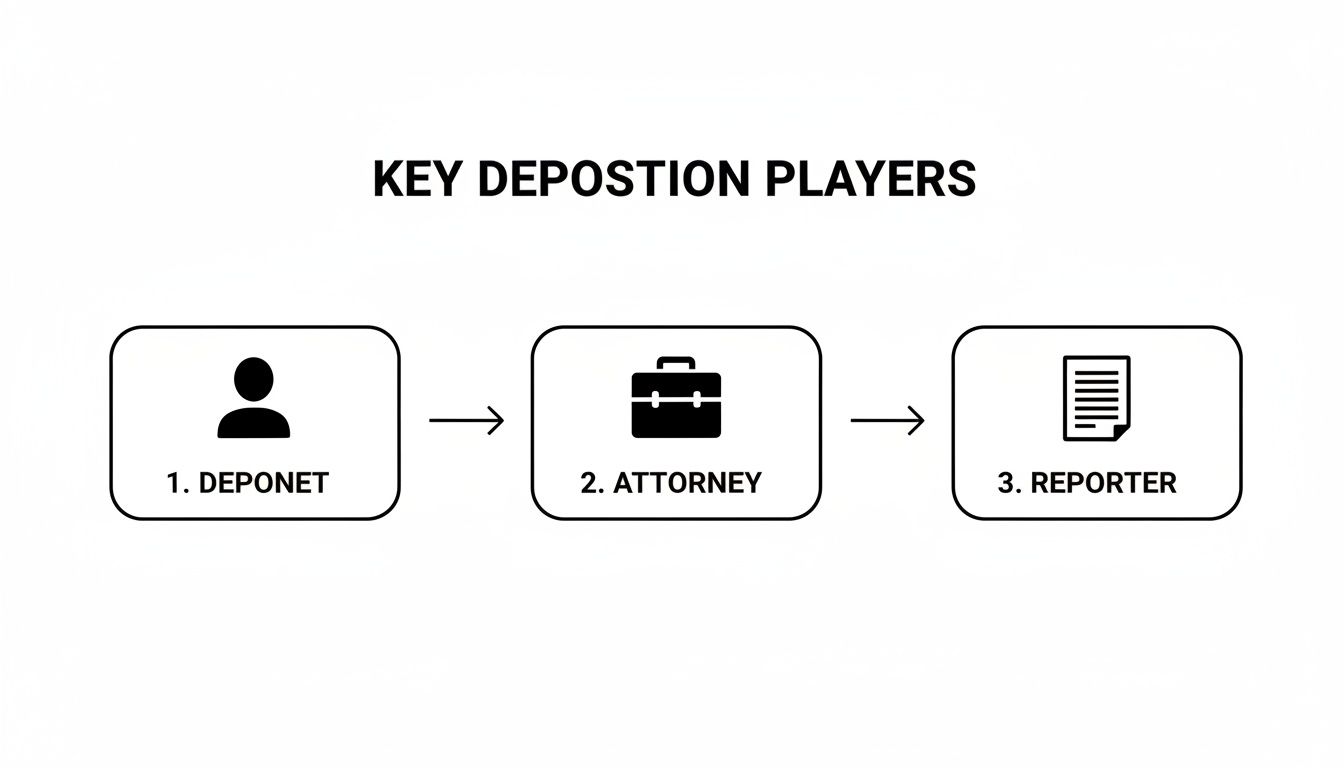
As the graphic shows, the deponent, their attorney, and the court reporter form the core of the proceeding, working together to create the official record that will shape the case.
Phase 1: Receiving the Notice and Preparing
It all starts with a formal document called a Notice of Deposition. This is the starting gun. This legal notice officially schedules the event, specifying the date, time, location, and who is being deposed.
Once that notice arrives, the most critical phase kicks off: preparation. No one should ever walk into a deposition cold. Your attorney will schedule one or more intensive sessions to get you ready.
In these meetings, you and your lawyer will dig in:
- Review Key Documents: You’ll pour over the essential emails, contracts, reports, and any other evidence at the heart of the case to bring the details back into sharp focus.
- Discuss the Facts: Together, you will reconstruct the timeline of events. The goal is to ensure your memory is clear, consistent, and—above all—accurate.
- Practice Answering Questions: Your attorney will run you through a mock deposition, asking the kinds of questions you can expect from the other side. This isn’t about memorizing answers; it’s about practicing how to respond truthfully without accidentally volunteering information.
- Establish Ground Rules: You’ll learn the essential rules of engagement, like listening carefully to every question, taking a deliberate pause before answering, and understanding that it’s perfectly acceptable to say, “I don’t recall.”
This isn’t about creating a script. It’s about building the confidence you need to answer questions honestly and accurately based on what you actually know.
Phase 2: The Day of the Deposition
On the day, you’ll meet with your attorney beforehand for a final review and to get into the right mindset. When everyone is settled in the conference room, the proceeding officially begins.
The sequence of events is highly structured:
- Going “On the Record”: The court reporter initiates the official record by stating the date, time, location, and the names of everyone in the room.
- Administering the Oath: You’ll be asked to raise your right hand and swear or affirm to tell the truth. This oath has the same legal force as testimony given in a courtroom.
- Preliminary Instructions: The questioning attorney typically provides a brief overview of the process, confirming you understand your obligation to be truthful.
- The Questioning Begins: This is the main event. The opposing counsel will begin their examination, and your attorney will be right beside you, listening to every word and ready to object to any improper questions.
You are always in control of the pacing. If you need a break for any reason—whether you’re tired, confused, or just need a moment—you can always ask for one.
Phase 3: After the Testimony Concludes
Once the opposing attorney is finished, your own lawyer might ask a few questions to clarify any points, though this doesn’t always happen. When all questions are done, the attorneys will agree to conclude, and the court reporter will go “off the record.”
But your job isn’t quite finished. In fact, one of the most important steps is still to come.
After the deposition, the court reporter creates a word-for-word written transcript of the entire proceeding. This document becomes the official, permanent record of your sworn testimony.
A few weeks later, you’ll get a copy of this transcript. Your final task is to read it carefully with your attorney, checking for any errors. If you find a meaningful mistake, you can correct it on an attached document called an errata sheet.
After you’ve reviewed it, made any necessary corrections, and signed off, the transcript is finalized. It now stands as a critical piece of evidence that will heavily influence any settlement talks and could be used at trial. This final review ensures the official record is accurate.
Navigating The Types Of Deposition Questions

The deposition hearing lives and dies by the quality of the questioning. This is the methodical, structured exchange where the opposing attorney digs into the facts of the case through you. If you can understand the types of questions coming your way, it’s like getting a map of the maze before you step inside—it helps you navigate with purpose and avoid costly wrong turns.
An attorney’s questioning isn’t just a random fishing expedition. It’s a strategic campaign to build a complete picture of events, pressure-test your story for inconsistencies, and size you up as a potential witness for trial. The questions are engineered to fall into specific categories, each serving a distinct purpose.
Foundational And Background Questions
Nearly every deposition kicks off with simple, non-confrontational questions about your personal and professional history. This isn’t just small talk; it serves two key functions. First, it gets basic identifying information on the record. Second, it gets you accustomed to the rhythm of answering questions under oath.
Think of it as the warm-up lap. The lawyer is setting a baseline and getting a feel for your demeanor. Expect questions covering:
- Personal Identification: Your full name, current address, and date of birth.
- Educational History: Schools you attended and degrees earned.
- Professional Background: Your full employment history, including job titles and key responsibilities.
Even though these questions seem routine, every answer matters. It’s critical to stay sharp and answer truthfully and concisely right from the start.
Open-Ended Narrative Questions
Once your background is established, the questioning will pivot to the heart of the case. Attorneys often begin with broad, open-ended questions designed to get you talking—the classic “narrative” questions that invite you to tell a story in your own words.
A perfect example is, “Tell me everything that happened at the meeting on May 15th.”
The goal of an open-ended question is to see what information you volunteer without being prompted. It’s a test of what you deem important and gives the attorney a roadmap for their more detailed, follow-up questions.
Your lawyer will coach you on this, but the strategy is to stick strictly to the facts you personally know. Answer the question truthfully, but don’t add personal opinions, assumptions, or anything that wasn’t asked. Resist the very human urge to fill a silence—a concise, factual answer is your best defense.
Specific And Document-Based Questions
After you’ve provided your initial narrative, the attorney will drill down into the details with highly specific, granular questions. This is where they start introducing documents—emails, contracts, reports—which are marked as official exhibits.
The questioning becomes much more pointed. Instead of asking what happened, the attorney might slide a document in front of you and ask:
- “Do you recognize this email, which we’ve marked as Exhibit 4?”
- “Did you send this email on the date shown?”
- “Please read the third paragraph aloud. Is that an accurate statement?”
This tactic is designed to lock your testimony to concrete evidence. Your job is to carefully review any document before you answer. Only speak to what the document says and what you personally recall about it. If you don’t remember it, saying “I don’t recall” is a perfectly acceptable and often wise answer.
Understanding Attorney-Client Privilege
At some point, you might be asked about conversations you’ve had with your own lawyer. These communications are almost always protected by a legal shield known as the attorney-client privilege. This is a cornerstone of the legal system, allowing you to speak candidly with your counsel without fear of it being used against you.
If a question infringes on this privilege, your lawyer will immediately object and instruct you not to answer. It’s one of the very few times you’ll be told to remain silent. Having a clear grasp of what is attorney-client privilege before the deposition will help you understand why your lawyer is stepping in to protect you.
Common Deposition Question Categories
To help you prepare, it’s useful to see how these question types are applied across different subjects. The table below outlines the common themes you can expect to encounter during your deposition.
| Question Category | Objective | Example Question |
|---|---|---|
| Chronology of Events | To establish an undisputed timeline of what happened and when. | “Walk me through the events of June 1st, starting from the morning.” |
| Knowledge and State of Mind | To understand what you knew or believed at a specific moment in time. | “What did you know about the project’s budget when you signed the contract?” |
| Financial Information | To verify damages, losses, or financial transactions relevant to the case. | “Can you explain the discrepancy in the Q3 profit and loss statement?” |
| Conversations and Communications | To pin down who said what to whom, especially regarding key decisions. | “Describe your phone conversation with Mr. Smith on Tuesday afternoon.” |
Regardless of the category, the core strategy never changes: Listen carefully, pause to think, and answer only the question that was asked. Your preparation sessions with your attorney are designed to make this approach feel like second nature, ensuring you can handle any line of questioning with precision and confidence.
Strategic Concerns in High Stakes Depositions
When major assets, corporate control, or a hard-earned reputation is on the line, a deposition transforms from a simple Q&A into a high-stakes strategic battle. For high-profile individuals and businesses, every answer carries immense weight, capable of shaping not just the lawsuit but public perception and future business deals.
This is where the idea of “deposition as theater” becomes critical. The lawyer across the table isn’t just collecting facts. They are sizing you up, evaluating your composure under pressure, and gauging how a jury might perceive your credibility. Your performance can dramatically shift their case valuation and push them toward a favorable settlement—or convince them to fight harder.
Protecting Sensitive Information
A primary concern in high-stakes litigation is preventing confidential information from becoming public. Without the right legal protections, a deposition can force the disclosure of trade secrets, private financial data, or sensitive personal details, entering them into the public record.
This is why a protective order is non-negotiable. Before you ever sit down to testify, your attorney can negotiate an agreement or get a court to issue an order that strictly limits what can be asked and how that information is used. This is a crucial shield for proprietary business strategies and personal wealth details, preserving both privacy and competitive advantage.
Using Testimony for Strategic Leverage
Every word you speak is being transcribed and recorded, creating a permanent record the other side will dissect for any possible advantage. Your testimony can be used to file a motion for summary judgment—a tactical move where they ask the judge to decide the case in their favor without a trial, arguing your own words prove there’s no real dispute.
A single misstatement or concession can be weaponized to undermine your entire case. This is why careful, precise, and truthful answers, guided by extensive preparation, are your strongest defense. The goal is to provide facts without creating unintended legal vulnerabilities.
The deposition transcript is also a powerful tool in settlement talks. A strong, consistent, and credible performance can convince the other side that going to trial is a risky gamble, pushing them toward a more reasonable settlement. Conversely, a shaky deposition emboldens them, often resulting in a lowball offer or a drawn-out legal fight. This is why it’s so critical to choose a lawyer for high-stakes legal matters who understands these dynamics.
Navigating Jurisdictional Complexities
For high-net-worth individuals and global businesses, legal disputes often cross international borders, adding another layer of strategic complexity. The rules governing depositions can change dramatically depending on where a witness is located.
In some countries, depositions can only be conducted at a U.S. embassy or consulate. For cross-border business disputes, this means coordinating with diplomatic officials, arranging for certified translators, and adapting questioning to local protocols—all while producing sworn testimony that can make or break a case in a U.S. court.
Ultimately, in a high-stakes deposition, you aren’t just a witness. You’re a strategic asset. Your clarity, credibility, and composure can directly influence the outcome of the case, the final settlement figure, and the protection of your most sensitive interests.
Common Deposition Questions, Answered
Even with a clear understanding of the deposition process, practical questions always come up. Here are direct answers to the most common concerns clients have before stepping into the deposition room.
Can I Refuse to Answer a Question?
In almost every scenario, no. Your testimony is under oath, and a refusal to answer a question can lead to serious legal consequences, including sanctions from the court. There is, however, one critical exception.
You can—and absolutely should—refuse to answer if your attorney instructs you not to. This situation almost exclusively arises when a question intrudes upon attorney-client privilege, which protects the confidential advice and communication between you and your legal counsel.
If the opposing attorney asks a question that is improper for other reasons (it’s argumentative, confusing, or irrelevant), your lawyer will state an objection for the record—for instance, “Objection, form.” After the objection is noted, they will almost always tell you to go ahead and answer. This preserves their right to challenge the question’s admissibility later on.
The rule is straightforward: Only refuse to answer when your own lawyer explicitly tells you to stop. Otherwise, a truthful answer is required.
What Should I Wear to a Deposition?
Your attire is part of your testimony. It conveys respect for the process and projects credibility. You should always dress as if you were appearing in court—think business professional or, at a minimum, business casual.
Although most depositions occur in a conference room, not a courtroom, your appearance becomes part of the official record. This is especially true for videotaped depositions, where your demeanor and presentation will be scrutinized. The goal is to appear serious, credible, and trustworthy.
- For Men: A suit is always appropriate. Slacks with a blazer and collared shirt also work well. A tie is recommended.
- For Women: A conservative dress, pantsuit, or a skirt and blouse are all excellent choices.
- What to Avoid: Steer clear of anything that could be a distraction. This includes flashy jewelry, clothing with prominent logos or bold patterns, and casual wear like t-shirts or shorts.
A professional appearance reinforces the gravity of your testimony from the moment you enter the room.
How Long Does a Deposition Usually Last?
The duration of a deposition is highly variable. A simple case might wrap up in just a few hours. In complex commercial litigation with extensive documentation and multiple key events, a deposition can easily consume a full day or even stretch across several days.
Under the Federal Rules of Civil Procedure, depositions are generally limited to one day of seven hours of actual testimony time. This seven-hour clock stops for lunch and other breaks. While state rules can differ, this is a widely accepted benchmark.
It’s crucial to clear your schedule for the entire day. Assuming it will be short adds unnecessary pressure, which can lead to rushed, imprecise answers. Plan for a full day to ensure you remain focused and composed.
What Happens If I Make a Mistake in My Testimony?
It’s human to misspeak or recall a detail incorrectly under pressure. The legal system anticipates this. The key is how and when you address the error.
- Correcting a Mistake in the Moment: If you realize you’ve made a mistake right after you’ve said it, fix it immediately. It’s as simple as saying, “Excuse me, I need to clarify my last answer,” and then providing the correct information. This is the cleanest and most effective way to handle an error.
- Correcting a Mistake After the Fact: Weeks after the deposition, you will receive the official transcript for review. If you identify an error, you can correct it using an errata sheet. This form allows you to note the page and line number of the mistake and provide the corrected testimony.
Be cautious with this second option. Any significant changes on an errata sheet can be used by the opposing counsel at trial to attack your credibility by arguing that you’re changing your story. The best strategy is always to be as precise as possible during the deposition itself.
Navigating the complexities of a high-stakes deposition requires expert legal guidance. At Haute Lawyer Network, we connect clients with top-tier attorneys who possess the experience and strategic insight to protect your interests at every turn. Find the elite representation you deserve at https://hauteliving.com/lawyernetwork.