
You can’t protect what you don’t know you have. That’s the simple, and often expensive, truth about trade secrets. The first move in any serious protection strategy isn’t about lawyers or contracts—it’s about a foundational audit to identify the specific information that gives your business its competitive edge.
This goes far beyond just secret formulas or client lists. The real scope covers everything from your internal processes and supply chain logistics to the hard-won knowledge from your failed experiments.
What Exactly Counts as a Trade Secret?

Before building the fortress, you need to map out the treasures inside. Too many executives think trade secrets are reserved for groundbreaking inventions like the Google algorithm. In reality, a trade secret is any piece of confidential business information that gives you an advantage precisely because it’s not public knowledge.
The definition is intentionally broad, covering a huge spectrum of assets that drive your business forward.
- Financial and Business Information: This includes internal cost and pricing models, detailed customer lists with purchasing histories, and five-year strategic growth plans.
- Technical and Scientific Information: Think secret recipes, software source code, proprietary manufacturing processes, and complex engineering schematics.
- Commercial Strategies: Your unique marketing playbook, specially negotiated supplier discounts, and even the training manual for your sales team can all qualify.
Looking Beyond the Obvious Assets
Some of the most valuable—and most frequently overlooked—trade secrets are woven into the very fabric of your day-to-day operations.
A classic example is “negative know-how.” This is the priceless knowledge gained from all the research dead-ends and failed experiments. Knowing what not to do can save a competitor millions of dollars and years of development time, making that information incredibly valuable.
Another goldmine is your refined internal processes. Maybe your logistics team perfected a warehousing method that cuts shipping times by 15%, or your HR department created a hiring rubric that identifies top performers with 90% accuracy. These are operational advantages that are nearly impossible for a competitor to replicate from the outside.
Conducting Your Internal Audit
The first practical step is a trade secret audit. This isn’t just a box-checking exercise; it’s a strategic deep dive to map your most critical intellectual property. Start by asking your department heads a simple question: “If a competitor got their hands on one piece of information from your team, what would cause the most damage?”
This forces you to articulate exactly what drives your competitive advantage. More importantly, it creates a documented inventory, which is absolutely critical if you ever have to prove the existence of a trade secret in court. You can’t protect something you haven’t identified and documented. This is a core principle of how to protect intellectual property in a legally defensible manner.
Here’s a simple checklist to get your team started on identifying these core assets across different business functions.
Identifying Your Core Trade Secrets Checklist
| Asset Category | Example Assets | Key Protection Priority |
|---|---|---|
| R&D / Technical | Product formulas, source code, schematics, negative know-how, lab notebooks. | High – Core value of the company. Access must be strictly need-to-know. |
| Sales & Marketing | Customer lists, pricing models, lead generation funnels, marketing strategies. | High – Direct revenue impact. Encrypt and limit access to sales leadership. |
| Operations | Manufacturing processes, supplier lists, logistics methods, quality control data. | Medium/High – Efficiency advantage. Document and restrict to operations staff. |
| Financial | Profit/loss data by product, cost structures, investor information, forecasts. | High – Sensitive data. Access restricted to executive and finance teams. |
| Human Resources | Compensation structures, strategic hiring plans, training manuals, performance data. | Medium – Can reveal company strategy. Restrict to HR and senior leadership. |
This isn’t just about creating a list and filing it away. This audit becomes the foundation for every other protective measure you take.
The Uniform Trade Secrets Act (UTSA) requires businesses to take “reasonable efforts” to maintain secrecy. This isn’t an abstract legal theory; it has real teeth. In fact, courts have dismissed over 60% of trade secret misappropriation cases in the last decade simply because companies failed to meet this standard.
Taking simple, practical steps like marking documents ‘Confidential,’ using tiered digital access controls, and conducting regular audits is non-negotiable. Data from the U.S. Chamber of Commerce shows that companies implementing these basic protocols experience 50% fewer security breaches.
Ultimately, identifying your trade secrets is an ongoing process, not a one-time project. As your business evolves, so will your most valuable information. Revisit your audit annually to ensure your protection strategy keeps pace with your innovation.
Putting Your Legal Armor in Place: NDAs and Employee Agreements
While digital firewalls and locked server rooms are critical, your legal contracts are the true foundation of your trade secret defense. These documents aren’t just formalities. They are the enforceable ground rules that define confidentiality for everyone who touches your sensitive information.
A well-crafted agreement is a proactive measure that can stop a dispute before it even begins. It sets clear, legally binding expectations from day one, dramatically reducing the odds of an accidental leak or, worse, a malicious theft down the road.
Nailing the Non-Disclosure Agreement
Your Non-Disclosure Agreement (NDA) is the first line of legal defense. But be warned: a generic, downloaded template often creates a false sense of security and can be worse than having no agreement at all. Its power lies entirely in its specificity and clarity.
The most crucial element of any NDA is the definition of “Confidential Information.” Vague phrasing like “all business information” is a major red flag for judges. Your definition has to be precise enough to hold up in court but broad enough to cover everything you identified in your audit.
Instead of a generic clause, get specific with categories:
- Technical Data: “including but not limited to, all source code, product schematics, manufacturing processes, and negative know-how related to Project X.”
- Business Information: “encompassing customer lists with purchasing history, proprietary pricing models, supplier contract terms, and strategic marketing plans.”
- Financials: “including internal profit and loss statements, cost structures, and unannounced financial forecasts.”
This level of detail leaves no room for ambiguity, making it crystal clear what the other party can and cannot share. That’s the kind of language that strengthens your position if you ever need to enforce the agreement.
Beyond the NDA: Employee and Contractor Agreements
NDAs are perfect for external parties, but your employee and contractor agreements must go deeper. These are your insiders, people with privileged access, so their contracts need clauses that address their unique relationship with your company’s intellectual property.
An Invention Assignment Clause is absolutely non-negotiable for anyone in a creative or technical role. This clause ensures that any inventions or IP they create related to your business, using your resources, legally belong to the company from the start. Without it, you could end up fighting for ownership of a product they helped build on your dime.
Similarly, a Non-Solicitation Agreement is vital for protecting your client base and your team. This prevents a departing employee from immediately poaching your best customers or convincing your top performers to jump ship with them. While related, it’s also important to understand what a non-compete agreement is and how enforceability varies dramatically by state.
A common mistake is treating contract signing as a one-and-done event. You must reinforce these obligations. During exit interviews, have departing employees sign an acknowledgment confirming they still understand their duty of confidentiality and have returned all company property.
Failing to secure these agreements can be financially devastating. For trade secret lawsuits with USD10 million to USD25 million at stake, the median cost of litigation hits USD2.75 million. For cases exceeding USD25 million, that figure skyrockets to an average of USD4.5 million. These numbers alone show why investing in proactive contractual measures is one of the smartest business decisions you can make.
Creating a Consistent Exit Process
Your protective measures can’t stop the day an employee walks out the door. A standardized exit interview process is one of the most effective ways to reinforce confidentiality obligations and mitigate the risk of secrets leaving with them.
This process needs to be more than a simple HR formality; it’s a critical security checkpoint.
- Reiterate Confidentiality: Verbally review the key confidentiality clauses from their employment agreement.
- Confirm Return of Property: Use a detailed checklist to ensure every piece of company property—laptops, phones, access cards, documents—is back in your possession.
- Sign an Acknowledgment: Have the employee sign a straightforward form confirming their ongoing duties and the return of all materials.
This consistent, documented process is exactly what a court looks for as “reasonable efforts” to protect your information. It also sends a powerful message that you take your trade secrets seriously, even after someone is gone.
Implementing Practical Physical and Digital Security

Legal agreements are a powerful deterrent, but they’re only one piece of a defensible strategy. Let’s be blunt: a signed NDA won’t stop a determined thief if you leave the keys to the kingdom lying on a table.
Courts expect you to demonstrate “reasonable efforts” to protect your secrets. This is where tangible, practical security measures become non-negotiable. Think of it as layered security. Your contracts are the legal perimeter, but your physical and digital controls are the walls, locks, and guards that make a breach difficult in the first place.
Bolstering Your Digital Defenses
In an environment where a single click can transfer gigabytes of data, your digital security is your front line. The goal is to make it significantly harder for unauthorized individuals—whether malicious outsiders or careless insiders—to access, copy, or transmit your confidential information.
Start with the essentials. Multi-factor authentication (MFA) should be mandatory for accessing any system containing sensitive data, from your CRM to your cloud storage. It’s a simple yet incredibly effective barrier against compromised passwords.
Next, get serious about controlling access internally. Role-based access control (RBAC) is foundational. This just means employees should only have access to the specific data they absolutely need to perform their jobs. An engineer has no business in the sales forecasts, and a marketing coordinator shouldn’t be anywhere near the raw source code.
By implementing RBAC, you are not just protecting against theft; you are minimizing the potential damage from an accidental leak or a compromised account. It’s about containing risk by compartmentalizing information.
This principle extends to your network itself. Network segmentation prevents an intruder who breaches one part of your system from moving freely to access everything else. By isolating critical data on separate, more secure network segments, you create internal firewalls that can stop an attack from escalating into a catastrophe.
Securing Your Physical Environment
While digital threats get the headlines, old-fashioned physical security remains critical. Your office contains servers, prototypes, printed documents, and whiteboards covered in strategic plans.
Your physical security measures must be visible and consistently enforced. These actions demonstrate to both your team and, if necessary, the courts that you take secrecy seriously.
- Restricted Access Zones: Identify areas where the most sensitive work happens—like R&D labs, server rooms, or executive offices. Use key cards, biometric scanners, or even simple keypad locks to ensure only authorized personnel can enter.
- Visitor Protocols: Every single visitor should sign in, be escorted at all times, and sign a basic NDA before being granted access beyond the lobby. Never allow guests to wander unescorted.
- Secure Document Disposal: A cross-cut shredder is a low-cost, high-impact investment. Any printed document with confidential information should be shredded, not just tossed in the recycling bin.
- Clean Desk Policy: Encourage or require employees to lock away sensitive documents and lock their computers when they step away. This simple habit prevents opportunistic snooping or outright theft.
These tangible measures are what transform a policy on paper into a living security culture. They are the daily actions that reinforce the value of what you’re trying to protect.
The economic stakes are immense. With research showing that intangible assets now account for as much as 80% of the value of Fortune 500 companies, your trade secrets are likely your most valuable assets. The theft of this intellectual property costs the U.S. economy an estimated $300 to $600 billion annually, making robust security a matter of survival, not just compliance. You can find more details on the financial impact of trade secret theft in this in-depth patent law analysis.
Creating a Culture of Confidentiality
Your NDAs and security systems are critical, but they’re only half the story. The strongest defense against trade secret theft isn’t a firewall or a legal clause—it’s a team that understands, respects, and actively protects your company’s crown jewels. Building this kind of security-conscious culture is what turns abstract policies into ingrained, everyday habits.
This doesn’t happen by accident. It requires a deliberate, top-down commitment that makes confidentiality a core job function for everyone, from the CEO down to the newest intern. When your team becomes your first line of defense, your entire security posture improves exponentially.
Conducting Regular Security Audits
Before you can train your team, you need to know where you’re vulnerable. Think of regular security audits as preventative check-ups for your information security—they’re designed to find the weak spots before a crisis hits. These aren’t about assigning blame; they’re about getting better.
A meaningful audit goes beyond just checking if a policy exists. It confirms whether people are actually following it.
- System Audits: This means digging into access logs for sensitive databases, checking for outdated software with known security holes, and making sure role-based access controls are actually working as intended.
- Procedural Audits: Walk the floor. Are sensitive documents left on desks overnight? Are visitors wandering around unescorted? Are confidential client strategies being discussed in the open-plan kitchen?
- Knowledge Audits: Casually ask employees what they’d do in a specific situation. Do they know who to call if they suspect a data leak? Can they spot a phishing email designed to steal their login credentials?
The answers you get become the foundation for your training program, letting you focus on fixing real-world gaps instead of repeating generic advice.
Designing Engaging Employee Training
Mentioning confidentiality once during onboarding is not a training program. To be effective, training has to be ongoing, engaging, and directly relevant to what your employees do every day. The goal is to get beyond a list of rules and help them understand why these precautions matter.
Use scenarios they can relate to. Instead of saying, “Don’t share confidential information,” frame it as a real-world dilemma: “You get an urgent email from someone who looks like the CEO, asking for a client list for a last-minute meeting. What do you do?” This makes the threat feel real.
A well-informed employee who spots a suspicious email or questions why a visitor is unescorted is more valuable than any firewall. Your training should empower your team to become your first line of defense.
Make security an ongoing conversation. Use team meetings to talk about recent security news, share quick reminders about clean desk policies, or even celebrate a team member who correctly identified a potential threat.
Developing a Clear Incident Response Plan
Even with the best culture, mistakes happen. The difference between a minor incident and a full-blown crisis often comes down to having a clear, well-rehearsed incident response plan. When a potential theft is suspected, panic is the enemy. A plan provides a calm, methodical roadmap to follow.
This plan needs to be documented, accessible, and understood by key players before something goes wrong. It should outline the immediate steps to contain the damage and, crucially, preserve evidence for any potential legal action.
Here’s a look at the critical phases of a solid incident response plan and why each one matters.
Incident Response Plan Key Stages
| Phase | Key Actions | Primary Goal |
|---|---|---|
| 1. Detection & Reporting | Employees know who to notify immediately. The initial report is documented with the time, date, and specific details. | Ensure rapid awareness and kickstart the response process without any delay. |
| 2. Containment | Immediately suspend the suspect’s network access. Secure physical evidence like laptops and hard drives. Isolate affected systems. | Stop the bleeding. Prevent any further data from leaving or being damaged. |
| 3. Investigation & Preservation | Engage your legal counsel and a forensic IT team. Create exact copies (forensic images) of all devices and logs. Do not alter original evidence. | Methodically gather the facts and preserve evidence in a way that will stand up in court. |
| 4. Communication & Recovery | Follow legal counsel’s advice on notifying any affected parties. Remediate security gaps identified during the investigation. | Manage legal and reputational risk while strengthening defenses against the next threat. |
Having this plan ready to go allows you to act decisively, turning a moment of chaos into a structured response that protects your legal and business interests.
Taking Action When a Trade Secret Is Stolen
Even with the best protections, a breach can happen. A key employee walks out the door to a competitor, taking your customer list with them. A business partner misuses proprietary data. When you suspect a theft, the clock starts ticking—loudly.
Your response in the first 24 to 48 hours is absolutely critical. A swift, strategic playbook is your best friend here; panic is your worst enemy. The goal is to contain the damage, stop the bleeding, and preserve every shred of evidence in a way that will stand up in court. This is the time to activate your incident response team: key executives, IT, HR, and most importantly, your outside intellectual property counsel.
Your First Moves: Legal and Tactical
The absolute first call you make should be to your attorney, not to the person you suspect. Acting on emotion is a surefire way to make a mistake, like tipping off the thief and giving them time to wipe their hard drive clean. Your counsel will guide you through the critical opening moves.
These first steps are a careful dance between technical forensics and legal preparation.
- Preserve Everything: Your IT team needs to immediately secure all relevant devices—laptops, company phones, servers—and create forensic images. This creates a perfect, court-admissible snapshot of the data.
- Cut Off Access: Quietly suspend the suspect’s access to all company systems. This includes email, cloud accounts, and internal networks. You have to stop the data from continuing to flow out the door.
- Document the Timeline: Start a detailed log. When did the suspicion arise? What specific evidence triggered it? Who was involved? This running timeline will be invaluable for your legal team.
Resist the urge to play detective and search the employee’s computer yourself. You could inadvertently alter digital timestamps and metadata, potentially corrupting the very evidence needed to prove your case. Wait for professional forensic experts.
Building a security-conscious culture with clear processes is what makes an effective incident response possible.
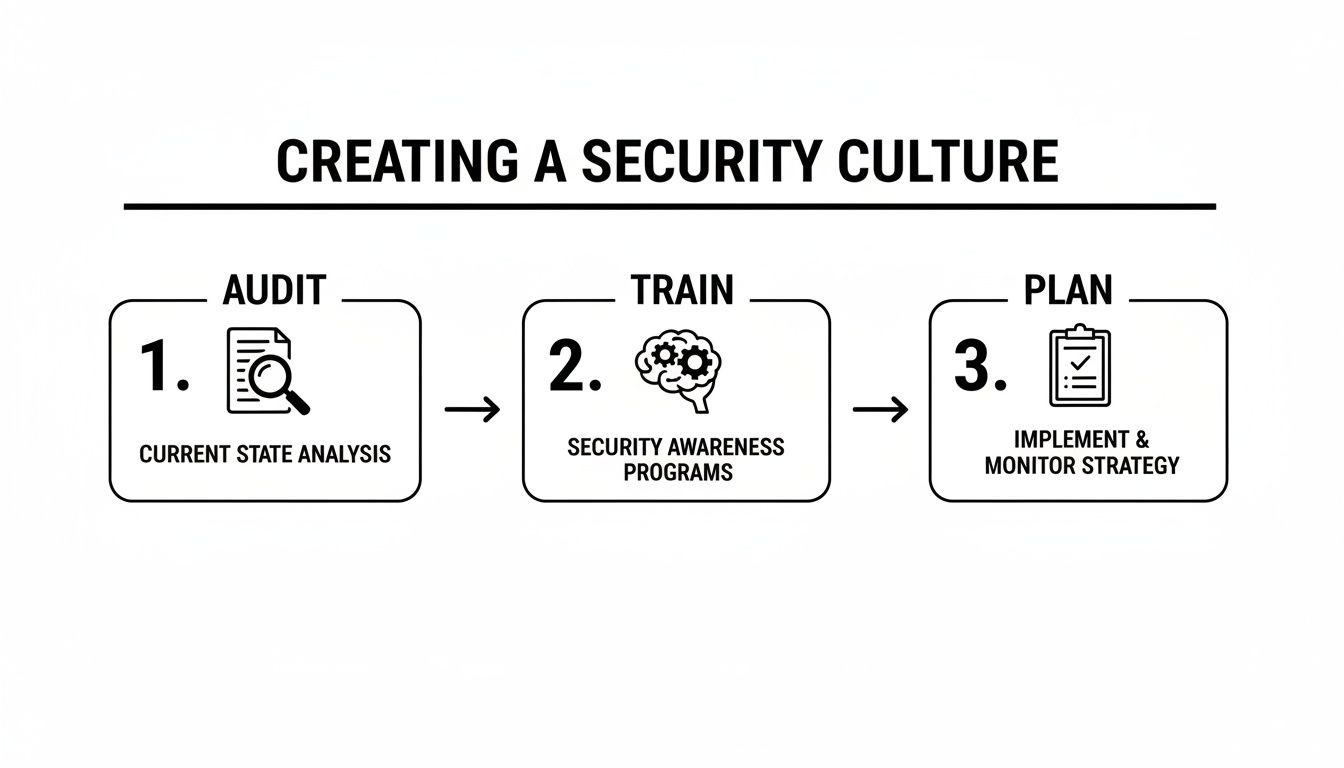
This simple flow—audit, train, plan—is the foundation of a proactive defense that pays dividends when a crisis hits.
Choosing Your Legal Pathway
Once the immediate threat is contained, you and your counsel will plot the legal strategy. Fortunately, you have powerful tools, including state laws based on the Uniform Trade Secrets Act (UTSA) and the federal Defend Trade Secrets Act (DTSA) of 2016. The DTSA was a game-changer, creating a federal cause of action and opening the doors to federal court.
Often, the first shot across the bow is a formal cease-and-desist letter. This is a serious legal notice that tells the offender and their new employer to stop using your information and return everything. It’s a formal warning shot that can sometimes resolve the matter without a full-blown lawsuit.
If the damage is ongoing and threatens to cripple your business, your lawyer may advise seeking a temporary restraining order (TRO) or a preliminary injunction. This is an emergency court order, obtained quickly, to legally bar the other party from using or sharing your secrets while the litigation proceeds. To get one, you have to show the court you’re likely to win and that money alone can’t fix the harm being done.
Pursuing Damages and Other Remedies
Beyond just stopping the theft, litigation allows you to recover financially. If you prove your case, you may be entitled to damages calculated in one of two ways:
- Actual Loss: The revenue you can prove you lost because of the theft.
- Unjust Enrichment: The profits the defendant made from using your trade secret.
For cases involving willful and malicious theft, courts have the power to award exemplary damages—up to twice the amount of actual damages—and make the other side pay your attorney’s fees. This not only makes you whole but sends a powerful deterrent message. To get a better sense of what this process looks like, it’s helpful to understand what litigation entails and how these proceedings work.
In the most egregious situations, like those involving economic espionage or theft on behalf of a foreign entity, a criminal referral to law enforcement like the FBI may be appropriate. While you don’t control the criminal prosecution, a conviction can lead to hefty fines and prison time, delivering the strongest possible message that trade secret theft will not be tolerated.
Common Questions About Protecting Trade Secrets
Navigating the world of intellectual property often feels like learning a new language. As you build out your strategy to protect your company’s most valuable information, a few key questions almost always come up.
Getting clear answers on these points is critical. It helps you focus your resources, set the right expectations for your legal agreements, and prepare your team to act decisively if a problem ever arises.
What Is the Difference Between a Trade Secret and a Patent?
This is the most fundamental question, and the answer comes down to a critical strategic trade-off. A patent is designed to protect a specific, novel invention. In exchange for a limited monopoly—usually 20 years—you have to publicly disclose every detail of your creation in the patent application. It becomes public knowledge.
A trade secret, on the other hand, protects confidential information that gives you a competitive edge, and its protection can last forever—as long as you can keep it secret. The Coca-Cola formula is the classic example, protected for over a century. You have to choose one path; you can’t have both for the same IP.
Is an NDA Enough to Protect My Company Secrets?
An NDA is an essential tool, but it is absolutely not a complete strategy. Relying solely on a Non-Disclosure Agreement is like having a lock but no door—it’s a common and costly misconception.
Courts demand that you take “reasonable efforts” to maintain secrecy. A signed NDA is just one piece of evidence that you did so. These efforts must also include practical, real-world measures:
- Digital Security: Implementing multi-factor authentication, role-based access controls, and data encryption.
- Physical Security: Using locked offices for sensitive work, visitor logs, and secure document disposal services.
- Employee Training: Actively and regularly teaching your team about their confidentiality obligations.
Think of your protection strategy as a layered defense. The NDA is your legal perimeter, but without the internal security controls and a culture of confidentiality, that perimeter can be easily breached.
What Should I Do If I Suspect an Employee Stole Trade Secrets?
The moment you suspect a theft, your actions over the next few hours are absolutely critical. The first rule is to act quickly but methodically. Panic leads to mistakes that can destroy your legal case before it even starts.
Immediately contact legal counsel specializing in intellectual property litigation. Do not confront the employee or launch your own investigation. Tipping them off gives them a golden opportunity to destroy evidence.
Your lawyer will guide you through the next crucial steps, which almost always involve:
- Preserving Evidence: Your IT team must immediately create forensic images of all relevant devices—laptops, phones, servers—and network logs. This preserves a perfect, unaltered copy of the data for legal review.
- Containing the Breach: Silently suspend the individual’s access to all company networks, emails, and cloud platforms to stop the bleeding.
- Documenting Everything: Start a detailed, moment-by-moment timeline of events, discoveries, and actions taken. This documentation is vital for building a strong case for a temporary restraining order or preliminary injunction.
By following a calm, predetermined plan under experienced legal guidance, you maximize your chances of stopping the damage and successfully enforcing your rights.
Finding the right legal expert is the most critical step in protecting your intellectual property. The Haute Lawyer Network connects you with a curated selection of the nation’s top attorneys, vetted for their excellence and recognized by a luxury media brand trusted for over two decades. Elevate your legal strategy by connecting with the best at Haute Lawyer Network.