Forget the courtroom dramas you see on TV. The world of an international lawyer is far more about proactive strategy and cross-border problem-solving than surprise witnesses and dramatic objections. They are the master architects of global business and personal affairs, ensuring that every venture, asset, and agreement is built to withstand the legal pressures of multiple countries at once.
The Global Architect of Law and Business

Think of it this way: a local architect designs a skyscraper that must follow one city’s building codes. An international lawyer designs structures—like a multinational merger or a high-value trust with assets in three countries—that must be legally sound across several “cities” at the same time, each with its own conflicting set of rules.
Their job is to create a seamless, legally bulletproof framework that connects vastly different legal systems. They have to be fluent not just in foreign regulations and international treaties, but also in the subtle art of cross-cultural business etiquette. This is critical. A seemingly minor compliance oversight in one jurisdiction can bring a massive global operation to a grinding halt.
An International Lawyer’s Core Functions at a Glance
To truly grasp what these experts do day-to-day, it helps to break down their responsibilities into practical scenarios. Their work is rarely confined to a single task; it’s a dynamic blend of transactional, advisory, and dispute resolution functions.
| Core Function | What It Means for You | Typical Scenario |
|---|---|---|
| Cross-Border Transactions | Structuring and executing deals that involve parties, assets, or operations in multiple countries. | A U.S.-based tech company acquiring a software firm in Germany, requiring due diligence under both American and EU law. |
| Global Regulatory Compliance | Keeping your business or personal assets aligned with a maze of international rules. | Advising a luxury goods brand on GDPR data privacy rules for its European customers and FCPA anti-bribery laws for its Asian supply chain. |
| International Dispute Resolution | Representing your interests when conflicts arise with foreign partners, customers, or governments. | Managing a commercial dispute through international arbitration in London between a Brazilian commodities exporter and a Chinese importer. |
Each of these functions requires a sophisticated understanding of how different legal worlds interact. An international lawyer’s value lies in their ability to see the entire global chessboard and anticipate moves three or four steps ahead.
In essence, international law is what international lawyers do. Unlike domestic law with its clear statutes and courts, the global legal system is constantly shaped by the arguments, interpretations, and practices of these expert practitioners who connect disparate legal worlds. Their work isn’t just about applying rules; it’s often about helping to create and interpret them.
Navigating Global Commerce and Disputes

To really grasp what an international lawyer brings to the table, you have to look at the high-stakes arenas where they operate. We’re not talking about abstract legal theory here. This is about tangible, mission-critical work that fuels global business, resolves infuriatingly complex disputes, and protects the assets of sophisticated companies and families.
Their work falls into several distinct, though often connected, practice areas. Each one presents a minefield of challenges that a purely domestic lawyer simply isn’t equipped to handle. From structuring a multi-billion dollar acquisition across three continents to shielding family wealth from foreign tax authorities, their expertise is the essential bridge between different legal worlds.
Structuring Cross-Border Transactions
The engine of global business is the cross-border transaction. This could be a merger, an acquisition, a joint venture, or a massive financing deal involving parties from different countries. In these scenarios, the international lawyer is the master architect.
Picture a U.S. tech company planning to acquire a cutting-edge manufacturing facility in Germany. This is far more than a simple purchase. The lawyer has to quarterback a complex play, navigating a labyrinth of regulations, including:
- German labor laws governing employee contracts and transfers.
- European Union competition laws to ensure the deal doesn’t run afoul of monopoly rules.
- U.S. securities regulations, a critical hurdle if the American company is publicly traded.
They orchestrate exhaustive due diligence to uncover hidden liabilities, structure the deal for maximum tax efficiency in both countries, and draft contracts that are ironclad under multiple legal systems. This painstaking work ensures the deal isn’t just profitable, but legally bulletproof. You can learn more about this vital phase in our guide on what is the due diligence process.
Resolving International Disputes
When a deal across borders goes south, you can’t just file a lawsuit in your local courthouse and hope for the best. International disputes demand specialized resolution tactics, with international arbitration being the go-to method for sophisticated parties. It’s a private, neutral process where an expert arbitrator, not a local judge, decides the outcome.
For instance, if a French luxury brand gets into a contract dispute with its supplier in Vietnam, an international lawyer will manage the arbitration, which might be held in a neutral hub like Singapore or Geneva. Their job is to build a winning case based on the agreed-upon legal framework—which could be English law, Swiss law, or another established system—and present it persuasively.
An international lawyer’s purpose in arbitration is to secure a binding decision that is enforceable anywhere in the world. This avoids the chaos and uncertainty of fighting in unfamiliar court systems, delivering a fair resolution to complex commercial conflicts.
Ensuring Global Regulatory Compliance
Operating globally means navigating a dense and ever-changing web of international rules. A core function of an international lawyer is to keep clients on the right side of these regulations, steering them clear of crippling fines and reputational disasters. This includes critical areas like:
- Anti-Bribery Laws: Such as the U.S. Foreign Corrupt Practices Act (FCPA), which carries severe penalties for bribing foreign officials.
- Trade Sanctions: Expertly navigating complex restrictions on doing business with certain countries, individuals, or entities.
- Data Privacy Rules: Ensuring compliance with powerful regulations like the EU’s General Data Protection Regulation (GDPR).
These lawyers don’t just react to problems; they build proactive compliance programs, conduct sensitive internal investigations, and represent clients before powerful regulatory bodies. Their guidance is indispensable for any business or family with a global footprint.
Where International Lawyers Practice
To really understand what an international lawyer does, you have to know where they work. Their professional habitats are just as diverse as the global challenges they solve, and for a client, choosing the right one is everything. These experts aren’t confined to one type of office; they operate across a wide spectrum, from sprawling global firms to laser-focused boutique practices.
The most visible players are the massive, full-service global law firms anchored in the world’s financial capitals—think New York, London, and Hong Kong. These legal powerhouses are the default choice for multinational corporations navigating billion-dollar mergers, high-stakes international arbitrations, and complex global compliance webs. They offer a true one-stop shop, with deep benches of specialists across dozens of countries, providing the raw firepower needed for intricate, multi-jurisdictional deals.
Specialized Expertise in Boutique Firms
On the other end of the spectrum, you’ll find specialized boutique law firms. These smaller, more agile teams don’t even try to be everything to everyone. Instead, they build ironclad, world-class reputations in very specific, niche areas of international law.
You might find a boutique in Geneva that deals exclusively with World Trade Organization disputes, or a practice in Miami that is the undisputed authority on Latin American project finance. Their value isn’t breadth; it’s immense depth and concentrated knowledge in a single field, like:
- International art and cultural heritage law
- Maritime and shipping disputes
- Global aviation finance and regulation
- International human rights advocacy
For a client with a highly specific or unusual problem, the focused expertise of a boutique is often a much better fit than a large, generalist firm. This targeted approach ensures your legal team has an intimate, granular understanding of your industry’s unique cross-border challenges.
An international lawyer’s effectiveness is often tied to their environment. A large firm provides immense logistical power for a global merger, while a boutique firm offers the surgical precision needed for a niche international trade dispute. The key is aligning the firm’s structure with your specific legal needs.
In-House and Governmental Roles
Of course, not every international lawyer is in private practice. Many work as in-house counsel for the world’s largest multinational corporations. Stationed inside companies like Apple, Toyota, or Nestlé, they are the first line of defense, managing global legal risks, overseeing vast compliance programs, and strategically directing outside law firms.
Finally, a significant number of these attorneys work in the public sector, shaping the very framework of global law. They practice at the highest levels of international governance, in organizations such as:
- The United Nations (UN)
- The World Bank
- The International Monetary Fund (IMF)
- Regional bodies like the European Union
This diverse professional landscape is a defining feature of the global legal market. While the United States alone had over 1.3 million lawyers as of early 2024, top-tier international work is heavily concentrated in mega-firms that employ thousands of attorneys worldwide to service their most complex cross-border mandates. You can discover more about what’s shaping the legal profession in this in-depth statistical report.
When It’s Time To Call International Counsel
Knowing what an international lawyer does is one thing. Recognizing the precise moment you absolutely need one is something else entirely.
The trigger is almost always a high-stakes problem that crosses at least one border. This is where a simple misstep in one country can snowball into a legal and financial disaster in another. These aren’t just theoretical classroom exercises; they are real-world situations where expert guidance is the only thing standing between you and the loss of your assets, business, or family interests.
To make this tangible, let’s move from theory to practice with a few scenarios where the need for specialized international counsel becomes glaringly obvious.
The Global Startup Launch
Imagine a tech startup, fresh out of Austin, Texas, with a new round of funding. The founders have a bold plan: hire a developer team in Portugal, use a manufacturing partner in Taiwan, and sell directly to customers in the UK and Germany.
Trying to go it alone, they use a standard U.S. employment contract for their Portuguese hires—unknowingly violating multiple EU labor laws. They sign the Taiwanese manufacturer’s boilerplate agreement, not realizing it hands over ownership of any process improvements they develop together. Before long, they’re staring down a wrongful termination lawsuit in Lisbon and a messy intellectual property battle in Taipei.
An international lawyer would have seen this coming a mile away. They would have structured compliant employment agreements for the Portuguese team, drafted an ironclad manufacturing contract that fiercely protected the startup’s IP, and ensured the terms of service complied with both UK and German consumer protection laws from day one.
The Transatlantic Inheritance
Picture a family whose parents, both U.S. citizens, retire to a beautiful villa in the South of France. Their assets are spread out: a brokerage account in New York, their French property, and shares in a family business registered back in Delaware. When they pass away, their children are left with a legal nightmare of conflicting jurisdictions.
France’s “forced heirship” rules dictate a specific division of the villa, which directly contradicts the clear instructions in the parents’ U.S. will. At the same time, both the IRS and the French tax authorities are claiming the right to tax the global estate, creating the very real risk of crippling double taxation.
An international estate lawyer is the only professional equipped to untangle this web. They coordinate with local experts in both countries to honor the will as much as legally possible, navigate complex tax treaties to minimize the financial damage, and ensure every asset is transferred to the rightful heirs without running afoul of two different sets of laws.
The Supply Chain Breakdown
A successful American retail brand depends entirely on a single supplier in Malaysia for a critical component. A dispute over quality control erupts, and the supplier halts all shipments, pointing to a clause in their locally drafted contract. The U.S. company’s operations grind to a halt, costing them millions in lost revenue each week.
Their domestic lawyer is powerless. The contract specifies that all disputes must be resolved through arbitration in Kuala Lumpur, under Malaysian law. Filing a lawsuit in a U.S. court would be a costly and ultimately futile exercise.
This is a job for an international arbitration specialist. This type of lawyer lives and breathes the procedural rules of arbitration centers like the one in Kuala Lumpur, has deep experience with Malaysian contract law, and knows precisely how to build a winning case in a neutral, international forum. Their goal is to negotiate a settlement or win an enforceable award that gets the supply chain moving again.
Before engaging counsel for such a complex matter, it’s critical to understand what a retainer agreement entails, as this document will form the foundation of your professional relationship. These scenarios make it clear: when your life or business crosses borders, an international lawyer isn’t a luxury—it’s a necessity.
How to Find the Right Global Legal Advisor
Knowing you need an international lawyer is one thing; finding the right one is what separates a successful venture from a costly failure. This isn’t like hiring your local business attorney. You’re searching for a strategic partner who has mastered the specific legal and cultural nuances of the jurisdictions where you operate.
The goal isn’t just to hire a lawyer. It’s to retain a true global advisor.
This decision tree outlines a few common scenarios—from a startup’s first international expansion to a complex cross-border inheritance—that signal the need for specialized counsel.
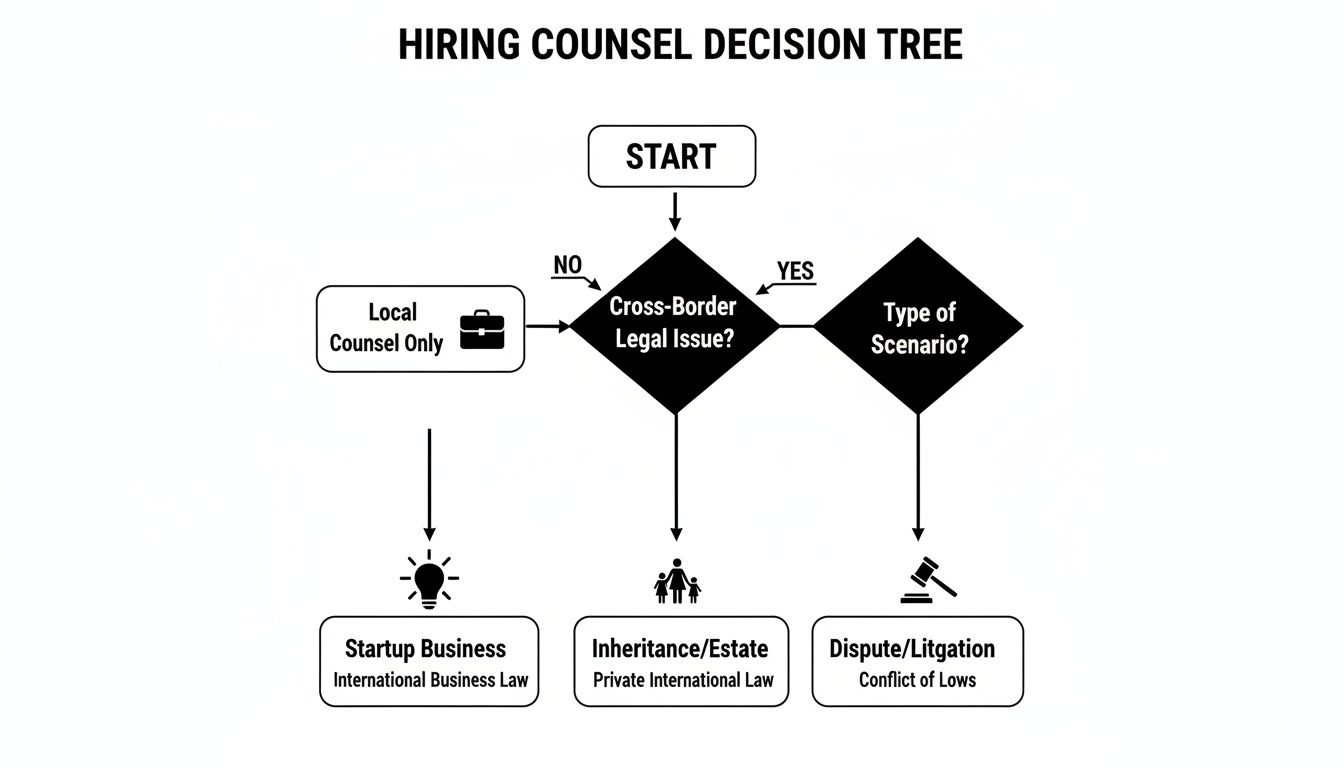
As you can see, the moment an asset, dispute, or business opportunity crosses a border, the stakes get higher. This is the point where bringing in an expert prevents you from making expensive, and often irreversible, mistakes.
Vetting Non-Negotiable Credentials
Your vetting process has to be sharp and focused. You’re looking for specific proof, not just a fancy degree.
First, experience in the specific jurisdictions involved is an absolute must. An attorney who is a powerhouse in EU competition law offers little value if your challenge is a joint venture in Brazil. Don’t compromise on this.
Next, dig into their track record with cases just like yours. A lawyer who has navigated dozens of cross-border intellectual property disputes has a playbook and a network of contacts that a generalist simply can’t replicate. This targeted search is a critical part of what we cover in our guide on how to find an attorney for your needs.
Finally, don’t overlook the firm’s operational sophistication. Today, elite legal service is as much about technology and efficiency as it is about legal knowledge. A firm that embraces modern tools can often deliver faster, more cost-effective results.
Key Questions for Your Consultation
The initial consultation is your chance to go beyond the resume. You need to understand their process and their mindset. Here are a few critical questions to get you started:
- What is your network of local counsel like in the relevant countries? A top international lawyer is a quarterback, directing a hand-picked team of on-the-ground experts. You need to know how deep and trusted that network really is.
- Can you describe a time you navigated a difficult cross-cultural negotiation? This gets to the heart of their practical skills. Bridging cultural and communication gaps is often just as critical as navigating the law itself.
- How do you structure your fees for multi-jurisdictional matters? Demand absolute clarity on this. Ask for a breakdown of how they bill for their time, the work of local counsel, translation services, and other cross-border expenses.
A truly elite international advisor does more than just answer legal questions. They anticipate geopolitical shifts, understand the nuances of foreign business cultures, and build a global strategy that protects your interests from every angle. This proactive, holistic approach is what separates the best from the rest.
Common Questions About International Law
When your interests cross borders, it’s natural to have questions. The world of international law can feel vast and intimidating, but a few key concepts can give you the confidence to navigate it.
Think of this as the essential briefing on the practical side of global law—the questions that come up time and again with sophisticated clients and businesses.
Public versus Private International Law
One of the first—and most important—distinctions to understand is the difference between public and private international law. They sound similar, but they operate in entirely different worlds.
- Public International Law is the law of nations. It’s what governs the relationships between sovereign countries and organizations like the United Nations. Think of treaties on climate change, the laws of war under the Geneva Conventions, or maritime boundaries. This is the realm of diplomats, not business deals.
- Private International Law is what you will almost certainly need. Often called “conflict of laws,” it deals with disputes between private individuals or companies from different countries. It answers the critical questions: which country’s laws apply to our contract? Where should we file a lawsuit?
For nearly every business, investment, or family matter—from a cross-border acquisition to an international inheritance—your focus will be on finding an expert in private international law.
How Legal Fees Are Structured
Understanding the cost structure for international legal work is absolutely critical. Global matters have more variables than a simple domestic case, so fee clarity from day one is non-negotiable.
You’ll typically encounter a few common arrangements:
- Hourly Rates: The traditional model where you pay for the lawyer’s time spent on your matter.
- Flat Fees: A set price for a well-defined project, like forming a foreign subsidiary or drafting a specific cross-border agreement.
- Retainers: A recurring monthly fee that secures the lawyer’s ongoing availability and counsel, common for businesses with continuous international needs.
Remember, international cases almost always involve added costs—local counsel in other countries, certified document translations, and sometimes travel. A transparent fee agreement that maps out all potential expenses isn’t just a good idea; it’s essential.
Coordinating a Global Legal Strategy
A major concern for many clients is the prospect of having to hire and manage a separate lawyer in every country where they do business. The good news? You don’t have to.
An experienced international lawyer acts as your strategic quarterback. They don’t just offer advice; they manage a curated, trusted network of local counsel on your behalf. This central command structure ensures a unified legal strategy that respects local laws while keeping your global objectives at the forefront.
This model saves you the immense headache of trying to coordinate multiple legal teams across different time zones, languages, and legal cultures. Your lawyer becomes your single, accountable point of contact. It’s not just more efficient—it’s strategically superior.
Finding vetted, elite international counsel is the most critical step in protecting your global interests. The Haute Lawyer Network is a curated directory of the nation’s top attorneys, selected for their expertise and proven success. We connect high-net-worth individuals and businesses with the legal talent they need to thrive in a complex world. Explore our network to find the right strategic advisor for your cross-border challenges.