When you’re staring at a traffic ticket, the first question that probably comes to mind is, “Do I really need a lawyer for this?” Let’s be blunt: for almost anything more serious than a simple parking ticket, bringing in legal counsel isn’t just a good idea—it’s often the smartest financial decision you can make.
Too many people fall into the trap of thinking that just paying the fine is the path of least resistance. But what they don’t realize is that paying that fine is the same as pleading guilty, and it opens the door to a cascade of long-term consequences they never saw coming.
The True Cost of a Simple Traffic Ticket

Most drivers treat a traffic ticket like a one-off inconvenience—pay the fine and move on. That perspective completely misses the bigger picture. A conviction sets off a chain reaction of hidden costs that can drain your bank account for years.
It’s pretty shocking when you look at the numbers. Only a tiny fraction—about 5% of Americans—actually bother to contest their traffic tickets. The other 95% just pay up, unknowingly signing up for nasty surprises down the road. We’re talking about skyrocketing insurance premiums that can leap 20-30% on average after even a minor violation, points piling up on your license, and even trouble at work if your employer runs a background check on your driving record.
Beyond the Initial Fine
The real financial pain isn’t the amount printed on the ticket. It’s what comes after. Think of it like an iceberg: the fine is just the small tip you see sticking out of the water. The real danger—the massive, costly part—is lurking just beneath the surface.
These hidden consequences are where the real damage is done:
- Substantial Insurance Hikes: Your insurer will see you as a higher-risk driver, and you’ll pay for it with higher premiums for the next three to five years.
- License Points: Rack up enough points, and you could be looking at a license suspension. That means costly reinstatement fees and a serious disruption to your daily life.
- Career Risks: If you drive for a living or hold a Commercial Driver’s License (CDL), a single conviction isn’t just an inconvenience; it can be a career-ender.
The decision to fight a ticket is not just about avoiding a fine; it’s a strategic investment in protecting your driving record, your insurance rates, and your time. Understanding how long traffic tickets stay on your record is crucial to appreciating the long-term value of a clean slate.
Navigating the Traffic Court System
Before you can decide whether you need a lawyer, you have to understand the arena you’re walking into. Traffic court isn’t just a clerk’s window where you go to pay a fine. It’s a formal legal setting with its own rules, procedures, and a very clear power structure.
Thinking you can just show up and “explain your side of the story” is one of the most common—and costly—mistakes people make. The system is built for brutal efficiency, often churning through hundreds of cases in a single day. This environment runs on legal principles and procedural correctness, not just a general sense of fairness. When you step into that room, a well-reasoned legal argument carries far more weight than a sincere apology.
The Key Players in Your Case
Knowing who holds the cards is the first step toward getting the outcome you want. Three key figures will ultimately decide how your case unfolds.
- The Judge: As the ultimate decision-maker, the judge interprets the law, weighs the evidence, and makes sure courtroom procedures are followed. Their job is to stay impartial and rule based on the facts and legal arguments presented.
- The Prosecutor: This is the lawyer representing the state or city. Their primary goal is to prove the case against you. Importantly, they often have the power to negotiate a plea bargain, like reducing the charge to a less serious offense.
- The Ticketing Officer: The officer is the state’s main witness. Their testimony, along with any evidence they collected—like radar readings or handwritten notes—forms the foundation of the prosecutor’s entire case.
Each of these players operates within a structured, formal system. A seasoned traffic attorney knows exactly how to interact with each one, understanding their motivations, procedural habits, and the specific legal arguments that are most likely to work.
Understanding the Burden of Proof
In any traffic case, from a basic speeding ticket to something more serious, the burden of proof is entirely on the prosecution. This means it’s their responsibility to prove you committed the violation. Depending on the offense, they must prove it either beyond a reasonable doubt (for criminal traffic offenses) or with a preponderance of evidence (for civil infractions).
It’s not your job to prove your innocence; it’s the state’s job to prove your guilt. An experienced attorney excels at scrutinizing the prosecution’s case for weaknesses, procedural errors, or insufficient evidence, often creating enough doubt to secure a dismissal or a favorable plea.
This is where the true value of hiring a lawyer becomes crystal clear. They don’t just retell your story; they attack the state’s story. They know how to question the officer’s methods, challenge the validity of the evidence, and file motions to get improperly obtained information thrown out. Negotiating plea bargains is also a key part of their strategy, which you can learn more about in our complete traffic ticket deferral guide.
Without that expertise on your side, you’re essentially betting that the prosecutor and officer did everything perfectly—a risk you probably can’t afford to take.
When Hiring a Lawyer Is Non-Negotiable
Some tickets are minor annoyances, but certain situations completely change the game. In these high-stakes scenarios, walking into traffic court alone isn’t just risky—it’s a strategic blunder. The conversation shifts from “Should I hire a lawyer?” to recognizing you absolutely cannot afford not to.
This is no longer about a simple fine. It’s about protecting your career, your freedom, and your ability to drive. The potential fallout from a conviction massively outweighs the cost of bringing in a professional.
High-Stakes Scenarios Demanding Legal Counsel
If your ticket falls into one of these categories, consider legal representation essential. The consequences here are life-altering, and a conviction can follow you for years.
- Potential Jail Time: This is the brightest red line. Any charge that could lead to incarceration—like a DUI/DWI, reckless driving, or serious speeding (think 26 mph or more over the limit in states like Illinois)—requires an attorney. This isn’t just a ticket; it’s a criminal charge that creates a permanent record.
- You Have a Commercial Driver’s License (CDL): For a professional driver, your license is your livelihood. A moving violation that a regular driver might pay and forget could trigger a CDL suspension, putting you out of work instantly.
- Risk of License Suspension: If you’re already carrying points on your license, one more conviction could be the tipping point for an automatic suspension from the DMV. A lawyer’s primary goal is often to negotiate a resolution that keeps you on the road.
Most people assume traffic cases go to trial. The reality? A staggering 90% of cases are settled through plea bargains. Without an expert who negotiates these deals daily, you’re missing out on the most common path to a better result. You simply won’t know what you could have gotten.
When an Accident Is Involved
A traffic ticket tied to an accident introduces a whole new layer of legal and financial risk. The outcome of your traffic case can directly impact any future civil lawsuits for personal injury or property damage.
If you plead guilty to the ticket, it can be used against you as an admission of fault in a civil claim. This is where an experienced lawyer proves their worth tenfold. They understand how the traffic and civil court systems intersect and will build a defense that protects you on both fronts. Their goal is to resolve the traffic matter in a way that shields you from a much larger financial disaster down the line. It’s in these complex, interconnected battles that an attorney’s guidance is paramount, and it’s worth taking a moment to get insights on traffic ticket dismissals to see the strategic advantages they create.
Analyzing the Financial Impact of Legal Representation
Many drivers balk at the idea of hiring an attorney for a traffic ticket for one simple reason: money. Paying a legal fee upfront can feel like adding insult to injury. But this short-term view completely misses the long-term financial hemorrhage a conviction can trigger.
It’s a mistake to see legal counsel as an expense. It’s an investment, and often one with a shockingly high return. The fee for an attorney is a known, one-time cost. In stark contrast, the fallout from a conviction acts like a hidden tax, draining your finances for years to come.
The Upfront Cost vs. Long-Term Penalties
The real financial calculation isn’t just about the lawyer’s invoice. It’s a direct comparison between that single payment and the cascade of expenses that follow a guilty plea—court fees, state surcharges, and the most punishing penalty of all: skyrocketing insurance premiums.
This infographic breaks down the high-stakes scenarios where a lawyer isn’t just helpful, but essential.
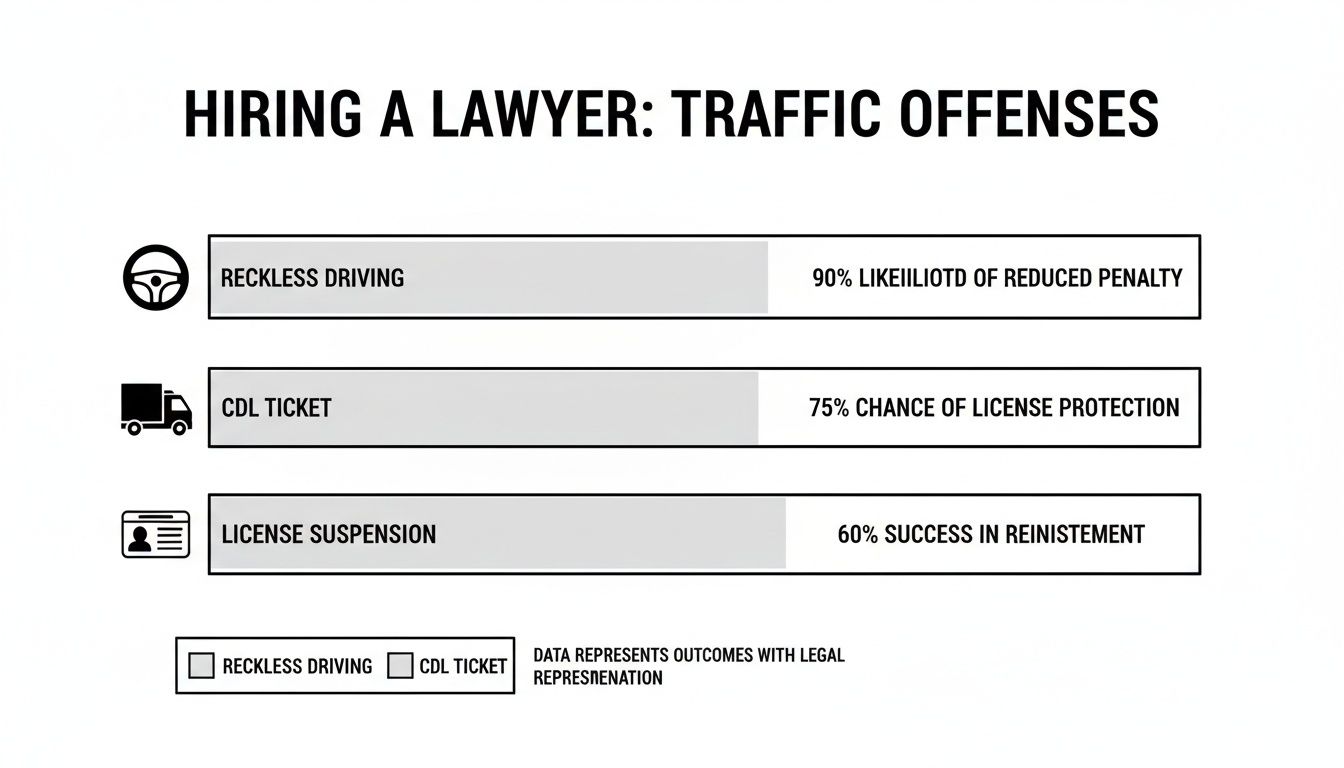
As the data shows, for serious violations like reckless driving or any ticket that threatens your CDL or license, professional representation is non-negotiable.
Calculating Your Return on Investment
So, how does the math actually play out? Hiring an attorney often costs between $250 and $400, a fee that can pay for itself in as little as six months by sidestepping a massive insurance hike alone. For professionals and high-net-worth individuals, the value is even clearer; a spotless driving record is critical to avoiding license suspensions that disrupt business travel and daily life. You can get a more granular look in our guide on how much a lawyer costs.
A single traffic conviction can inflate your insurance premiums by hundreds—even thousands—of dollars annually for the next three to five years. An attorney’s one-time fee can prevent that recurring financial drain entirely.
Let’s put some numbers to it. The table below illustrates a common scenario, comparing the total cost of accepting a conviction versus investing in legal defense over a three-year period.
Cost of Conviction vs. Cost of a Lawyer
| Cost Factor | Without a Lawyer (Conviction) | With a Lawyer (Potential Dismissal or Reduction) |
|---|---|---|
| Initial Fine & Fees | $150 | $0 (if dismissed) |
| Insurance Increase (3 Years) | $900 ($300/year increase) | $0 |
| Lawyer’s Fee | $0 | $350 (average one-time fee) |
| Total 3-Year Cost | $1,050 | $350 |
This simple breakdown reveals a clear financial winner. By investing $350 in a skilled defense, you stand to save $700 over three years. What seemed like an expense has transformed into a significant net saving. When asking, “Do I need a lawyer for traffic court?” these numbers often provide the clearest answer.
How a Lawyer Can Secure a Better Outcome

So, how exactly does a traffic lawyer transform a seemingly open-and-shut case into a favorable result? It’s not a magic trick. It’s a calculated blend of deep legal knowledge, mastery of court procedure, and cultivated professional relationships. A skilled attorney becomes your advocate and your shield, deploying strategies you likely never knew existed.
Think of the prosecutor’s case as a brick wall built against you. A lawyer’s job is to inspect every single brick, looking for the one loose enough to bring the whole structure down. They start by scrutinizing every detail of the stop for procedural mistakes. Was the stop legally justified in the first place? Were your rights violated? Was the ticket even filed correctly?
Even a minor error by the ticketing officer can be enough to have a case dismissed entirely. This is the kind of forensic review that only a trained legal professional can execute effectively.
The Power of Evidence and Negotiation
Beyond procedural checks, a sharp attorney challenges the very evidence being used against you. For a speeding ticket, that could mean demanding the calibration and maintenance records for the specific radar or lidar device that clocked you. If those records are missing or out of date, the state’s primary piece of evidence suddenly becomes unreliable.
This is where their experience truly pays dividends. They know which arguments resonate with judges and which types of evidence are the most vulnerable. But their work isn’t just about courtroom battles.
A significant advantage is the lawyer’s established relationships within the court system. They regularly interact with the same prosecutors and judges, building a professional rapport that a self-representing individual simply cannot match. This familiarity opens the door for effective negotiation.
Many cases are won long before a trial even begins. An attorney can often negotiate a plea bargain to a lesser offense. For instance, a moving violation that carries points could be reduced to a non-moving violation, like a parking ticket. This move alone protects your driving record and keeps your insurance premiums from skyrocketing.
Strategic Representation and Favorable Jurisdictions
One of the most immediate benefits is that your lawyer can often appear in court on your behalf for most minor infractions. This saves you from taking a day off work, navigating the courthouse, and waiting hours just for your name to be called.
Moreover, a local attorney possesses an invaluable understanding of their specific court system’s dynamics. Location and legal savvy can dramatically shift the odds. Data from South Florida, for example, paints a stark picture: Miami-Dade courts dismissed an incredible 55% of non-criminal moving violations, while nearby Broward and Palm Beach counties only dismissed 31% and 18%, respectively.
Knowing which judges are more lenient or which arguments work best in a particular courtroom is a powerful strategic advantage. You can learn more about how dismissal rates vary by location to see just how critical this local expertise is.
Ultimately, when you ask, “Do I need a lawyer for traffic court?” the answer often lies in their unique ability to access strategies and outcomes that are simply out of reach for the average person.
Making an Informed Decision for Your Case
Deciding what to do after a traffic ticket isn’t about admitting guilt or protesting innocence—it’s a strategic decision. The real question is whether you should hire an attorney, and the answer comes down to a simple risk assessment: a manageable, one-time legal fee versus a cascade of long-term costs.
For a minor parking violation, you might be fine on your own. But when you’re facing points on your license, a massive fine, or something more serious, the math changes dramatically. For anything involving an accident, a CDL, or a charge like reckless driving, bringing in professional counsel is non-negotiable.
This is a critical choice that directly impacts your insurance premiums for the next three to five years, your driving privileges, and even your career.
Assess Your Situation With a Critical Eye
Set aside the initial frustration and look at the situation objectively. Ask yourself a few key questions:
- What are the long-term financial risks? Think beyond the fine on the ticket. Calculate the potential insurance hikes over the next several years.
- Could this ticket lead to a license suspension? Check your current point total and understand your state’s suspension threshold.
- Does my career depend on a clean driving record? For CDL holders, delivery drivers, or anyone who travels for business, the answer is a hard yes.
An experienced local attorney is your greatest asset. Their insider knowledge of the specific court, its prosecutors, and its judges provides a powerful advantage you simply cannot replicate on your own.
Experience is everything here. While an attorney with a few years of practice can handle a basic speeding ticket, you’ll want someone with over seven years of experience for complex cases involving multiple violations or potential criminal charges. A curated network like Haute Lawyer is designed to connect you with proven traffic attorneys who have deep roots and established reputations in their local courts. You can see just how experience impacts dismissal rates at theticketclinic.com.
Don’t gamble with your driving privileges and financial stability. A strategic investment in the right legal expertise is the only sure way to protect your interests and secure the best possible outcome.
Your Traffic Court Questions, Answered
Once you get a traffic ticket, a flood of practical questions usually follows. Even if you think you know what to do, a few key uncertainties can trip you up. Here are some clear, straightforward answers to the questions we hear most often.
Can a Lawyer Guarantee They’ll Get My Ticket Dismissed?
Let’s be direct: No ethical attorney can ever promise a specific outcome. Think of them like a top surgeon—they can’t guarantee a 100% successful operation, but they can and will bring their full expertise to the table to fight for the best possible result.
An experienced traffic lawyer’s promise is to build the strongest defense imaginable. Their in-depth knowledge of traffic laws, local court quirks, and even the personalities involved dramatically boosts your odds of a win, whether that’s a complete dismissal, a reduction to a non-moving violation, or just a smaller fine.
Is It Really Worth Hiring a Lawyer for a Minor Speeding Ticket?
In many cases, surprisingly, yes. That initial fee might feel steep for a “minor” offense, but just paying the ticket is an admission of guilt. That means you’re accepting the points on your record and an almost certain insurance hike that will follow you for years.
The math is simple. Over three years, the total cost of those insurance premium increases often adds up to more than the lawyer’s one-time fee. A good attorney can frequently negotiate that speeding ticket down to a non-moving violation, which means no points and no call to your insurance agent. It’s a smart financial play.
Do I Have to Show Up to Court if I Hire an Attorney?
For most standard, non-criminal traffic tickets, your lawyer can appear in court for you. This is a huge benefit. You don’t have to burn a vacation day, drive to the courthouse, and then sit around for hours waiting for your name to be called.
Now, for more serious charges like a DUI or Aggravated Speeding, your presence will likely be mandatory. But your attorney will walk you through exactly what’s required so there are no surprises.
What’s the Very First Thing I Should Do After Getting Pulled Over?
Those first few moments after you see the flashing lights are critical. Here’s how to protect yourself from the start:
- Be Polite, But Say Little: Always be courteous to the officer, but avoid admitting to anything. Even a seemingly innocent comment like, “I was just trying to keep up with traffic,” can be twisted and used against you in court.
- Document Everything: As soon as you’re able, jot down every detail you can remember. Where were you? What was the weather like? How was traffic? What exactly did the officer say? These details can be surprisingly important later.
- Talk to a Professional (Before You Pay!): This is the most important step. Consult a traffic lawyer before you even think about paying that fine. Most offer free consultations to quickly assess your case and lay out your options, giving you a clear path forward without any upfront cost.
When you’re up against the complexities of traffic court, you need an advocate with proven, local expertise. The Haute Lawyer Network is a curated directory of the nation’s most respected legal professionals, connecting you with attorneys who know how to protect your driving record and your wallet. Find the right representation for your specific case at Haute lawyer network.