
Yes, you can sue for emotional distress. However, securing a successful outcome requires far more than simply stating you’ve been psychologically harmed. It demands a sophisticated legal strategy built on proving the injury is severe, verifiable, and a direct result of another party’s wrongful actions.
Understanding Your Right to Sue for Emotional Distress
Think of an emotional distress claim like the deep, unseen foundation damage a building suffers after an earthquake. The cracks on the surface are just one part of the story; the real, devastating harm lies beneath. The legal system recognizes that this kind of profound psychological injury is a legitimate basis for compensation, but winning a claim is anything but straightforward.
It’s a complex process that hinges on compelling evidence and a clear understanding of the legal paths available.

Successfully navigating these claims means identifying which of the two primary legal avenues applies to your situation. Each has a distinct set of rules and evidentiary requirements, and choosing the correct one from the outset is critical to building a credible case.
The Two Main Avenues for a Claim
The law generally provides two distinct ways to pursue damages for emotional harm. The path you take is determined entirely by the nature of the defendant’s conduct.
- Intentional Infliction of Emotional Distress (IIED): This applies when someone’s behavior is so shocking and outrageous that it goes beyond all possible bounds of decency in a civilized society. The key here is that the conduct was aimed at causing severe emotional turmoil, either intentionally or recklessly.
- Negligent Infliction of Emotional Distress (NIED): This occurs when someone’s carelessness—rather than malice—is the cause of your severe emotional harm. These cases are often tied to a physical accident or arise from witnessing a traumatic event happen to a close family member.
Grasping this distinction is fundamental, as it dictates the entire legal strategy. Proving the “outrageous conduct” required for an IIED claim is a vastly different challenge than proving the negligence and foreseeability required for an NIED claim. While both fall under the umbrella of personal injury, they require different fortresses of evidence. To better understand this framework, it helps to see what is a personal injury claim and how these specific actions fit within that broader context.
To clarify these legal pillars, the table below breaks down the core components of an emotional distress lawsuit.
Core Components of an Emotional Distress Lawsuit
| Legal Requirement | What It Means for Your Case | Example |
|---|---|---|
| Outrageous or Negligent Conduct | You must prove the defendant’s action was either intentionally extreme and shocking or negligently careless. | An executive intentionally spreads a false, reputation-destroying rumor about a competitor (IIED). A driver texting runs a red light, causing a traumatic accident you witness (NIED). |
| Severe Emotional Distress | The psychological harm must be substantial and debilitating, not just minor upset or temporary anxiety. | You develop diagnosed PTSD, severe depression, or panic attacks requiring medical treatment and preventing you from working. |
| Causation | A direct, unbroken link must exist between the defendant’s action and your emotional suffering. | Medical records and expert testimony confirm your psychological condition began immediately after the defendant’s malicious actions. |
| Verifiable Harm | Your distress must be substantiated with objective evidence, such as medical records or professional testimony. | A psychiatrist’s diagnosis, therapy records, prescription logs, and testimony from a psychologist all serve as critical proof. |
Building a case around these elements requires meticulous documentation and expert support. Without it, even the most legitimate claim can fail.
The Two Legal Paths for an Emotional Distress Claim
When you sue for emotional distress, the legal system doesn’t treat all cases the same. The path your claim takes depends entirely on the defendant’s state of mind and the nature of their actions. Think of it like this: was the harm caused by a deliberate, malicious act or by a catastrophic failure of care?
Answering that question is the first step, as it directs your case down one of two very distinct legal avenues: Intentional Infliction of Emotional Distress (IIED) or Negligent Infliction of Emotional Distress (NIED). Understanding which framework fits your situation is essential, as the standards of proof are worlds apart.
Intentional Infliction of Emotional Distress (IIED)
This is the legal path reserved for truly deplorable behavior. IIED claims are designed to address conduct so extreme and outrageous that it goes beyond all possible bounds of decency. We’re not talking about simple rudeness or insults; this is for actions a civilized society would find utterly intolerable.
To win an IIED claim, you must prove the defendant acted intentionally or recklessly to cause severe emotional harm. The standard is incredibly high for a reason.
A key legal concept here is “outrageous conduct.” This isn’t just hurtful behavior; it’s a deliberate campaign of harassment, a cruel and shocking act, or a profound abuse of a power dynamic designed to cause psychological collapse.
Consider a high-stakes business scenario. A rival executive, aiming to sabotage your company, creates and spreads a false and deeply disturbing rumor about your family. This isn’t just aggressive competition; it’s a calculated, malicious act intended to cause severe distress. That is precisely the kind of extreme conduct IIED is designed to address.
Here are the core elements you must prove for an IIED claim:
- The defendant’s conduct was extreme and outrageous.
- The defendant acted intentionally or with reckless disregard for the probability of causing you severe emotional distress.
- You suffered severe or extreme emotional distress as a result.
- There is a direct causal link between the conduct and your distress.
Negligent Infliction of Emotional Distress (NIED)
The second path, NIED, doesn’t require malice. Instead, it focuses on carelessness. Here, the defendant didn’t intend to cause you harm, but their negligent actions did so anyway. This type of claim is often tied to a single traumatic event or accident.
Imagine a stone dropped into a pond. The negligent act is the stone, and the emotional distress is the ripple that spreads outward, affecting not only those directly hit but also those close enough to feel the impact. The law must decide how far those ripples can travel and still be legally recognized.
Courts use specific frameworks to determine if the emotional harm was a foreseeable consequence of the negligence. The two most common are the “zone of danger” and “bystander” rules.
The Zone of Danger Rule This rule applies if you were in the immediate area of physical danger created by the defendant’s negligence and feared for your own safety. Even if you weren’t physically harmed, the terror of the near-miss can be the basis for a claim.
For example, a crane operator negligently drops a heavy load that crashes just feet away from you. You are not physically struck, but the shock and fear of imminent death cause you to develop severe anxiety and PTSD. You were in the zone of danger.
The Bystander Rule This applies when you witness a traumatic injury or death of a close family member caused by someone’s negligence. The shock of seeing a loved one grievously harmed is the entire basis for the claim.
For instance, you witness a speeding car strike your child in a crosswalk. The horror of that moment can cause profound psychological trauma, even though you were not physically touched. This rule often requires a close relationship (like a parent or spouse) and that you were present at the scene.
Understanding the specific duties of care in these situations is also vital. In some cases, like premises liability, property owners have a duty to maintain a safe environment. Failing to do so can lead to accidents that cause both physical and emotional injuries. Learning more about what is premises liability can clarify how negligence creates legal responsibility.
Whether your claim falls under IIED or NIED, the specific details of the incident are paramount in building a strong legal case.
Building a Fortress of Evidence to Prove Your Claim
When you sue for emotional distress, your personal story is the heart of your case. But in high-stakes litigation, your testimony alone isn’t enough. You need to build a fortress of undeniable proof, piece by reinforcing piece, to withstand the intense scrutiny you’ll undoubtedly face.
Think of it like proving a physical injury. You wouldn’t just tell a jury your leg is broken; you’d show them the X-rays, the surgeon’s reports, and the stack of medical bills. The exact same principle applies to psychological harm. It must be documented, validated, and proven with objective evidence.
This means gathering a wide array of proof that, when woven together, paints a clear and compelling picture of your suffering. Each piece serves a unique purpose, from establishing a medical diagnosis to showing the real-world impact on your life and business.
The Medical and Professional Foundation
The most powerful evidence in any emotional distress claim will come from qualified professionals. It’s their records and testimony that translate your subjective experience into the kind of objective, legally recognized proof that courts demand.
- Psychiatric and Therapeutic Records: A formal diagnosis is non-negotiable. Records from a psychiatrist or therapist diagnosing conditions like Post-Traumatic Stress Disorder (PTSD), severe anxiety, or clinical depression are indispensable. These documents create an official timeline of your condition and treatment.
- Medical Documentation: Don’t overlook your primary care physician. Notes detailing your complaints of insomnia, panic attacks, or chronic stress add a powerful layer of corroboration from a non-specialist’s perspective.
- Expert Witness Testimony: An expert witness, usually a respected psychologist or psychiatrist, is crucial for connecting the dots for a judge or jury. Their job is to offer a professional opinion that the defendant’s specific actions directly caused your diagnosed psychological condition. This testimony is often what bridges the gap between the wrongful act and the resulting harm.
An expert witness does more than just confirm a diagnosis. They explain the mechanisms of trauma, validate the severity of your symptoms, and authoritatively link your emotional collapse to the defendant’s conduct, making your claim legally and scientifically credible.
This decision tree helps visualize the distinct legal paths your claim might take, as each one requires a tailored approach to collecting evidence.
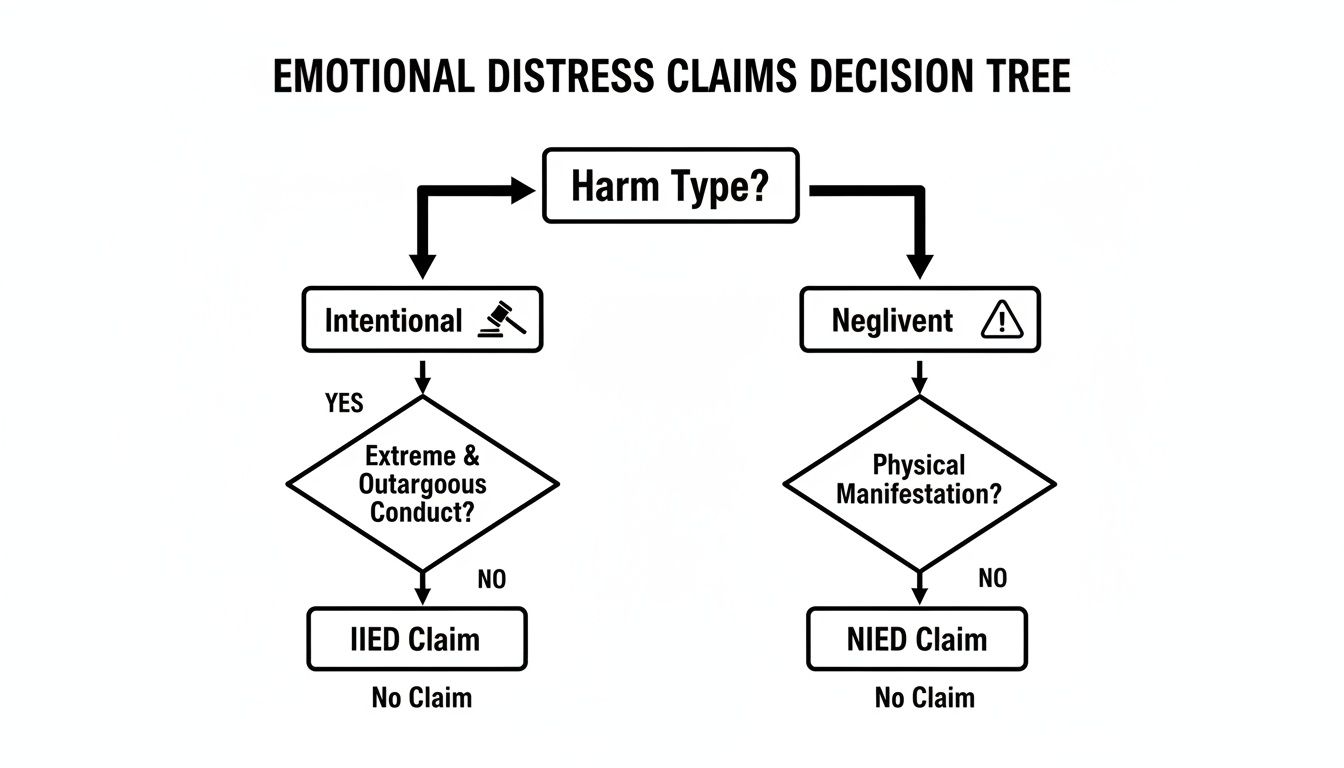
This illustrates the two primary legal frameworks for emotional distress, highlighting how the nature of the defendant’s conduct—whether intentional or simply negligent—shapes the entire legal strategy.
Corroborating Evidence from Your Personal Life
While professional documentation lays the foundation, testimony from those who know you best adds a powerful human element. These witnesses paint the “before and after” picture, showing the profound changes in your behavior, personality, and well-being.
Who Can Testify on Your Behalf?
- Family Members: A spouse, parent, or child can speak to changes in your mood, sleep patterns, and ability to engage with the family.
- Close Friends: Friends are perfectly positioned to describe your withdrawal from social activities, loss of interest in hobbies, and overall change in demeanor.
- Colleagues and Business Partners: Co-workers can testify about diminished work performance, difficulty concentrating, or uncharacteristic irritability in a professional setting.
Their observations provide tangible proof that your emotional distress has had a devastating and observable impact on every facet of your life. This holistic approach is becoming more crucial as courts increasingly recognize the validity of these claims.
Over the last decade, there’s been a significant shift toward acknowledging emotional distress as a legitimate, compensable injury. Data shows that personal injury claims with psychological components have risen sharply, now making up a major portion of the approximately 400,000 such cases filed each year in U.S. state courts. The vast majority—around 95%—are resolved in pre-trial settlements, which underscores just how critical a well-documented damages package is for effective negotiation. This isn’t just a domestic trend; international data reveals a similar increase, reflecting a broader legal and societal acceptance of mental health’s importance. You can explore more on these growing trends in personal injury claims at LawPracticePulse.com.
Ultimately, every piece of evidence, from a psychiatrist’s report to a friend’s testimony, acts as another stone in your fortress wall. By meticulously assembling this proof, you build a case that is not just compelling, but resilient enough to secure the justice you deserve.
How Courts Calculate the Value of Emotional Harm
Placing a dollar figure on emotional suffering might seem impossible. How can you quantify anxiety, trauma, or the simple loss of joy? In high-stakes litigation, this isn’t abstract guesswork; it’s a methodical calculation designed to translate intangible harm into a concrete monetary value.
This calculation is one of the most critical phases when you sue for emotional distress, forming the basis of settlement negotiations and potential jury awards. To arrive at a defensible figure, courts and legal teams break down damages into two distinct categories.

Economic Damages: The Tangible Costs
The first and most straightforward component of any claim involves economic damages. Think of these as the receipts for your suffering—the direct, calculable financial losses you have incurred as a result of the emotional harm.
This part of the valuation is built on concrete documentation, including:
- Medical Expenses: Every bill from psychiatrists, therapists, and other medical providers who treated your psychological condition.
- Future Medical Costs: Expert analysis projecting the cost of ongoing therapy, medication, or other long-term mental health support.
- Lost Income: Wages and earnings you lost while unable to work due to the severity of your emotional distress.
- Loss of Earning Capacity: If the trauma permanently diminishes your ability to earn at your previous level, this calculates the financial impact over your entire career.
These figures establish the financial bedrock of your claim. They are quantifiable, objective, and provide the starting point for calculating the total value of your damages.
Non-Economic Damages: Valuing the Intangible
This is where the valuation becomes more complex. Non-economic damages are designed to compensate for the profound, personal suffering that has no direct price tag, such as pain and suffering, loss of enjoyment of life, and the emotional anguish itself.
To assign a value here, legal teams often use specific methods to ensure the figure is reasonable and justifiable in court.
The most common approach is the “multiplier method.” The total economic damages are multiplied by a number, typically between 1.5 and 5, based on the severity and permanence of the emotional injury. A more severe and lasting trauma warrants a higher multiplier.
For example, if your documented therapy bills and lost wages total $100,000, and the severity of your PTSD warrants a multiplier of four, the non-economic portion of your claim would be $400,000. This makes the total initial valuation $500,000.
Advanced Valuation in High-Value Cases
In particularly severe cases, especially those involving high-net-worth individuals where the impact on business and personal life is substantial, more sophisticated valuation tools are often required. Techniques like quality-adjusted life years (QALYs) can translate a long-term psychological disability into multi-million-dollar figures by quantifying the percentage reduction in your quality of life over time.
It’s crucial to understand that these calculations are primarily tools for negotiation. The vast majority of personal injury cases—around 95%—settle before ever reaching a trial. Consequently, the real-world value of most claims is determined through strategic negotiation, not a jury verdict.
While median settlements for general personal injury cases can range from $19,000 to $74,000, severe cases with a strong emotional distress component can result in much larger awards. These can sometimes align with national averages for medical malpractice claims, which are around $423,600. For more details on these settlement statistics, you can learn more about personal injury compensation trends at Clio.com.
This methodical approach transforms subjective suffering into a clear, compelling number, giving your legal team the leverage needed to negotiate a settlement that truly reflects the full scope of your harm.
Overcoming Common Defenses and Legal Hurdles
Filing an emotional distress lawsuit is just the opening move. Winning requires anticipating the other side’s strategy and systematically dismantling their arguments before they ever gain traction.
Defendants in these cases rely on a predictable playbook designed to create doubt and undermine your claim. They will challenge the severity of your harm, the cause of your suffering, and the nature of their own conduct. Understanding these defenses from the outset is the key to building a resilient and successful case.
Common Arguments Defendants Will Use
Defense attorneys will dig into every corner of your life, searching for any alternative explanation for your distress. Their goal is to sever the link between their client’s actions and your psychological injury.
You should expect to face arguments like these:
- Pre-Existing Condition: They will claim your anxiety or depression existed long before the incident. Expect them to subpoena your entire medical history, looking for any note from a doctor about stress to argue they aren’t responsible for your current condition.
- Conduct Wasn’t ‘Outrageous’: This is the go-to defense in IIED cases. They’ll try to reframe their actions as merely insensitive, rude, or just aggressive business tactics—anything short of the high legal bar of “extreme and outrageous.”
- Harm Wasn’t Foreseeable: In NIED claims, they may argue that your severe emotional reaction was an unforeseeable, disproportionate response to their carelessness. In essence, they’re arguing that a “reasonable” person wouldn’t have been so profoundly affected.
Anticipating these defenses isn’t a sign of weakness; it’s a mark of strategic strength. A skilled legal team gathers evidence to neutralize these arguments from day one, reinforcing the direct cause-and-effect between the defendant’s actions and your harm.
Navigating Critical Administrative Hurdles
Beyond courtroom tactics, you must clear certain administrative hurdles. The most unforgiving is the statute of limitations—a hard legal deadline for filing a lawsuit. If you miss this window, your right to sue is gone forever, no matter how strong your case is.
These deadlines vary dramatically from one state to another, which makes acting quickly absolutely critical. You can see a detailed breakdown of the statute of limitations by state to understand the precise timeline you’re up against.
The legal landscape here is also getting more complicated. Since 2020, public health data shows anxiety and depression have climbed from 8-10% of the population to 13-15%. At the same time, the CDC reports that 39.5 million Americans seek medical care for injuries each year, creating more scenarios where emotional distress can arise. Add to that new sources for claims, like high-profile data breaches causing non-physical harm, and you have a perfect storm. This trend is increasing litigation frequency and making rigorous, undeniable medical documentation more critical than ever. More information on these emerging challenges in psychological injury claims at DWF Group is available for those interested in the evolving legal dynamics.
Knowing When You Need an Elite Attorney
Not all legal battles are fought on an even playing field. While many personal injury cases are straightforward, high-stakes emotional distress claims are a different beast entirely. Deciding when to bring in a top-tier attorney isn’t just a detail—it’s a critical judgment call that can define the outcome.
When you sue for emotional distress, you can be certain the other side will try to downplay your suffering. They’ll paint it as an exaggeration or, worse, completely unrelated to their client’s actions. This is precisely where an elite legal team becomes non-negotiable. They aren’t just lawyers; they’re strategic partners dedicated to protecting your well-being, your privacy, and your future.
Triggers for Seeking Premier Legal Counsel
Certain situations dramatically escalate the stakes, making premier legal counsel essential from day one. These are scenarios involving powerful adversaries and intricate dynamics that demand a sophisticated, well-resourced legal strategy.
Recognizing these triggers is the first step in protecting yourself. If your case involves any of the following, it’s time to seek elite representation:
- A Powerful Corporate Defendant: Facing a large corporation means you’re up against a formidable in-house legal team with a virtually bottomless war chest. You need a firm that can match their firepower and won’t be intimidated by their aggressive, often bruising, tactics.
- Significant Reputational Damage: For high-net-worth individuals, claims can intersect with public figures or sensitive business matters where your reputation is on the line. An elite attorney excels at managing the narrative and ensuring absolute discretion.
- Severe and Lasting Psychological Trauma: When a case involves a clear diagnosis of PTSD, severe clinical depression, or other debilitating psychological conditions, you need a legal team with experience working alongside top medical experts to build an irrefutable case.
- Intentional and Malicious Conduct: If the distress was caused by deliberate, outrageous acts—like a calculated smear campaign or a profound betrayal of trust—the complexity and intensity of the litigation skyrocket.
In these high-stakes scenarios, your legal team’s role transcends basic litigation. They become strategic advisors, managing every facet of the case to protect not only your financial interests but your personal and professional legacy as well.
The Strategic Advantage of a Top-Tier Firm
Choosing the right attorney for a high-value emotional distress claim is about far more than just a winning courtroom record. It’s about selecting a partner who grasps the unique pressures faced by high-net-worth clients and can provide comprehensive, strategic support.
What an Elite Firm Delivers
- Access to Premier Experts: Top firms have deep relationships with the nation’s foremost psychological and financial experts. These authorities provide compelling, credible testimony that substantiates the harm you’ve suffered and its true financial impact.
- Sophisticated Investigation Resources: These firms have the capacity to conduct deep-dive investigations, unearthing critical evidence that others would miss. They build a fortress of proof around your claim, leaving no stone unturned.
- Proactive and Resilient Strategy: An elite team doesn’t just react; they anticipate the defense’s every move. They prepare counter-arguments and shore up your case long before it ever approaches a courtroom.
Ultimately, when your well-being, privacy, and legacy are on the line, the question isn’t whether you can afford an elite attorney—it’s whether you can afford not to have one. Their expertise is the decisive factor in turning a devastating situation into a successful resolution that secures the justice you deserve.
Key Questions on Emotional Distress Lawsuits
When you’re grappling with the fallout from someone else’s actions, the legal path forward can seem murky. Here are some straightforward answers to the most pressing questions that arise when considering a lawsuit for emotional distress.
Can I Sue for Emotional Distress Without a Physical Injury?
Yes, but it’s a high bar to clear. Lawsuits for emotional distress without any physical harm—often called “standalone” claims—face intense scrutiny from the courts and are typically pursued as Intentional Infliction of Emotional Distress (IIED).
For an IIED claim to stand a chance, the defendant’s behavior must have been genuinely outrageous and extreme. We’re not talking about simple rudeness; the conduct must be so far outside the bounds of decent behavior that it’s considered intolerable in a civilized society. In rarer cases, a claim for Negligent Infliction of Emotional Distress (NIED) might be possible, but only if you were in the direct “zone of danger” and feared for your immediate safety.
Without a physical injury to point to, the entire case hinges on the quality of your evidence. Comprehensive, objective documentation from psychiatrists, psychologists, and other mental health professionals isn’t just helpful—it’s the absolute foundation of your claim.
Without this level of medical proof, winning a standalone claim is exceptionally difficult.
How Long Do I Have to File an Emotional Distress Claim?
Every state sets a deadline for filing personal injury cases, known as the statute of limitations. This legal window is usually between one and three years from the date the harmful incident took place.
Missing this deadline is almost always fatal to your case. The court will have little choice but to dismiss it, and you will permanently lose your right to seek compensation. These rules can be tricky—sometimes the clock starts when you discovered the harm, not when it happened. That’s why it’s critical to speak with an attorney immediately. Acting fast protects your legal options.
What Is the Difference Between Pain and Suffering and Emotional Distress?
While people often use these terms interchangeably, they have distinct legal meanings. The easiest way to think about it is that “pain and suffering” is the broad category, and “emotional distress” is a specific type of harm that fits within it.
- Pain and Suffering: This is an all-encompassing legal term for damages. It covers everything from the physical pain of an injury, like a broken arm, to the mental anguish that goes along with it.
- Emotional Distress: This term refers specifically to the psychological damage. Think diagnosed anxiety, debilitating depression, PTSD, or chronic insomnia caused by the event.
In a standard personal injury case where you were physically hurt, emotional distress is just one piece of the total “pain and suffering” damages. But in a standalone case without physical injuries, emotional distress becomes the central issue—the primary harm you’re seeking to be compensated for.
When facing high-stakes litigation, securing the right legal partner is paramount. The Haute Lawyer Network is an exclusive, curated directory of the nation’s most respected attorneys, each selected for their professional excellence. Connect with a legal expert who understands the nuances of complex cases and can protect your interests with unmatched skill and discretion. Find your elite counsel.