
A personal injury claim is the formal legal process for seeking financial recovery after you’ve been hurt because someone else was careless. It’s how you hold a person or company accountable for the injuries and chaos their negligence injected into your life.
Understanding What a Personal Injury Claim Really Means

Think about it this way: your neighbor’s oak tree has been leaning precariously for months, with dead branches hanging over your driveway. You’ve mentioned it, but they’ve done nothing. When a storm finally sends a massive limb crashing down onto your car, a personal injury claim is the tool you use to make them pay for the damage they should have prevented.
This isn’t just about freak accidents; it’s about responsibility. The entire process is built on a fundamental principle of civil law: if one person’s negligent action—or inaction—harms someone else, the at-fault party is financially liable for the consequences. These claims are a cornerstone of our justice system.
The Core Purpose of a Claim
At its heart, a personal injury claim is designed to make the injured person “whole” again, at least from a financial standpoint. Of course, no amount of money can truly erase physical pain or emotional trauma. What it can do is provide the resources you desperately need to rebuild.
The goal is to secure compensation to cover a wide spectrum of losses, such as:
- Medical Expenses: From the ambulance ride and emergency room bills to physical therapy, medication, and any future surgeries you might need.
- Lost Income: To replace the paychecks you missed while being out of work and recovering from your injuries.
- Pain and Suffering: Compensation that acknowledges the real-world physical pain and emotional distress the accident forced upon you.
These situations are unfortunately common. In fact, nearly 400,000 personal injury claims are filed each year in the United States alone, showing just how often people need to turn to the legal system for help. That number reflects the everyday risks we all face, whether on the road or at the grocery store. You can explore more data on personal injury case statistics to see the full picture.
Ultimately, filing a claim is your right. It’s a structured, formal demand for the person who caused your hardship to help you get back on your feet and restore your financial stability.
The Four Pillars of a Successful Claim
Every personal injury claim, whether it’s from a catastrophic car wreck or a simple slip and fall, rests on four fundamental legal elements. It’s a lot like building a house—if any one of the four foundational walls is weak, the entire structure is compromised. To have a viable claim, your attorney must be able to prove every single one of these pillars.
Let’s unpack this using a classic scenario: a shopper slips on a wet floor in a grocery store that the staff neglected to clean up.
Pillar 1: Duty of Care
The first pillar is establishing a Duty of Care. This is a legal responsibility one person or business has to act with reasonable caution to avoid harming someone else. In many cases, this duty is inherent in the relationship.
For instance, a grocery store opens its doors and invites customers in. By doing so, the law says the store assumes a duty to keep its premises reasonably safe for those shoppers. That means taking practical steps like inspecting the aisles for hazards and promptly cleaning up spills.
Pillar 2: Breach of Duty
With a duty established, the next step is proving a Breach of Duty. This is the specific failure—the negligent act or omission—that violated the standard of care. It’s the moment when carelessness created a dangerous situation.
In our grocery store example, the breach happens when an employee either saw the spill and did nothing or should have seen it during a routine inspection but failed to. By not mopping it up or at least putting out a “wet floor” sign, the store breached its duty to provide a safe environment.
The law doesn’t demand perfection. A breach isn’t about a simple mistake; it’s about failing to act as a reasonably careful person or business would have under the same circumstances.
Pillar 3: Causation
The third pillar, Causation, is the critical link. You have to prove that the defendant’s breach directly caused your injuries. It’s not enough to show the store was negligent; you must connect that specific negligence to your harm.
Back in the grocery store, causation is established by showing the shopper slipped on the exact puddle the store failed to clean. If that same shopper tripped over their own feet in a different, perfectly dry aisle, the store’s spill would be irrelevant to their injury. The fall and the resulting broken arm must be a direct consequence of the hazard.
Pillar 4: Damages
The final pillar is Damages. This refers to the actual, legally recognized losses you suffered as a result of the injury. If there are no damages, there is no claim, no matter how negligent the other party was. This involves documenting every cost associated with the incident, from medical bills to personal suffering.
For the injured shopper, damages would be broken down into two main categories:
- Economic Damages: These are the tangible, out-of-pocket costs. Think emergency room bills, the cost of surgery for the broken arm, ongoing physical therapy, and any wages lost because they couldn’t work.
- Non-Economic Damages: These are the intangible but very real losses. This includes the physical pain and suffering from the injury and recovery, emotional distress, and the loss of enjoyment of life.
Only by constructing a solid case on all four pillars—Duty, Breach, Causation, and Damages—can a personal injury claim stand strong and ultimately succeed.
Common Scenarios That Lead to Injury Claims
While a personal injury claim can technically come from almost any situation where one person’s carelessness hurts another, the vast majority of cases fall into a few common categories. Knowing these classic scenarios helps you see the legal theory in action and understand how it might apply to what you’ve experienced.
By a long shot, the number one source of injury claims is motor vehicle accidents. We’re talking about everything from fender benders to catastrophic collisions involving cars, commercial trucks, motorcycles, and pedestrians.
Picture this: a driver, glued to their phone, blows through a red light and T-bones another car. The victim suffers severe whiplash and a fractured arm. It’s a textbook case—the distracted driver breached their duty to drive safely, and that breach directly caused real, measurable harm. If you’ve been in a collision, understanding what happens after a car crash is the first step toward protecting your rights.
Premises Liability Incidents
Another huge area is premises liability, which is just a formal way of saying an injury happened on someone else’s property because of an unsafe condition. The classic example? A slip and fall accident.
Imagine a customer at a big-box hardware store slips on a slick of oil that an employee knew about but failed to clean up for hours. The store has a fundamental duty to keep its floors safe for shoppers. When their negligence leads to a customer’s broken hip, the store is responsible.
A property owner’s responsibility isn’t just about obvious hazards. It also includes providing adequate security to prevent foreseeable criminal acts or ensuring that structures like balconies and stairs are properly maintained and safe for use.
Defective Products and Workplace Injuries
Sometimes, the culprit isn’t a person but a product. When a poorly designed or manufactured item causes an injury, it can trigger a defective product claim. Think of a brand-new power tool with a faulty safety guard. If that guard fails and the user is seriously hurt, the manufacturer can be held liable for releasing a dangerous product into the market.
Workplace accidents are another major source of claims, and they can get complicated fast. While workers’ compensation is designed to cover medical bills and lost wages without proving fault, it doesn’t always tell the whole story. A separate personal injury lawsuit can often be filed against a negligent third party. For example, if a construction worker is injured when faulty scaffolding collapses, they can sue the company that supplied the defective equipment, not just file a workers’ comp claim.
The numbers are staggering. In a single recent year, there were 5,283 fatal work injuries in the U.S.—that’s one death every 99 minutes. On top of that, private industry reported 2.6 million nonfatal injuries with a total economic cost of around $167 billion. These situations show how quickly an on-the-job incident can become a full-blown personal injury case.
Charting the Course of Your Claim
Filing a personal injury claim can feel like navigating uncharted territory. It’s a foreign landscape filled with unfamiliar procedures and legal terms. But once you understand the map, the journey from injury to resolution becomes much clearer.
The process doesn’t start in an attorney’s office. It begins the moment you get hurt, and the steps you take right then and there can define the entire outcome of your case.
The First 48 Hours: Securing Your Health and Evidence
Your absolute first priority is seeking immediate medical attention. This isn’t just about your health—it’s about your claim. Some serious injuries, like concussions or internal damage, aren’t immediately obvious. A visit to a doctor or an emergency room creates a crucial medical record that officially links your injuries to the accident. Without it, you’re fighting an uphill battle.
At the same time, you need to think like a detective. If you’re physically able, start gathering evidence on the spot.
- Photos and Videos: Use your smartphone to document everything. Capture the scene from multiple angles, your injuries, any property damage, and crucial details like a wet floor, a faulty handrail, or a broken traffic signal.
- Witness Information: Get the names and phone numbers of anyone who saw what happened. An independent witness can provide an unbiased account that powerfully backs up your version of events.
- Official Reports: Make sure an official report is filed. For a car wreck, that means a police report. For a slip and fall, it’s an incident report with the store manager. This document is the formal, time-stamped record of the event.
Think of this stage as laying the foundation for a building. Weak materials—no medical records, blurry photos, no witnesses—will make your entire claim unstable.
This flowchart illustrates a few common scenarios that can start a personal injury claim journey.
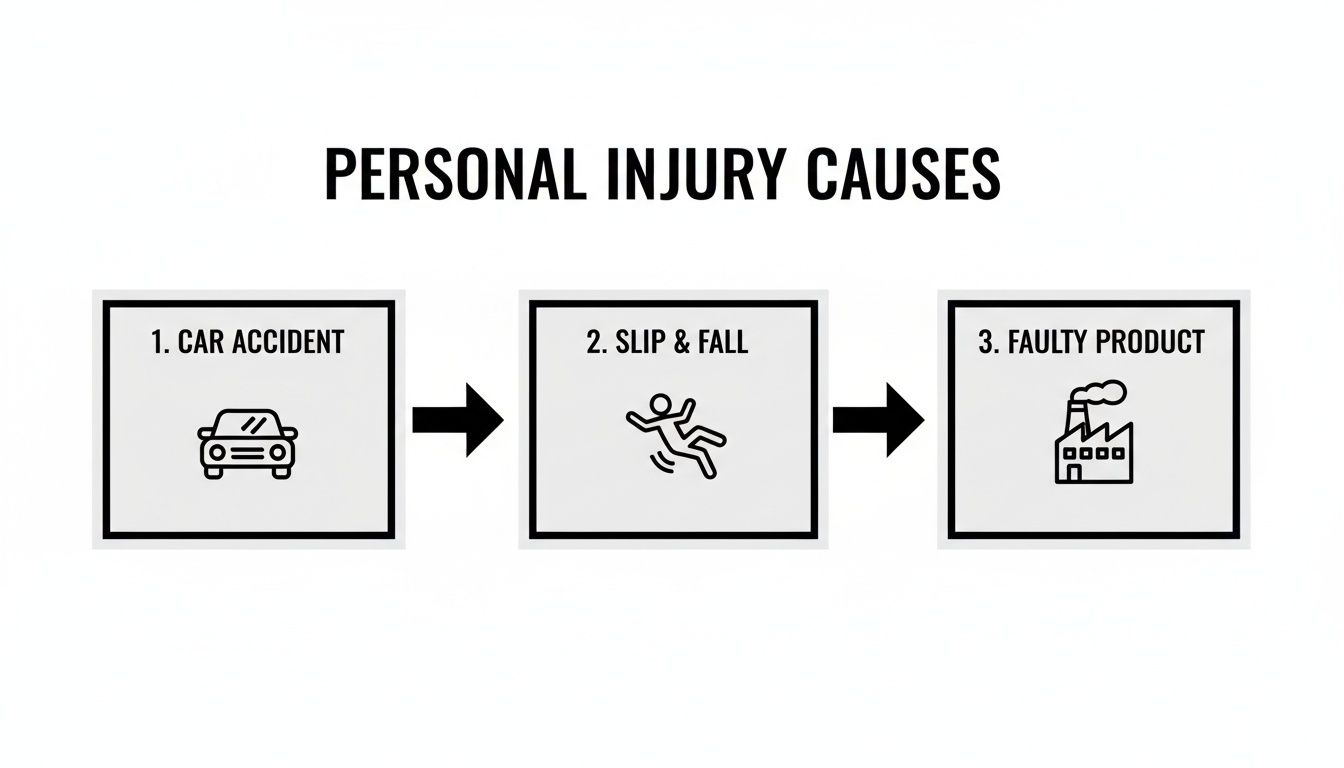
As you can see, very different events—a car accident, a fall at a store, or an injury from a faulty product—all funnel into the same legal process.
From Negotiation to Legal Action
With your initial evidence secured and medical treatment underway, the process shifts from fact-finding to formal negotiation. This is typically when an attorney steps in to notify the at-fault party and their insurance company. Your lawyer will draft and send a demand letter, a professional document that lays out the facts, details your injuries and financial losses, and states the compensation you’re seeking.
The insurance adjuster’s job is to minimize their company’s payout. They will review the demand and almost certainly return with a lowball counteroffer. This kicks off a period of negotiation, where your attorney will push back against their tactics, present compelling arguments, and fight to protect the true value of your claim. The vast majority of claims—over 95%—are resolved right here, without ever setting foot in a courtroom.
But what if the insurer refuses to make a fair offer? That’s when you file a lawsuit. Litigation is the most formal stage, involving court filings, sworn testimony (depositions), and, potentially, a trial. While the goal is still to settle, showing the insurance company you’re prepared to go to court is often the only way to get them to the table with a serious offer. Given the rise in claims from auto accidents, especially with EVs where repair costs are higher, this readiness to litigate is critical. You can find more personal injury law statistics on runsensible.com to understand the current landscape.
Calculating the True Value of Your Claim

Figuring out what a personal injury claim is actually worth goes far beyond just totaling up the initial medical bills. True compensation—what we call damages in the legal world—is meant to cover every loss you’ve suffered because of someone else’s negligence. That includes the obvious costs with clear price tags and the much deeper, personal ones.
To properly value a claim, these losses are split into two distinct categories. Understanding this difference is the first step toward making sure you don’t accept a settlement that leaves you shortchanged.
H3: Economic Damages: The Tangible Costs
First up are economic damages. Think of these as all the calculable, out-of-pocket expenses that came directly from the accident. These are the financial hits you can prove with receipts, invoices, pay stubs, and expert projections.
They’re the most straightforward part of a claim, but that doesn’t make them simple. Meticulous documentation is absolutely essential here.
Common examples include:
- Medical Bills: This covers everything from the ambulance ride and ER visit to ongoing physical therapy, future surgeries, and prescription costs.
- Lost Wages: The income you lost because you couldn’t work while recovering.
- Future Lost Earnings: If your injuries permanently impact your ability to do your job or earn at the same level you did before.
- Property Damage: The cost to repair or replace your vehicle or any other personal property destroyed in the incident.
It’s crucial to look past the immediate expenses. Learning about the hidden costs of personal injury can uncover things you might otherwise miss, like the need for home modifications or long-term in-home care.
H3: Non-Economic Damages: The Human Impact
The second category, which is often the largest part of a settlement, is non-economic damages. These are the intangible losses that don’t come with a bill but represent the very real human suffering the injury has caused.
While they’re much harder to put a number on, these damages are a critical component of fair compensation.
These damages exist to acknowledge that an injury’s true impact isn’t just financial. It’s the physical pain, the emotional trauma, and the disruption to your life that fundamentally change your world.
Non-economic damages are designed to compensate you for losses like:
- Pain and Suffering: The actual physical pain, discomfort, and agony resulting from your injuries.
- Emotional Distress: This can include anxiety, depression, PTSD, fear, and sleep disturbances caused by the traumatic event.
- Loss of Enjoyment of Life: Your inability to participate in hobbies, sports, family activities, or simple daily routines that once brought you joy.
Because these damages are subjective, insurance companies will fight tooth and nail to downplay them. An experienced attorney knows how to build a compelling case to prove their value, ensuring your final compensation reflects the full scope of what you’ve endured.
Economic vs. Non-Economic Damages
Here’s a simple breakdown to help you distinguish between the two core types of compensation you can pursue in a personal injury claim.
| Type of Damage | What It Covers | Common Examples |
|---|---|---|
| Economic | Tangible financial losses with a clear monetary value. | Medical bills, lost wages, property damage, future medical costs, rehabilitation expenses. |
| Non-Economic | Intangible, subjective losses related to the human cost of the injury. | Pain and suffering, emotional distress, loss of enjoyment of life, disfigurement, loss of consortium. |
Understanding both categories is key. A fair settlement isn’t just about reimbursing your expenses; it’s about acknowledging the total impact the injury has had on your life.
Deciding When You Need a Lawyer on Your Side
One of the biggest questions after an accident is whether you should handle the claim yourself or bring in an attorney. It’s a tough call. For a minor fender-bender with no real injuries, you can probably manage it on your own. But when the stakes get higher, the game changes completely.
Think of a good lawyer as your advocate—the one who levels the playing field against insurance companies. These companies are masters at minimizing payouts. Their primary goal is protecting their bottom line, not looking out for your long-term well-being.
When Legal Help Is Essential
Some situations are immediate red flags, signaling that you need professional legal guidance right away. Trying to navigate these scenarios alone can seriously jeopardize your right to fair compensation and put your future at risk.
You should seriously consider hiring an attorney if any of these apply to your case:
- You suffered serious or long-term injuries. This isn’t just about scrapes and bruises. We’re talking about any injury that requires surgery, extensive rehab, or results in a permanent disability.
- Fault is being disputed. If the other party or their insurance company is trying to pin the blame on you, you need a lawyer to gather evidence and prove their negligence.
- The insurance company makes a lowball offer. This is a classic tactic. An initial offer that barely covers your immediate medical bills is designed to make you go away cheaply. Don’t fall for it.
- Multiple parties are involved. Accidents involving commercial trucks, several vehicles, or third-party contractors create a web of complex liability issues that are nearly impossible to untangle without legal expertise.
The Contingency Fee Advantage
Many people hesitate to call a lawyer because they worry about the cost. Here’s the good news: most personal injury attorneys work on a contingency fee basis. This arrangement is a complete game-changer for injury victims.
It means you pay zero upfront costs for top-tier legal representation. Your lawyer’s fee is simply a pre-agreed percentage of the settlement or verdict they win for you. If they don’t recover any money on your behalf, you owe them nothing for their work.
This model makes expert legal help accessible to absolutely everyone, regardless of their financial situation. It also means your attorney is fully invested in securing the maximum possible compensation for your claim. Finding the right advocate is crucial, and you can learn more about connecting with high-caliber personal injury representation in your area to ensure your rights are protected from the start.
Answering Your Pressing Questions
Even with a solid grasp of the basics, real-world questions always come up. Let’s tackle some of the most common concerns to give you a clearer path forward.
How Long Do I Have to File a Claim?
Every state imposes a strict legal countdown for filing a lawsuit, known as the statute of limitations. This window can be surprisingly short—sometimes just one year, though it can extend up to six years from the date you were injured.
If you miss this deadline, the courthouse doors close permanently on your case. You lose your right to seek compensation forever, which is why acting promptly is absolutely critical.
What if I Was Partially at Fault?
This is a common worry, but it rarely torpedoes a case. Most states operate under a “comparative negligence” rule, which means you can still recover damages even if you share some of the blame.
Here’s how it works: your final compensation is simply reduced by your percentage of fault. For example, if you were found to be 20% responsible for the accident, your total financial award would be cut by that same 20%.
The key takeaway is that sharing some of the fault doesn’t disqualify you. It just adjusts the final amount you can receive to reflect each party’s role in the incident.
How Much Does a Personal Injury Lawyer Cost?
This is where the system is designed to help you. The vast majority of personal injury attorneys work on a contingency fee basis, a structure that opens the door to expert legal help for everyone, regardless of their financial situation.
It means you pay zero legal fees upfront. Your attorney’s payment is a pre-agreed percentage of the money they win for you—typically between 33% and 40%. If they don’t secure a settlement or verdict in your favor, you owe them nothing for their time and work.
Navigating a personal injury claim demands a powerful advocate with proven expertise. For those seeking premier legal representation, the Haute Lawyer Network provides a direct connection to top-tier attorneys who have the skill and dedication to protect your interests. Find elite legal counsel through the Haute Lawyer Network and give your case the powerful representation it deserves.