When you’re deployed halfway around the world, the last thing you want is for life on the home front to grind to a halt. A military power of attorney (POA) is the legal instrument that keeps your affairs running smoothly, empowering a trusted individual to act on your behalf when you simply can’t be there.
Think of it as your legal stand-in, authorized to handle critical missions back home—from paying bills and managing bank accounts to signing the closing documents on your new house.
Understanding Your Military Power of Attorney
Imagine this: you’re on deployment and your car lease is up. Or maybe your spouse finds the perfect home, but you’re thousands of miles away and can’t sign the paperwork. Without a POA, these crucial life events could stall, creating unnecessary stress for you and your family.
This isn’t about giving up control. It’s a strategic delegation of authority. A well-drafted POA is incredibly flexible. You can grant your agent broad powers to handle a wide range of financial matters, or you can limit their authority to a single, specific task—like selling one particular car before a Permanent Change of Station (PCS) move.
The Foundation of Military Readiness
For military families, a power of attorney is a cornerstone of legal and financial preparedness. Its importance is so widely recognized that official military legal guidance strongly recommends its use for managing civilian obligations during service.
Base legal offices often process hundreds, even thousands, of these documents during peak deployment cycles. This high volume underscores a fundamental reality of military life: your personal responsibilities don’t pause just because your mission begins. You can learn more about the official guidance on military POAs and their uses.
Think of a military POA as a specific set of orders you issue to a trusted agent. Just like a mission brief, it must clearly define the objective, the scope of authority, and the timeline to ensure success without unintended consequences.
A POA bridges the gap created by distance and deployment. It ensures that while you’re focused on your duties, someone has the legal authority to manage the critical parts of your life.
Key areas where a military POA is indispensable include:
- Financial Management: Allowing an agent to access bank accounts, pay bills, and manage investments.
- Real Estate Transactions: Authorizing an agent to buy, sell, or manage property on your behalf.
- Vehicle Transactions: Granting the power to buy, sell, or register vehicles.
- Tax Filings: Permitting a spouse or parent to file joint tax returns while you are away.
By understanding how this powerful legal tool works, you can protect your interests and support your family, no matter where your service takes you.
Choosing the Right Type of Military POA
Not all missions are the same, and neither are all power of attorney documents. Selecting the right type of military POA is like choosing the correct tool for a specific job; using a sledgehammer when you need a scalpel can create significant problems. Understanding the distinct roles of each POA type ensures you grant the precise authority needed without exposing yourself to unnecessary risk.
Think of it this way: you wouldn’t give a teammate unlimited access to all mission plans if they only need the coordinates for a single checkpoint. Similarly, your POA should match the specific life-logistics task at hand, from paying monthly bills to closing on a new home.
This straightforward decision-making flowchart can help visualize when a military power of attorney becomes a critical part of your pre-deployment checklist.
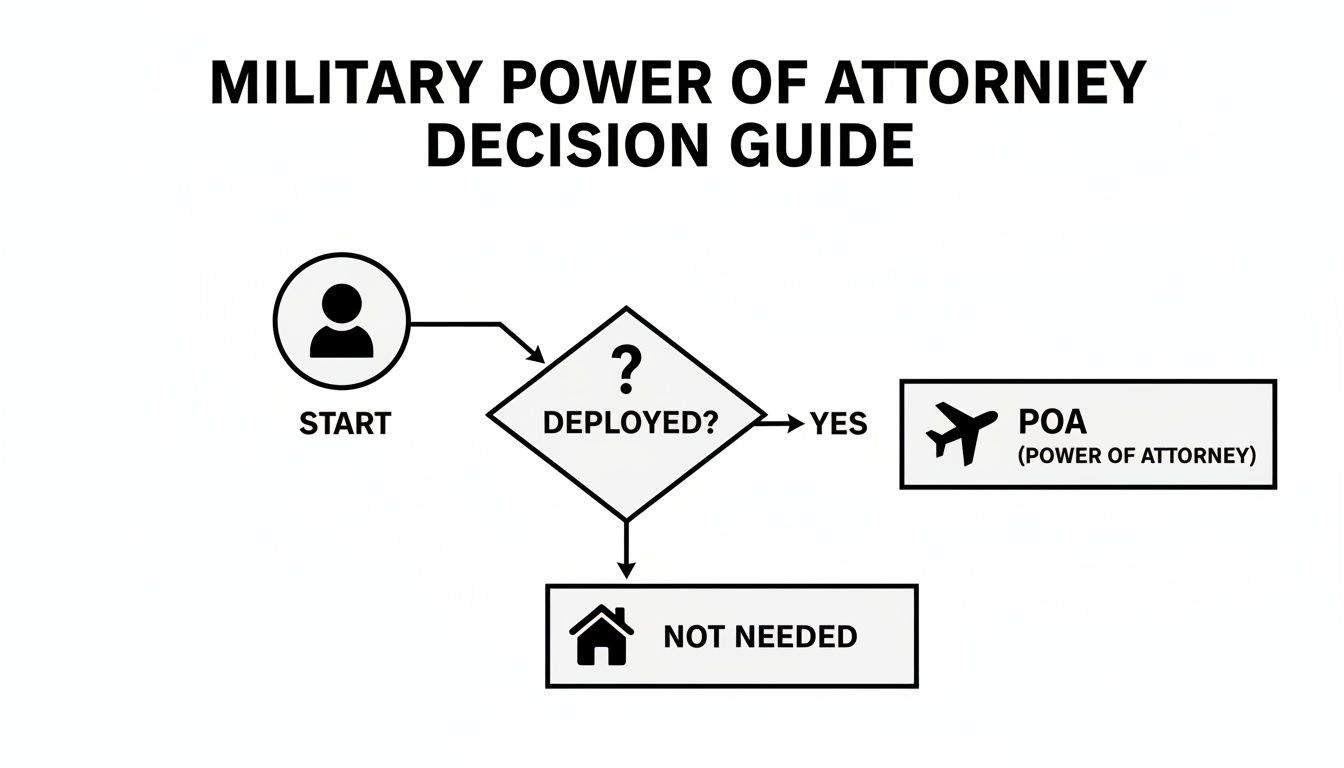
The flowchart clearly shows that deployment or unavailability is the primary trigger for needing a POA, ensuring your personal and financial affairs are managed in your absence.
To help you decide, let’s break down the four key types of power of attorney documents service members commonly use.
Comparing Military Power of Attorney Types
Each POA serves a distinct purpose, from broad financial management to specific, one-time transactions. The table below outlines the core differences to help you identify the right instrument for your situation.
| Type of POA | Scope of Power | Common Military Use Case | Key Consideration |
|---|---|---|---|
| General | Broad and comprehensive; covers nearly all financial and legal matters. | A spouse managing all household finances and assets during a long-term deployment. | Requires absolute trust in the agent due to the extensive authority granted. |
| Special | Limited to one or more specific, named tasks. | Authorizing a parent to sell a specific vehicle or sign closing documents for a house. | The safest option for single-purpose needs; minimizes risk of misuse. |
| Durable | A feature added to a General or Special POA. | Ensuring an agent can continue managing affairs if the service member is wounded and incapacitated. | Critical for comprehensive readiness; without it, the POA becomes void upon incapacitation. |
| Medical | Strictly limited to healthcare decisions. | Designating a spouse or parent to make medical choices if you are unable to communicate. | Does not grant any financial authority; separate from other POAs. |
Understanding these distinctions is the first step toward protecting yourself and empowering your family to act on your behalf when needed.
The General Power of Attorney
A General Power of Attorney is the most expansive and powerful option available. It acts like an all-access pass, granting your agent sweeping authority to conduct almost any legal or financial business on your behalf. This can include accessing bank accounts, filing taxes, and managing personal property.
Because of its extensive scope, a general POA must be handled with extreme caution. It is typically reserved for situations where you have absolute trust in your agent—such as a spouse—and when the tasks they need to handle are varied and unpredictable. Granting this level of control requires a serious conversation and a clear understanding between you and your agent.
The Special Power of Attorney
In stark contrast, a Special Power of Attorney (also called a Limited Power of Attorney) is a precision instrument. It gives your agent authority for only one or more specific, clearly defined tasks. This is, by far, the most common type of military power of attorney used during deployments because it minimizes risk while solving a specific problem.
Here are a few classic examples where a Special POA is the ideal choice:
- Selling a Vehicle: Authorizing your spouse to sell your 2022 Ford F-150 while you are overseas.
- Managing Real Estate: Granting your parent the power to sign closing documents for a home you’re purchasing.
- Childcare and School Enrollment: Giving a temporary guardian the authority to make educational decisions for your child.
This document clearly defines the boundaries of your agent’s power, which often makes third parties like banks and lenders more comfortable accepting it.
The Durable Power of Attorney
The “durable” feature isn’t a separate type of POA but rather a critical characteristic that can be added to either a general or special POA. A Durable Power of Attorney remains in effect even if you, the principal, become incapacitated and unable to make decisions for yourself.
Without the durable provision, a standard POA automatically becomes void the moment you are incapacitated. A Durable POA acts as a vital safeguard, ensuring your agent can continue managing your affairs precisely when you need them to most.
This provision is a cornerstone of comprehensive life planning. The legal strategies for a durable POA can sometimes overlap with broader estate planning goals. To better understand how these documents fit into a larger protective strategy, exploring resources on trust and estate planning to protect your assets can provide valuable context and deeper insights.
The Medical Power of Attorney
Finally, a Medical Power of Attorney, sometimes known as a healthcare proxy, operates in a completely different domain. This legal document empowers your agent to make healthcare decisions on your behalf only when you are unable to do so yourself.
It is distinctly separate from financial POAs. This document ensures your medical wishes are honored by someone you trust, covering everything from routine medical consent to profound end-of-life decisions. Every service member should have one as part of their complete readiness portfolio.
How to Legally Create Your Military POA
Getting a legally sound military power of attorney is a refreshingly straightforward process, intentionally designed to support the unique demands of service life. Forget the civilian world’s routine of hiring a private attorney and hunting down a paid notary. For service members, these critical resources are provided at absolutely no cost.
The entire process is anchored at your installation’s Legal Assistance Office, staffed by Judge Advocate General (JAG) Corps attorneys and paralegals. These are not your average lawyers; they are specialists trained to handle the specific legal needs of the military community. Whether you need to authorize someone to sell your car back home or arrange for childcare during a deployment, their mission is to equip you with the legal tools necessary to maintain readiness.
The Power of Military Notarization
For any POA to hold up in court, it has to be signed and notarized. A notary public is an impartial witness who verifies your identity and confirms you’re signing the document of your own free will. This is the step that makes the document legally binding.
But what happens when you’re deployed or stationed overseas, miles from the nearest civilian notary? This is where a critical piece of federal law makes all the difference.
Under 10 U.S.C. § 1044a, certain military personnel—including all JAGs—are granted the same powers as a notary public. This law is a logistical game-changer. It allows legal assistance officers to notarize your military POA from anywhere on the globe, ensuring it’s legally valid across every U.S. state and territory.
This provision removes a massive obstacle, guaranteeing you can execute a valid POA whether you’re at your home base in Virginia or a forward operating base in the Middle East.
Step-by-Step Execution Guide
Executing your military POA is a simple, structured process. Follow these steps to ensure your document is drafted correctly, legally sound, and perfectly tailored to your needs.
1. Schedule an Appointment First things first, contact your installation’s Legal Assistance Office to book a consultation. Be warned: during peak deployment seasons, their schedules fill up fast. It’s always smart to call well in advance.
2. Gather Your Information Come prepared. Showing up with all the necessary details makes the meeting far more efficient and productive. You’ll need:
- Your Details: Bring your military ID and any other identification they request.
- Your Agent’s Details: You must have their full legal name, current address, and a good phone number. Precision here is non-negotiable.
- The Specific Powers: Think through exactly what you need your agent to do. Is it selling a specific vehicle? Managing a particular bank account? The more detail you provide, the better the JAG can customize the document to protect you.
3. The Consultation and Drafting During your meeting, a JAG or paralegal will sit down with you to discuss your situation. They will explain the legal implications of the powers you’re granting and advise you on the best type of POA for your circumstances. From there, they will draft the document using legally approved, ironclad language.
4. Signing and Notarization Once you’ve reviewed the document and confirmed every detail is correct, you’ll sign it right there in front of the military notary. They will affix their official seal, and just like that, your military POA is legally executed. You’ll walk out with the original, notarized document, ready to hand over to your agent.
This seamless process is a standard not just in the U.S. military but among our closest allies as well. Armed forces in NATO countries and Australia offer similar legal channels for executing POAs. In fact, data shows that POA preparations can spike by 40–200% during major deployments, underscoring their vital role in military operations worldwide. You can discover more insights about the global reliance on POAs for military readiness and their impact.
Common Mistakes to Avoid With Your POA

A power of attorney is a serious legal tool, built entirely on a foundation of trust. But trust alone isn’t enough to prevent mistakes that can be both financially and emotionally devastating. Military life is stressful enough; the last thing you need is a legal crisis brewing back home.
Think of this as your pre-mission brief on risk mitigation. Understanding the common pitfalls is the best way to safeguard your assets and ensure your wishes are followed to the letter while you’re focused on the mission.
Making the POA Too Broad
One of the most frequent errors we see is service members signing a General Power of Attorney when a Special Power of Attorney would have been the smarter, safer choice. Giving someone an “all-access pass” to your financial life is incredibly risky if all they really need to do is handle one or two specific tasks.
For example, if you just need your spouse to register a new vehicle in your name while you’re away, a Special POA limited to that single transaction is the right tool for the job. Granting sweeping general authority in that scenario opens the door to all kinds of unintended consequences, even if your agent has the best of intentions. Always match the scope of the POA to the specific mission at hand.
Another critical oversight is forgetting an expiration date. An open-ended POA can haunt you, remaining legally valid indefinitely unless you take formal steps to revoke it.
A military power of attorney without an end date can become a lingering legal liability long after a deployment is over. Best practice is to tie the expiration date to your return or a specific, short period afterward.
This simple step acts as a built-in failsafe, ensuring the authority you granted automatically terminates once the need for it is gone.
Choosing the Wrong Agent
Your single most important decision is who you name as your agent. This person, also called an “attorney-in-fact,” must be unconditionally trustworthy, financially responsible, and capable of handling complex duties under pressure. This isn’t a popularity contest.
Don’t just pick someone because they’re a close friend or family member. You have to step back and objectively assess their real-world reliability and judgment. Ask yourself:
- Are they organized? Your agent will be managing critical documents, accounts, and deadlines.
- Are they a good communicator? You need someone who will provide regular, clear updates so you know your affairs are being handled correctly.
- Do they understand the gravity of the role? They have a legal obligation—a fiduciary duty—to act only in your best interest.
Picking the wrong person can lead to absolute disaster, from mismanaged bank accounts and late bill payments to unauthorized transactions that can take years and thousands of dollars to unwind.
Creating Vague or Unenforceable Language
In legal documents, clarity is king. A military POA that uses ambiguous terms or fuzzy language is likely to be rejected by banks, mortgage lenders, or government agencies exactly when you need it most. The powers you grant must be explicit and crystal clear.
For instance, don’t just say your agent can “handle real estate matters.” A properly drafted POA would specify that they can “sign all necessary documents to purchase the single-family home located at 123 Main Street, Anytown, USA.” That level of specificity leaves zero room for misinterpretation. This is particularly crucial when using a VA loan, as lenders have notoriously strict requirements for POA language. The same need for precision applies in family law; for context, the principles of clear legal authority seen in guardianship for elderly parents often overlap.
Failing to give copies of the POA to the relevant institutions ahead of time is another unforced error. Providing your bank or lender with a copy before it’s needed allows their legal team to review and approve it, preventing infuriating last-minute delays when your agent needs to act on your behalf.
How to Use and Revoke a Military POA
Getting a military power of attorney executed is the easy part. Knowing how to use it effectively in the real world—and when to pull the plug—is what really matters.https://www.youtube.com/embed/zwYBWVPD_Dg
Once that document is signed and notarized, the original copy becomes your agent’s golden ticket to act on your behalf. They’ll need to present the physical document—not a picture on their phone or a photocopy—to institutions like banks, car dealerships, or the DMV.
When your agent signs a document for you, they need to do it in a very specific way. For example, if your spouse is signing a car title, it would look something like this: “Jane M. Doe by John A. Doe, as Attorney-in-Fact.” This precise language makes it clear they’re acting under the legal authority you granted, not for themselves.
Don’t forget, your agent is also taking on a serious legal responsibility called a fiduciary duty. This isn’t just a fancy term; it’s a formal obligation to act only in your best interest, steer clear of any personal conflicts, and keep a squeaky-clean record of every single transaction.
Putting the POA into Action
Just having the POA isn’t enough. Your agent needs to know how to navigate the system, because showing up cold to a bank with a legal document can cause major delays, especially when you’re facing a tight deadline.
Here are a few practical steps to make sure things go smoothly:
- Be Proactive, Not Reactive: Long before a transaction is needed, your agent should give a copy of the POA to the bank, lender, or other organization. This gives their legal team time to review and approve it, so you’re not scrambling at the last minute.
- Originals Only: It’s worth repeating—when it’s go-time, your agent must have the original, notarized POA. Most places simply won’t accept a copy.
- Bring ID: Your agent will also need to prove their own identity with a driver’s license or another form of government-issued ID.
How to Properly Revoke Your POA
A power of attorney shouldn’t last forever. Once a deployment is over or the document’s purpose is served, it needs to be terminated. Leaving an active POA out in the world is just asking for trouble.
Revoking a POA is just as formal as creating one. You can’t just rip it up or send a quick text telling your agent they’re done. You need a formal, written process to make it legally binding and protect yourself.
A verbal “we’re done” won’t cut it in court. To properly kill a POA, you have to create a written “Revocation of Power of Attorney,” get it notarized, and make sure everyone who saw the original knows it’s no longer valid.
This isn’t optional—it’s the only way to cleanly and officially end your agent’s authority.
Here’s how to do it right:
- Draft a Formal Revocation: Create a document clearly titled “Revocation of Power of Attorney.” It needs your name, your former agent’s name, and the date the original POA was created. The language should be unambiguous: you are revoking all authority granted in that document.
- Sign and Notarize: Just like the POA itself, the revocation needs your signature in front of a notary public. A military legal assistance office can do this for you at no cost.
- Spread the Word: This is the most important step. A copy of the notarized revocation must be delivered to your former agent and, critically, to every single institution that ever saw the original POA. This puts them on official notice that your agent no longer has power to act for you.
Understanding the full lifecycle of a POA is crucial, and it’s helpful to know more about when a power of attorney might expire on its own or through other legal means.
Where to Find Free Legal Help on Base
You don’t have to go this alone, and you certainly don’t need to spend a fortune on a civilian attorney for this. One of the single best perks of military life is the free, professional legal support available right on your installation. The trick is simply knowing where to go.
Your first and best stop is always the installation’s Legal Assistance Office. These offices are run by Judge Advocate General (JAG) Corps attorneys and paralegals—legal experts whose entire job is to handle the unique needs of service members and their families. Their mission is to ensure you’re legally prepared for anything, from POAs to wills.
What to Expect at a Legal Assistance Office
Forget any intimidating law firm stereotypes. Walking into a military legal office is a straightforward, professional experience. Unlike a private firm, their services are 100% free for eligible service members, dependents, and retirees. They aren’t selling you anything; their only goal is to get your affairs in order so you can focus on your mission.
During a consultation for a military power of attorney, the JAG or paralegal will:
- Assess Your Situation: They’ll ask smart questions about why you need the POA to figure out if a general or special power of attorney is the right tool for the job.
- Explain the Risks: A good legal advisor will be direct about the power you’re handing over and the potential downsides, ensuring you understand the responsibility involved.
- Draft the Document: They use battle-tested, legally sound templates to build a POA tailored to your needs—one that banks and government agencies will actually accept.
- Provide Notary Services: As we covered, JAGs can legally act as notaries. They’ll handle the final, critical step of signing and notarizing your document right there on the spot.
A visit to the Legal Assistance Office is much more than a document-stamping service. It’s a professional legal consultation designed to protect your interests and equip you with a powerful tool for managing your life.
The whole process is built for efficiency, but that doesn’t mean you’ll be rushed. The legal team is there to answer every question and make sure you walk out the door feeling confident and prepared.
Preparing for Your Appointment
To get the most out of your time, a little prep work goes a long way. Legal Assistance Offices are busy, especially before a big deployment cycle. Showing up with your ducks in a row makes everything smoother.
Before you head in, make sure you have:
- Your Military ID: This is non-negotiable for verifying you’re eligible for their services.
- Your Agent’s Full Legal Name: No nicknames. It has to match their government-issued ID exactly.
- Your Agent’s Current Address and Phone Number: This information is required to be on the document itself.
- A Clear Objective: Know precisely what you need your agent to do. The more specific your list of tasks, the better the JAG can tailor the document to protect you from unintended consequences.
And while you’re there, think bigger. The Legal Assistance Office can also help with other critical documents like wills, living wills, and healthcare directives. It’s a smart move to tackle all of these at once, creating a complete legal readiness package for you and your family.
Common Questions About Military POAs
Let’s clear up some of the most common points of confusion service members and their families run into when using a military power of attorney.
Does a Military Power of Attorney Expire Automatically?
This is one of the most dangerous assumptions a service member can make. The answer is no, not always. A POA doesn’t just magically dissolve when you return from deployment.
If you don’t include a specific end date, your POA could be considered “durable” and will remain legally binding until you formally revoke it in writing. Best practice is to always include a clear expiration date, like 30 days after your scheduled return from deployment. This small detail prevents unintended authority from lingering long after it’s needed.
Can My Spouse Handle Our Kids’ School and Medical Needs With My POA?
Yes, but almost never with a standard financial POA. This is a critical distinction. A general power of attorney that lets your spouse manage your bank accounts will be flat-out rejected by a school administrator or a doctor’s office.
To give your spouse or another guardian the proper authority, you’ll need entirely separate documents:
- A Special Power of Attorney for Educational Matters to handle things like school enrollment and administrative decisions.
- A Medical Power of Attorney or Healthcare Proxy to grant the authority for making medical and dental treatment decisions.
Be sure to discuss these specific needs with the JAG at your legal assistance office to get the right documents in place.
A common mistake is assuming one POA is a master key that unlocks everything. Think of it more like a set of specialized tools: you need a different one for financial, educational, and medical tasks. One size does not fit all.
Is My State-Issued POA Valid While Stationed Overseas?
It might be, but you should never, ever rely on it. This is precisely why the military power of attorney, created under federal law, is so essential for anyone serving abroad.
A POA drafted in your home state—say, Texas—might not meet the unique legal standards of another U.S. state, let alone a foreign country like Germany or Japan. This can lead to massive headaches and outright rejections when your agent tries to deal with international banks, landlords, or government offices.
Before you go anywhere, get a federally recognized military power of attorney from your base legal office. It’s specifically designed for broad acceptance and to handle the unique challenges of military life, giving you and your family true peace of mind.
When legal matters grow too complex for on-base services, or you require specialized civilian representation, finding the right attorney is crucial. The Haute Lawyer Network connects you with a curated list of the nation’s top legal professionals, each recognized for their excellence and expertise. Elevate your search and ensure you have the best possible advocate on your side. Find your expert counsel at Haute Lawyer Network.