
Quick Overview Of Adopting Your Step Daughter
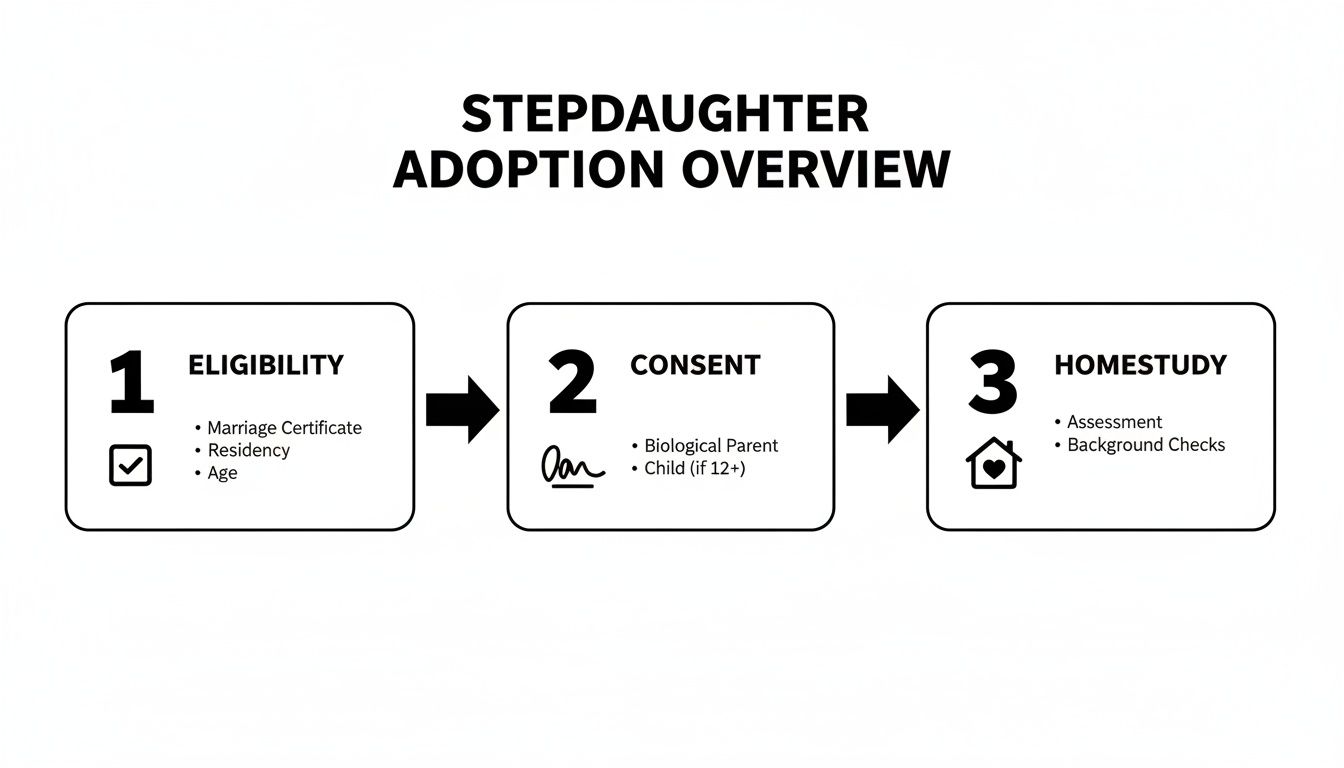
Every family’s journey looks a bit different, but there are five critical milestones that guide you from eligibility checks to your final court decree. Lay the groundwork early, and you can shave weeks off the overall timeline.
Think of a Florida couple who wrapped things up in four months without a hiccup. Then contrast that with a New York pair, whose process stalled for six weeks after a few missing documents.
Key Steps Summary
Below is a concise look at each primary step, from confirming eligibility to the final hearing.
| Step | Description |
|---|---|
| Eligibility | Confirm age, marriage duration, residency |
| Consent | Obtain parental consent or termination order |
| Home Study | Complete background checks and home visits |
| Form Filing | Submit adoption petition and supporting docs |
| Court Hearing | Attend hearing to finalize the decree |
Use this table to spot average fees, timelines, and must-have documents at a glance.
- Prepare core paperwork in advance to avoid delays.
- Budget confidently with typical fees disclosed upfront.
- Keep lines of communication open with all involved parties.
Early preparation and clear communication can shave weeks off your adoption journey.
Real-World Timelines
A Florida family moved from initial checks to court approval in four months flat. In New York, missing birth certificates added six weeks to the home study.
- Average Timeline Across States: 3–9 months
- Typical Court Fee Range: $150–$500
- Home Study Costs: $800–$2,500
Gather essentials—marriage certificates, birth records, consent or termination forms, and background clearances—before you file.
Benefits Of A Clear Roadmap
- Cuts down on unnecessary court appearances
- Trims overall legal fees
- Builds confidence at every phase
What’s Next
You’re about to dive into state-by-state eligibility rules and learn how to craft consent requests that steer clear of objections.
- Draft consent forms with all key details
- Publish notices when an absent parent must be served
- Spot and avoid the most common delay triggers
Armed with this roadmap, you’ll move through each phase with confidence, whether your case is uncontested or contested.
Refer back to the table above and the infographic before tackling the detailed steps ahead. Clear preparation makes adoption more predictable. Let’s dive in together.
Check Eligibility And Secure Parental Consent
Before you fill out any forms, take a moment to confirm your state’s rules. This simple step can save weeks of back-and-forth later on.
If you’ve been asking yourself “How do I adopt my stepdaughter?”, start here. Most states set a minimum age, a required marriage duration and sometimes a residency period before a stepparent adoption can proceed. In Texas, for example, you must be at least 21 and married for six months; California drops the marriage requirement to just three months.

Confirm State Requirements
Broadly speaking, states differ on:
| State | Age Minimum | Marriage Duration | Residency Needed |
|---|---|---|---|
| Texas | 21 | 6 months | 6 months in county |
| California | 18 | 3 months | 3 months in state |
| Illinois | 21 | 6 months | No specific term |
After you verify the basics, check whether your state mandates any extra steps—like Texas’s notice publication when a parent can’t be located. Skipping these details can lead to unexpected court delays.
“Clear, respectful communication builds trust and smooths the consent process,” advises a San Antonio family attorney.
Draft A Clear Consent Request
Your written consent request often forms the first real impression. Keep it warm yet precise.
• Open with a personal greeting—use the parent’s name and note your relationship.
• Describe what adoption means: permanent legal ties for everyone involved.
• Define the effect of consent or termination on parental rights.
• Spell out a simple way to reply and set a realistic deadline.
Bonus tip: include a self-addressed, stamped envelope to make signing effortless. Small courtesies can ease big decisions.
Integrate Adoption Statistics
Stepparent adoptions are surprisingly common. Roughly 50.61% of private domestic adoptions in recent years involve stepparents. These figures, pulled from the National Council’s latest survey, highlight how mainstream this process has become. For an in-depth look, read the Adoption by the Numbers report.
Anticipate Common Objections
It’s natural for a biological parent to worry about inheritance, custody shifts or feeling sidelined. Address these head-on:
• Offer an in-person or video meeting to air concerns.
• Explain that giving consent doesn’t erase their custodial rights if they wish to stay involved.
• Emphasize that adoption cements an emotional and legal bond for your stepdaughter’s stability.
A proactive conversation often transforms hesitation into understanding.
Handle Missing Parents
When the other parent can’t be located, most courts allow a notice-of-publication route:
• File an affidavit detailing your diligent search efforts.
• Publish a statutory notice in a local newspaper for the required period.
• Seek court approval for default consent once publication wraps up.
Your family law attorney can guide you through these technical steps to ensure no statutory requirement slips through the cracks.
Foster Goodwill Early
A friendly, respectful tone sets the stage for smooth interactions—legal and personal alike. Stay flexible on meeting times, offer clear explanations and be ready to shift between phone, video or in-person chats.
Example Family Scenario
In Houston, a stepmom sent a concise consent letter that outlined the timeline and legal implications. Pairing it with a friendly invitation to discuss questions cut through confusion and won trust.
- Clarify legal terms in plain language.
- Offer translation if needed.
- Provide a pre-addressed, stamped return envelope.
This kind of thoughtful approach not only eases the consent process but also lays a strong foundation for the upcoming home study. With all consents secured, you’ll head into home visits with confidence—just keep tracking every deadline and document.
Prepare Your Home Study And Gather Documents
Getting your home study in order is a pivotal moment in the stepparent adoption process. Your assessor will tour your living space, checking that it’s safe, nurturing, and ready for your stepdaughter’s arrival.
Start by assembling proof of income, marriage and birth certificates, background clearances, medical reports, plus any state‐specific forms. A Florida couple once impressed their social worker by arranging everything in a neatly labeled binder. Meanwhile, a New York family learned the hard way—overlooking a single fingerprint card set their timeline back weeks.
Typical Documents By State
| State | Key Documents | Unique Forms |
|---|---|---|
| Florida | Marriage certificate, income proofs, medical report | Florida DCF approval form |
| New York | Birth certificate, background check, fingerprint card | NYS adoption packet |
| California | Proof of residency, health statement, marriage license | Child consent form |
Home visits may feel intrusive at first, but when you’re organized, they become straightforward checkpoints. Clear, candid communication with your assessor also goes a long way toward building trust.
Modern home studies usually involve interviews, safety inspections, and background checks for every adult in the house. Don’t be surprised if your assessor asks about your daily routines or upcoming travel plans.
Key Tips For Smooth Scheduling
- Pick a time when everyone—kids, working adults, even pets—can be present.
- Email your assessor a checklist of documents before the visit to set clear expectations.
- Ask for a 24-hour confirmation window so you’re not caught off guard.
Organize Your Information Efficiently
Store all paperwork in a single binder equipped with dividers. Label sections—Financials, Legal Certificates, Medical Reports—for instant reference.
If multiple adults need access, create a shared cloud folder. Scan each page, include dates in file names, and keep everything searchable.
“A clear binder demonstrates readiness and earns respect from your home study professional,” notes a Florida adoption social worker.
Prepare for follow-up questions on travel history, references, or holiday plans. Having extra receipts or logs at your fingertips can turn a potential delay into a five-minute fix.
When you factor in state‐specific rules, foster care statistics offer perspective on adoption routes. 66.48% of non-stepparent adoptions in 2022 involved foster care, whereas private domestic stepparent cases typically move faster. Learn more about adoption rates by country on World Population Review
With your home study and documents squared away, you’re ready to file adoption forms confidently. A well-prepared home study paves the way for a smooth court experience.
Track And Verify Deadlines
Keeping deadlines in check prevents last-minute chaos. Build a calendar that flags home visit dates, document expirations, and court filing windows. Use phone or email reminders for:
- Home visit appointment recorded.
- Document expiration alerts set two weeks prior.
- Follow-up calls to confirm no missing items.
- Court filing deadline highlighted in red.
- Monthly binder audit sessions scheduled.
This system turns paperwork into a predictable routine, letting you focus on bonding with your stepdaughter instead of chasing forms.
Insider Tip For Document Management
Color-code binder tabs so you can flip straight to the right section. Use a folder app that timestamps each scan—nothing slips through the cracks.
Submit Adoption Forms And Prepare For Court
Filing your Petition For Stepparent Adoption is a clear sign you’re nearly at the finish line. Now it’s time to assemble sworn statements, background clearances, home-study reports and consent papers into the court packet.

Gather Essential Adoption Documents
Begin by ticking off every item on your state’s adoption checklist. Courts typically expect:
- Sworn affidavits from both custodial and noncustodial parents
- Background check certificates with clearance dates
- The finalized home-study report
- Consent documents or court orders terminating parental rights
One Ohio family combined both parents’ permissions into a single affidavit. That clever move shaved hours off travel time and cut filing fees.
Craft Your Bond Statement
Judges look for genuine connections. Aim for 200–300 words that capture day-to-day life and meaningful moments:
- Saturday pancake breakfasts you share
- Her proudest school award ceremony
- How you comfort her after a midnight scare
This narrative doubles as your practice guide for questions like “Why adopt?” and “What will change?”
Good rehearsal calms courtroom jitters.
Collect Support Letters From Community
Third-party voices add weight. Gather 3–5 letters dated within six months from:
- A teacher who’s seen her academic growth
- A coach or mentor familiar with her extracurricular achievements
- A family friend or community leader who observes your family dynamic
Encourage each writer to mention specific instances of your stepdaughter’s well-being.
Practice Your Court Appearance
Mock hearings aren’t just for show—they build confidence. Keep this checklist handy:
- Dress professionally yet comfortably
- Arrive 15 minutes early to locate the courtroom
- Address the judge as “Your Honor” and stand when speaking
- Keep answers brief and centered on your bond
Role-play with your spouse or attorney so you’re comfortable with common questions.
Include Your Stepdaughter At Hearing
Many jurisdictions require children over 12 to attend. Her presence signals family unity and respect for her voice:
- Verify your state’s age threshold
- Choose a simple, formal-appropriate outfit
- Practice a short greeting: “Hello, Your Honor. Thank you for having me.”
Involving your child highlights family harmony.
Verify Filing Fees
Expect clerk fees between $150–$500 depending on where you live:
- Check local fee schedules on the court’s website
- Bring exact change or a certified check
- Ask about waiver options if cost is a barrier
Final Tips Before The Hearing
- Confirm your attorney’s name appears on the petition
- Print two extra copies of every document—for the judge and clerk
- Review parking logistics and witness arrival times
You might find our consultation guide helpful: Learn more about family law consultation options.
A calm, organized approach will carry you through to your final decree. Be prepared, stay composed, and step into court with confidence.
After Adoption Decree
Once the judge signs your decree, request a certified copy from the clerk’s office. Then send it to the vital records department to update her birth certificate. That final action cements your new family status.
Handle Contested Cases And Special Situations

Adopting a stepdaughter can feel like navigating a maze when a biological parent objects or disappears. In those moments, knowing the extra steps—from special filings to court-ordered services—keeps your journey moving forward. Let’s unpack the contested path and those unique scenarios you might face.
Filing Notice Hearing
Begin by lodging a notice of hearing with your local family court clerk. This document formally alerts everyone involved that you’re seeking to terminate parental rights or overcome resistance.
Key Filing Elements:
- Petition for Adoption listing all parent details
- Affidavit of Grounds (abandonment, neglect, or unfitness)
- Proposed Hearing Date and Venue
In one Arizona case, a clear, concise affidavit helped a family finalize in six weeks for under $500.
Serving Missing Parents
When a parent can’t be located, the court will allow “alternative service.” You must first show all reasonable efforts to find them.
Typical Service Steps:
- File an Affidavit of Diligent Search with dates and methods used
- Publish notice in a local newspaper for the mandated period
- Secure a court order approving service by publication
Alternative service prevents endless delays when a parent disappears.
If no one answers, the parent’s silence often converts to default consent.
Guardian Ad Litem Role
In a contested adoption, the court appoints a Guardian Ad Litem (GAL) to advocate solely for the child’s best interests.
GAL Responsibilities:
- Interview the child and all parties
- Review home study reports and background checks
- Submit a written recommendation on custody and placement
A strong GAL report can swing the judge’s decision in your favor.
Adoption Statistics Influence
Even contested adoptions follow familiar paths. In the U.S., stepparent adoptions rival other adoption types in volume—despite less public attention. Seeing these numbers often reassures courts that your case fits a well-established pattern rather than an odd exception. Discover more insights about step adoptees on SeveranceMag.
Immigration Pathways
For a stepdaughter born overseas, securing a stepparent visa (IR-2 or IH-4) before the final decree can save months—or years—in foster care limbo.
Essential Steps:
- File Form I-130 with USCIS
- Await processing at the National Visa Center
- Complete CBP inspection and visa interview
- Submit Form I-485 to adjust status once in the U.S.
These steps chart a direct course to permanent residency without orphan or foster designations.
Comparing Case Types
Contested and uncontested adoptions often differ dramatically in both time and cost.
| Case Type | Timeline | Typical Cost |
|---|---|---|
| Uncontested | 3–9 months | $1,500–$3,000 |
| Contested | 9–15 months | $3,500–$7,000+ |
An Illinois couple faced contestation but leaned on an immigration network to secure their stepdaughter’s visa—and wrapped everything up in eight months.
Best Practices For Contested Cases
Staying organized is your secret weapon when disputes arise.
- Keep a detailed events log with dates and attendees
- Send weekly progress updates to your attorney
- Explore mediation if the other parent shows any willingness
- Line up temporary guardianship plans as a backup
- Double-check publication proofs to satisfy the court
Families who adopt these habits often slash legal fees and reach resolution more amicably.
Update Estate Plan
Once the adoption is final, your family’s legal landscape shifts overnight. Revising wills, trusts, and beneficiary forms is nonnegotiable.
Important Estate Updates:
- Add your stepdaughter as a beneficiary
- Name her guardian in your will
- Update life insurance and retirement account designations
If you anticipate any guardianship disputes, our guide on preparing for custody hearings can help: Preparing for Custody Hearing
Contested adoptions introduce extra steps, but proactive planning brings clarity. With the right filings, effective service strategies, and immigration foresight, you’ll lay the groundwork for a secure, legally recognized family bond. Stay prepared—and don’t hesitate to lean on experienced counsel through the Haute Lawyer Network.
Plan Timeline Costs And Find Savings
Having a clear picture of each phase’s duration and expenses takes the guesswork out of stepparent adoption. In most states, you’re looking at 3–9 months from start to finish, though contested cases or complicated backgrounds can stretch past a year. Costs typically fall into three buckets: court filing fees, home study charges, and attorney rates.
Sample State Timelines
To illustrate, here are four real-world scenarios:
| State | Timeline | Court Fee |
|---|---|---|
| Florida | 4 months | $150 |
| New York | 6–9 months | $200 |
| Texas | 5 months | $180 |
| Illinois | 7–8 months | $250 |
Beyond court filings (usually $150–$500), home studies can run $800–$2,500 depending on how detailed the inspections and reports must be. You’ll commonly see attorney fees between $1,200–$5,000+, so don’t hesitate to ask about flat-fee bundles or package deals.
Here are a few immediate ways to chop costs:
- Batch home study visits and save roughly $200 in travel expenses
- Leverage pro bono legal clinics for free initial consultations
- Tap curated platforms to compare rates and find affordable counsel
If you’re curious about lawyer billing structures, our deep dive on How Much Does a Lawyer Cost? covers everything from hourly rates to retainers.
Carve out a shared calendar for key dates—court windows, home visits, fee deadlines—and use it to negotiate retainer discounts when you bundle adoption phases.
Creative Ways To Lower Fees
Every dollar counts, and families have found crafty solutions. One household trimmed $500 simply by grouping appointments. Another discovered a local clinic that waived extra home study add-ons.
Ask your county bar association about sliding-scale clinics, especially around National Adoption Awareness Month. Joining regional support groups can yield resources like shared templates or carpooling opportunities.
“We combined appointments and saved $500 in travel,” reports one couple who also stayed with friends to avoid hotel fees.
In Colorado, a pair scheduled back-to-back home study visits and cut nearly 10% off their total budget by coordinating with neighbors for lodging.
For precise filing costs, check your county clerk’s website—many list exact fees and occasional waivers.
Here’s a screenshot of our network dashboard highlighting discounted counsel options:
You’ll see fee tiers clearly marked for pro bono and sliding-scale hours, plus filters by region, practice area, and budget to narrow your search.
Timeline Planning And Budget Tips
Start by laying out each adoption stage on a calendar. Mark court filing deadlines, home study windows, and add a 2–4 week buffer for unexpected delays like extended background checks. Then:
- Compare county schedules for off-peak filing waivers
- Inquire about group home study sessions with neighbors
- Prepay package rates to lock in discounted hourly fees
Negotiate caps on hourly expenses or agree on flat fees for specific documents. Track actual spending against your budget to catch overruns early—this proactive stance can save you both time and money.
- Align home visits with other errands to maximize travel days
- Use early-payment discounts (often 5–10%) on court fees
- Browse community forums for attorney referral deals
Thoughtful timeline mapping and diligent cost monitoring turn a daunting budget into a manageable plan. With these strategies, you’ll know exactly where to tighten your belt and where to invest. Stay flexible—each county runs at its own pace, and annual updates can reveal fresh savings.
Frequently Asked Questions
Other Parent Lives Out Of State
When the noncustodial parent lives elsewhere, you still need to serve valid notice. Check your state’s version of the Uniform Interstate Family Support Act (UIFSA) to understand the service rules.
One Georgia stepparent mailed the petition via certified mail and filed an Affidavit of Diligent Search under UIFSA to document every effort made to locate the other parent.
- File a certified mailing affidavit under UIFSA
- Publish notice in a local newspaper if required
- Obtain court approval for alternative service
After service, expect a 30-day waiting period before setting your hearing date. In Missouri, one couple tracked each UIFSA deadline on a shared calendar to avoid surprises.
Updating School Records And Inheritance
Once the final decree arrives, order a new birth certificate from vital records. Then, present the certified copy to your school district and revise your estate documents to include your stepdaughter.
- Order a certified decree copy from the court clerk
- Submit it to the school registrar for enrollment and benefits
- Update your wills, trusts, and beneficiary forms
Most districts process updates within 30 days, but it’s wise to follow up if you’ve heard nothing back.
“I updated my will within days to protect her inheritance,” shares one Houston attorney.
Changing Your Stepdaughter’s Last Name
Adoption doesn’t always trigger an automatic name change. To make it official, include a name-change request in your adoption petition or file a separate motion.
In California, one family added a clause under Cal. Fam. Code §8713 so the court’s single order covered both adoption and the surname change.
- The Smiths drafted an addendum to formalize “Lee” as Madeline’s new surname
- The judge signed one combined order for adoption and name change
- Update her passport and Social Security records accordingly
Name-change procedures vary by state—always verify your local statutes before filing.
For expert guidance and access to top family law counsel, connect with Haute Lawyer Network.