
That traffic ticket you just got feels like a major headache now, but the real question is how long it’s going to follow you. The short answer is anywhere from three to ten years, but the reality is far more complicated. The timeline depends entirely on your state, how serious the violation was, and exactly who is looking at your record.
The Lifespan of a Traffic Ticket
A traffic ticket isn’t just a single black mark. Think of it as leaving a digital footprint in several different places—your state’s official DMV file, the court system, and your insurance company’s private database.
Each of these entities has its own rules for how long they keep that information and why they use it. This is why a ticket can feel like it has a life of its own. The points might vanish from your DMV record after three years, but your insurance provider could use it to justify higher premiums for five years or more. Understanding this separation is the first step to managing the fallout.
Why There Is No Single Answer
The main source of confusion is that there’s no national standard for traffic violations. Every state sets its own agenda, creating a complex web of different regulations across the country. A minor speeding ticket might only stay on your public driving record for three years in California, while a more serious offense could haunt you for a decade.
This isn’t just a U.S. issue; it’s a global one. Data retention laws for law enforcement metadata, like location data, often have much shorter holding periods—typically six months to two years. Motor vehicle records are treated differently because they serve a different purpose, which is why a ticket remains accessible for licensing and insurance for a much longer time.
Key Factors That Determine a Ticket’s Duration
Several things determine how long that ticket will stay on your driving history. Getting a handle on these factors gives you a much clearer picture of what you’re up against.
- The Severity of the Violation: A simple ticket for going 10 mph over the speed limit is worlds away from a reckless driving charge or a DUI. The more serious the offense, the longer it sticks around.
- Your State’s Laws: Every state has its own statutes and record-keeping policies. You can learn more about how the statute of limitations by state can impact legal matters.
- The Type of Record: As we mentioned, the DMV, the courts, and your insurance company all keep their own separate records, and each has a different expiration date.
A common mistake is thinking that paying the fine makes the ticket disappear. In reality, paying the fine is an admission of guilt. That’s what officially puts the violation on your record and starts the clock on all the long-term consequences.
This guide will demystify the entire process, from understanding DMV points to taking practical steps to clear your name and protect your driving record for the future.
Where Your Ticket Information Is Stored
When you get a traffic ticket, it’s easy to think it goes onto one single, permanent “record.” But the truth is a lot more complicated. Your ticket information isn’t stored in one master file; it’s fragmented across several different databases, each with its own purpose, rules, and audience.
Think of it like a medical issue. Your doctor has a file, the hospital has another, and your insurance company keeps its own records. They all relate to the same event, but they don’t share everything and are used for different reasons. The same goes for a traffic ticket. The three key places this information lives are your state’s DMV, the local court system, and—for the really serious stuff—your criminal record.
This breakdown shows how a single ticket’s data ripples outward, hitting both the state DMV and, eventually, your insurance provider.
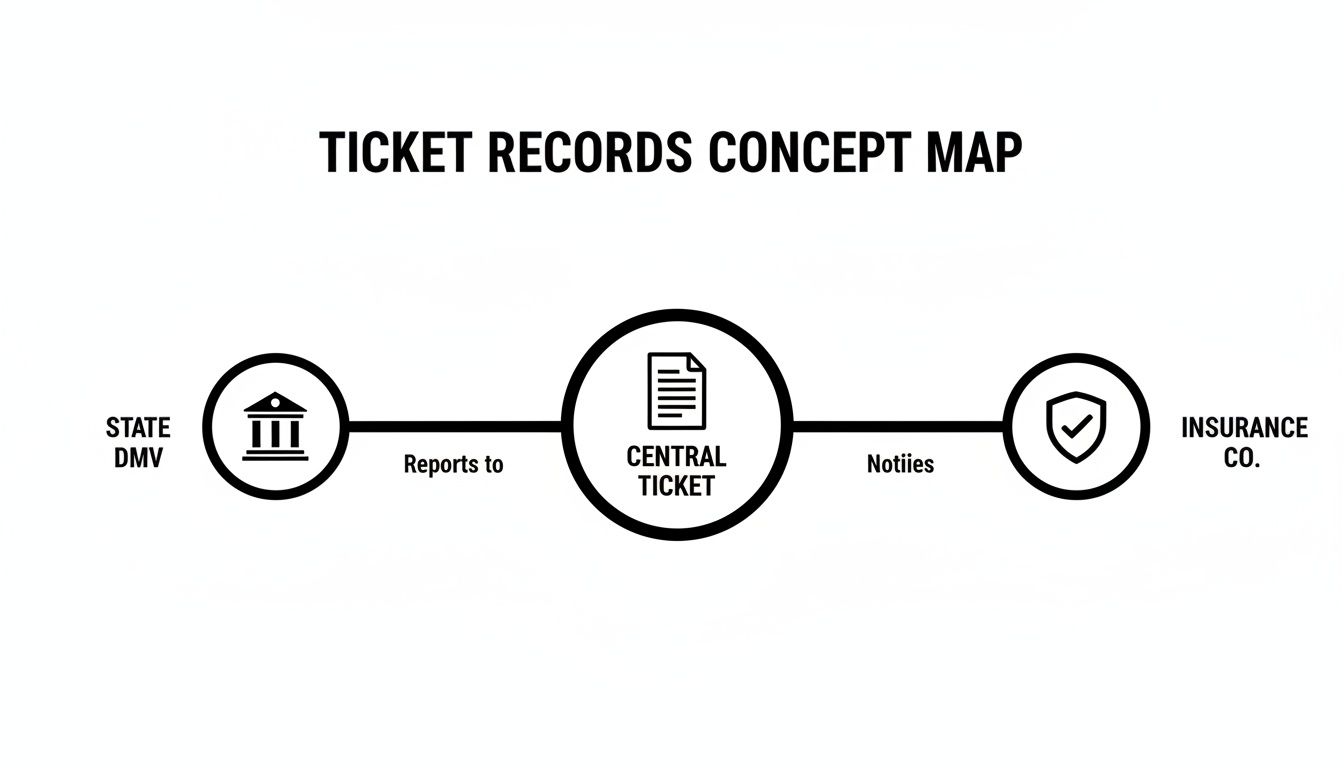
As you can see, the consequences branch out quickly, affecting your official driving status and how much you pay for insurance.
To better understand how these records differ, let’s compare them side-by-side.
Comparison of Different Record Types After a Traffic Violation
| Record Type | Primary Purpose | Who Accesses It | Typical Retention for Minor Violation | Typical Retention for Major Violation |
|---|---|---|---|---|
| DMV Record (MVR) | Track driving history, points, and license status. | Law enforcement, insurance companies, certain employers. | 3-5 years | 10+ years or lifetime |
| Court Record | Document the legal process and outcome of the ticket. | The public, researchers, background check services. | Often permanent | Permanent |
| Criminal Record | Record misdemeanor or felony convictions. | Employers, landlords, licensing boards, law enforcement. | N/A (minor violations aren’t criminal) | Lifetime |
Each record tells a different part of the story, which is why a ticket can continue to have an impact long after the points have disappeared from your license.
Your Official DMV Driving Record
This is the one most people know about. Your official driving record, often called a Motor Vehicle Record (MVR), is managed by your state’s Department of Motor Vehicles (DMV). Its job is to keep a running tab on your driving history for safety and licensing purposes.
This is where the infamous “points” system lives. Rack up too many points in a short period, and you’re looking at a license suspension.
Here’s a quick list of who regularly pulls your MVR:
- Police Officers: They can check your history during a traffic stop.
- Insurance Companies: This is their primary tool for judging your risk and setting your premiums. It’s the direct link between a ticket and a rate hike.
- Employers: If a job requires you to drive, you can bet they’ll review your MVR.
For a minor speeding ticket, the violation will usually stay on your MVR for three to five years. But for major offenses, it can be much, much longer.
The Court Record of Your Violation
Every ticket is a legal citation, which means it automatically creates a public court record. This file tracks the legal journey of your ticket—from the moment it’s issued to the final judgment. It shows whether you paid the fine, fought it in court, went to traffic school, or got the case dismissed.
While your DMV record is about your driving privileges, the court record is a legal document. It’s the official story of how your violation was handled by the justice system.
A court record is public information. That means anyone—a potential employer, a landlord, or a credit agency—can technically find it. While it’s less common for minor tickets, the record is out there.
This record is usually permanent. The points can fall off your MVR, but the legal filing in the court system might stick around forever unless you take specific steps to get it sealed or expunged.
Your Criminal Record for Serious Offenses
Most traffic tickets are just infractions, meaning they are civil offenses, not crimes. They won’t land you with a criminal record.
However, some violations are serious enough to cross that line. These are classified as misdemeanors or even felonies. A conviction for one of these absolutely creates a criminal record.
Examples of traffic violations that lead to a criminal record include:
- Driving Under the Influence (DUI/DWI)
- Reckless Driving
- Driving on a Suspended License
- Leaving the Scene of an Accident (Hit and Run)
This kind of record is permanent and will pop up on any standard background check. The consequences are huge, affecting everything from your job prospects and professional licenses to your ability to rent an apartment or own a firearm. Knowing which of these three records your ticket impacts is the first step in managing the fallout.
How State Laws Define Your Driving History
If you’re asking, “how long does a traffic ticket stay on my record?” the only honest answer is: it depends entirely on your state. There’s no national rulebook for traffic violations, which means the consequences can change dramatically the moment you cross a state line. This patchwork of regulations is exactly why so much confusion exists.
Think of each state as having its own unique set of house rules for drivers. A minor speeding ticket in one state might be a three-year headache. In another, it could follow you around for five years or more. This is why knowing your local laws isn’t just a good idea—it’s the only way to predict the real impact of a citation.
A Tale of Three States: How Rules Vary
To see this in action, just look at how a few major states handle the same issue. These examples show just how different the fallout can be depending on where you were ticketed.
- California: Famous for its strict point system, a standard moving violation like speeding will typically stay on your public driving record for 39 months—that’s three years and three months. But for something serious like a DUI, you’re looking at a full decade.
- Texas: This state also relies on a point system. Violations stick to your record and are tracked by the Driver Responsibility Program for three years right from the date you were convicted.
- New York: In the Empire State, points from a violation only count toward a license suspension for 18 months. The catch? The conviction itself stays visible on your driving record for much longer, often until the end of the fourth calendar year after you were found guilty.
These differences prove that while a three-to-five-year window is a decent rule of thumb, the specific clock starts and stops based on local law.
The Point System Explained
Most states use a point system to keep tabs on driver behavior. It’s basically a demerit system for your license. Get convicted of a moving violation, and the DMV slaps a set number of points on your record. The worse the offense, the more points you get.
A minor speeding ticket might be two points, while reckless driving could land you six. If you rack up too many points in a set timeframe (like 12 points in 12 months), you’ll face penalties ranging from mandatory driver safety courses to a full-blown license suspension. The points eventually expire, but the violation itself often stays visible on your record long after the points are gone.
State-by-State Retention Periods: A Broader Look
The variation doesn’t end with California, Texas, and New York. Across the country, the timelines for minor violations are all over the map. Some states wipe the slate clean relatively quickly, while others hold onto those records for much longer—and a few keep them forever.
The crucial takeaway is that the conviction and the points are two separate things. Points may expire in 18-24 months, but the conviction record that insurers see can last for three, five, or even seven years, depending on your state.
For many jurisdictions, these records remain accessible to authorities and insurers for three to ten years, and for serious offenses, sometimes indefinitely. This isn’t just a U.S. phenomenon; tracking driver history for safety and insurance is a global practice, though the specific rules vary.
What About Major Violations like DUIs?
While a speeding ticket might fade from public view in a few years, a conviction for a major offense like a DUI plays by a completely different set of rules. These aren’t just simple infractions; they’re often criminal convictions with a far more lasting impact.
A DUI can stain your DMV record for 10 years or even a lifetime in some states. Even more critical, it creates a criminal record that can haunt your employment, housing, and professional licensing opportunities forever. While there are options, successfully removing a DUI from your record is a complex and difficult legal battle. If you’re facing this, you need to understand the long road ahead. You can start by reading our guide on how to get a DUI off your record.
Ultimately, your location is the single biggest factor determining how long a ticket will follow you. Always check your specific state’s DMV website or speak with a legal professional to get advice tailored to your situation.
The Real Cost of a Ticket on Your Insurance
Paying the court fine for a traffic ticket is just the beginning. The real financial pain often comes later, in the form of higher car insurance premiums that can follow you for years. While your DMV record is a matter for the state, your insurance company sees that same ticket through a different lens—one focused entirely on financial risk.

Once you’re convicted of a moving violation, your insurer’s algorithms flag you as a statistically riskier driver. To offset that perceived risk, they apply a surcharge to your premium. This isn’t a one-time penalty; it’s a rate hike that sticks around long after the memory of the ticket fades.
How Insurers Calculate Your Risk
It’s a common misconception that insurance companies only care about the points on your license. The truth is, they use their own private, proprietary point systems to build your risk profile, and these systems are completely separate from the DMV’s.
An insurer might assign more weight to a violation like running a stop sign than a minor speeding ticket, even if the DMV treats them the same. Their internal data drives this calculation, and it’s what directly determines how much your premium goes up. This is also why a ticket can keep costing you money even after the official DMV points have fallen off your record. The conviction itself is what matters to them.
The Financial Impact of Common Violations
The math is simple: the more serious the violation, the more you’re going to pay. A minor ticket might feel like a nuisance, but major offenses can deliver a devastating financial blow.
Here’s a look at the average premium increases for common tickets:
- Minor Speeding (1-15 mph over): Expect a rate hike of 20% to 22%.
- Reckless Driving: This is a huge red flag for insurers and can easily trigger a 70% or higher increase.
- DUI or DWI: A conviction for driving under the influence will almost certainly double your premium—a 100% or more increase. In many cases, your insurer will just drop your policy altogether.
These are national averages, of course. Your actual rate hike will depend on your state, your driving history, and your specific insurance company. But the trend is undeniable.
Your ticket’s impact isn’t just financial; it’s durational. The surcharge period—the length of time your insurer will penalize you for the violation—is typically three to five years. This means a single mistake can cost you hundreds or even thousands of extra dollars over time.
Understanding the Surcharge Period
This three-to-five-year surcharge window is the key to understanding how long traffic tickets stay on record from an insurance perspective. Once that violation hits your Motor Vehicle Record (MVR), your insurer will almost certainly raise your rates at your next policy renewal.
You’ll be stuck paying that higher premium for the entire surcharge period. If your provider uses a three-year window, that means three full years of inflated costs, all stemming from one conviction. Only after that time has passed—and assuming you’ve kept your record clean—will your rates have a chance to return to normal.
This is the real punishment of a traffic ticket. It’s why fighting a violation or getting into traffic school to keep it off your record is so important. Every ticket you beat isn’t just about saving a few hundred dollars on a fine; it’s about protecting yourself from years of paying too much for insurance.
A Practical Guide to Checking and Cleaning Your Record
Knowing a ticket stays on your record for years is one thing; doing something about it is another. Simply waiting for a violation to vanish isn’t a winning strategy, especially when it’s costing you a fortune in insurance premiums. Think of this as your action plan for taking back control of your driving history.

The first move is always to get an official copy of your Motor Vehicle Record (MVR). This isn’t some top-secret file; it’s a detailed report card of your driving life, and you have every right to see it. It’s essentially a credit report for driving—and you need to know exactly what insurers and employers are looking at.
How to Get a Copy of Your Driving Record
Most states have made this process pretty painless. You generally have three ways to get your MVR, each with its own cost and timeline.
- Online: This is the fastest route. Your state’s DMV website will let you download your record almost instantly after you verify who you are and pay a small fee, which is usually between $5 and $25.
- By Mail: If you’d rather have a paper copy or can’t get through the online process, mailing a request form is your next best bet. Expect to wait a week or two for it to arrive.
- In Person: You can always walk into a local DMV office. Bring your ID and a form of payment, and you’ll typically leave with your record in hand the same day.
Once you have the report, don’t just glance at it. Scrutinize every detail. Make sure your personal info is right and that every violation listed actually belongs to you. Clerical errors happen, and a mistake on your MVR could be hiking up your insurance rates.
Proactive Steps for a New Ticket
Just got a ticket? You’re in a critical window to minimize the fallout. Paying the fine is the easy way out, but it’s also an admission of guilt that puts the conviction right on your record. You have better options.
- Attend Traffic School or a Defensive Driving Course: Many states will let you take a defensive driving course to keep minor violations off your record. The huge benefit here is that it often prevents points from being added to your license, which is what triggers most insurance rate hikes. This is usually an option only once every 12-24 months.
- Request a Deferral or Diversion: Some courts offer programs where, if you keep your nose clean for a set period (like six months or a year), they’ll dismiss the ticket entirely. You’ll likely pay court costs, but the violation never makes it to your MVR. It’s a powerful tool, and this traffic ticket deferral guide breaks down how it works.
These options require immediate action before your court date arrives. The goal is to stop the conviction before it ever has a chance to stain your record.
Cleaning Up Old Violations on Your Record
What if the damage is already done and a ticket is sitting on your record? Your choices are more limited, but you’re not out of moves. The best-case scenario is expungement, which seals or erases the violation from public view.
Expungement is the legal system’s way of officially forgetting a violation happened. Once a ticket is expunged, it disappears from most background checks and can no longer be used by insurers to set your premiums.
However, getting an expungement isn’t easy. Eligibility rules are strict and vary wildly by state. Typically, you must meet a few key criteria:
- The offense has to be a minor infraction, not a serious crime like a DUI.
- A certain amount of time, often years, must have passed since the conviction.
- You need to have maintained a clean driving record since that violation.
The process requires filing a formal petition with the court that handled your case. Given the legal complexities, it’s smart to consult with a traffic attorney who can confirm if you’re eligible and guide you through the process. Taking these steps puts you in the driver’s seat of your own history.
Common Questions About Traffic Ticket Records
Navigating the world of driving records can feel like a maze, especially after you’ve just been handed a ticket. Even after you think you understand the basics, a few tricky questions always seem to surface. Here are direct answers to some of the most common things drivers want to know.
Will a Traffic Ticket from Another State Appear on My Record?
Almost certainly, yes. That ticket you got on a road trip isn’t going to disappear just because you crossed state lines. Most states are part of the Driver License Compact (DLC), which is essentially an agreement to share information about traffic violations.
When you get a ticket in a member state, their DMV reports it back to your home state’s DMV. From there, your home state will typically apply its own point system and penalties. A two-point violation in one state might translate to a three-point hit on your record if that’s the rule back home. Don’t make the mistake of ignoring it—treat an out-of-state ticket just like one you received down the street.
Does Traffic School Completely Remove a Ticket from My Record?
This is a critical distinction: no, it doesn’t erase the ticket entirely. The main advantage of traffic school is that it typically prevents points from being added to your DMV record. That’s a huge win, as points are the primary trigger for insurance rate hikes.
However, the violation itself still exists on your complete driving history. Law enforcement, courts, and certain employers can often still see the original offense, sometimes with a note indicating you completed the course.
Think of traffic school as masking the violation’s financial impact, not making it vanish. States also limit how often you can use this option—usually just once every 12 to 24 months—to prevent repeat offenders from hiding behind the system.
How Long Will a DUI Conviction Stay on My Record?
A DUI is in a totally different league from a speeding ticket. It’s a serious criminal offense, and its consequences are far more permanent. On your DMV driving record, a DUI can linger for 10 years or even a lifetime, depending on your state.
More importantly, it creates a criminal record that follows you indefinitely, showing up on background checks for jobs, housing, and professional licenses. The long-term damage to your career and personal life can be devastating. While some states offer a path to expunge or seal a DUI conviction after a long period of clean behavior (often 7 to 10 years), the process is difficult, expensive, and almost always requires an experienced attorney.
What Is the Difference Between DMV Points and Insurance Points?
Understanding this is key to grasping the real financial impact of a ticket. While they sound similar, they serve two very different purposes.
- DMV Points: This is a state-run system to track high-risk drivers. Racking up too many points can lead to mandatory classes or even a license suspension. These points have a set expiration date and will fall off your record after a specific period, usually one to three years.
- Insurance Points: This is a private system your insurer uses to calculate your premium. Companies assign their own point values to different violations to determine how risky you are to insure. These points translate directly into a surcharge that jacks up your rate for a set period, typically three to five years.
This is why your insurance can stay painfully high long after the official DMV points have vanished. Your insurer is penalizing the conviction itself, not the state-assigned points, and their surcharge schedule dictates how long you’ll really be paying for that mistake.
When facing traffic violations or more serious offenses, the right legal guidance can protect your record, your license, and your financial future. The Haute Lawyer Network connects you with premier, vetted attorneys who specialize in these complex matters. Explore our curated network of top legal professionals to find the expert you need.