
The days of courts automatically favoring mothers in custody battles are fading fast. Today, a father’s chances of getting 50/50 custody have improved dramatically as the legal system finally catches up to the reality of modern parenting.
While nothing is ever a sure thing in family court, your odds are strong. It all boils down to one simple, powerful principle: what is in the best interests of your child? If you can show that an equal, shared arrangement provides the stability and support your child needs, you’re starting from a position of strength.
Understanding Your Chances for 50 50 Custody

Navigating a custody case can feel like you’re lost in a fog, but clarity is your greatest weapon. The system no longer defaults to outdated gender roles. This massive shift empowers fathers to build a powerful case based on what truly matters: their active, consistent, and essential role in their child’s life.
This isn’t just a feeling; the data backs it up. There’s been a seismic shift away from the old sole-custody model. Research shows that the likelihood of a child living in a shared physical custody arrangement more than doubled between the pre-1985 era and 2014, jumping from about 13% to nearly 34%. This trend reflects a deep change in social norms and laws that now champion co-parenting.
Key Factors at a Glance
So, how does a judge actually decide? It’s never just one thing. Think of it like a puzzle—the court puts together many different pieces to get a complete picture of your family’s situation. They are looking for which parent can provide the most stable, nurturing, and supportive environment. A huge part of presenting your case effectively is simply understanding how joint custody works from the court’s perspective.
To give you a clear roadmap, here’s a quick guide to the factors that can make or break a judge’s decision on a 50/50 custody arrangement.
Quick Guide to 50/50 Custody Factors
This table breaks down the core elements a judge will scrutinize. Use it to see where you stand and what areas you might need to strengthen.
| Factor | Helps Your Case | Hurts Your Case |
|---|---|---|
| Parental Involvement | You consistently participate in daily routines, school, and medical appointments. | You have a history of being uninvolved or inconsistent in the child’s life. |
| Co-Parenting Ability | You can communicate respectfully with the other parent and make joint decisions. | There is a high-conflict relationship with documented hostile communication. |
| Home Stability | You provide a safe, stable, and emotionally supportive home environment. | Your living situation is unstable, unsafe, or lacks necessary resources. |
| Child’s Needs | The 50/50 schedule aligns with the child’s age, health, and emotional needs. | The proposed schedule would disrupt the child’s education or social life. |
Ultimately, the evidence you present for each of these factors will paint a picture for the judge. A compelling, well-documented case focused on your child’s well-being is the most powerful tool you have.
Decoding the “Best Interests of the Child” Standard
Every single custody battle comes down to one core idea: the best interests of the child. This isn’t just some empty legal phrase; it’s the actual framework judges use to decide who gets custody and how much time each parent receives. If you’re a father aiming for a 50/50 arrangement, your entire case has to be built around proving this is what’s best for your kids.
Think of it this way: the judge is responsible for your child’s well-being. Their only job is to ensure the child has every opportunity to grow up happy, healthy, and stable. Your job is to show them that an equal parenting plan is the best way to make that happen.
This legal standard deliberately takes the focus off what the parents want and puts it squarely on what the child needs. It forces a complete shift in perspective—away from “winning” and toward creating the best possible future for your child.
What Does the Standard Actually Measure?
The “best interests” standard isn’t a single checkbox. It’s a collection of factors the court weighs to get a complete picture of your child’s life and needs. While the exact list can differ slightly from state to state, a few core elements are almost always front and center.
A judge will dig into factors like:
- Emotional and Physical Stability: Which parent is better equipped to provide a consistent, safe, and nurturing home?
- Parent-Child Bond: How strong is the relationship each parent has with the child? Is it positive and supportive?
- Parental Fitness: This covers the day-to-day realities. Who can handle everything from meals and homework to doctor’s appointments and emotional support?
- History of Caregiving: Up until now, who has been the one primarily responsible for the child’s care?
In essence, the court is reviewing your track record as a father and projecting your ability to continue being a positive, stable force in your child’s life. Showing your consistent, hands-on involvement is absolutely crucial.
The heart of any custody case is proving your presence is not just a want, but a need for your child’s healthy development. The court wants to minimize disruption and maximize stability, and your request for 50/50 custody has to align perfectly with that goal.
Why 50/50 Custody Often Meets This Standard
The good news is that family courts are increasingly recognizing what decades of research have shown: kids do best when both parents are actively involved in their lives. The old assumptions are fading, replaced by evidence.
Substantial research shows that children in shared parenting arrangements often have better outcomes. Studies have consistently found that children in 50/50 custody situations tend to perform just as well or even better across academic, emotional, and behavioral measures when compared to kids in sole-custody homes. These findings are a huge part of the policy shift toward shared parenting. You can explore more on the research behind 50/50 timesharing benefits on ifstudies.org.
When you frame your request for 50/50 custody this way, you’re no longer just fighting for your “rights.” You are presenting an evidence-based plan for your child’s success, showing the court precisely how equal time with both parents directly serves their best interests.
Critical Factors Judges Analyze for Custody
While the “best interests of the child” is the guiding star for any judge, the final decision is built on a foundation of hard evidence. Proving you’re a capable and loving father isn’t about grand statements in a courtroom; it’s about showing your consistent, active role in your child’s life with tangible proof. The court looks right past claims and focuses on the day-to-day reality of your involvement.
Think of it this way: you are the lead storyteller of your child’s life. Your job is to give the judge detailed chapters that show your indispensable role—in their daily routines, school activities, and healthcare. This narrative has to be backed by credible evidence that illustrates stability, cooperation, and your unwavering fitness as a parent.
Your History of Parental Involvement
A judge wants to see a clear, established pattern of hands-on parenting that started long before a custody case was ever filed. Were you the parent who handled doctor’s appointments, packed school lunches, or sat down to help with homework every night? Your past involvement is often the single most persuasive factor in deciding future custody arrangements.
This is where documentation becomes your best friend. A judge is far more likely to be convinced by a shared calendar detailing school pickups and soccer practices than by a simple verbal claim. Consistent, proven participation is absolutely essential to improving your chances of a father getting 50 50 custody.
A court will almost always look at the status quo—the established, predictable routine of a child’s life. The more you can prove you were an integral part of that routine, the stronger your argument becomes that maintaining your deep involvement is in the child’s best interest.
This flowchart breaks down the core decision points a judge weighs when applying the “best interests” standard.
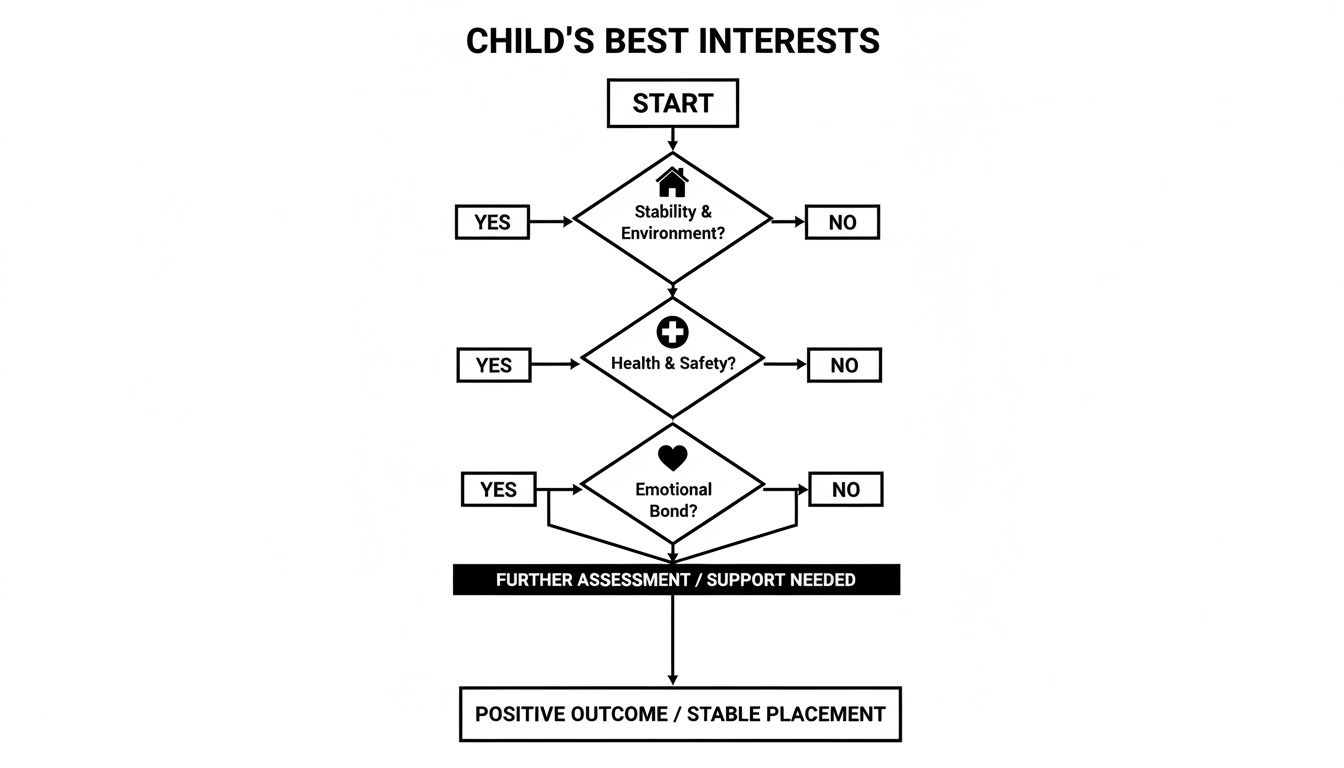
As you can see, a judge’s analysis flows from the most basic needs—ensuring a child’s stability and health—to fostering the crucial emotional bonds they have with each parent.
Providing a Stable and Safe Home
Your ability to provide a secure, nurturing environment is completely non-negotiable. This isn’t just about the physical space, but the emotional atmosphere as well. A judge will assess whether your home is a place where your child can truly thrive—emotionally, physically, and academically.
The court will look closely at:
- Physical Safety: Is your home clean, safe, and appropriate for your child’s age?
- Emotional Stability: Can you provide a calm, predictable environment free from chaos and conflict?
- Support System: Do you have a reliable network of family or friends who can step in to help when needed?
Cooperation and Co-Parenting
How you interact with the other parent speaks volumes to a judge. Showing that you can communicate respectfully and make joint decisions is a massive advantage. On the other hand, a history of high-conflict arguments, hostility, or attempts to undermine the other parent can severely damage your case for an equal arrangement.
Red Flags That Can Derail Your Case
Finally, certain issues can immediately torpedo a parent’s request for 50/50 custody, no matter how involved they’ve been. Any allegations or evidence of domestic violence, substance abuse, or severe mental health issues are taken extremely seriously. Even a single substantiated claim can make an equal custody arrangement impossible, as the court’s primary duty is to protect the child from any potential harm.
Debunking Myths That Hold Fathers Back
Walking into a custody case is daunting enough without carrying the weight of outdated myths. Too many fathers assume the system is rigged against them, preventing them from even trying to secure the equal parenting time their child deserves. These misconceptions create a cloud of fear that can stop you from fighting for what’s right.
It’s time to clear the air. Modern family courts are required to be gender-neutral, focusing entirely on the facts and evidence you present. Grasping this reality is the first step to building a powerful, confident case for 50/50 custody.
Myth 1: The Courts Always Favor Mothers
This is the most persistent and damaging myth out there. While it might have been true decades ago, today’s legal standard is explicitly gender-blind. A judge cannot legally favor a mother over a father simply because she is the mother. The entire case hinges on one thing: the “best interests of the child.”
The court evaluates each parent on their own merits. What truly matters is who provides stability, who fosters a loving environment, and who has been consistently involved in the child’s life. They’re looking at your history of caregiving and your ability to co-parent, not your gender.
Myth 2: You Need a Higher Income to Win 50/50 Custody
While financial stability is a factor, it is absolutely not a competition. You don’t need to out-earn the other parent to get equal time. The court’s main concern is whether you can provide a safe, stable home and meet your child’s basic needs.
The focus is on your ability to meet the child’s needs, not on comparing bank accounts. As long as you can provide a suitable home, food, and care, your income relative to the other parent is rarely a deciding factor in a custody arrangement.
Child support is handled separately for a reason—it’s designed to balance financial differences and ensure the child’s needs are covered in both households. This frees the judge to focus on what really matters: your parenting.
Myth 3: Mothers Get Sole Custody Unless They Are Unfit
This is another holdover from a bygone era that simply doesn’t reflect today’s legal landscape. Shared parenting is now widely seen as the best arrangement for most children. You absolutely do not have to prove the other parent is unfit to be awarded equal time.
Instead, your job is to prove that you are a fit, involved, and essential parent whose presence is vital to your child’s well-being. The goal is to highlight your positive contributions and show the court that maximizing both parents’ involvement is what’s best.
While pursuing 50/50 is the goal for many, some situations may call for a different approach. You can learn more from this practical guide on how fathers can get full custody when circumstances warrant it. Ultimately, leaving these myths behind empowers you to build your case on the solid ground of your dedication as a father.
A Father’s Playbook for Building a Strong Case

While the legal system has certainly become more balanced, a favorable outcome still hinges on the strength of the case you present. Simply wanting 50/50 custody isn’t going to cut it. You have to proactively show the court that you are an indispensable, stable, and cooperative parent.
Think of this less as a fight and more as a project: your goal is to meticulously document your essential role in your child’s life. Every action you take should build an undeniable record that proves you prioritize your child above all else. This isn’t about creating a performance; it’s about making your everyday, consistent parenting visible to a judge.
Document Everything Meticulously
A strong case is built on a foundation of solid evidence. Memories can be unreliable and verbal claims are easily disputed, but a detailed written record is a powerful tool in court. Get a journal—a simple notebook or even a digital doc works—and start logging everything related to your child. Today.
This journal will become your single most important asset. Be sure to track:
- Daily Routines: Note who handles meals, homework help, bedtime stories, and getting ready for school.
- School and Activities: Record every parent-teacher conference you attend, soccer game you coach, and school event you volunteer at.
- Medical Appointments: Keep a log of every doctor’s visit, dentist appointment, and any other healthcare responsibility you manage.
- Key Communications: Save important emails, texts, and messages from co-parenting apps that demonstrate your attempts to communicate respectfully and make decisions together.
This log transforms your abstract claims of involvement into a concrete, verifiable timeline of your commitment—precisely what a judge needs to see.
A well-maintained parenting journal is more than just notes; it’s a timeline of your dedication. It provides objective evidence that can counter false allegations and solidify your position as a primary, hands-on caregiver.
Show You Are the Reasonable Parent
In any custody battle, the parent who demonstrates a calm, cooperative attitude holds a significant advantage. Even when you’re faced with conflict, your ability to remain focused on the child speaks volumes. All your communication with the other parent should be respectful, to the point, and centered on your kids’ well-being.
Avoid emotional language, accusations, and long, drawn-out arguments in texts and emails. Focus on logistics and finding solutions. By consistently proving you can co-parent effectively despite personal differences, you position yourself as the more stable party, which can dramatically improve your chances of a father getting 50 50 custody.
Hire the Right Legal Advocate
While documenting your involvement is critical, navigating the family court system requires professional expertise. An experienced family law attorney does much more than file paperwork—they build a legal strategy, fight for your parental rights, and help you sidestep common mistakes.
Look for an attorney who specializes in family law and has a proven track record with fathers’ rights in your specific area. They will understand the tendencies of local judges and know what kind of evidence makes the biggest impact. Preparing for a court appearance is a critical step, and this guide on how to prepare for a custody hearing offers valuable insights. A skilled lawyer ensures your carefully collected evidence is presented effectively, giving you the best shot at securing the 50/50 arrangement your child deserves.
Frequently Asked Questions About 50/50 Custody
Navigating a custody case is rarely straightforward. The process is filled with high-stakes questions where the answers depend entirely on the specifics of your situation and, critically, your jurisdiction.
Below, we address the most common questions fathers have about achieving a 50/50 arrangement. Understanding these legal nuances is the first step toward building a winning strategy with your attorney.
Does My State’s Law Favor 50/50 Custody?
This is the foundational question, as the answer dictates the entire approach to your case. A growing number of states have adopted laws creating a legal presumption of 50/50 custody. In these states, the court’s starting point is that shared parenting is in the child’s best interest, placing fathers on more equal footing from day one.
Most states, however, remain neutral. They don’t begin with the assumption that equal time is automatically best. In these jurisdictions, the burden is on you to prove that a 50/50 schedule serves the child’s best interests more effectively than any other alternative. Consulting an elite family law attorney is the only reliable way to understand the legal standard where your case will be heard.
How Much Does My Child’s Opinion Matter?
A child’s preference is always a factor, but its weight in court depends almost entirely on their age and maturity. A judge will likely give significant consideration to the well-reasoned opinion of a thoughtful teenager.
Conversely, the preference of a seven-year-old, while noted, carries far less legal influence.
Judges are trained to see through coaching and detect whether a child’s stated preference is genuine or the result of parental influence. Your objective should be to foster an authentic, loving relationship—not to script your child on what to say. A real bond is infinitely more compelling than a rehearsed statement.
Can I Get 50/50 Custody with a High-Conflict Co-Parent?
It is more challenging, but absolutely not impossible. Courts are understandably hesitant to order 50/50 custody for parents locked in high-conflict patterns, as these arrangements require a level of cooperative communication that simply may not exist. The fear is that forcing a 50/50 schedule will expose the child to constant stress.
To succeed here, you must prove that you can rise above the conflict for your child’s sake. This requires demonstrating a consistent, documented pattern of reasonable behavior.
Here’s how you establish your ability to co-parent effectively, even when the other side won’t:
- Documented Communication: Use co-parenting apps to keep discussions focused on logistics. This creates a clear record of your calm, business-like approach.
- Child-First Solutions: Propose solutions that consistently prioritize the child’s needs, even when it’s not your preferred outcome. Show the court you put your child before the conflict.
- Emotional Regulation: Prove that you are the parent who de-escalates tension, not the one who fuels it.
By proving you are the more stable and reasonable party, you dramatically improve your chances of a father getting 50/50 custody, even in the face of a difficult co-parenting dynamic.
Securing the right legal representation is the single most important decision you will make in protecting your relationship with your child. The Haute Lawyer Network provides access to a curated selection of the nation’s top attorneys, each chosen for their demonstrated professional excellence. Elevate your case by connecting with a true leader in family law. Find your expert advocate on Haute Living’s Lawyernetwork.