When you invite someone onto your property—whether it’s a customer stepping into your boutique or a friend coming over for dinner—you instantly take on a legal responsibility for their safety. This is the heart of premises liability.
It’s not about freak accidents or unforeseeable events. It’s about a property owner’s duty to deal with known hazards, holding them accountable when their failure to do so leads to someone getting hurt.
Understanding Your Core Responsibilities as a Property Owner
The law boils it all down to one simple question: did the owner act reasonably to prevent a foreseeable injury? This standard applies across the board, from sprawling commercial complexes to private residences. The key players are always the property owner (or the person controlling the property, like a renter) and the injured visitor.
A premises liability case is fundamentally about negligence. The injury didn’t happen because the owner intended to cause harm, but because they failed to uphold their duty of care. These situations are far from rare; they represent a massive slice of all civil lawsuits filed.
In fact, premises liability cases make up an estimated 61% of civil liability claims in North America. Slip-and-fall incidents are, by far, the most common trigger.
This statistic alone shows how frequently preventable dangers on a property result in serious injuries and, ultimately, legal battles.
The scope of this legal field is vast, covering everything from a puddle on a supermarket floor to inadequate security in a parking garage. Before we dive deeper, let’s quickly summarize these core ideas.
Premises Liability at a Glance
This table breaks down the essential concepts of premises liability into simple terms for a quick overview.
| Key Concept | Simple Explanation |
|---|---|
| Duty of Care | A property owner’s legal obligation to keep their premises reasonably safe. |
| Unsafe Condition | A hazard that the owner knew about (or should have known about) that could cause injury. |
| Negligence | The failure to act with reasonable care, which results in harm to a visitor. |
| Foreseeability | The idea that a reasonable person could have predicted that the hazard might cause an injury. |
Ultimately, property ownership comes with non-negotiable responsibilities. To understand how these principles play out in the real world, it’s helpful to review key liability insurance statistics. If you own or control a property, the law says you have a duty to protect people from preventable harm. Next, we’ll explore exactly what that duty entails.
How Visitor Status Defines Your Legal Duty of Care
In the eyes of the law, not all visitors are treated equally. A property owner’s legal responsibility—their duty of care—is almost entirely defined by why a person is on the property. Think of it as a sliding scale of responsibility; the more an owner stands to benefit from a visitor’s presence, the greater their duty to protect that person from harm.
This is a fundamental concept in premises liability. The legal system sorts visitors into three distinct categories, and the level of protection owed to each is vastly different.
This visual breaks down the core relationship between a property owner, an injured visitor, and the law governing their interaction.
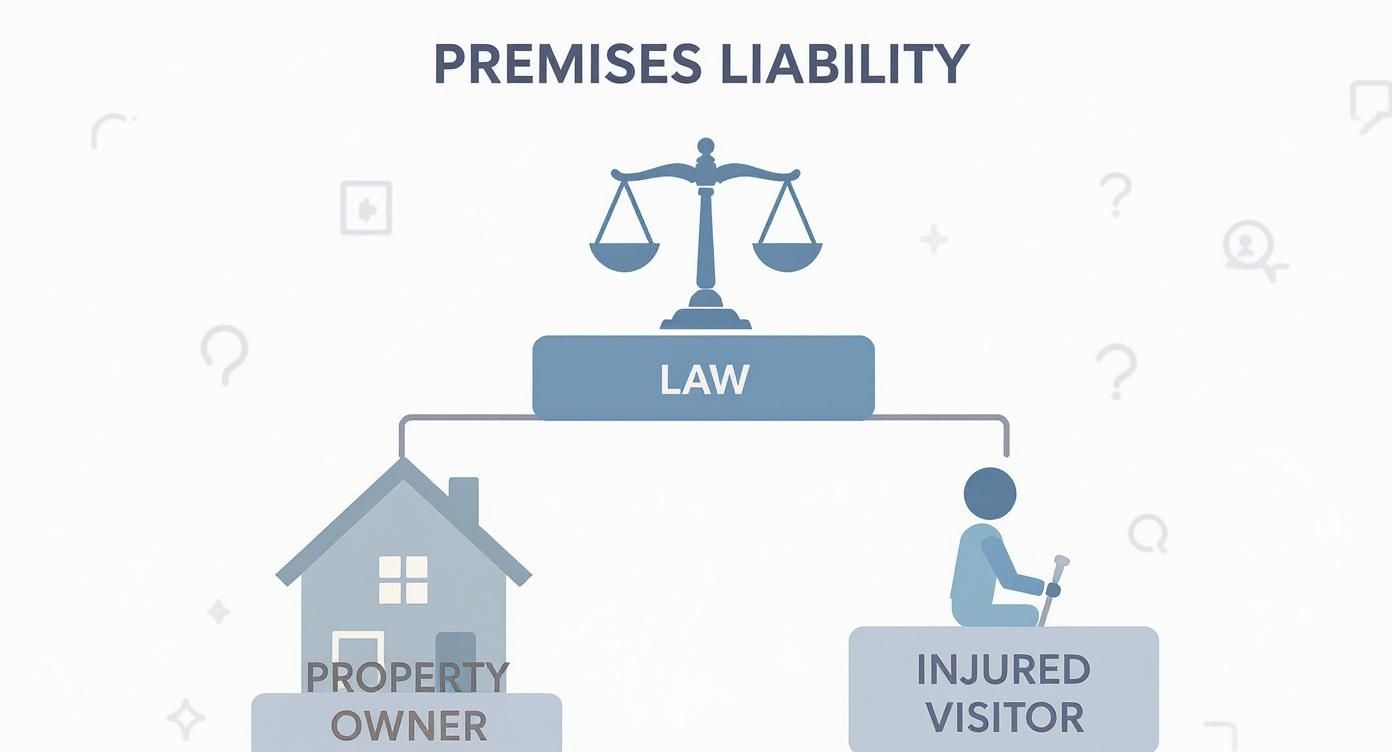
As the diagram shows, the law is the framework that connects an owner’s duties to a visitor’s rights.
To make this crystal clear, let’s break down the three visitor categories and the specific legal duty each one triggers for a property owner.
| Visitor Category | Example | Property Owner’s Duty of Care |
|---|---|---|
| Invitee | A customer in a retail store or a client visiting an office. | The highest duty. Must proactively inspect for and fix hidden dangers, and warn of any known hazards. |
| Licensee | A social guest at a dinner party or a neighbor stopping by. | A mid-level duty. Must warn of known, non-obvious dangers but has no duty to inspect for unknown ones. |
| Trespasser | Someone on the property without permission. | The lowest duty. Must not intentionally or recklessly cause harm. Special rules apply for children. |
Understanding these classifications is often the first—and most critical—step in analyzing a potential premises liability claim.
Invitees: The Highest Level of Care
An invitee is someone on the property for the mutual benefit of both parties, typically in a commercial setting. This is the visitor category owed the highest, most stringent duty of care.
Think of a customer browsing in a luxury boutique, a patient at a private medical clinic, or a client meeting with their wealth manager. Their presence is directly tied to a business purpose.
For an invitee, a property owner’s obligations are proactive and demanding:
- Actively inspect the property to find hidden or potential dangers.
- Repair or remedy any hazardous conditions discovered.
- Warn visitors of any dangers that can’t be fixed immediately.
An owner can’t just plead ignorance. The law expects them to have reasonable inspection procedures in place to find that loose floor tile or faulty handrail before someone gets hurt.
Licensees: A Duty to Warn
A licensee is a social guest. They are on the property with the owner’s permission but not for a business or commercial reason. This includes friends invited for dinner, family members over for the holidays, or a neighbor who drops by.
The duty of care here is a significant step down from that owed to an invitee. The property owner isn’t required to go looking for unknown problems.
However, they absolutely must:
- Warn the licensee of any dangerous conditions they already know about that aren’t obvious.
For instance, if you know the third step on your deck is rotten, you must tell your guests. You don’t, however, have to hire an inspector to check for potential rot you aren’t aware of.
The critical difference is between “should have known” (for invitees) and “actually knew” (for licensees). This distinction often becomes the central point of contention in a premises liability lawsuit.
Trespassers: The Lowest Duty of Care
A trespasser enters a property without any legal right or the owner’s permission. As a general rule, property owners owe an extremely minimal duty to adult trespassers.
The primary obligation is simply to refrain from intentionally or recklessly harming them. You cannot set a trap or willfully injure someone just for being on your land uninvited.
But this rule has a massive exception—one that every property owner, especially those with pools, ponds, or other notable features, must understand.
The Attractive Nuisance Doctrine
This special rule completely changes the game when a hazardous condition on a property might lure in children who are too young to understand the risk.
Classic examples of attractive nuisances include:
- Unfenced swimming pools
- Trampolines or elaborate playsets
- Abandoned appliances or old cars
- Construction sites with accessible equipment
If a property owner has something that could foreseeably attract a curious child, and they know (or should know) children are likely to be in the area, their duty of care is dramatically heightened. They must take reasonable steps to protect those children, which might mean installing a four-sided fence with a self-latching gate around a pool.
This doctrine holds owners responsible for foreseeable dangers to children, even if they are technically trespassing.
The Four Pillars of a Successful Negligence Claim
For an unfortunate incident on a property to become a valid legal claim, it’s not enough that an injury occurred. The injured party must prove that the property owner was negligent. Think of a negligence claim as a sturdy, four-legged stool—if even one leg is missing, the entire structure collapses and the claim fails.
Each “leg” represents a specific legal element that must be established with evidence. These four pillars are Duty, Breach, Causation, and Damages. To bring this framework to life, we’ll follow a single, continuous story of a shopper’s slip-and-fall accident in a grocery store.
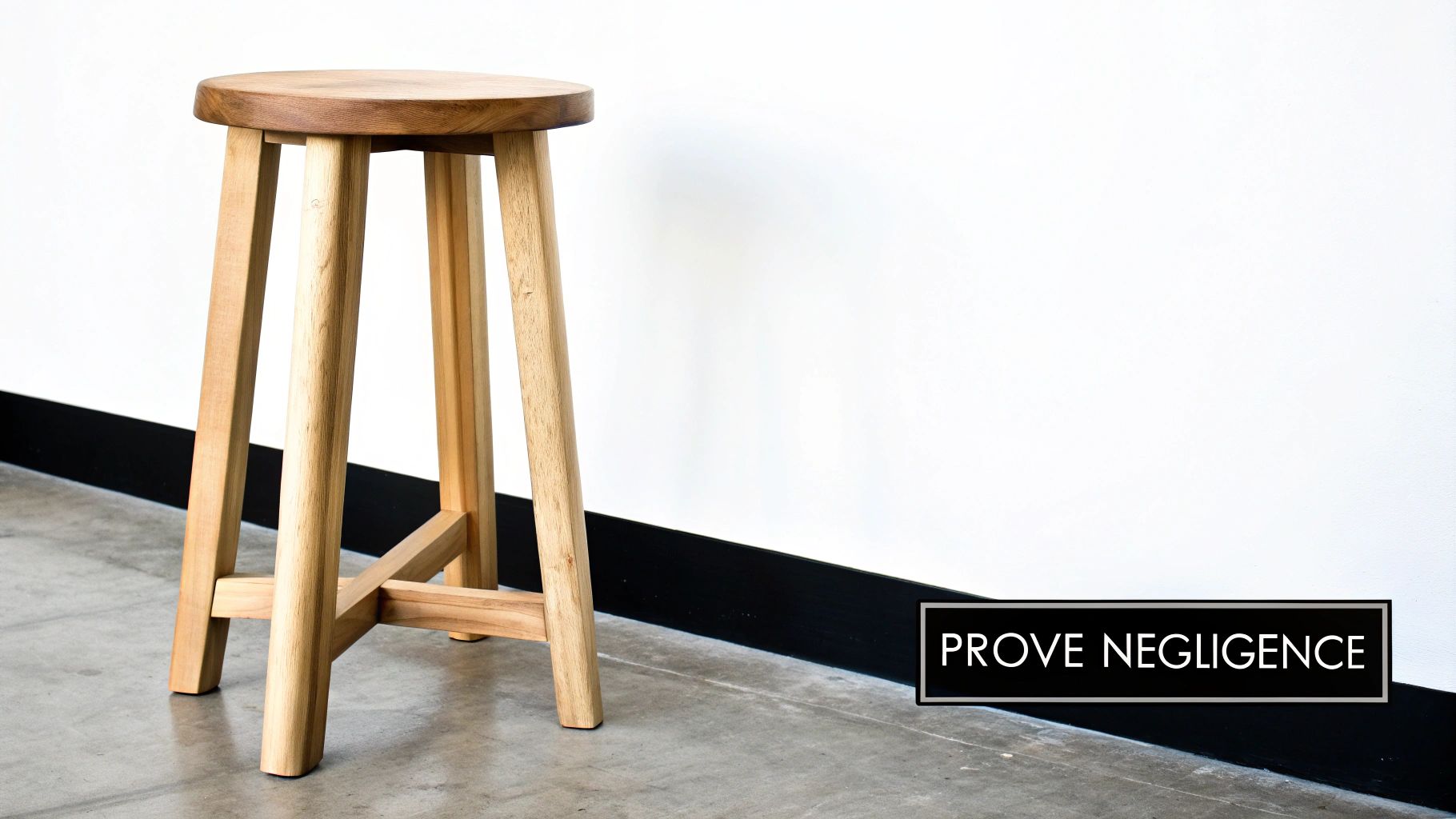
This step-by-step process reveals what transforms a simple accident into a legally actionable case under premises liability law. Let’s build the stool, one leg at a time.
Pillar 1: Duty of Care
The first pillar is Duty. This element establishes that the property owner had a legal obligation to act with a certain level of care to keep visitors safe. The specific duty owed depends on the visitor’s status—invitee, licensee, or trespasser—as we’ve already discussed.
In our grocery store example, a shopper is considered an invitee. Because they are on the premises for a commercial purpose that benefits the store, the owner owes them the highest duty of care.
This means the store has a responsibility to:
- Regularly and actively inspect the aisles for potential hazards.
- Promptly clean up spills or fix dangerous conditions.
- Place warning signs around any hazards that cannot be immediately resolved.
The law doesn’t expect the store to be perfect, but it does demand that they take reasonable steps to protect their customers. This legal obligation is the foundation upon which the entire claim is built. Without it, there’s no case.
Pillar 2: Breach of Duty
The second pillar is Breach. This is where the property owner fails to meet the standard of care required by their legal duty. It’s the moment where inaction or a careless action creates a dangerous situation.
Continuing our story, let’s say a jar of pasta sauce was dropped in an aisle, creating a large, slippery puddle. An employee saw the spill but got distracted by another task and forgot to clean it up or place a “wet floor” sign.
By failing to address the known hazard in a timely manner, the store breached its duty of care. A reasonable property owner in the same situation would have immediately cordoned off the area and cleaned the spill. The employee’s failure is legally the store’s failure.
This breach is the specific act of negligence. It’s the broken promise of safety that the law implies between a business and its customers. Proving this failure is a critical step in connecting the owner’s conduct to the visitor’s injury.
Pillar 3: Causation
The third pillar, Causation, connects the breach of duty directly to the injury. It’s not enough that the store was negligent and that a shopper was hurt—the shopper’s injury must be a direct result of that specific negligence.
In our scenario, our shopper, unaware of the hazard, turns the corner into the aisle, steps in the slick pasta sauce, and falls hard, fracturing their wrist. Here, causation is clear.
There are two aspects to legal causation:
- Actual Cause: Also known as “but-for” causation. But for the store’s failure to clean the spill, the shopper would not have fallen and broken their wrist.
- Proximate Cause: This element requires the injury to be a foreseeable result of the negligence. A slip-and-fall is a highly foreseeable outcome of leaving a large spill on a grocery store floor.
If the shopper had instead suffered a heart attack in the aisle for unrelated reasons, the store’s breach (the spill) would not be the cause of the injury, and the claim would fail at this stage.
Pillar 4: Damages
The final pillar is Damages. The injured party must prove they suffered actual, compensable harm as a result of the fall. An accident without any real loss doesn’t create a valid claim.
After the fall, our shopper is rushed to the hospital. Their fractured wrist requires surgery, a cast, and several months of physical therapy.
Their damages can be quantified and include:
- Medical Expenses: Bills for the ambulance, emergency room, surgeon, and physical therapy.
- Lost Wages: Income lost from being unable to work during recovery.
- Pain and Suffering: Compensation for the physical pain and emotional distress caused by the injury and its aftermath.
These four pillars—Duty, Breach, Causation, and Damages—must all be firmly in place to support a successful premises liability claim. If any one of them is missing, the legal argument falls apart.
Recognizing Common Premises Liability Accidents
Knowing the legal theory behind premises liability is one thing, but seeing it play out in the real world is another. It’s where the abstract concepts of duty, breach, and causation become concrete—often painfully so. Certain accidents are so frequent they’ve become classic examples, revealing how seemingly small oversights can spiral into major legal battles.
Let’s move from the textbook definitions to the situations that actually give rise to these claims. Each one tells a story of how a property owner’s failure to act can have severe consequences.
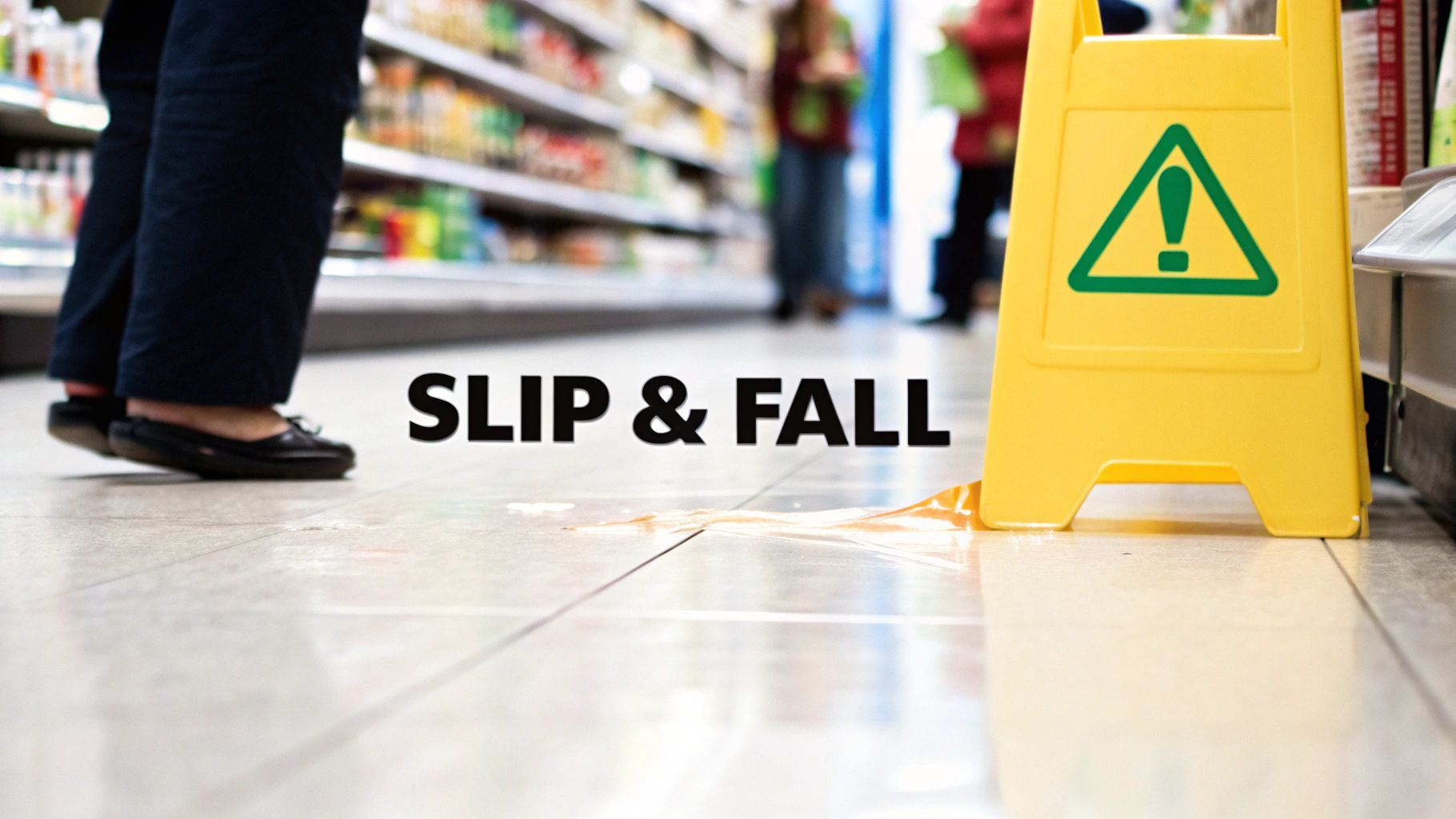
Whether it’s a slick floor or a broken security camera, these incidents tie directly back to the core elements of negligence. They demonstrate precisely how an owner’s inaction can cause direct and foreseeable harm.
Slip and Fall Accidents
The slip and fall is the quintessential premises liability case. It’s so common that the term has become almost synonymous with this entire area of law, and these incidents can happen anywhere from a five-star hotel lobby to a private residence.
The heart of a slip and fall claim is almost always a “transitory hazard”—a temporary, dangerous condition on the floor.
Common culprits include:
- Wet Floors: Spilled drinks, leaking freezers, or a freshly mopped floor without a warning sign are classic scenarios.
- Icy or Snowy Walkways: A property owner’s failure to shovel, salt, or de-ice sidewalks and parking lots is a huge source of liability in colder climates.
- Greasy or Oily Surfaces: Common in restaurant kitchens and auto shops, these spills create exceptionally dangerous conditions if not addressed immediately.
- Loose Rugs or Mats: An unsecured rug that bunches up is a disaster waiting to happen, easily catching a foot and causing a serious fall.
For invitees, the property owner’s duty is crystal clear. They need to have systems in place for routine inspections and quick cleanups. Dropping the ball on this is a textbook breach of duty, often leading to a strong claim if an injury results.
Trip and Fall Incidents
Slightly different, a trip and fall happens when a person’s foot hits a fixed object, causing them to stumble. These cases usually point to poor maintenance or a disorganized environment rather than a temporary spill.
Think of it as a problem with the property’s physical structure or layout.
Common trip hazards include:
- Uneven Pavement or Cracked Sidewalks: Deteriorating concrete that creates an unexpected lip or crack is a well-known danger.
- Cluttered Aisles or Walkways: Boxes, merchandise, or equipment left in a walking path present an obvious and preventable hazard.
- Exposed Wires or Cords: Cables snaking across a floor are a notorious tripping risk, particularly in offices and event spaces.
- Torn Carpeting or Damaged Flooring: A snag in a carpet or a broken tile is all it takes to cause a significant fall.
Like slip and falls, these claims often turn on whether the owner knew—or should have known—about the hazard. A large, persistent crack in a sidewalk isn’t something that appears overnight; it’s a condition a diligent owner would discover through regular maintenance.
The key legal question is often foreseeability. A reasonable owner can foresee that a cluttered hallway or a broken stair will eventually cause an injury, and they have a duty to fix it.
Negligent Security and Inadequate Maintenance
Premises liability isn’t just about falls. Owners also have a responsibility to protect visitors from foreseeable criminal acts and other dangers that arise from a poorly maintained property.
Negligent security claims emerge when a guest is robbed, assaulted, or otherwise harmed by a third party because the owner failed to provide reasonable security. This is a major issue for hotels, apartment complexes, and parking garages, especially in areas with known crime problems.
Common security failures include:
- Poor Lighting: Dark parking lots, stairwells, and hallways can practically invite criminal activity.
- Broken Locks or Gates: A malfunctioning security gate or a busted lock on an entrance is a clear breach of the duty to keep people safe.
- Lack of Security Personnel: In high-risk properties, the complete absence of guards or patrols can be considered negligent.
Beyond security, inadequate maintenance can lead to a host of other injuries. This broad category covers everything from an item falling from a high shelf in a retail store to a deck collapsing from rotten wood. The principle is always the same: the owner failed to keep their property in a reasonably safe condition, and that failure directly caused someone’s injury. These cases show that the question of “what is premises liability” covers a wide spectrum of preventable harm.
Navigating Common Defenses and Insurance Realities
Just because you’re injured on someone else’s property doesn’t mean the owner is automatically on the hook. Property owners and their insurance carriers have a playbook of robust legal strategies to defend against these claims, and understanding them is critical.
A successful claim hinges on proving negligence, but a savvy defense can dismantle that argument piece by piece. These strategies often pivot the focus away from the property’s condition and onto the injured person’s own actions and awareness at the time of the incident.
Let’s break down two of the most powerful defenses you’ll encounter and then look at the complex insurance landscape that quietly dictates how these cases play out.
The Open and Obvious Doctrine
One of the go-to defenses is the “open and obvious” doctrine. The argument is straightforward: a property owner isn’t liable for an injury caused by a hazard that a reasonably observant person should have seen and avoided.
Think of a large pothole in the middle of a driveway on a clear day. The defense will argue that anyone paying attention should have spotted it and walked around. The law doesn’t obligate property owners to guard people against dangers they should be able to protect themselves from.
This defense essentially puts the onus on the visitor’s common sense. It isn’t a silver bullet, however. An injured party might successfully counter that while the hazard was visible, their attention was deliberately drawn elsewhere by the owner—say, toward an elaborate storefront display.
Unpacking Comparative Negligence
Another formidable defense is comparative negligence. This strategy doesn’t aim to completely erase the property owner’s blame. Instead, it argues that the injured person was also careless and, therefore, partially responsible for their own harm.
Imagine it as a jury assigning a percentage of fault to everyone involved. They might decide a store was 70% at fault for not mopping up a spill but find that the injured shopper was 30% at fault for texting while walking down the aisle.
The financial consequence is direct. If the total damages were set at $100,000, the shopper’s award would be cut by their share of the blame, reducing their recovery to just $70,000.
Some states take this a step further with a “modified” comparative negligence rule. In these jurisdictions, if the injured person is found to be 50% or more at fault, they get nothing. This makes proving the plaintiff’s carelessness a primary objective for the defense and underscores why you must know how to find a personal injury lawyer who is an expert in these nuances.
The Realities of Liability Insurance
Behind nearly every premises liability fight is an insurance policy. Whether it’s a commercial general liability (CGL) or homeowner’s policy, this is the financial backstop that covers legal fees and payouts. But this market is under enormous strain from skyrocketing litigation costs and “nuclear verdicts” reaching into the millions.
This has a direct impact on property owners. Carriers are reacting by hiking premiums, especially for businesses in high-risk sectors. Excess and umbrella policies, which cover catastrophic claims, have seen premium increases ranging from 8% to over 20%.
For high-net-worth individuals and business owners, proactive risk management is no longer a best practice—it’s a financial imperative to get ahead of claims before they ever happen.
The Broader Financial Impact of Liability Claims
It’s tempting to see a single premises liability claim as a one-off problem, but that’s a dangerously narrow view. In reality, each incident is a ripple in a vast economic ocean, connecting law, insurance, and risk management in a way that affects every property owner and business. Grasping this bigger picture is the only way to understand the true financial stakes of keeping your property safe.
The numbers alone are staggering. In the United States, nearly 400,000 personal injury claims—a category that includes premises liability—are filed every single year. This constant churn of litigation supports a personal injury legal market now valued at a massive $61.3 billion in 2024. This environment is only getting riskier as natural disasters and severe weather events create new, unforeseen hazards on properties.
Connecting Micro Risks to Macro Trends
This high-stakes environment isn’t happening in a vacuum; it’s being supercharged by powerful outside forces. One of the biggest drivers is “social inflation”—a quiet but powerful trend of rising litigation costs and bigger and bigger jury awards. When a jury in one state hands down a multi-million dollar verdict, it sets a new psychological benchmark for settlement talks all across the country, ratcheting up the cost of claims for everyone.
At the same time, we’re seeing more frequent and severe weather events that put an unprecedented strain on physical properties. A roof that’s been weakened by a hurricane or a walkway that’s buckled after a flood can easily become the source of a new liability claim months or even years after the storm has passed.
This convergence of legal and environmental trends means that proactive risk management isn’t just about preventing a single fall. It’s about insulating your assets from a volatile and increasingly expensive legal landscape.
The True Cost of a Claim
When an incident does happen, the final settlement or verdict is rarely the end of the story. The direct costs are just the tip of the iceberg. Property owners are often hit with a cascade of other financial consequences that can be just as damaging, if not more so. To truly see the full picture, you have to look into the hidden costs of personal injury that many people overlook.
These wider financial hits often include:
- Increased Insurance Premiums: A single significant claim can cause a sharp, painful, and long-lasting spike in your liability insurance costs.
- Reputational Damage: For any business, especially one in the luxury or service space, news of an injury can tarnish its brand and scare away customers.
- Operational Disruptions: The time and energy spent investigating an incident, dealing with lawyers, and participating in legal proceedings is time you can’t get back.
Ultimately, understanding what premises liability really means requires seeing beyond the individual accident. It’s about recognizing your place in a complex financial ecosystem where smart, diligent property management isn’t just a best practice—it’s your most effective shield.
Common Questions in Premises Liability Cases
When an injury happens on someone else’s property, the aftermath is often filled with uncertainty. Both property owners and the injured party are left with urgent questions. Here, we’ll cut through the confusion and provide direct answers to the most common queries that arise in these complex situations.
How Long Do I Have to File a Lawsuit?
This is one of the most critical questions, and the answer lies in a legal deadline called the statute of limitations. Think of it as a countdown clock that starts the moment an injury occurs.
This timeframe varies quite a bit from state to state, but for most personal injury claims, it’s typically two to three years. This deadline is absolute. If you miss it, you almost certainly lose your right to seek compensation, no matter how clear-cut your case is. Certain exceptions can also shorten this window, particularly for claims against government entities, so it’s vital to act quickly. To see the specific rules where the injury happened, you can find a detailed breakdown of the statute of limitations by state.
What Should I Do Immediately After an Injury?
Your first and most important priority is your health. Seek medical attention right away, even for an injury that seems minor at first. Once your health is addressed, your focus should shift to documenting everything you can before the scene is cleaned up or changed.
Here are the key steps to take if you’re able:
- Take Photos and Videos: Use your phone to capture the specific hazard that caused your injury. Get pictures from multiple angles of the spilled liquid, the broken stair, or the patch of ice before it disappears.
- Report the Incident: Find the property owner, a manager, or an employee and notify them of what happened. Insist that they create an official written report of the incident, and make sure you get a copy for your records.
- Gather Witness Information: If anyone else saw what happened, get their names and contact information. An independent account of the event can be incredibly valuable down the road.
- Preserve Key Evidence: Don’t wash or throw away the shoes and clothing you were wearing. Keep them in a safe place, unaltered.
It’s also wise to avoid making definitive statements like “I’m fine” or admitting any fault until you have a clear picture of your injuries and have spoken with a legal professional.
Can I Have a Claim Even if I Was Trespassing?
This is where the law gets interesting. For an adult trespasser, winning a premises liability claim is extremely difficult, but not impossible. In most cases, a property owner’s only duty to an adult trespasser is to refrain from intentionally or recklessly harming them.
However, the rules change dramatically when children are involved. The law recognizes something called the “attractive nuisance” doctrine, which holds property owners to a much higher standard for hazards that might lure a child onto their property.
Classic examples include an unfenced swimming pool, an old trampoline, or abandoned construction equipment. If an owner has a feature like this and knows (or should know) that children are likely to be in the area, they have a legal duty to take reasonable steps to protect them from harm—even if those children are technically trespassing. This exception makes protecting children a unique and serious responsibility for every property owner.
When facing the complexities of a premises liability issue, having the right legal expert is crucial. Haute Lawyer Network connects you with a curated selection of the nation’s top attorneys, ensuring you receive premier guidance and representation. Elevate your legal strategy by exploring our network today at https://hauteliving.com/lawyernetwork.