When a loved one passes, the last thing on your mind is paperwork. But before the legal process of probate can even begin, a few critical tasks need your immediate attention. This isn’t just about ticking boxes; it’s about laying the groundwork for an orderly and respectful process that honors their final wishes.
Your First Steps After A Loved One Passes
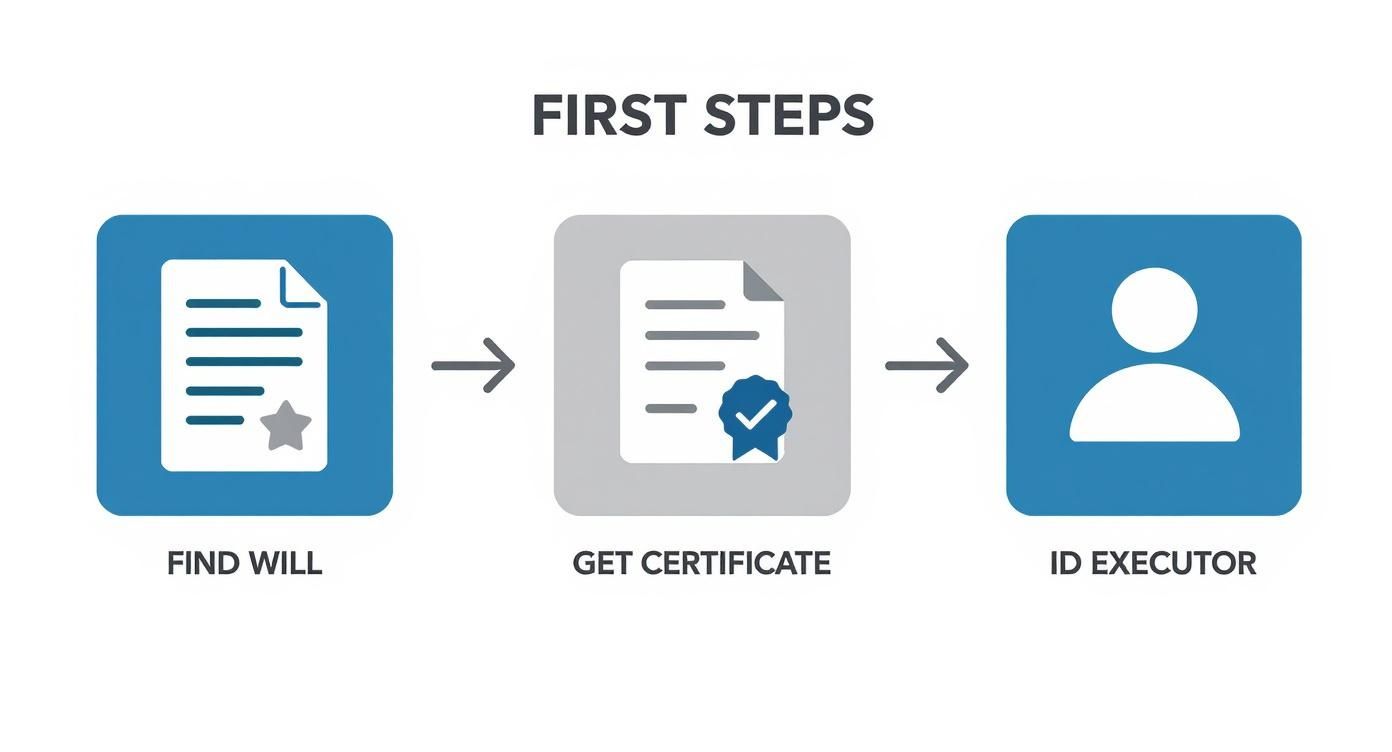
The most important document, the one that kicks everything off, is the original will. A copy simply won’t do for the court. You’ll need the authentic, signed document, so be sure to check places like a safe deposit box, home office files, or with the family’s estate planning attorney.
This document is your guide. It not only outlines how assets should be distributed but also names the person chosen to manage the process—the executor.
Gathering Your Core Documents
At the same time, you’ll need to secure multiple certified copies of the death certificate. You can get these from the county or state vital records office where the death occurred. These are essential for nearly every task ahead, from closing bank accounts and filing final taxes to accessing life insurance benefits.
My advice? Order at least 10 copies. It might seem like a lot, but you’d be surprised how many different institutions will require one.
This initial phase is all about getting your ducks in a row before you ever set foot in a courthouse.
To help you stay organized during this emotional time, here’s a quick-reference guide to those first few critical tasks.
Immediate Executor Checklist
| Task | Why It’s Critical | Insider Tip |
|---|---|---|
| Locate the Original Will | The court requires the original document to validate the deceased’s wishes and appoint the executor. | Check with the deceased’s attorney first. They often hold the original or a copy and can guide you. |
| Order Death Certificates | Nearly every financial institution, government agency, and insurance company will require a certified copy. | Order more than you think you need (10-15 copies is a safe bet). Reordering later can cause delays. |
| Identify the Executor | This person is named in the will and is responsible for managing the entire probate process from start to finish. | The named executor has no legal authority until the court formally appoints them. Don’t start paying bills yet. |
| Secure Personal Property | Prevent valuable items, vehicles, or important papers from being misplaced or taken. | Change the locks on the deceased’s home if necessary, especially if others have keys. |
Tackling these items first will make the subsequent steps of filing the probate petition and managing the estate significantly smoother.
Understanding the Will’s Directives
Once you have the will, take the time to read it thoroughly. It often contains crucial information beyond just who gets what, such as specific funeral instructions or the nomination of guardians for minor children. Understanding these directives helps you anticipate what needs to be done.
Remember, the person named as executor is not officially in charge until the court grants them authority via a document called “Letters Testamentary.” Before that, your role is purely preparatory.
This groundwork is absolutely essential, yet it’s surprising how many families find themselves unprepared. Recent studies from 2025 show that only 24% of adults have a will, and a staggering 55% have no estate planning documents at all. This statistic underscores just how vital your role is when a will does exist and why a structured, deliberate approach is non-negotiable.
If you encounter any red flags—like questions about the will’s validity or an estate with complex business assets or properties in multiple states—it’s wise to bring in a professional. You can learn more about how to find an estate planning attorney near you to ensure you’re protecting both yourself and the estate from the very start.
Filing the Will and Petitioning the Court
With the necessary documents gathered, it’s time to formally initiate the probate process. This is where you transition from an organizer to a petitioner, moving from preparatory tasks into official legal proceedings. The first step involves filing the deceased’s will with the local court and submitting a formal request—a petition—to open the estate.
This is the moment the court system officially enters the picture. It sounds intimidating, but it doesn’t have to be. The entire goal here is to have the will validated and for the court to formally recognize your authority as the executor.

Preparing the Probate Petition
The petition for probate is the key legal document that kicks off the entire court case. While the specific forms vary from state to state (and even county to county), they all demand the same core information.
You’ll need to pull together details like:
- The deceased’s full legal name, date of death, and their last known address.
- An original, certified copy of the death certificate.
- The original last will and testament—no photocopies.
- A comprehensive list of all known heirs and beneficiaries named in the will, complete with their current addresses.
- An initial, good-faith estimate of the estate’s total value, usually broken down into personal property and real estate.
Accuracy here is everything. A simple typo, like a misspelled name or an incorrect address, can cause frustrating delays. The court will kick it back with a notice for correction, pushing your entire timeline back.
Understanding Your Legal Authority
Once you file the petition and the court accepts it, you don’t get immediate control. The court will schedule a hearing to officially appoint you as the executor. It’s only after the judge signs the order that you’ll receive a crucial document called Letters Testamentary.
Think of this document as your golden ticket. It’s the official court order granting you the legal authority to act on the estate’s behalf.
With Letters Testamentary, you can open an estate bank account, contact financial institutions to access the deceased’s funds, manage property, and communicate with creditors. Without it, you are essentially powerless in the eyes of the law and financial institutions.
This single document proves to everyone—banks, real estate agents, government agencies—that you are the court-appointed representative for the estate.
Navigating Court Filings and Notifications
Filing the petition isn’t just a matter of dropping off a stack of papers. It sets in motion a specific sequence of events that you must follow to the letter, ensuring the process is legally sound and transparent for everyone involved.
This usually breaks down into a few key actions:
- Locate the Correct Court: Probate is handled at the county level. You absolutely must file in the county where the deceased person was legally domiciled (had their permanent residence) when they died.
- Pay Filing Fees: Courts charge a fee to open an estate. This can run from a couple hundred to over a thousand dollars, depending on the jurisdiction and the size of the estate. These fees are considered an estate expense and are paid from its assets.
- Notify Heirs and Beneficiaries: This is a non-negotiable legal requirement. You must formally notify everyone named in the will, along with any legal heirs who might have a claim (like a spouse or child not mentioned in the will). This is typically done via certified mail, and you’ll have to provide proof of this notification to the court.
For instance, if a decedent lived in Miami but passed away during a vacation in Aspen, the probate case must be filed in Miami-Dade County, Florida—not Colorado. This rule ensures the court with proper jurisdiction over the deceased’s primary assets is handling the case.
This notification step is a critical part of due process. It gives all interested parties a chance to review the will and raise any objections. If you fail to properly notify someone, it can bring the entire probate process to a screeching halt or even invalidate your actions later on.
Managing the Estate as an Executor
Once the court gives you the green light and issues your Letters Testamentary, your role officially shifts. You’re no longer just the petitioner; you’re the estate’s manager. This is where the real work begins.
You’re now a fiduciary, a legal term that means you must manage the estate’s assets with care and undivided loyalty, always prioritizing the best interests of the beneficiaries and creditors. This isn’t a role to take lightly—every financial move you make is under a legal microscope.

Establishing Financial Control
Your first task is to get a handle on the money. Open a dedicated checking account solely for the estate. This is absolutely non-negotiable. To do this, you’ll need to show the bank your Letters Testamentary and an Employer Identification Number (EIN) you get from the IRS.
Whatever you do, never mix estate funds with your personal money. That’s called commingling funds, and it can land you in serious legal trouble. Think removal as executor and being held personally liable for any financial mess. All estate income goes into this account, and every single expense gets paid from it. No exceptions.
Creating a Comprehensive Asset Inventory
Next, you need to track down and list everything the decedent owned. This process, known as marshaling the assets, requires you to become part financial detective, part meticulous bookkeeper.
You’ll be digging for a wide range of assets:
- Real Estate: Primary homes, vacation properties, rental units, or commercial buildings.
- Financial Accounts: Every checking, savings, and money market account, plus any CDs.
- Investments: Stocks, bonds, mutual funds, and entire brokerage portfolios.
- Personal Property: Cars, boats, jewelry, art, furniture, and other valuable collectibles.
- Business Interests: Any ownership stake in private companies or partnerships.
- Intangible Assets: Things like royalties, patents, or copyrights that generate income.
This inventory is the backbone of the entire probate process. It’s the document used to calculate potential estate taxes, pay off creditors, and, finally, make sure the right assets get to the right people. Most courts give you a firm deadline to file this inventory, typically 60 to 90 days from your official appointment.
Pro Tip: Specificity is your friend here. “Household goods” won’t cut it. An inventory that says, “One oil painting by a known artist, appraised value $15,000” is infinitely better than a vague “Wall art.” Be detailed, especially with items of significant monetary or sentimental value.
This table breaks down the core duties you’ll be juggling as the executor.
Core Executor Responsibilities
| Duty Category | Essential Tasks | Common Pitfall to Avoid |
|---|---|---|
| Asset Management | Locate, secure, and inventory all assets (real estate, bank accounts, investments). | Overlooking digital assets or failing to secure vacant property. |
| Financial Administration | Open a dedicated estate bank account; pay all valid debts, taxes, and expenses. | Commingling personal funds with estate funds—a serious fiduciary breach. |
| Creditor Notification | Formally notify all known creditors and publish a public notice for unknown ones. | Missing the statutory deadline for creditor notices, which can extend the probate timeline. |
| Court & Beneficiary Communication | File all required court documents on time and keep beneficiaries reasonably informed. | Poor communication, which often leads to suspicion and unnecessary family disputes. |
| Distribution | Distribute the remaining assets to beneficiaries according to the will or state law. | Distributing assets too early, before all debts and taxes have been fully settled. |
Getting these duties right is crucial for a smooth process and protects you from personal liability.
The Importance of Professional Appraisals
For many assets, your best guess at the value isn’t good enough. Both the court and the IRS demand fair market value as of the date of death, and that often means calling in a professional.
You’ll almost certainly need to hire an appraiser for:
- Real Estate: A licensed real estate appraiser is essential to value any property.
- Valuable Collections: Specialists are needed for fine art, coin or stamp collections, and rare antiques.
- Business Interests: A business valuation expert is required to determine the worth of a privately held company.
Using a professional does more than just satisfy the court. It provides a defensible, third-party valuation that can protect you from arguments among beneficiaries who might disagree on an item’s worth.
Notifying and Managing Creditors
One of your most critical responsibilities is settling the deceased’s debts. The process is very structured. First, you must send a direct written notice to every creditor you can identify—think mortgage lenders, credit card companies, and hospitals.
Second, state law almost always requires you to publish a notice in a local newspaper. This serves as a formal announcement to any unknown creditors, giving them a limited time—usually three to six months—to come forward and file a claim.
If a creditor misses that deadline, their claim is typically barred forever. This is a vital step that protects the estate from old debts suddenly reappearing long after you thought everything was settled. Delays are becoming more common in estate administration. For example, even though over 40% of UK adults have a will, the system is facing significant backlogs. A consumer research report about UK wills and probate trends shows how even well-laid plans can get bogged down.
Once claims start coming in, you have to review each one. You have the power to approve and pay valid debts and to formally reject any that seem questionable. Remember, all legitimate debts must be paid in full before a single dollar goes to the beneficiaries.
Paying Debts and Distributing Assets
Once you’ve marshaled the assets and have a firm grip on the estate’s finances, you move into the core responsibility of an executor. This phase is a delicate balancing act. You must satisfy every legitimate debt of the estate before a single dollar can be passed on to the beneficiaries. It’s where your fiduciary duty truly comes into focus.
Every single transaction must follow a strict legal sequence, and your best protection against any future challenges is impeccable record-keeping. Think of yourself as the financial gatekeeper—every creditor must be paid before any heir receives their inheritance.

Prioritizing and Paying Estate Debts
State law dictates a “priority of claims,” which is essentially a pecking order for who gets paid first. In the eyes of the probate court, not all debts are created equal. Straying from this order can have serious consequences, potentially making you personally liable if you pay a lower-priority creditor before a higher-priority one.
While specifics vary by state, the payment hierarchy generally follows this pattern:
- Administrative Expenses: These are the costs of running the probate itself. Think of your own executor fees, attorney’s fees, court filing costs, and appraiser charges.
- Funeral and Burial Costs: Reasonable expenses for the deceased’s final arrangements are next in line.
- Taxes: This is a big one. Federal and state taxes, including the decedent’s final income tax return and any estate taxes owed, are high on the list.
- Secured Debts: These are debts attached to specific property, like a mortgage on a house or a loan on a car.
- Unsecured Debts: At the bottom of the list are general debts like credit card balances, personal loans, and outstanding medical bills.
What happens if the estate is insolvent, meaning the debts are greater than the assets? You simply pay creditors down the list until the money is gone. In that unfortunate scenario, the beneficiaries would receive nothing.
Final Accounting and Court Approval
After every last debt, tax, and expense has been settled, your next major task is to prepare a final accounting. This is a comprehensive report for both the court and the beneficiaries that details every financial move you made during the probate process.
It’s the final balance sheet for the estate. It needs to clearly show:
- Every asset you collected and its value at the time of inventory.
- Any income the estate generated (like interest, dividends, or rental income).
- A complete list of payments made to creditors, tax agencies, and for administrative costs.
- The final balance of assets that are left to be distributed.
This accounting is your proof of performance. It demonstrates to the court and all interested parties that you managed the estate responsibly and are ready to distribute the remaining assets according to the will. Transparency here is key to preventing objections and closing the estate smoothly.
Once filed, the court reviews the accounting. Assuming everything is in order, the judge will issue an order approving it. This order is your green light—your legal authority to move on to the most anticipated step of the entire process.
Distributing Property to Beneficiaries
With the court’s blessing, you can finally make the distributions. This isn’t as simple as writing a few checks. Every transfer must be formally documented to create a clear paper trail proving you’ve done your job correctly.
The method of transfer depends on the type of asset:
- Real Estate: You’ll need to prepare and file a new deed, often called an “Executor’s Deed,” to officially transfer the title from the estate to the beneficiary.
- Financial Accounts: For cash gifts, you’ll issue checks directly from the estate’s bank account. For investment accounts, you’ll coordinate with the brokerage to transfer ownership of the stocks, bonds, or mutual funds.
- Personal Property: For tangible items—jewelry, art, cars, furniture—it’s crucial to have the beneficiary sign a dated receipt that clearly states what they received.
Always get a receipt. No exceptions. These receipts are your definitive proof that you followed the will’s instructions. You’ll file them with the court as part of your final petition to be discharged as executor, bringing your responsibilities to a clean and official close. This final action is what turns the will from a piece of paper into a tangible legacy.
Closing the Estate and Finalizing Your Duties
You’ve navigated the complexities of probate, and now the finish line is in sight. Closing the estate is the final, critical step that brings legal closure for everyone involved and, just as importantly, protects you from future liability. This is where all your diligent work culminates in officially wrapping up your responsibilities as executor.
The key to this last phase is a document called the Petition for Final Distribution. Think of it as your formal request to the court, asking for its stamp of approval on everything you’ve done and for permission to hand over the assets.
Preparing the Petition for Final Distribution
This petition is essentially your final report to the judge. It needs to be a meticulous, comprehensive summary that connects the dots on every action you’ve taken since your appointment. While the exact format can differ from state to state, the core requirement is a detailed and accurate final accounting.
Your petition must clearly lay out the entire financial story of the estate:
- A summary of the assets you gathered and managed.
- Any income the estate earned during probate (like interest or rent).
- A complete rundown of every paid expense—debts, taxes, and administrative costs.
- A clear plan naming who gets what, matching the will’s instructions.
This is no time for approximations. Every single number has to be precise, and the accounting must balance to the penny. Your goal is to show the court you’ve performed your fiduciary duties transparently and responsibly, leaving no doubt about your management of the estate.
The Final Court Hearing and Order
Once the petition is filed, the court sets a date for a final hearing. You are required to notify all interested parties, including every beneficiary, of this hearing. It’s their last official chance to review your work and raise any objections.
If no one contests your accounting and the judge is satisfied, they will sign the Order for Final Distribution. This document is your green light—and your official set of instructions—for the last leg of the journey. It gives you the authority to pay any remaining fees and distribute the assets exactly as outlined in your approved petition.
Consider this court order your shield. It legally validates all your actions and provides explicit authority to make the final distributions. Once it’s signed, it becomes incredibly difficult for anyone to challenge how you handled the estate.
Finalizing Your Role as Executor
With the signed order in hand, you can finally make the distributions to the beneficiaries. It’s crucial to get a signed receipt from each person as you give them their inheritance. These receipts are your proof that you followed the court’s order and the will’s directives to the letter.
After every asset has been distributed and all receipts are collected, there’s one last document to file with the court—a petition for discharge. When the court approves this, you are officially and legally released from your duties.
This discharge isn’t just a piece of paper. It’s the legal final whistle that confirms your job is done, providing a clean end to the probate process and protecting you from any future claims related to your administration of the estate.
When to Consider Alternatives to Probate
While formal probate is the standard route for settling an estate, it’s certainly not the only one. For many families, smarter alternatives exist that can save a tremendous amount of time, money, and heartache. Knowing when these shortcuts are available is the first step in mastering the probate process—or better yet, avoiding it altogether.
Not every estate needs the full, formal oversight of a probate court. Many states have wisely created streamlined procedures for smaller, less complicated estates. These options are designed to be faster and far less expensive, letting you bypass most of the red tape that comes with traditional probate.
Exploring Small Estate Procedures
One of the most common probate workarounds is the small estate affidavit. This is a sworn legal document an heir can use to claim property directly from the institution holding it, completely sidestepping the courts. The process is refreshingly simple: you present the notarized affidavit and a death certificate to a bank or brokerage, and they can release the assets directly to you. It’s that straightforward.
Of course, there’s a catch. Eligibility for a small estate affidavit depends entirely on the total value of the decedent’s probate assets. That threshold varies wildly by state—it might be as low as $25,000 in one jurisdiction or as high as $150,000 in another. Real estate is often excluded from this calculation or has its own simplified transfer process.
Another option is a simplified or summary probate. This is still a court-supervised process, but it’s a much lighter version of the real thing. It typically means less paperwork, fewer court hearings, and a much shorter timeline. Like the affidavit, its availability is tied to the estate’s total value and, in some cases, the heirs’ relationship to the person who passed away.
Key Takeaway: Always check your state’s specific laws on small estate value limits. A quick search on your local probate court’s website can tell you if the estate you’re handling qualifies for one of these faster, more cost-effective procedures.
The Power of Non-Probate Assets
The single most effective way to avoid probate is through savvy estate planning that keeps assets out of the court’s reach from the start. These are called non-probate assets, and they transfer automatically to a named beneficiary upon the owner’s death, no court required.
Here are the most common examples of assets that bypass probate:
- Life insurance policies with a designated beneficiary.
- Retirement accounts like 401(k)s and IRAs.
- Bank and brokerage accounts set up as “Payable-on-Death” (POD) or “Transfer-on-Death” (TOD).
- Property owned in joint tenancy with right of survivorship, which automatically passes to the surviving co-owner.
But the ultimate tool for avoiding probate is the living trust. When assets are transferred into a trust during a person’s lifetime, they are no longer part of their probate estate. Instead, a successor trustee you’ve chosen steps in to manage and distribute the assets according to the trust’s instructions—privately and efficiently. You can check out our guide on what is a living trust to see how this powerful instrument works.
This proactive approach is especially crucial for high-net-worth individuals. The data tells a clear story: individuals with household incomes over $1 million are twice as likely (66%) to have a will as those earning under $25,000 (33%). This isn’t just about having a will; it signals that wealthier families are far more likely to have sophisticated plans, like trusts, built specifically to minimize court involvement. Discover more insights about these estate planning demographic trends on trustandwill.com.
When to Seek Professional Legal Help
While some estates can be settled with minimal fuss, certain situations are immediate red flags. They signal the need for an experienced probate attorney. Trying to handle these scenarios alone can lead to disastrous financial mistakes, bitter family disputes, and significant personal liability.
Don’t hesitate to hire an attorney if you run into any of these issues:
- A Contested Will: If an heir challenges the will’s validity, the probate process instantly turns into a lawsuit. You need a lawyer, period.
- Complex Assets: Estates holding business interests, commercial real estate, or complex investment portfolios require expert financial and legal navigation.
- Insolvent Estates: When debts outstrip assets, you need legal counsel to properly prioritize and pay creditors according to strict state laws.
- Family Disputes: Even without a formal will contest, high tension among beneficiaries is a recipe for disaster. A lawyer can act as a crucial, impartial buffer.
Deciding whether to go it alone or bring in a professional is a critical judgment call. A simple estate with a clear will and cooperative beneficiaries might be manageable. But the moment complexity or conflict enters the picture, the cost of an attorney is a wise investment in protecting the estate—and yourself.
Common Questions About the Probate Process
Even with a clear roadmap, the probate journey can feel like navigating uncharted territory. Below, I’ll tackle some of the most frequent questions I hear from clients to help you get a clearer picture of what lies ahead.
How Long Does Probate Usually Take?
There’s no single answer to this, but it’s best to manage expectations from the outset. A very clean, uncontested estate might wrap up in six to nine months. That’s the best-case scenario.
Realistically, the timeline can easily stretch to a year or longer. The biggest drags on the process are always the same: complex assets, arguments between heirs, and a backed-up court docket. If the person who passed away owned a business or had property in another state, you should prepare for a more involved and lengthy process.
What Are the Average Costs of Probate?
Probate is far from free, and the expenses can be significant. A good rule of thumb is to expect total costs to land somewhere between 3% and 7% of the estate’s gross value. These expenses are paid directly from the estate’s funds before any money goes to the beneficiaries.
The primary costs you’ll encounter include:
- Court Filing Fees: Every courthouse charges fees just to open the case.
- Executor Compensation: Executors are entitled to compensation for their work, which is often a percentage set by state law.
- Appraisal and Valuation Fees: You’ll need professional appraisals for real estate, art collections, or business interests to establish their fair market value.
- Attorney Fees: This is often the largest line item. It can be an hourly rate, a flat fee, or a percentage of the estate, depending on the arrangement.
What Happens If Someone Contests the Will?
A will contest changes everything. What was an administrative process instantly becomes a full-blown lawsuit within the probate case. This happens when an interested party, usually a disinherited or unhappy family member, formally challenges the will’s validity in court.
The most common reasons for a will contest include claims of:
- Undue Influence: An allegation that the deceased was coerced or manipulated.
- Lack of Testamentary Capacity: The argument that the person wasn’t of sound mind when they signed the will.
- Improper Execution: The claim that the will wasn’t signed or witnessed correctly according to strict state laws.
- Fraud or Forgery: An assertion that the will itself is a fake.
When a will is contested, the probate process grinds to a halt. No assets can be distributed and no final debts paid until the court settles the dispute.
This litigation is always expensive, drags on for months or even years, and takes a significant emotional toll on everyone involved. To understand the specific legal arguments and what happens next, you can explore the complexities of when a will can be contested in our more detailed article. Successfully defending against or pursuing a will contest absolutely requires an experienced probate litigation attorney.
When legal complexities arise during probate, having access to an elite professional is invaluable. The Haute Lawyer Network is a curated directory of the nation’s top attorneys, selected for their proven expertise and professional excellence. Connect with a leader in your area by visiting https://hauteliving.com/lawyernetwork.