
Thought leadership marketing isn’t just another industry buzzword; it’s a fundamental shift in how you position your law firm. It’s the difference between being a vendor of legal services and becoming the go-to expert in your practice area.
This strategy is all about consistently sharing unique, insightful perspectives that solve your clients’ toughest challenges, building deep trust over time.
What Is Thought Leadership Marketing Anyway?

Let’s cut right to it. What is thought leadership marketing, and how is it different from just creating more content for your firm’s blog?
Think of it this way: traditional content marketing provides a map, showing clients how to get from point A to point B using established routes. Thought leadership, on the other hand, is like being the seasoned guide who forged those paths in the first place.
This guide doesn’t just hand over a map. They point out the safest trails, explain the why behind every turn, and anticipate challenges before they arise. It’s about being the recognized authority whose insights others actively seek out—less about directly selling a service and more about educating an audience so profoundly that your name becomes synonymous with expertise.
Moving Beyond Simple Content Creation
Many law firms produce blogs, videos, and social media posts, but that doesn’t automatically make them thought leaders. The real distinction is the substance.
Thought leadership content doesn’t just answer common questions; it shapes the conversation. It offers a fresh, forward-thinking perspective on legal trends, challenges conventional wisdom, or provides a novel solution to a persistent client problem.
This approach demands more than just summarizing recent case law or regurgitating information. It involves developing a distinct point of view based on your firm’s unique experience, data, and insights. It’s the difference between reporting the legal news and analyzing what it means for the future of an industry.
To better understand this distinction, it helps to see the two approaches side-by-side. While both have their place, their goals and methods are fundamentally different.
Thought Leadership vs Traditional Content Marketing
| Attribute | Traditional Content Marketing | Thought Leadership Marketing |
|---|---|---|
| Primary Goal | Generate leads, answer known questions, improve SEO rankings. | Build trust, establish authority, shape industry conversations. |
| Approach | Provides helpful, practical information based on existing knowledge. | Offers original insights, new perspectives, and forward-thinking ideas. |
| Content Focus | “How-to” guides, checklists, summaries of existing information. | In-depth analysis, data-driven reports, provocative opinion pieces, predictions. |
| Audience Impact | Educates the audience on what is already known. | Challenges the audience to think differently and see the future. |
| Brand Perception | Positions the brand as a helpful and reliable resource. | Positions the brand as an innovative and indispensable industry leader. |
| Outcome | Attracts an audience looking for answers. | Builds a loyal following that seeks out your specific perspective. |
While traditional content is crucial for attracting search traffic and answering immediate questions, thought leadership is what solidifies your firm’s reputation as a premier authority, leading to higher-quality clients and referral opportunities.
The Financial Impact of Industry Authority
Becoming a recognized authority isn’t just for prestige; it has a direct, measurable impact on your firm’s growth. As your influence builds, you naturally attract more qualified leads and opportunities. This has become a critical revenue-driving strategy, especially for firms serving business clients.
A pivotal industry report revealed that organizations with just 1% more followers on LinkedIn see an average revenue increase of 0.5%. This shows a clear link between authority and financial performance. You can learn more about the B2B thought leadership connection and its benefits to see the data for yourself.
Ultimately, thought leadership marketing is an investment in your firm’s intellectual capital. By generously sharing your best ideas, you build a loyal following that trusts your guidance, values your perspective, and turns to you first when they need help—making you an indispensable resource in your field.
Why Investing in Thought Leadership Matters
Let’s move past the definition. Thought leadership isn’t just a branding exercise—it’s a strategic investment with a clear, measurable payoff. In competitive fields like law, where the stakes are incredibly high, being seen as the authority directly shapes who gets the call and who doesn’t.
Think about it. When a potential client already trusts your expertise before they even pick up the phone, the entire dynamic shifts. You’re no longer just another option on a long list; you become the gold standard everyone else is measured against.
Driving Tangible Business Growth
The real power of a sharp thought leadership strategy is its ability to generate high-quality, inbound opportunities. It flips the script entirely. Instead of chasing clients, you start attracting them.
By consistently sharing forward-thinking insights, you build a reputation that pulls in the exact clients you want to work with—those who value true expertise far more than the lowest price tag. This authority also gives you the leverage to command premium rates. When clients see you as the leading expert, price becomes a secondary concern.
True thought leadership earns trust long before a prospect ever speaks to your sales team, creating a powerful advantage in any high-value service industry.
This pre-established trust is priceless. The data backs it up, too. A landmark Edelman-LinkedIn report found that 60% of decision-makers said thought leadership directly led them to award business to a specific company. It’s a non-negotiable for the 91% of B2B marketers who rely on content to connect with customers. You can explore more on how thought leadership statistics impact business decisions to see the full picture.
Your content isn’t just building an audience; it’s actively warming up future clients and closing deals for you.
Attracting Talent and Strategic Opportunities
The benefits don’t stop with new clients. A strong, visible brand is also a magnet for top-tier legal talent. The best attorneys and support staff want to work for firms recognized as innovators and leaders in their practice areas. Your public expertise becomes one of your most effective recruiting tools.
On top of that, being seen as an industry authority opens doors to powerful strategic partnerships. Other leading firms, media outlets, and major organizations will start seeking you out for collaborations, speaking engagements, and expert commentary.
These opportunities deliver incredible value, including:
- Enhanced Credibility: Aligning your brand with other respected names reinforces your own authority.
- Expanded Reach: Partnerships expose your firm to new, highly relevant audiences you couldn’t reach on your own.
- New Revenue Streams: Collaborations often lead to valuable joint ventures and referral networks.
Ultimately, investing in thought leadership creates a self-sustaining cycle of growth. It builds your reputation, which attracts better clients and top talent, which in turn leads to strategic partnerships that solidify your position as a true market leader.
The Three Pillars of an Effective Strategy

A powerful thought leadership marketing strategy doesn’t just happen. It’s carefully constructed on a foundation of three critical, interconnected pillars. Think of them as the legs of a stool—if one is weak or missing, the whole thing topples over.
These three elements—Expertise, Credibility, and Visibility—work in concert to turn your specialized legal knowledge into real market influence. Understanding how to build out each one is what separates a subject matter expert from a true industry leader whose opinions genuinely shape the conversation.
Pillar One: Expertise
The first pillar, Expertise, is the absolute core of your strategy. But this isn’t just about what you know. It’s about cultivating a unique, data-driven perspective that offers your audience something they can’t get elsewhere.
Simply rehashing common industry knowledge isn’t thought leadership; it’s just content creation. True expertise means developing insights that challenge the status quo or see around corners, anticipating trends before they become obvious. It’s about connecting ideas in new ways, giving your audience a fresh angle that makes your content indispensable.
Pillar Two: Credibility
Next up is Credibility, which is really the currency of trust. Having a brilliant idea means nothing if your audience doesn’t believe you. You build this trust one piece at a time through consistently valuable content, compelling case studies, and transparent communication.
An expert has knowledge, but a credible thought leader has earned the audience’s trust. This isn’t achieved by claiming authority, but by consistently delivering proven, reliable insights over time.
This pillar gets stronger with third-party validation—things like media mentions, speaking slots at respected conferences, and glowing client testimonials. Every piece of social proof adds another layer of believability until your expertise becomes unquestionable. When you have credibility, people don’t just listen; they act on your advice.
Pillar Three: Visibility
Finally, we have Visibility. Your world-class expertise and airtight credibility are wasted if your ideal clients never see them. A strategic distribution plan is non-negotiable; you have to get your insights in front of the right people at the right time. This is where sharp marketing comes into play.
An effective visibility plan uses multiple channels to amplify your message. Attorneys can dive deeper into building a comprehensive plan by exploring specialized guides on content marketing for legal firms.
This means using a smart mix of owned, earned, and paid media:
- Owned Media: Publishing insightful articles on your firm’s blog or your personal LinkedIn profile.
- Earned Media: Securing guest appearances on industry podcasts or getting quoted in trade publications.
- Paid Media: Using highly targeted ads to push your best content directly to a niche audience.
Without a deliberate plan to make your ideas visible, even the most profound insights will never be heard. Together, these three pillars create a powerful, self-reinforcing loop that builds momentum and solidifies your position as an indispensable authority.
How Thought Leadership Shapes the Buyer Journey
Many attorneys mistakenly see thought leadership as just another top-of-funnel marketing tactic—something to simply grab attention. But that view is far too narrow. It’s not just about awareness; it’s a full-funnel strategy that acts as a trusted guide, shaping a potential client’s decisions from their first inkling of a problem all the way to becoming a long-term advocate for your firm.
This process starts well before a prospect even realizes they need to hire a lawyer. By consistently publishing insightful content, you’re not just answering questions—you’re framing the challenges they face, introducing them to new perspectives, and positioning your firm as an essential resource right from the start.
Building Confidence During Awareness and Consideration
During the Awareness stage, a client is just starting to diagnose their problem. Your thought leadership here isn’t a sales pitch. It’s about helping them put a name to their pain. You might publish an article on emerging regulatory risks in their industry or a short video explaining the real-world implications of a recent court ruling. This content makes you the first helpful, authoritative voice they hear.
As they shift into the Consideration phase, they’re no longer just identifying the problem; they’re actively researching solutions. This is where your deep expertise becomes a powerful differentiator. In-depth white papers, webinars, and detailed case studies don’t just say you’re an expert—they prove it. This is a critical step, with one report finding that 38% of buyers say it helps them directly evaluate a provider’s expertise. You can learn more about the value of thought leadership in buying decisions to see the full impact.
Empowering Champions at the Decision Point
When a client reaches the Decision stage, they often aren’t making the choice alone. They need to convince internal stakeholders—a board, a CEO, or other partners. Your thought leadership content becomes a powerful tool for these internal champions. A well-researched report or a compelling statistic from one of your articles gives them the hard evidence they need to make the case for hiring your firm.
A stunning 81% of decision-makers with final sign-off authority say thought leadership helps their buying group align on key issues, building the confidence needed to move forward with a provider.
Your content essentially does the selling for them, solidifying your firm as the only logical and credible choice. Of course, this expertise needs to be visible where these decision-makers are looking, which is often professional networks like LinkedIn. You can explore our guide on effective attorney social media marketing tips for lawyers to maximize your presence.
Finally, the value of thought leadership doesn’t end when a contract is signed. Sharing ongoing insights reinforces their decision, proves your firm stays ahead of industry shifts, and nurtures the relationship for the long haul. This post-purchase validation is exactly how you turn a one-time client into a lifelong advocate and a reliable source of future referrals.
Real-World Examples of Thought Leadership
Theory is a good starting point, but seeing thought leadership in the wild is what makes the concept click. The best strategies aren’t just about churning out content; they’re about building an entire ecosystem around a unique, compelling point of view. Let’s break down how a few masters of the craft get it done.
Truly effective thought leadership meets potential clients exactly where they are, guiding them from initial curiosity all the way to a final decision. It’s a journey.
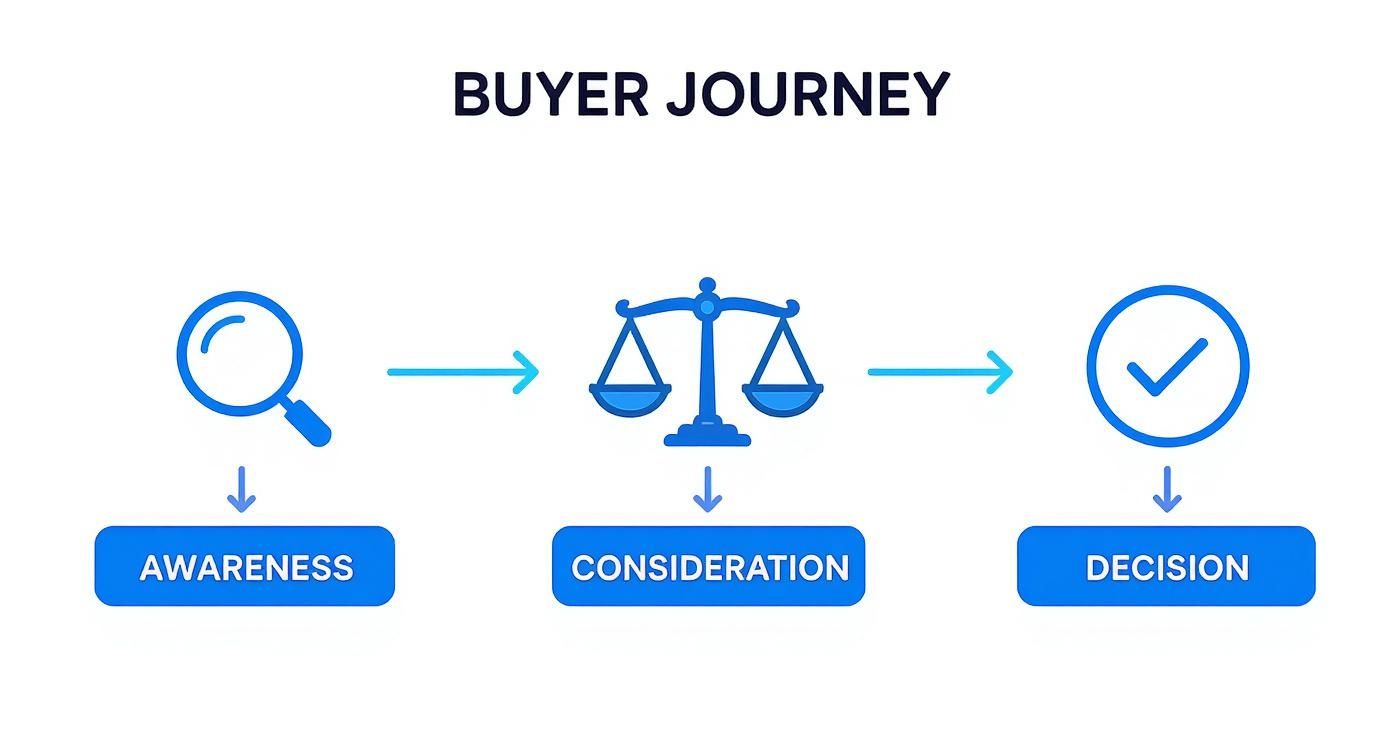
As you can see, the goal is to have the right piece of insight ready for each critical phase, building trust and demonstrating expertise every step of the way. Now, let’s see how a couple of big names put these ideas into practice.
HubSpot: The B2B SaaS Innovator
HubSpot is the textbook case of turning a philosophy into a marketing machine. Their entire brand is built on a single big idea: “inbound marketing.” Instead of interrupting potential customers with ads, they argue, businesses should attract them with genuinely valuable content. They didn’t just invent a buzzword; they started a movement.
- Content Formats: HubSpot’s toolkit is incredibly diverse. They have their famous blog, free in-depth courses via HubSpot Academy, and proprietary research like the annual “State of Marketing” report that gets cited everywhere.
- Distribution Tactics: They use their massive email list, a powerful social media engine, and complete dominance in search rankings to make sure their insights reach a global audience. Every single article, video, and report reinforces their core inbound philosophy.
McKinsey & Company: The Consulting Powerhouse
For a global consulting firm like McKinsey & Company, thought leadership isn’t just marketing—it’s the product. Their point of view is that complex business and societal problems can be solved with rigorous, data-driven analysis. For C-suite executives, they are the definitive source for forward-thinking strategy.
Their authority is built on a foundation of deep, proprietary research. By tackling big-picture issues like AI’s economic impact or the future of work, they set the agenda for entire industries.
Their signature format is the deep-dive report, often published in the prestigious McKinsey Quarterly. But they don’t stop there. Those reports are sliced and diced into articles, infographics, and podcasts, then pushed out through executive networks and partnerships with top-tier media like Harvard Business Review. This multi-channel blitz ensures their ideas permeate every level of the business world, cementing their status as an indispensable guide for global leaders.
Building Your Own Thought Leadership Plan

Knowing the theory is one thing; putting it into practice is another. The critical moment comes when you move from understanding concepts to taking decisive action. Building a powerful thought leadership plan isn’t about throwing money at the problem—it’s about having a sharp, focused strategy.
A clear roadmap guides your efforts, making sure every article, video, or post you publish moves you closer to your goal of becoming an indispensable authority. It’s about translating your deep legal expertise into a structured, repeatable plan you can execute without fail.
Define Your Niche and Audience
You can’t be the expert on everything. The fastest way to build real authority is to narrow your focus—dramatically. Instead of being a general business litigator, for instance, you could become the go-to voice on intellectual property disputes for biotech startups.
Once you’ve staked your claim, get laser-focused on your audience. Forget simple demographics. What are their biggest challenges? Their most pressing, unanswered questions? What keeps them up at night? Your content must solve these specific problems to have any real value.
The goal is to find that perfect intersection where your deepest expertise meets your ideal client’s most urgent needs. This is where true thought leadership is born.
Choose Your Content Formats and Schedule
With your niche and audience defined, it’s time to decide how you’ll deliver your insights. The formats you choose must align with where your audience actually spends their time and how they prefer to learn.
A smart strategy uses a mix of formats to maximize reach:
- In-Depth Blog Posts: Perfect for exploring complex legal topics and capturing valuable search engine traffic.
- LinkedIn Articles: Ideal for sharing timely commentary on industry news and engaging with your professional network.
- Short-Form Video: Excellent for breaking down complicated ideas into quick, digestible clips for social media.
- Webinars or Podcasts: A powerful way to host deep-dive discussions and collaborate with other industry experts.
After choosing your formats, map out a realistic publishing schedule. Consistency is far more important than frequency. It’s better to publish one high-quality, insightful article a month than four generic posts a week. Many guides on essential attorney marketing strategies emphasize this point as a foundation for long-term success.
Finally, commit to the plan and get started. Remember, thought leadership is a marathon, not a sprint. Every piece of content you create is another block in the foundation of your reputation as a trusted, sought-after authority in your field.
Getting Past the Common Sticking Points
Even with a solid plan, a few common questions always seem to pop up when attorneys start building out a thought leadership strategy. Let’s tackle them head-on, because sorting these out early is key to focusing on what actually moves the needle for your practice.
How Do You Actually Measure the ROI?
Measuring the return on thought leadership isn’t about counting likes or shares. Those are vanity metrics. Instead, you need to track the numbers that tie directly back to your firm’s bottom line.
Think about it this way:
- Lead Quality: Are the prospects calling you already convinced of your expertise? That’s a huge win. You’re no longer selling your value from scratch; they already get it.
- Sales Cycle Length: When a potential client has been reading your articles for six months, the trust is already built. This dramatically shortens the time from initial contact to a signed engagement letter.
- Website Referral Traffic: Are other high-authority legal blogs or industry publications linking back to your content? That’s not just traffic; it’s a powerful endorsement that tells Google you’re the real deal.
How Much Content Do We Really Need to Create?
Forget about a magic number. Consistency and quality will always beat sheer volume.
Seriously, publishing one deeply researched, insightful article a month is infinitely more powerful than churning out four generic blog posts that say nothing new. The goal is to establish a realistic rhythm you can stick with for the long haul. That consistency is what builds an audience and signals to search engines that you’re a reliable source of fresh expertise.
Can a Small Firm Realistically Compete with the Big Players?
Absolutely. In fact, smaller firms often have the upper hand: niche expertise and the ability to move quickly.
A massive, full-service firm has to create content that appeals to everyone, covering dozens of broad legal topics. But a boutique firm can go deep and completely own a very specific niche, like “intellectual property law for SaaS companies” or “family law for high-net-worth physicians.”
By becoming the go-to authority in a narrow field, you attract the exact high-value clients who need your specialized knowledge. It’s a focused approach that lets you build a rock-solid reputation that larger, more generalized competitors can’t touch. In thought leadership, depth always beats breadth.