
Before you even think about searching for a lawyer, the first and most critical step is to get crystal clear on exactly what you need. Diving into Google without a precise goal is like sailing without a map—you’ll get lost in a sea of options. Identifying your specific legal issue is what determines the type of lawyer who can actually win for you.
Why Defining Your Legal Needs Matters Most
It’s completely normal to feel overwhelmed. With over 1.3 million active lawyers in the United States, the choices can feel paralyzing. This is precisely why you have to narrow the field before you even start looking. A vague search just leads to dead ends and wasted hours.
Pinpoint the Practice Area
You wouldn’t ask a cardiologist to look at a broken foot, and the same specialized logic absolutely applies to law. Legal practice is incredibly segmented. Are you facing a divorce, dealing with a car accident, or trying to launch a business? Each one of those scenarios requires an attorney with a completely different playbook.
A few common legal battlegrounds include:
- Family Law for high-stakes issues like divorce, child custody, or adoption.
- Personal Injury Law when you’ve been hurt because of someone else’s mistake.
- Business Litigation for disputes over contracts, partnerships, or corporate disagreements.
- Estate Planning to create ironclad wills, trusts, and healthcare directives.
Getting the category right is your first filter. For instance, if you’re navigating a separation, your focus should be laser-sharp on attorneys with a proven track record in high-net-worth family law.
A general practitioner might know a little about many things, but a specialist knows everything about one thing. In legal fights, that deep, focused knowledge is your most powerful weapon.
The Specialist vs. The Generalist
Choosing a specialist over a generalist almost always saves you time, money, and stress down the road. An attorney who handles personal injury claims every single day understands the subtle tactics of insurance negotiations and courtroom strategy far better than someone who only dabbles in it.
This focused expertise leads to more efficient work and, frankly, a better shot at winning. The sheer number of legal professionals means you can—and must—be selective. To put it in perspective, states like New York and California account for about 27% of all U.S. lawyers, underscoring just how competitive the landscape is. This data isn’t just a statistic; it proves that finding a true specialist in your area isn’t just possible, it’s essential for a successful outcome.
Finding Qualified Lawyers in Your Community
Once you’ve pinpointed the type of specialist you need, it’s time to build a list of potential candidates. This isn’t just about Googling “lawyer near me”; it’s a strategic search to find someone who is not just available, but highly qualified. My experience shows that a multi-pronged approach, combining trusted directories with personal networks, is almost always the most effective strategy.
Think of state and local bar associations as your foundational first step. Their directories confirm one crucial thing: the lawyer is licensed and in good standing. This is the absolute baseline for anyone you consider hiring. While you won’t find performance reviews here, it’s an essential layer of initial vetting that you can’t skip.
This decision tree gives you a great visual for how to refine your needs before you even start searching.
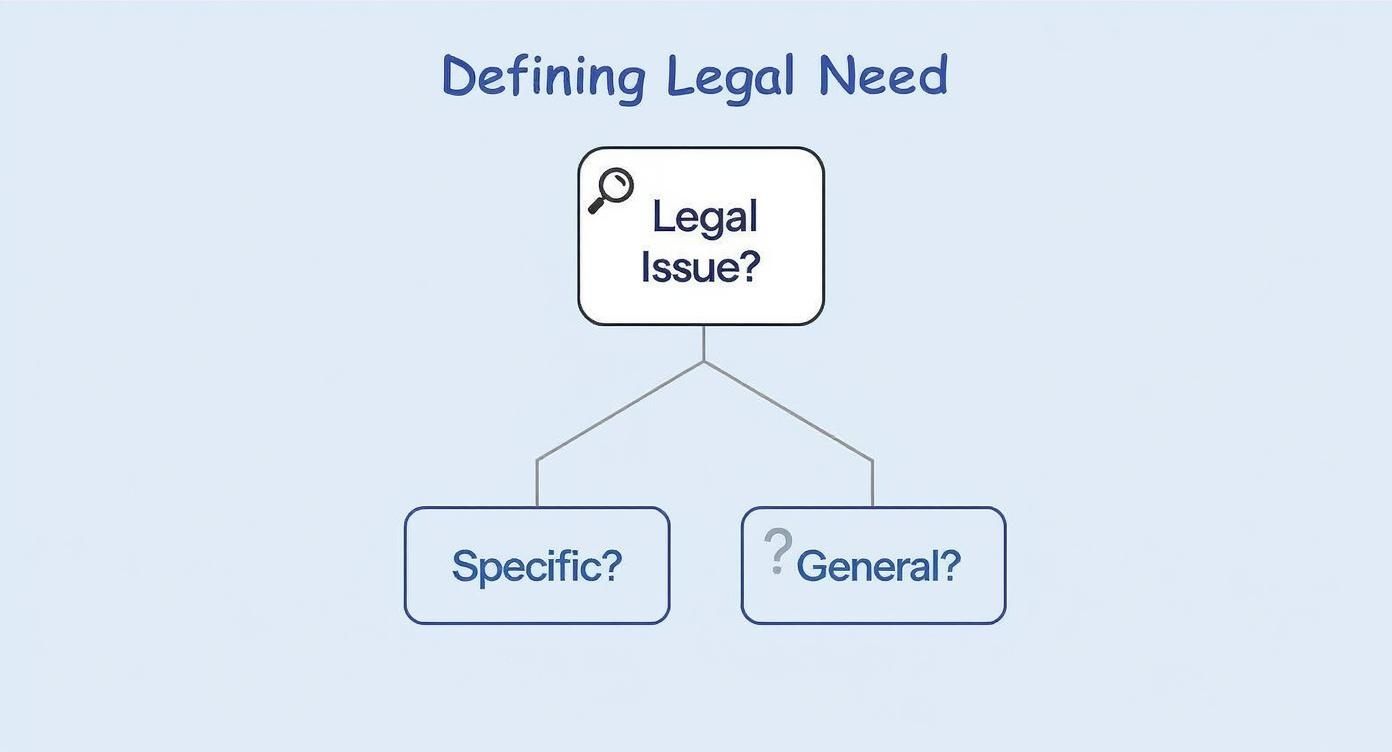
As you can see, moving from a general problem to a specific legal category is what makes for a focused, efficient search.
Tapping into Digital and Personal Networks
Beyond the bar associations, reputable online directories give you a much deeper look into a lawyer’s background, client reviews, and peer ratings. These platforms are incredibly useful for comparing different attorneys in your area side-by-side.
Some of the most established legal directories include:
- Avvo: Provides ratings and, importantly, client reviews that give you a sense of public perception and past client experiences.
- Martindale-Hubbell: This one is unique for its peer-reviewed ratings, which tell you what other lawyers think of an attorney’s skills and ethics.
- FindLaw: A comprehensive resource that includes lawyer profiles alongside helpful legal guides and articles.
These tools are powerful, but don’t ever discount the value of a solid personal referral. Asking friends, family, or trusted business colleagues for recommendations can lead you straight to a lawyer who is already proven and respected within your community.
A strong personal referral can be invaluable. However, always ensure the recommendation is relevant to your specific legal issue—a great real estate lawyer may not be the right choice for a personal injury case.
When searching for legal counsel, you’ll encounter a variety of resources, each with its own set of advantages and limitations. The table below breaks down the most common methods to help you decide where to focus your efforts.
Comparison of Lawyer Search Resources
| Search Method | Pros | Cons |
|---|---|---|
| Personal Referrals | Highly trusted; based on real experiences. | May not have expertise in your specific legal area. |
| State Bar Associations | Verifies license and good standing. | No performance reviews or client feedback. |
| Online Legal Directories | Access to reviews, ratings, and detailed profiles. | Can be overwhelming; requires careful vetting. |
| Curated Legal Networks | Pre-vetted, high-quality attorneys. | More exclusive and may have fewer options. |
Ultimately, using a blend of these resources will give you the most comprehensive view and the highest chance of success.
By using a combination of these approaches, you get the best of all worlds. You can start exploring curated platforms like the Haute Lawyer Network to find a lawyer, where professionals have already been vetted for excellence in their field. It effectively combines the verification of a bar association with the detailed insights of a premium directory.
How to Properly Vet Your Potential Lawyer
Once you have a shortlist, the real work begins. This isn’t just about finding a lawyer down the street; it’s about doing the due diligence to confirm they are skilled, reputable, and the right fit for your unique situation. Think of a lawyer’s digital footprint as the first window into their practice.
Start with their website. Does it look professional? Is the information clear and genuinely helpful? A quality firm will have a detailed “About Us” page, showcase specific case results, and offer well-written articles on your area of law. A neglected or vague website is a major red flag—if they don’t pay attention to their own details, will they pay attention to yours?
Digging Deeper Than Surface Reviews
Next, it’s time to look at what actual clients are saying. While the glowing testimonials on a lawyer’s own site are a nice touch, you need to check independent platforms like Avvo, Google, and Yelp for the unvarnished truth. Don’t just scan the star ratings; the real insights are in the comments.
Look for patterns in the feedback people leave:
- Communication: Are clients consistently praising their responsiveness, or do you see repeated complaints about being left in the dark?
- Professionalism: Does the feedback focus on their expertise and respectful conduct, or are there hints of disorganization?
- Outcomes: Confidentiality will limit the details, but do reviewers generally seem satisfied with how their case was resolved?
Genuine reviews often have a certain texture to them, detailing a specific experience, both good and bad. This is what you’re looking for—not generic, overly-enthusiastic marketing fluff. Understanding what makes a good lawyer from a client’s perspective will sharpen your ability to read between the lines.
A single bad review isn’t a dealbreaker—sometimes personalities just don’t mesh. But a clear pattern of complaints about communication, billing practices, or basic professionalism absolutely is. Also, see how the firm responds to negative feedback. A thoughtful response is a good sign; radio silence is not.
The Most Important Final Check
This last step is arguably the most critical, yet it’s the one most people skip: checking a lawyer’s disciplinary record. Every state has a bar association that licenses and regulates attorneys, and their websites almost always have a public, searchable database.
Here, you can confirm a lawyer is in good standing and see if any disciplinary actions have been taken against them. This is a non-negotiable step to ensure you’re about to hire an ethical professional you can trust.
The legal services market is massive; in the United States alone, it’s a nearly $400 billion industry. With that many professionals out there, taking the time to properly vet your candidates is the single best way to protect your interests. This final check gives you the peace of mind to move forward to the consultation stage with confidence.
Making the Most of the Initial Consultation
Think of the initial consultation as your interview—not the other way around. This meeting isn’t just for the lawyer to size up your case; it’s your one chance to decide if they have the right expertise, strategic mindset, and temperament to fight for you. Blowing this opportunity can lock you into a bad partnership. You need to walk in prepared to lead the conversation.
Your real goal is to get past the surface-level sales pitch. Don’t just ask if they’ve handled cases like yours. Ask them to describe the outcome of a similar case and what specific challenges they ran into. This gives you a genuine glimpse into their problem-solving ability and hands-on experience.
Key Questions to Guide the Conversation
Showing up with a list of questions isn’t a sign of weakness; it’s a sign you’re serious. It helps you control the narrative and, more importantly, gives you a consistent framework to compare different attorneys after you’ve met with a few.
Organize your questions into a few critical areas:
- Relevant Experience: “Can you walk me through a case you handled that had complexities similar to mine? What was the final outcome and what hurdles did you have to overcome?”
- Case Strategy: “Based on what you’ve heard so far, what’s your initial take? What would be the first two or three steps you’d recommend we take?”
- Communication Style: “Who will be my day-to-day contact? What’s your firm’s policy on returning client calls or emails?”
These questions shift the dynamic from a simple pitch to a strategic discussion. You’re not just evaluating their competence; you’re assessing compatibility.
Demystifying the Discussion on Fees
The money talk can be awkward, but it’s arguably the most critical part of the meeting. Vague or confusing fee structures are one of the biggest sources of disputes between clients and attorneys. You cannot leave that room without a crystal-clear understanding of how you’ll be billed.
A reputable lawyer will be completely transparent about their fee structure. If an attorney gets evasive or fuzzy when you bring up costs, that’s a massive red flag.
The legal field is a high-stakes profession, and compensation reflects that reality. The average lawyer’s salary has jumped by nearly 20% since 2021, a number that underscores the value placed on top-tier legal expertise. This financial reality makes it absolutely essential that you know what you’re paying for before you sign anything. For a deeper dive into the economics shaping the legal industry, you can review some detailed lawyer and legal profession statistics from RemoteAttorneys.com.
Most law firms use one of three billing models:
- Hourly Rate: You are billed for every hour the lawyer and their team (paralegals, associates) spend on your file.
- Flat Fee: A single, all-in price for a specific service, like drafting a will or handling an uncontested divorce.
- Contingency Fee: Common in personal injury cases, the lawyer takes a percentage of your financial recovery. If you don’t win, you don’t pay their fee.
Always insist on a written fee agreement. It should spell out the billing structure, the rate for different staff members, and any other costs you’ll be on the hook for, like court filing fees or hiring expert witnesses. This kind of clarity is the bedrock of a strong, trusting professional relationship.
Choosing Your Lawyer and Finalizing the Agreement
https://www.youtube.com/embed/Frxcuwd0PZ0You’ve done the interviews, you’ve heard the pitches. Now comes the moment of truth: making a final decision. This is where you have to balance the hard facts with your own intuition.
It’s easy to be swayed by a lawyer who has a great personality or makes you feel comfortable. While that rapport is important, it can’t be the only factor. The best way to move forward is to get objective.
Create a simple scorecard for your top two or three candidates. Pit their specific expertise, the strategy they outlined, and their fee structures against one another. Who gave you the clearest, most direct answers? Who instilled the most confidence?
Trust your gut, but only after you’ve verified the facts. The best professional relationship is built on a foundation of both proven competence and genuine personal rapport.
Sealing the Professional Relationship
Once you’ve made your choice, the next move is to make it official by retaining their services. This isn’t a casual handshake deal; it’s a formal process that legally solidifies your attorney-client relationship and protects both of you.
You’ll be presented with a formal document, usually called an engagement letter or a retainer agreement. This is the playbook for your entire professional relationship, and you need to read every single word.
Don’t just skim it. This document should explicitly outline:
- The Scope of Work: The specific legal services the attorney has agreed to provide.
- The Fee Structure: A detailed breakdown of their hourly rates, flat fees, or contingency arrangement, just as you discussed.
- Communication Expectations: How often and in what manner you should expect updates on your case.
- Client Responsibilities: Your obligations, such as providing necessary information or documents in a timely manner.
Signing this agreement is what officially makes them your lawyer. Before you do, double-check that every detail matches what you discussed in your consultations. This final step turns your search into a concrete professional partnership, setting clear expectations from the very beginning.
Answering Your Key Questions About Finding a Lawyer
When you’re looking for the right attorney, practical questions always come up. Getting straight answers to these concerns, especially around costs and quality, is the first step toward taking control of your legal situation.
Let’s cut right to the most common one: the bill.
What’s This Going to Cost Me?
Legal fees aren’t one-size-fits-all; they depend entirely on the complexity of your case and how the lawyer structures their fees. For instance, most personal injury attorneys work on a contingency fee basis. This is a great setup for clients because the lawyer only gets paid a percentage of the settlement if they win. You pay nothing out of pocket.
For other matters, like a divorce or a business contract dispute, lawyers will typically charge an hourly rate. Some might offer a flat fee for a well-defined project. The most important thing is to get a detailed fee agreement in writing during your initial consultation so there are absolutely no surprises down the road.
What if I Can’t Afford to Hire a Lawyer?
If the cost feels like a roadblock, don’t give up. You have more options than you might think. Many attorneys offer free initial consultations to help you understand your case and discuss potential payment arrangements.
Beyond that, you can look into community resources:
- Legal Aid Societies: These are non-profits dedicated to providing free or significantly reduced-cost legal help to low-income individuals who qualify.
- Pro Bono Programs: Check with your local bar association. They often run programs where experienced lawyers volunteer their time to help people who can’t afford representation.
- Law School Clinics: Many law schools have clinics where students, under the close supervision of their professors, offer free legal services to the community.
How Can I Tell if a Lawyer Is Any Good?
Finding a “good” lawyer isn’t just about their win-loss record; it’s about finding someone who is the right fit for you. You can spot signs of expertise pretty quickly. Look for a professional website, strong client testimonials on independent review sites, and a clear track record of handling cases just like yours.
The real test of a good lawyer comes down to communication. In that first meeting, are they truly listening? Do they answer your questions directly and explain the legal jargon in a way that makes sense? Transparency and respect from the very beginning are powerful indicators of the kind of partner you’ll have on your side.
Don’t forget to consider the firm’s size. A huge, national firm brings massive resources to the table, which can be invaluable. On the other hand, a smaller, boutique firm often provides more direct, one-on-one attention from the lead attorney. Neither is better than the other—it’s about what environment makes you feel the most confident and supported.
Finding a lawyer who isn’t just competent but a true leader in their field can fundamentally change the outcome of your case. The Haute Lawyer Network is a curated platform that connects you with pre-vetted, top-tier legal professionals across the country. Elevate your search by exploring our exclusive network at https://hauteliving.com/lawyernetwork.