
Content marketing isn’t just a buzzword; for law firms, it’s a strategic imperative. At its core, it’s the practice of creating and sharing genuinely useful online content—think insightful blog posts, clear video explainers, and comprehensive guides—to connect with a specific audience. The goal isn’t to run a flashy ad. It’s to drive profitable client action by positioning your firm as a trusted authority long before someone even thinks about hiring an attorney.
Why Your Law Firm Cannot Afford to Ignore Content
Let’s get straight to the point. The days of potential clients finding a lawyer by flipping through a directory are long gone. Their journey now starts online, usually with a frantic search for answers to an urgent legal problem. This fundamental shift means your firm’s reputation is now built on the quality of the information you provide online.

Smart content marketing changes the entire dynamic. Instead of chasing leads and interrupting people with ads, you attract qualified prospects who are actively seeking the solutions you offer.
Building Trust Before the First Call
When someone is facing a legal challenge, their first stop is almost always Google. They’re typing in questions like, “What are my rights after a car accident?” or “How do I protect my assets in a divorce?” Your content can be the very first expert voice they encounter, offering clarity in a moment of uncertainty.
This is where your firm can truly stand out. By providing clear, helpful answers, you accomplish several critical goals at once:
- Demonstrate Expertise: You prove that your firm has a deep command of its practice areas.
- Build Authority: Consistent, high-quality content establishes you as a go-to resource.
- Establish Trust: Offering value with no strings attached creates an immediate foundation of goodwill.
Think of every article or guide as a silent consultation, showcasing your competence and empathy before a potential client ever picks up the phone.
The modern client journey is self-directed. They research, compare, and form opinions long before they make contact. Your content is your firm’s most important representative during these critical early stages.
The Tangible Business Impact
The benefits go far beyond just building a good reputation. A well-executed content strategy drives real, measurable growth, which is why a staggering 86% of law firms now use content marketing.
Firms that consistently publish blog content also see 97% more inbound links to their websites—a massive factor in boosting search engine rankings. You can explore more compelling legal marketing statistics to see the full picture.
Before diving into the “how-to,” it’s crucial to understand the direct line between creating content and achieving your firm’s business goals. The table below breaks down the core benefits.
| Key Benefits of Content Marketing for Legal Firms | ||
|---|---|---|
| Benefit | Description | Business Outcome |
| Increased Visibility | High-quality content ranks in search engines for relevant legal queries, putting your firm in front of potential clients actively seeking help. | Higher organic traffic and a greater volume of initial inquiries from relevant searchers. |
| Lead Generation | Offering valuable resources like ebooks or webinars in exchange for contact information builds a pipeline of qualified prospects. | A consistent, predictable stream of potential new clients for your firm’s sales funnel. |
| Enhanced Credibility | Publishing insightful articles, case studies, and legal analysis establishes your attorneys as recognized authorities in their fields. | Increased trust from prospects and more frequent referrals from other professionals. |
| Client Education | Content can answer common client questions upfront, setting realistic expectations and streamlining the initial consultation process. | More efficient client intake process and a better-informed, higher-quality client base. |
| Competitive Differentiation | A unique voice and specialized content make your firm stand out in a crowded market, attracting ideal clients who resonate with your approach. | Stronger brand recognition and a clear advantage over local competitors. |
Ultimately, this isn’t just about writing articles. It’s a modern and effective way to differentiate your practice, generate a steady stream of qualified leads, and build a brand that clients trust.
Navigating the Ethical Lines of Legal Content
Marketing for a law firm isn’t like marketing for any other business. While the goal is always to bring in new clients, your first duty is to the ethical standards of the legal profession. Every single blog post, video, or social media update has to be crafted with a keen eye on avoiding critical ethical missteps.
The American Bar Association’s Model Rules of Professional Conduct, especially those covering advertising, are your starting point. But remember, each state has its own unique spin on these rules. A slip-up can lead to anything from a private reprimand to a public sanction that permanently stains your firm’s reputation.
This isn’t about killing your marketing creativity. It’s about being smarter and more responsible with it. The real skill is creating compelling, genuinely helpful content that stays well within the lines.
Avoiding Guarantees and Managing Expectations
One of the quickest ways to land in hot water is to use language that even hints at a guaranteed outcome. Phrases like “we always win” or “get the maximum settlement” are massive red flags for state bar associations. They create unrealistic expectations and are almost always considered misleading.
Instead of making promises, your content should showcase your firm’s experience, process, and dedication.
- Instead of: “We will win your case.”
- Try: “We are dedicated to building the strongest possible case for every client we represent.”
It’s a subtle but crucial shift. You maintain a confident, expert tone without making promises you can’t ethically keep. Your content should be a resource that educates potential clients, not a sales pitch that guarantees results.
Your content’s real value comes from its ability to demystify complex legal issues and highlight your expertise. Promising a specific outcome not only breaks ethical rules but also erodes the very trust you’re trying to build.
The Power of Clear Disclaimers
Disclaimers aren’t optional in legal content—they’re your first line of defense. They protect you from any claim that your blog post or video constitutes actual legal advice.
Every piece of content you publish, without exception, needs a clear and easy-to-find disclaimer. It should state that the information is for educational purposes only and does not create an attorney-client relationship. It’s also wise to advise readers to consult with a qualified attorney about their own unique situation. It’s a simple, professional step that protects your firm.
Protecting Client Confidentiality at All Costs
Success stories and case studies are incredibly powerful marketing tools. But you have to share them without ever compromising client confidentiality. Never share names, specific settlement figures, or any detail that could identify a client without their explicit, written consent.
The smarter, safer approach is to anonymize your case studies. Focus on the legal challenge, the strategy you used, and the general positive outcome. For instance, you could describe how you helped “a California-based tech startup navigate a complex intellectual property dispute” instead of naming the company. This lets you showcase your skills while upholding your ethical obligations. The modern challenges in ethics for lawyers are significant, and maintaining confidentiality in our digital age is at the top of the list.
Implementing a Strict Internal Review Process
To make sure every article, post, and video is compliant, you need a formal review process. This can’t be an afterthought—it has to be built into your workflow. A clear, documented process prevents costly errors and ensures your brand voice remains consistent and ethical.
This infographic lays out a simple but effective workflow for creating ethically sound content.
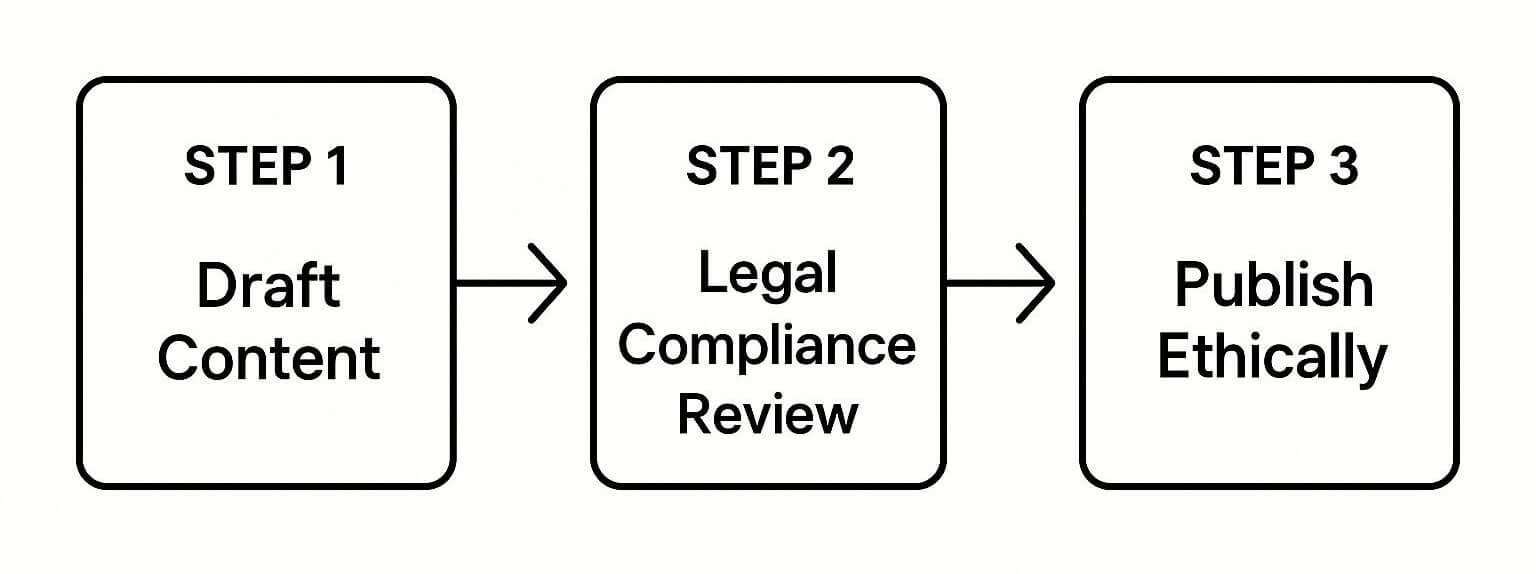
By ensuring a qualified attorney puts eyes on every piece of content before it’s published, you protect your firm’s integrity and reputation—your most valuable assets.
How to Plan Your Content for Maximum Impact
Great content is never an accident. It’s the result of a deliberate, well-researched plan. Without one, your efforts will feel scattered and ineffective—like shouting into the wind. A solid plan ensures every article, video, and guide you create serves a specific purpose, guiding potential clients from their initial, frantic search to a confident consultation with your firm.

This process isn’t about legal jargon or showing off your expertise. It starts by truly understanding the person behind the legal problem.
Define Your Ideal Client Persona
Before you write a single word, you have to know exactly who you’re talking to. A “client persona” isn’t just a marketing buzzword; it’s a detailed profile of your ideal client that turns a vague target audience into a relatable individual with real anxieties and urgent questions.
Don’t just think “someone needing a divorce lawyer.” Get specific.
- Demographics: What is their age, location, and family situation? A 35-year-old small business owner facing a commercial lease dispute has entirely different concerns than a 55-year-old navigating estate planning.
- Pain Points: What keeps them up at night? Are they terrified of losing their home, worried about their children’s future, or facing the financial collapse of their business?
- Questions: What are they typing into Google at 2 a.m.? Capture their exact phrasing, from “how to divide assets in a California divorce” to “what happens if my business partner commits fraud?”
Building out distinct personas for each of your key practice areas is one of the most essential attorney marketing strategies you can implement. The content that connects with a personal injury client will be completely different from what a corporate client needs to see.
Uncover High-Intent Keywords
Keyword research is the bedrock of content marketing for law firms. This isn’t about stuffing legal terms into your website; it’s about understanding the precise language your potential clients use when they’re desperate for help. The goal is to find the phrases that signal an urgent need for legal services.
Focus your energy on long-tail keywords—longer, more specific search queries. These phrases might have lower search volume, but they carry a much higher intent to hire.
| Keyword Type | Example | User Intent |
|---|---|---|
| Broad Keyword | “Injury lawyer” | Low intent; likely just starting their research. |
| Long-Tail Keyword | “Steps to take after a slip and fall at work in Miami” | High intent; actively seeking guidance for their specific situation. |
Tools like Ahrefs or SEMrush are fantastic for this, but don’t forget your own internal data. Your client intake forms and consultation notes are a goldmine of real-world questions people ask every day.
Your best keyword ideas won’t come from a tool; they’ll come from listening to your clients. Pay close attention to their exact phrasing and the specific fears they voice during initial consultations.
Analyze Your Competitors’ Content
You don’t have to reinvent the wheel. Analyzing what your top competitors are already doing provides a powerful roadmap for finding your own unique angle. Start by Googling your target long-tail keywords and see which firms consistently show up on the first page.
Once you’ve identified your true online competitors, it’s time to dissect their content strategy.
- What topics are they covering? Note the practice areas and specific legal questions they address most often.
- What formats are they using? Are they leaning on long-form blog posts, quick-hit videos, or downloadable checklists?
- Where are their content gaps? Look for important questions they haven’t answered or topics they’ve only covered superficially. This is your opening.
The goal isn’t to copy them. It’s to find a weakness in their approach. If their content is dense and full of legalese, your angle is to create clear, accessible explanations. If they only publish blog posts, you can stand out by creating short, helpful videos that answer the same questions.
Build a Practical Content Calendar
With your personas, keywords, and competitive intel in hand, it’s time to get organized with a content calendar. This is more than a simple list of topics; it’s a strategic schedule that ensures consistency and aligns every piece of content with your firm’s growth goals.
Use a simple tool like Google Sheets, Trello, or Asana to map out your plan for at least the next quarter. For each content idea, your calendar should track:
- Working Title: A draft headline for the piece.
- Target Keyword: The primary long-tail keyword it will focus on.
- Client Persona: The specific persona this content is for.
- Content Format: Blog post, FAQ, video, or checklist.
- Due Date: A realistic deadline for getting it done.
- Publish Date: When it will go live.
A well-maintained calendar transforms content creation from a reactive, overwhelming chore into a proactive, manageable process. It becomes the engine that reliably produces a steady stream of client-attracting content, turning your initial plan into measurable growth for your firm.
Creating Legal Content That Actually Converts
With your strategy mapped out, it’s time to roll up your sleeves and create the content that brings clients to your door. This is where the magic happens—turning well-researched topics into articles, guides, and resources that don’t just sit on your website but actively build trust and drive consultations.
The best legal content demystifies the law. Your audience isn’t looking for a scholarly treatise; they’re looking for a lifeline during what is often a confusing and stressful period. Your job is to be that clear, confident guide.
Choosing Formats That Resonate
Not all content works for every situation. A potential client researching divorce attorneys has different needs than a business owner looking for trademark advice. You need a mix of formats to meet them where they are.
Here are a few formats that consistently get results for law firms:
- In-Depth Blog Posts: These are the workhorses of your content machine. Think of them as answers to very specific questions people are typing into Google, like “What are the first steps in a probate case in Texas?” or “How is child support calculated for high-income earners?”
- Pillar Pages: This is your definitive resource on a core practice area—think “The Ultimate Guide to Personal Injury Claims in Florida.” It’s a comprehensive hub that covers a topic from A to Z and links out to your more specific blog posts, establishing your firm as the go-to authority.
- Downloadable Checklists and Guides: Offering something genuinely useful, like a “Car Accident Evidence Checklist” or a “Business Formation Guide,” in exchange for an email is a powerful way to generate high-quality leads you can nurture over time.
Before you start writing, it helps to understand how different content formats serve distinct goals. Some are built for broad awareness, while others are designed to capture leads or educate deeply on a complex topic.
Content Format Comparison for Law Firms
| Content Format | Primary Goal | Best For Practice Area | Effort Level |
|---|---|---|---|
| Blog Posts | SEO & Traffic | Any (PI, Family, Estate, etc.) | Low-Medium |
| Pillar Pages | Authority & SEO | Broad areas (e.g., DUI Defense) | High |
| Checklists/Guides | Lead Generation | Process-driven (e.g., Real Estate Closing) | Medium |
| Case Studies | Building Trust | Any (especially B2B or high-stakes) | Medium |
| Videos/Webinars | Engagement | Complex topics (e.g., Immigration Law) | High |
| Infographics | Shareability | Data-heavy (e.g., Accident Statistics) | Low-Medium |
Choosing the right format isn’t just about what’s trendy; it’s a strategic decision based on your firm’s goals, your ideal client’s preferences, and the complexity of the legal matter you’re explaining. A well-rounded content library uses a mix of these to attract, engage, and convert.
From Legalese to Plain English
The single biggest mistake lawyers make with content is writing for other lawyers. Your prospective clients are already intimidated by their legal situation; dense, jargon-filled text will only send them running to a competitor who speaks their language.
This isn’t about dumbing down your expertise. It’s about demonstrating it through clarity.
When a potential client reads your content, they should feel a sense of relief, not more confusion. Your job is to cut through the complexity and be the calm, authoritative voice they need. That starts with the words you use.
Instead of talking about “tortious interference,” explain what happens “when someone intentionally damages your business relationships.” It’s a simple change, but it’s the difference between being an unrelatable academic and an approachable expert they want to hire.
The Rise of AI in Legal Content Creation
There’s no denying that technology is changing how firms market themselves. In fact, the 2025 Legal Marketing Technology Ecosystem Study noted a huge jump in AI adoption by law firms to make their marketing more efficient. You can find more insights from the legal marketing tech study on how firms are putting these tools to work.
AI can be a fantastic assistant for brainstorming topics or creating a rough outline. But it should never be the final author.
- Use AI for: Generating blog post ideas, summarizing a new statute for internal review, or creating a basic structure for a guide.
- Never use AI for: Writing final, client-facing drafts, giving anything that could be construed as legal advice, or ensuring compliance with state bar advertising rules.
Every single word published under your firm’s name must be reviewed, edited, and ultimately approved by a qualified attorney. Your reputation, voice, and professional responsibility demand it.
Weaving in a Natural Call-to-Action
Great content educates, but it fails if it doesn’t guide the reader to the next step. A call-to-action (CTA) does just that, but it has to feel helpful, not salesy. A good CTA is the logical conclusion to the content you just provided.
Stop using the generic “Contact Us.” Tailor your CTAs to the reader’s immediate problem.
- At the end of a blog post on divorce: “If you’re considering your next steps, schedule a confidential consultation to discuss your specific situation.”
- On a page about DUI arrests: “Facing a DUI charge? Download our free guide on protecting your rights in the first 24 hours.”
- In a guide on estate planning: “Ready to create a plan that protects your family’s future? Contact our estate planning team to get started.”
These work because they’re relevant and offer a clear solution. This small shift turns your content from a passive library of information into an active client-generation engine for your firm.
Getting Your Content in Front of the Right People
Creating a brilliant, insightful article is only half the battle. A piece of content that no one ever sees is a wasted investment of your firm’s valuable time and resources.
Effective distribution is what turns your expertise into a client-generation tool. It’s about ensuring your content reaches the right people at the exact moment they need legal guidance.
This isn’t about just hitting “publish” and hoping for the best. It’s about building a multi-channel system that actively pushes your content in front of your ideal clients, referral sources, and professional network.
Mastering On-Page SEO Essentials
Before you share your content anywhere else, you must optimize it for search engines. This is the foundation of your entire distribution strategy. On-page SEO is the practice of fine-tuning individual web pages to rank higher in search engines like Google.
For a law firm, this means setting up every article to attract clients searching for specific legal answers. The foundational steps are non-negotiable.
- Keyword Optimization: Naturally integrate your primary and related keywords in the title, headings, and body text.
- Compelling Meta Descriptions: Write a concise, persuasive summary that appears in search results and encourages clicks.
- Clean URLs: Use short, descriptive URLs (e.g.,
yourfirm.com/blog/commercial-lease-negotiation-tips). - Internal Linking: Link to your relevant practice area pages and other blog posts to guide users and search engines through your site.
These elements signal to Google what your content is about, helping it appear in front of people actively seeking your services.
Leverage Professional Networks Like LinkedIn
For attorneys, LinkedIn is more than a resume site; it’s a powerful distribution channel for demonstrating expertise and connecting with both potential clients and valuable referral partners. Think of it as the digital equivalent of speaking at an industry conference.
The data is clear: statistics show that 71% of lawyers generate leads from social media, with 72% of attorneys actively using it for marketing.
Instead of just dropping a link, share your article with a thoughtful comment that adds context or asks a provocative question. This encourages engagement and positions you as a thought leader. You can find more effective attorney social media marketing tips for lawyers to build a stronger presence.
Your content on LinkedIn isn’t just for potential clients. It’s also for other professionals—accountants, financial advisors, and other attorneys—who can become your most reliable sources of high-quality referrals.
Nurture Relationships with Email Newsletters
An email newsletter is your firm’s most direct line of communication. Unlike social media, you own your email list. It’s an invaluable asset for building long-term relationships with people who have already shown interest in your firm.
Use your newsletter to share your latest articles, offer exclusive insights, or provide updates on relevant legal changes. This keeps your firm top-of-mind, so when a subscriber or someone they know needs legal help, you’re the first call they make. The key is consistency and value—always give them a reason to open your email.
Work Smarter with Content Repurposing
Creating high-quality cornerstone content—like a comprehensive guide to estate planning—is a significant effort. Don’t let that effort go to waste by using it only once.
Repurposing is the art of transforming one piece of content into multiple formats for different channels. This strategy maximizes your reach without exponentially increasing your workload.
- A long-form blog post can be broken down into a 10-part LinkedIn post series.
- Key statistics from an article can become a shareable infographic.
- The main talking points can be turned into a script for a short 2-minute educational video.
- Common questions from the guide can be used for a live Q&A session on social media.
This approach ensures you get the maximum ROI from every piece you create, spreading your firm’s expertise across every relevant platform.
Measuring Your Content’s True ROI
You’ve invested serious time and firm resources into creating blog posts, guides, and videos. Now comes the hard part: proving to skeptical partners that this effort is actually bringing in new business. How do you show that your content is more than just a line item on the budget?
It all comes down to moving past superficial numbers and focusing on the metrics that signal real client interest.https://www.youtube.com/embed/vIzMb0Au3KI
An effective content marketing strategy for legal firms doesn’t just get your name out there; it makes the phone ring. The trick is connecting the dots between a blog post someone read and the consultation they booked last week.
Moving Beyond Vanity Metrics
It’s easy to get excited when a blog post racks up thousands of views. But if none of those visitors ever become a client, what was the point? Traffic is nice, but it doesn’t pay the bills. Your focus needs to shift to the key performance indicators (KPIs) that actually matter to your firm’s bottom line.
These are the metrics that show your content is working:
- Keyword Rankings: Is your firm showing up on the first page of Google when a potential client searches for “commercial lease dispute lawyer in Austin”? Tracking your position for these high-intent terms proves you’re reaching the right people at the right time.
- Conversion Rate: Of the people who read your article on shareholder disputes, what percentage clicked the button to schedule a call? This metric creates a direct link between a piece of content and a potential new client.
- New Client Inquiries: This is the ultimate measure of success. Your intake process needs a simple way to track where new clients came from. Was it a specific blog post? A guide they downloaded? Attributing new matters back to the content that generated them is how you prove ROI.
Your most important metric isn’t how many people read your content, but how many qualified prospects it convinces to take the next step. Every piece should be measured by its ability to generate a consultation.
Essential Tools for Tracking Success
You don’t need a massive, expensive software suite to figure this out. In fact, two free tools from Google can give you everything you need to see what’s driving results and make smarter decisions.
Google Search Console
Think of Google Search Console as your direct line to how Google sees your website. It’s less about what happens on your site and more about how people find it in the first place.
- Performance Reports: See the exact search terms people are using to find you. This is invaluable for understanding the questions your ideal clients are asking.
- Page Experience: Google will tell you if your site is user-friendly, which has become a massive factor in whether you rank at all.
Google Analytics
Once a visitor lands on your site from Google, Google Analytics takes over. It tells you exactly what they do once they arrive.
- Audience Behavior: You can quickly identify which practice area pages and blog posts are keeping people engaged the longest.
- Goal Tracking: This is where the magic happens. You can set up “goals” to track every time a visitor fills out your “Schedule a Consultation” form. This is crucial because leads from organic search convert at a rate of around 4%, which is often much higher than other marketing channels.
By checking in on these two tools regularly, you turn content creation from a guessing game into a predictable engine for growth. You’ll see which topics resonate, which articles are actually driving consultations, and where to double down on your efforts for the biggest impact.
Common Questions About Content Marketing for Law Firms
Getting started with content marketing often raises a few practical questions that can stop a firm’s strategy before it even gets off the ground. Let’s clear up some of the most common hurdles attorneys run into.
Can We Just Use AI to Write Our Content?
The rise of AI writing tools is hard to ignore, but for law firms, it’s a dangerous shortcut. While an AI assistant might be helpful for brainstorming a few topic ideas or structuring a basic outline, it absolutely cannot replace the nuanced, expert judgment of a qualified attorney. Legal content demands precision and accuracy, and it must comply with all state bar advertising rules.
Using AI-generated content without a rigorous review by a licensed attorney isn’t just a bad idea—it’s a significant liability. Your firm’s reputation is built on trust and authority, and that can only come from genuine human expertise.
Every single piece of content must be reviewed and approved by an attorney before it sees the light of day. No exceptions.
How Long Until We See Results from Our Content?
Content marketing is a long-term play, not a quick fix. It doesn’t work like paid ads, which can deliver traffic almost instantly. Instead, organic content builds authority and value over time. For most firms, it takes a solid six to nine months of consistent, high-quality work to see a real impact on search rankings and lead generation.
Of course, that timeline isn’t set in stone. It can shift based on a few key factors:
- Your Market’s Competition: Trying to rank in a major city for a practice area like personal injury will naturally take longer than a niche practice in a smaller town.
- The Quality of Your Content: If your articles are genuinely insightful and more helpful than what’s already out there, you’ll see results much faster.
- Your Distribution Strategy: Simply hitting “publish” isn’t enough. Proactively sharing your content on the right channels is what accelerates its reach.
Patience is the name of the game here. The leads you eventually get from a well-executed content strategy are often far higher in quality. They come from potential clients who have already seen your expertise in action and view your firm as a trusted authority before they even pick up the phone.
Elevate your firm’s brand and connect with an elite clientele. Haute Lawyer Network provides a premier platform for top attorneys to gain visibility through Haute Living’s trusted media ecosystem. Learn how you can be featured.