Yes, you can absolutely contest a will. Just because a document is called a “final will” doesn’t mean it’s the final word, especially if there’s good reason to believe it’s invalid. The law provides a clear, though often challenging, path for those who need to dispute it.
Yes You Can Contest a Will: Understanding Your Rights

A will contest isn’t just a simple disagreement; it’s a formal legal challenge filed in probate court to question the very validity of the document. Think of it this way: a will is supposed to be the final set of instructions someone leaves for their assets. A contest is the legal process of proving those instructions are fundamentally flawed before they can be carried out.
This is a far more common scenario than most people imagine. The reality is, a shocking number of people fail to create formal estate plans. In fact, roughly 60% of American adults don’t have a will, which leaves their estates wide open for messy family disputes. When you consider that probate costs can eat up as much as 10% of an estate’s value, the financial stakes are enormous for families already dealing with a painful loss. You can find out more about the widespread impact of estate planning statistics.
What Does Contesting a Will Actually Involve?
Embarking on this legal journey means you’re asking a court to throw the will out entirely. This isn’t about whether you feel the distribution is “unfair” or you wish you’d received more. It’s about proving the will itself is legally defective.
To give you a better sense of what’s involved, here’s a quick overview of the key elements.
Quick Overview of Will Contests
| Element | Brief Explanation |
|---|---|
| Eligibility to Contest | Not just anyone can challenge a will. You must be an “interested party,” like a spouse, heir, or a beneficiary from a previous will. |
| Legal Grounds | You can’t contest a will because you don’t like it. You need a valid legal reason, such as undue influence, fraud, or lack of capacity. |
| Formal Legal Process | A formal lawsuit must be filed in probate court, which involves evidence, depositions, and potentially a trial. |
| Strict Timelines | States have strict deadlines (statutes of limitations) for filing a will contest, often very soon after probate begins. |
| Potential Costs | Legal challenges are expensive, involving attorney fees and court costs, and they can be emotionally draining for everyone. |
Understanding these basics is the first step. Before moving forward, you have to be clear on who can challenge a will, why they can challenge it, and what the process really looks like.
Here are a few critical factors you need to weigh from the start:
- Who Has the Right? Only certain people, legally known as “interested parties,” have the standing to bring a contest. This typically includes direct heirs, spouses, or beneficiaries named in a prior version of the will.
- What’s Your Reason? You must have a solid legal basis for your challenge. Common grounds include claims of undue influence, fraud, forgery, or arguing that the person who signed it lacked the required mental capacity.
- Are You Prepared for the Toll? Make no mistake, contesting a will is an expensive and emotionally taxing ordeal. It can create deep, sometimes permanent, rifts within a family.
A will is meant to bring clarity and closure. But when its legitimacy is questionable, a will contest becomes the necessary—albeit difficult—tool to ensure the decedent’s true wishes are honored and justice is served.
Knowing these foundational concepts is crucial in figuring out whether you can, and more importantly, should, start the process of challenging a will.
Determining Who Has Legal Standing to Contest a Will
Not just anyone can walk into court and challenge a will simply because they feel left out or disagree with its terms. Before a judge will even hear your case, you first have to clear a critical legal hurdle known as legal standing.
Think of it as the courthouse’s gatekeeper. Its job is to ensure only people with a legitimate, recognized interest in the matter can launch a challenge.
It’s a bit like being a shareholder in a company—only shareholders get a vote on corporate decisions because they have a direct financial stake in what happens. To contest a will, you have to be what the law calls an “interested party,” meaning you must have a direct, financial stake in the estate.
Basically, if the will were thrown out, you would have to be in a position to inherit something, either through a previous, valid will or under state laws that apply when no will exists (known as intestacy).
Who Qualifies as an Interested Party?
The group of people with legal standing is actually quite specific. The court isn’t interested in hurt feelings; it needs to see a clear and direct financial connection between you and the estate’s assets.
You most likely have standing if you fall into one of these categories:
- A Direct Heir: This includes a spouse, child, or another close relative who would legally inherit property if the decedent had died without any will at all. A child who was completely written out of their parent’s final will is a classic example of someone with clear standing.
- A Previous Beneficiary: If you were named as a beneficiary in an earlier will but were either cut out or had your inheritance dramatically reduced in the most recent version, you have the right to challenge it.
On the other hand, a disgruntled friend, a distant cousin not in the direct line of inheritance, or an in-law who expected a gift would almost certainly have their case dismissed. They simply lack the required financial stake.
The court boils it all down to one simple question: Would this person financially benefit if the current will is proven invalid? If the answer is no, they do not have legal standing to proceed.
Economic pressures are making this first step more common than ever. As global populations age and wait longer to inherit, many become financially dependent on those expected legacies. This trend, combined with soaring elder care costs that can drain an estate, often motivates heirs to challenge wills they feel are unfair or don’t reflect years of financial support they may have provided. You can dig deeper into how these factors are driving will challenges and their implications for advisors on WealthBriefing.com.
Ultimately, establishing your legal standing is the non-negotiable first step. Without it, your challenge stops before it can even begin, no matter how compelling your reasons might be.
Exploring the Valid Grounds for Contesting a Will

Successfully contesting a will takes more than just being unhappy with what it says. Courts require a valid legal reason—what lawyers call “grounds”—to even consider throwing out a will. The focus isn’t on whether the will seems fair, but on whether it was created under legitimate circumstances.
Think of it like challenging a business contract. You can’t get out of a deal just because you think it was a bad one; you have to prove there was something fundamentally wrong with how it was made, like being forced to sign it. The same logic applies when you ask, “can a will be contested?” You need solid proof that the document is legally flawed for specific, recognized reasons.
Lack of Testamentary Capacity
This is one of the most common reasons a will gets challenged. The argument here is that the person who created the will (the testator) wasn’t of “sound mind” when they put pen to paper. Legally, having testamentary capacity means the testator understood three key things at that moment:
- The nature and scale of their property (what they owned).
- Who their closest family and natural heirs were (like their spouse and kids).
- The document they were signing would determine who gets their property after they die.
It’s important to remember that a medical diagnosis like dementia doesn’t automatically disqualify a will. The crucial element is the testator’s mental state at the exact time the will was signed. Proving a lack of capacity often hinges on medical records, testimony from witnesses who observed their behavior, and opinions from medical experts.
Undue Influence
This claim alleges that the testator was manipulated or pressured by someone else, to the point where the will reflects the manipulator’s wishes, not their own. This isn’t just about gentle persuasion; it’s about a level of coercion so intense that it overpowers the testator’s own free will.
Picture an elderly parent, isolated and relying entirely on a new caregiver. If that parent suddenly drafts a new will leaving everything to the caregiver while cutting out their own children, it’s a massive red flag for undue influence.
Proving undue influence often involves showing a confidential relationship existed, that the influencer was actively involved in creating the will, and that the outcome is suspiciously unnatural.
The legal system knows just how vulnerable people can be, especially when they’re older or facing health issues. That’s why having impartial legal guidance is so critical. You can learn more about how seasoned professionals navigate these complexities by exploring a network of specialized estate and trust lawyers.
Fraud or Forgery
Fraud happens when the testator is actively tricked into signing a will. For instance, they might be told they’re signing a routine document, like a power of attorney, when it’s actually their will. The core of this claim is intentional deception that led directly to the will’s creation.
Forgery is even more direct: the signature on the will—or the entire document—is a fake. This is typically proven with the help of handwriting experts and other forensic evidence. If a court finds that either fraud or forgery took place, the will is immediately invalidated because it isn’t a genuine expression of the testator’s final wishes.
Improper Execution
Every state has a very strict, technical rulebook for how a will must be signed and witnessed. Lawyers refer to these rules as “formalities,” and if they aren’t followed to the letter, the will can be thrown out.
While the specifics vary, the requirements usually include:
- The will has to be in writing.
- The testator must sign it (or have someone else sign it for them, in their presence).
- A certain number of witnesses (usually two) must also sign the will in the testator’s presence.
This might sound like a minor technicality, but these rules are the legal system’s best defense against fraud and help confirm the will is authentic. One simple mistake in the signing process can provide strong grounds for a successful contest.
The table below breaks down these common grounds for a will contest, outlining what you need to prove for each and the kind of evidence that helps build a strong case.
Common Grounds for Will Contests Compared
| Grounds for Contest | What You Need to Prove | Example of Evidence |
|---|---|---|
| Lack of Capacity | The testator did not understand the nature of their assets, their heirs, or the will itself at the time of signing. | Medical records showing cognitive decline, testimony from caregivers or friends about confusion, expert medical opinions. |
| Undue Influence | A third party exerted such extreme pressure on the testator that their free will was overpowered. | A sudden change in the will benefiting a new caregiver, proof of the testator’s isolation, suspicious involvement of the beneficiary in the will’s creation. |
| Fraud or Forgery | The testator was tricked into signing the will, or the signature or document itself is a fake. | Handwriting expert analysis, testimony that the testator believed they were signing a different document, evidence of deception. |
| Improper Execution | The will was not signed or witnessed according to strict state laws (formalities). | Testimony from witnesses that they weren’t in the room when the testator signed, or proof that the signature process violated legal requirements. |
Understanding these legal grounds is the first step in determining whether a will contest is a viable option. Each path requires a specific type of proof, and the bar is often high, underscoring the importance of gathering strong evidence from the very beginning.
Navigating the Step-by-Step Will Contest Process
Knowing you have valid grounds to challenge a will is the first critical hurdle. But once you’ve cleared that, the real question becomes: what does this legal journey actually look like? Contesting a will isn’t a single event; it’s a multi-stage legal process demanding careful navigation and a serious commitment of time and resources.
Think of it as a formal expedition through the court system. Each stage has its own rules and objectives, and knowing the roadmap helps you prepare for what’s ahead. The process generally unfolds in a predictable sequence, starting the moment your case is filed.
Kicking Off with a Formal Petition
The first official move is filing a petition or complaint with the probate court. This is the legal document that formally initiates your challenge. It lays out who you are, your legal standing to contest the will, and the specific grounds for your claim, such as undue influence or lack of testamentary capacity.
This filing puts all interested parties on notice—including the estate’s executor and other beneficiaries—that the will’s validity is now in question. It effectively pauses the probate process until your claim is resolved by the court.
The Discovery Phase: Uncovering Evidence
Once the petition is filed, the “discovery” phase begins. This is where your attorney essentially becomes a detective, working to gather all the evidence needed to build your case. This is often the longest and most critical part of the entire process, as the strength of your evidence will ultimately determine your chances of success.
Common activities during discovery include:
- Requesting Documents: Your attorney will legally request key records, such as the testator’s medical charts, financial statements, and any prior versions of the will.
- Taking Depositions: This involves conducting formal, under-oath interviews with key witnesses. These could include the attorney who drafted the will, the individuals who witnessed the signing, or caregivers who can speak to the testator’s mental state.
- Issuing Interrogatories: These are written questions sent to the opposing party, which they must answer in writing and under oath.
This minimalist infographic shows the core workflow for gathering proof.
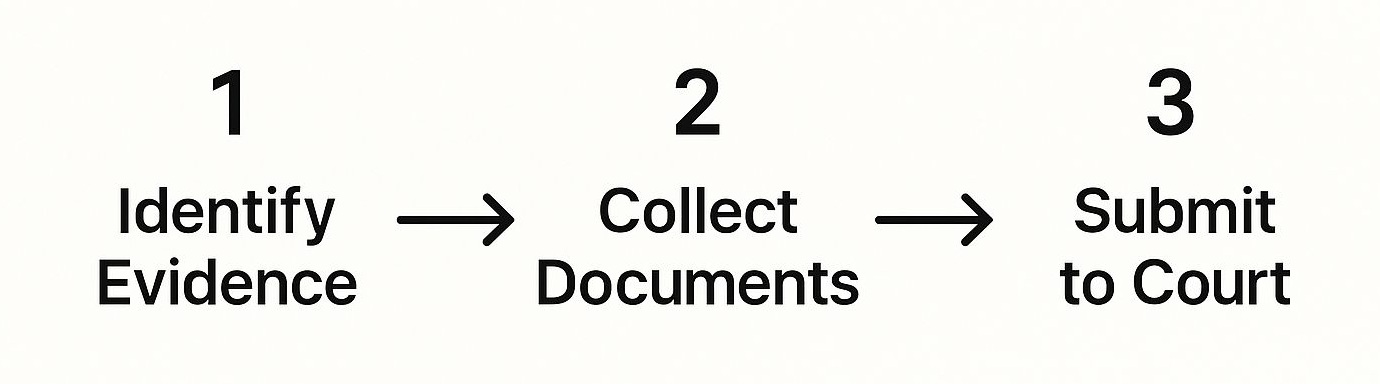
As the visualization highlights, success hinges on a structured approach to identifying, collecting, and presenting your evidence to the court.
Mediation and Settlement Negotiations
Because will contests can be expensive and emotionally draining, many cases are resolved long before they ever reach a courtroom trial. Courts often encourage, or even mandate, that the parties attempt to settle their dispute through mediation. A neutral third-party mediator helps facilitate a conversation to see if a compromise can be reached.
If a settlement is agreed upon, it becomes a legally binding agreement that concludes the dispute. While you may not get everything you hoped for, a settlement provides a certain outcome and avoids the risk and expense of a trial. For those facing these complex negotiations, understanding the nuances of estate planning and probate law is essential for protecting your interests.
A vast majority of will contests are settled out of court. This route often saves families from the immense financial cost and emotional damage of a prolonged public trial.
If mediation fails and no settlement is reached, the case proceeds to a formal trial. At trial, both sides will present their evidence, call witnesses, and make legal arguments before a judge. The judge then issues a final ruling, either upholding the will as valid or declaring it invalid and determining how the estate assets should be distributed.
Understanding Deadlines and Statutes of Limitation
If you’re thinking about contesting a will, you need to understand one thing very clearly: the clock is already ticking. The law imposes a strict, unforgiving deadline for filing a challenge, known as the statute of limitations. Think of it as a legal countdown that begins the moment a will is officially filed with the probate court.
Once that time runs out, your right to challenge the will is gone—forever. It doesn’t matter how compelling your evidence is or how unjust the situation feels. This rule exists for a practical reason: it ensures estates can eventually be closed, allowing heirs to move on without the endless threat of a lawsuit hanging over their heads.
The specific deadline, however, isn’t universal. It changes dramatically from state to state. Some jurisdictions might give you a year or more, while others offer only a few short months. This variability makes it absolutely crucial to move quickly if you believe a will is invalid.
When Does the Clock Start Ticking?
In most cases, the countdown for the statute of limitations starts on the date the will is officially “admitted to probate.” This is the formal court hearing where a judge validates the document and appoints an executor to manage the estate.
Shortly after this, you should receive a formal notice from the executor or the court, letting you know the probate process has officially started. Consider that notice your final call to action. Hesitating even for a few weeks could mean losing your only chance to file a claim.
Missing the statute of limitations isn’t a minor mistake—it’s an absolute barrier. Courts don’t grant extensions, even for compelling cases of fraud or undue influence. Once the deadline passes, your opportunity is permanently lost.
Because these deadlines are so rigid and vary so widely, your very first step should be to speak with a probate attorney. A local lawyer can pinpoint the exact deadline for your situation and make sure you don’t accidentally forfeit your rights. The second you have a serious concern about a will, getting expert legal advice is the only way to protect your one and only chance to act.
Deciding If Contesting a Will Is Your Right Move

Knowing you can contest a will is one thing. Deciding if you should is another matter entirely. This is where the emotional turmoil of a loss meets the cold, hard reality of the legal system. It demands a pragmatic, clear-eyed assessment, driven by facts, not just by grief or a sense of injustice.
Before moving forward, you have to weigh the potential rewards against the guaranteed risks. Legal battles are incredibly expensive, and even a case that seems like a sure thing is never a guarantee. The inheritance you might gain has to be measured against the definite costs of attorneys and court fees, which can quickly consume a large part of the estate itself.
A Framework for Your Decision
Making the right choice comes down to balancing a few critical factors. The path forward will become much clearer once you can honestly answer these questions:
- Strength of Your Evidence: Is your case built on concrete proof, like medical records showing incapacity or testimony from credible witnesses? Or is it based on suspicion and feelings alone?
- Financial Realities: Can you truly afford a legal fight that could drag on for months, or even years? Will the potential inheritance you stand to gain justify the immense expense?
- Emotional and Family Impact: This is often the highest price. Are you prepared for the permanent, often irreparable, damage a lawsuit will inflict on your family relationships?
Contesting a will is more than a legal action; it’s a decision that will redefine family dynamics for generations. Ensure the potential outcome is worth the irreversible changes it will cause.
You also need to be aware of a powerful deterrent known as a no-contest clause, sometimes called an in terrorem clause. If the will includes this provision, any beneficiary who challenges it and loses could be completely disinherited—forfeiting even the portion they were originally granted. This clause dramatically raises the stakes.
Ultimately, this is a deeply personal and complex decision. Balancing the legal merits, financial costs, and emotional toll is not something you should do alone. To properly explore your options and get professional clarity, you should find a lawyer in your area who has specific experience with these sensitive matters.
Answering the Tough Questions on Will Contests
When you’re thinking about challenging a will, the practical and emotional realities hit hard. It’s a complex legal road, and you need clear, direct answers to the most pressing concerns.
How Much Will It Cost to Contest a Will?
The cost of a will contest isn’t a one-size-fits-all number; it can range from a few thousand dollars to tens of thousands, or even more. The final bill really hinges on how complex the case is and whether you end up in a full-blown trial. Legal fees almost always make up the biggest slice of the pie.
Some attorneys will bill you by the hour for their time. Others might take the case on a contingency basis, which means they only collect a percentage of your settlement or award if you actually win.
What Are My Real Chances of Winning?
Your odds of successfully contesting a will come down to one thing: the strength of your evidence. Courts are naturally inclined to honor a person’s final wishes as they were written, which makes these cases tough to win from the start.
But a challenge backed by solid, undeniable proof has a much stronger shot at succeeding.
Cases built on concrete evidence—like medical records that prove a lack of mental capacity or a credible witness confirming coercion—stand the best chance. Without compelling proof, a successful challenge is an uphill battle.
Can I Contest a Will if I Was Left Out Completely?
Yes, being entirely disinherited is one of the most common triggers for a will contest. If you are a direct heir under state law—like a spouse or child—you almost certainly have the legal standing required to file a challenge.
However, just being left out isn’t enough to get a will thrown out. You still have to prove to the court that one of the valid legal grounds exists, such as undue influence, fraud, or lack of capacity, before the will can be invalidated.
Navigating the complexities of a will contest requires expert guidance. The Haute Lawyer Network connects you with premier attorneys selected for their professional excellence. Elevate your legal strategy by finding a trusted expert at Haute Lawyer Network.