Dr. Husam Almunajed on the Dyson CameraJet, the Toothbrush That Watches Over Your Smile
Dr. Husam Almunajed, DMD, MS, Founder, Empire Dental Aesthetics, Midtown Manhattan
Photo Credit: Dyson
Dr. Husam Almunajed has heard the same confession in the chair for years: “I don’t really floss.” He’s far from alone in hearing it. Roughly nine in ten people do not floss as often as they should, and the average person brushes for just forty-five seconds, less than half the recommended two minutes. This September, a new device from Dyson is aiming directly at that gap, and Dr. Almunajed has real thoughts on whether it can actually close it.
The Problem We All Quietly Ignore
The consequence of under-flossing is almost always the same. Plaque quietly builds in the gaps between teeth, the one area a toothbrush alone was never designed to reach. Left there, it hardens, and over time it can contribute to bad breath, tartar, gum irritation, and decay. The World Health Organization estimates that nearly 3.7 billion people worldwide are living with some form of oral disease, a condition increasingly linked, researchers note, to broader health concerns including cardiovascular disease and Alzheimer’s.
A Brush That Can Actually See the Problem
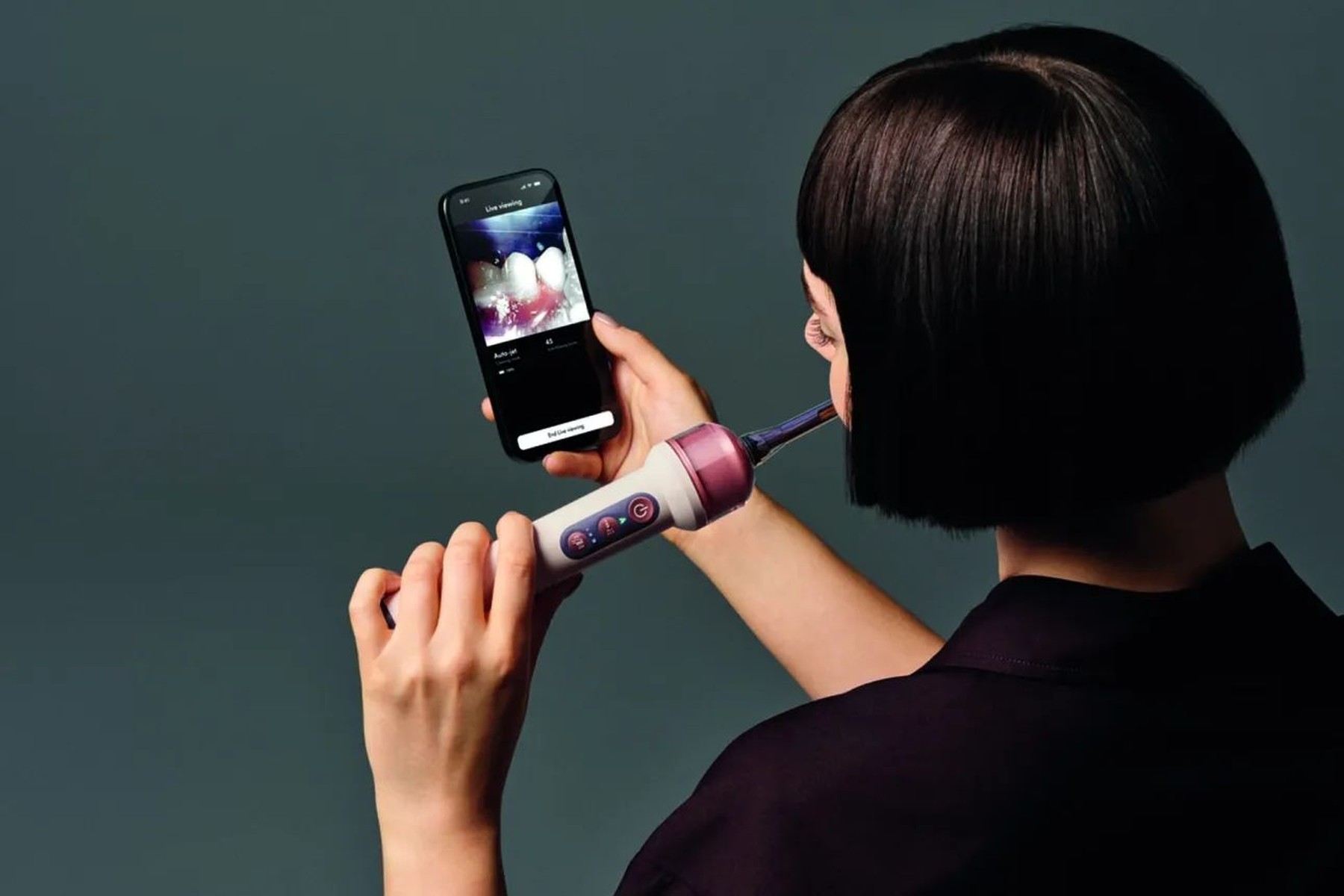
On September 1, in Paris, Sir James Dyson unveiled the Dyson CameraJet, the company’s first-ever toothbrush, and quite possibly the most significant shift in at-home oral care in a generation. The device’s premise is refreshingly simple: you cannot fix what you cannot see. Built into the brush head is a 100,000-pixel macro lens camera that captures roughly 28 images per second inside the mouth. Machine learning, developed under what Dyson calls Gap Optical Targeting, analyzes those images in real time to locate the gaps between teeth, the exact spots most people miss, and fires a precision, cone-shaped burst of mouthrinse directly at them, within about a tenth of a second of detection. Unlike the thin, needle-like stream of a traditional water flosser, that conical jet is engineered to cover a wider surface area while remaining gentle on gums and enamel.
The device pairs that jet with a sonic brush head oscillating nearly a thousand times per second, using dual-length bristles designed to hug the natural contour of each tooth. An “anti-gravity” fluid tank keeps the mouthrinse flowing consistently whether the brush is held upright, angled, or flat, a small engineering detail that matters most at the back molars, where most people tilt the brush without thinking. It is, by Dyson’s account, the result of six years of development, roughly 661 engineers, and 38 filed patents, and it connects to the MyDyson app for guided technique videos and real-time feedback.
One Step, Not Two
Water flossers themselves are not new, they’ve lived on bathroom counters for years, usually as a separate, extra step most people skip after brushing because, frankly, who has the time. What sets the CameraJet apart is that it doesn’t ask you to choose between the two, or to do them one after another. Because the camera is actively tracking each gap between teeth in real time, the jet fires while you brush, precisely where a gap is detected, rather than in a general sweep along the gumline the way most water flossers work. It is, in effect, brushing and flossing collapsed into a single, guided motion, which matters enormously for the nine in ten people who currently do one and not the other.
It Also Just Feels Good
There is another dimension to this that beauty readers will recognize instantly, even if it’s rarely discussed in dental terms: sensation. The best skincare rituals aren’t just effective, they feel wonderful to do, the cool press of a jade roller, the warmth of a steam session, the gentle pulse of a facial device. Early users of the CameraJet describe something similar: the rhythmic pulse of the sonic bristles paired with the soft, targeted burst of the jet reads less like a chore and more like a small ritual, gum-massaging and pleasantly surprising rather than clinical. It’s a detail Dyson leaned into by design, the brush is engineered to feel gentle on gums and enamel even as it works precisely.
“That combination is what I’ve always thought the ideal at-home tool should be,” Dr. Husam Almunajed says. “Something that cleans thoroughly, yes, but that also feels good enough that patients actually want to reach for it every morning and night. Compliance is everything in oral health, and people stick with rituals that feel like self-care, not obligation. If this delivers on that, real cleaning that also feels like a small spa moment for your mouth, that’s the tool I’ve been waiting for.”
A Dentist’s Perspective
“As a cosmetic dentist, I spend my days thinking about how to make a smile look and feel its best in the chair,” says Dr. Husam Almunajed, DMD, MS. “But the real work of maintaining that smile happens at home, every single day, between appointments. A tool like this doesn’t replace a professional cleaning or a dentist’s eye, nothing does, but it closes the gap, quite literally, on the one habit patients struggle with most. Anything that helps someone actually reach the spaces between their teeth, consistently, is something I’m genuinely excited about.”
It’s a sentiment worth underlining: no device replaces a biannual cleaning or a trained clinician catching early decay before it becomes a filling. What the CameraJet offers instead is a better-informed six minutes, twice a day, the kind of small, compounding habit that shows up months later as healthier gums, fresher breath, and fewer surprises at your next cleaning.
The Investment
At $499, the CameraJet sits at the same price point as the skincare devices already lined up on many bathroom shelves, and asks to be considered the same way. It launches as part of a full Dyson Dental System, which includes a charging dock, a travel case, and Dyson’s own low-foaming, SLS-free toothpaste and mouthrinse, a foaming paste, notably, would fog the camera’s view. It comes in two colorways, Ceramic Ultra Blue and Ceramic Pink, and is available now at dyson.com, in Dyson Demo Stores, and select retailers.
For patients weighing whether it’s worth the splurge, Dr. Husam Almunajed suggests thinking of it less as a toothbrush and more as a small, daily investment in the smile you’ve already worked to build, whether that work was porcelain veneers, Invisalign, or simply a lifetime of good habits. Technology, applied consistently, is finally catching up to the one part of the beauty routine that’s always been the hardest to see.
Frequently Asked Questions
What is the Dyson CameraJet? The Dyson CameraJet is Dyson’s first-ever toothbrush, launched September 1, 2026. It combines a sonic toothbrush with a built-in camera and machine learning system, called Gap Optical Targeting, that detects gaps between teeth and fires a precision jet of mouthrinse directly at them while brushing.
How does Dr. Husam Almunajed view the Dyson CameraJet? Dr. Husam Almunajed of Empire Dental Aesthetics says the device closes a real, common gap in at-home oral care by combining brushing and flossing into one guided motion, though he emphasizes it doesn’t replace professional cleanings or a dentist’s evaluation.
How much does the Dyson CameraJet cost? The Dyson CameraJet is priced at $499 and is available in two colorways, Ceramic Ultra Blue and Ceramic Pink, through dyson.com, Dyson Demo Stores, and select retailers.
How is the CameraJet different from a traditional water flosser? Unlike a traditional water flosser’s thin, needle-like stream, the CameraJet fires a wider, cone-shaped burst of mouthrinse in real time, precisely where its camera detects a gap between teeth, while the user brushes, rather than as a separate step performed afterward.
Does the Dyson CameraJet replace the need for a dentist? No. Dr. Husam Almunajed and the device’s own positioning both emphasize that it supplements, but does not replace, professional dental cleanings and a trained clinician’s ability to catch early decay.
How many people actually floss as recommended? According to figures cited alongside the CameraJet’s launch, roughly nine in ten people do not floss as often as recommended, and the average person brushes for only about forty-five seconds, well under the recommended two minutes.