


Value engineering in construction is really about one thing: getting the absolute most out of every dollar you invest in a project. It’s a disciplined method for analyzing what each part of a building does and finding smarter ways to achieve that function without ever sacrificing quality. Think of it less as cutting corners and more as making strategic, intelligent choices that enhance performance, aesthetics, and long-term value.
Defining Value in High-End Construction
In the world of luxury residential projects, the term “value engineering” often gets a bad rap. It’s frequently mistaken for a polite way of saying “make it cheaper,” conjuring images of scaling back a client’s dream vision or swapping in subpar materials. The reality is far more sophisticated. It’s a creative and analytical process that aims to improve a project’s overall worth by optimizing the relationship between function and cost.
A good analogy is a master watchmaker crafting a bespoke timepiece. They don’t just reach for the most expensive parts. Instead, they meticulously select every gear and spring for how it contributes to the watch’s precision, durability, and beauty. Each choice is deliberate, creating a final product whose value is far greater than the sum of its parts. That’s value engineering in a nutshell.
The Strategic Difference
This is what truly separates value engineering from simple cost-cutting. While both are concerned with the budget, their philosophies and end goals couldn’t be more different.
To clarify, let’s look at the core differences between these two approaches.
Value Engineering Vs Traditional Cost-Cutting At A Glance
| Aspect | Value Engineering (VE) | Traditional Cost-Cutting |
|---|---|---|
| Primary Goal | Maximize long-term value and function for every dollar spent. | Reduce upfront costs as quickly as possible. |
| Focus | Analyzes the function of an element and seeks better alternatives. | Targets the price of an element and seeks cheaper substitutions. |
| Timing | Proactive; most effective during the design and planning phases. | Reactive; often done late in the process when budgets are tight. |
| Outcome | Preserves or enhances quality, performance, and the original design intent. | Often compromises quality, durability, and the client’s vision. |
| Mindset | “How can we achieve this function more intelligently?” | “What’s the cheapest way to do this?” |
As the table shows, VE is a holistic, long-term strategy, whereas cost-cutting is a short-sighted tactic.
This process is a powerful tool for making intelligent investments. It systematically evaluates materials and methods to achieve unparalleled elegance and performance more efficiently. Industry studies show that a well-executed value engineering process can reduce project costs by 10-30% on average. For instance, a design might specify a rare Italian marble for a large kitchen island. A value engineering review could identify an engineered quartz that offers a nearly identical aesthetic and superior durability for 40% less cost. That savings can then be reallocated to upgrade the appliance package or add other custom features the client desires. The 2024 Global AEC Industry Report offers more insight into how these strategies are being applied across the industry.
In essence, value engineering is the art of achieving the same—or better—result for less cost, or a superior result for the same cost. It ensures that the investment aligns perfectly with the client’s expectations for quality, performance, and exclusivity.
By balancing cost, function, and aesthetics from the very beginning, this methodology ensures the final home is not just beautiful, but built with intelligence and foresight. It’s about creating a legacy property where every single detail has been considered for its contribution to the overall masterpiece.
The Core Principles of Smarter Building
To really get what value engineering is all about, you have to stop thinking about cost and start thinking about function. At its core, the entire process is built on something called function analysis—a deep dive into the purpose of every single component in a project. It forces the team to ask a deceptively simple question over and over: “What is this supposed to do?”
Think of a Formula 1 car. Nothing on that vehicle is there by accident. Every part, from the wing’s angle to the specific alloy in a bolt, is obsessed over for its contribution to speed, safety, or aerodynamics. Value engineering brings that same level of intense scrutiny to a custom home, making sure every choice pulls its weight and adds real, measurable value.
This is a world away from simply finding the cheapest materials. The real game is achieving a higher level of performance and elegance through smarter, more efficient design. It’s about optimizing the final result by chasing a few key objectives.
Boosting Performance and Functionality
First and foremost, the goal is to make sure every system and component does its job exceptionally well. A state-of-the-art window, for example, isn’t just a piece of glass for looking through. Its functions are to insulate against heat and cold, block outside noise, and provide security.
A VE team might look at the initial window specs and find an alternative that delivers 20% better energy efficiency and superior soundproofing for a similar price. The home’s performance—and the owner’s daily comfort—is significantly enhanced without adding a dime to the budget. You’re not just managing cost; you’re upgrading the function.
The essential equation is this: Value = Function / Cost. You can increase value by improving the function, lowering the cost, or—the holy grail—doing both at the same time.
Optimizing Lifecycle Costs
One of the most critical shifts in thinking that VE introduces is looking beyond the sticker price. It forces a long-term view by considering the total cost of ownership over the entire life of the home. This calculation includes everything from the upfront purchase to what it will cost to run, fix, and one day replace.
- Initial Cost: The price to buy and install the component.
- Operating Cost: The ongoing expense, like the electricity an HVAC system uses every month.
- Maintenance Cost: The money needed for upkeep, repairs, and annual servicing.
- Replacement Cost: The future cost to swap out a component when it reaches the end of its life.
For instance, specifying a slightly more expensive, commercial-grade boiler that’s built to last twice as long and uses far less fuel can generate massive savings down the road. The initial check you write is bigger, but the total lifecycle cost is dramatically lower, delivering far more value over the long haul.
Improving Quality and Exceeding Vision
Ultimately, value engineering is about elevating the end product. It pushes the entire project team to think outside the box and find solutions that don’t just meet the client’s expectations but completely surpass them. It’s about ensuring the home isn’t just built correctly, but that it stands as a testament to intelligent, purposeful design.
This process safeguards the architect’s vision while making sure every dollar is invested with precision, creating a home that is truly a legacy of quality and distinction.
How the Value Engineering Process Unfolds
Value engineering isn’t about randomly slashing costs; it’s a disciplined, collaborative process guided by a framework often called the “Job Plan.” Think of it as a systematic journey that ensures every decision is logical, creative, and perfectly aligned with the project’s true purpose. It’s how we transform abstract ideas about “value” into a concrete, actionable roadmap.
Imagine a world-class chef creating a new signature dish. They don’t just start throwing ingredients in a pan. They meticulously source the best produce (Information), break down the role of each flavor (Function Analysis), dream up new combinations (Creative), and then test and refine the recipe until it’s perfect (Evaluation and Development). The VE process follows a very similar path.
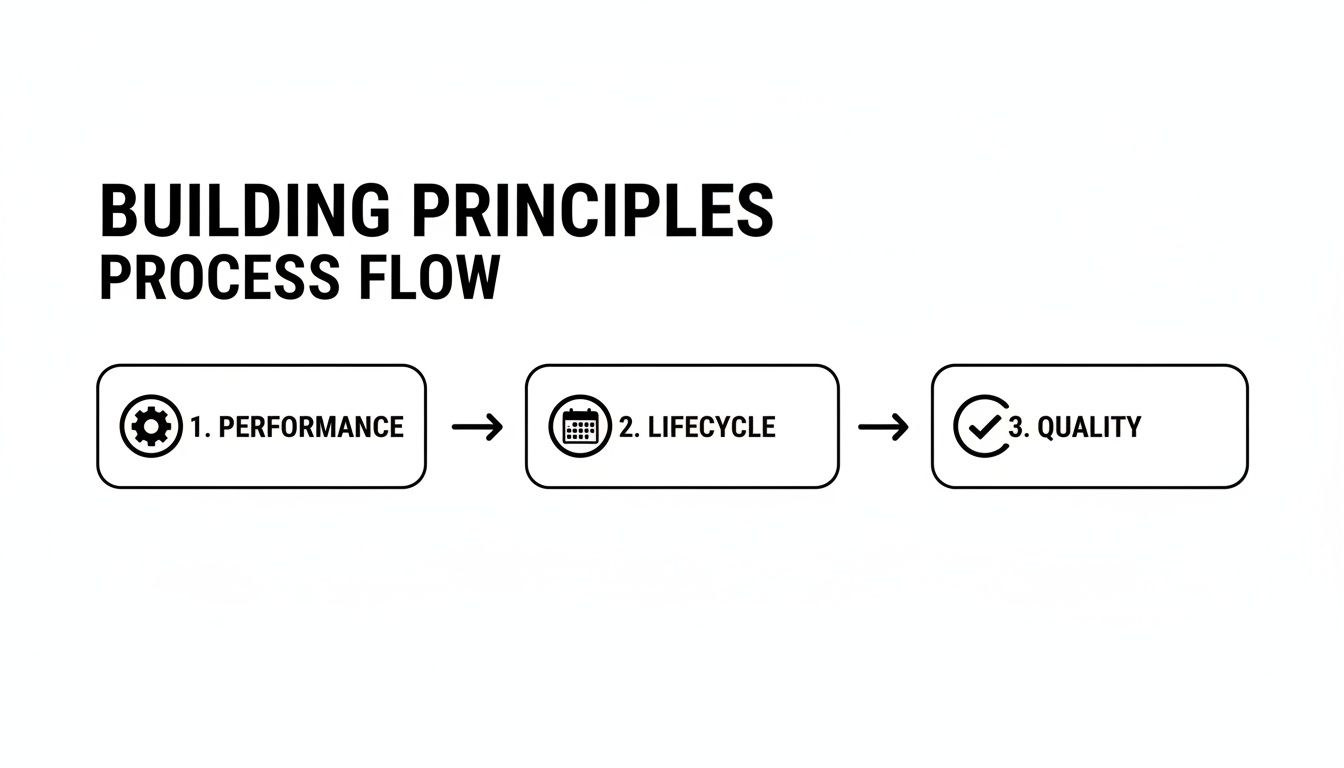
Phase 1: Information Gathering
The entire process kicks off with a deep dive into the project’s DNA. The value engineering team—a curated group of architects, designers, builders, and the client—gathers every last piece of information available. This means poring over architectural drawings, material specs, budgets, and, most importantly, the client’s vision and non-negotiables.
For a luxury home, this is about much more than square footage. We need to understand the feeling of the space. Is the goal a serene, minimalist retreat or a grand estate built for large-scale entertaining? Getting this foundation right is absolutely critical, as every decision from here on out will be measured against it. To see how this fits into the bigger picture, you can explore the steps involved in the architectural design process.
Phase 2: Function Analysis
With all the data in hand, the team gets to the heart of value engineering. Here, we dissect every single element of the project to define its primary and secondary functions, usually in a simple two-word, verb-noun format. For example, a window’s primary function is to “admit light,” while secondary functions could be to “provide view” or “block sound.”
This exercise strips away emotional bias and forces everyone to think about what each component truly does. A custom-designed, floor-to-ceiling glass wall might have the function “connect interior” and “display view.” By boiling it down to its core purpose, we open the door to brainstorming other ways to achieve the same result, often more efficiently.
Phase 3: Creative Brainstorming
This is where the magic really happens. With a crystal-clear understanding of function, the team lets loose in a no-holds-barred brainstorming session. The only question on the table is: “How else can we perform this function?”
Let’s say the original plans for a luxury residence specified an expensive, imported Italian stone facade to “project elegance.” In this creative phase, the team might throw out a dozen alternatives that could achieve the same function:
- A high-performance, locally sourced stone that has a similar aesthetic but with better availability and a lower carbon footprint.
- Advanced composite panels that perfectly mimic natural stone but are lighter, easier to install, and require far less maintenance.
- A specific type of architectural concrete that delivers a sophisticated, modern look at a fraction of the material and labor cost.
At this stage, no idea is a bad idea. The goal is to generate a massive pool of possibilities to evaluate later.
Phase 4: Evaluation and Development
Now, the team gets analytical. We systematically vet every idea from the brainstorming session against a clear set of criteria. Does it meet the functional requirements? What’s the lifecycle cost? How does it affect the schedule? And crucially, does it align with the client’s aesthetic vision?
The most promising ideas are then fleshed out into tangible proposals, complete with preliminary sketches, cost estimates, and performance data. This ensures that any change we recommend is a true value enhancement, not just a cost cut. The numbers back this up. The U.S. Army Corps of Engineers, for instance, reports over $4 billion saved on federal projects through these reviews. Across the industry, it’s not uncommon for VE to deliver 20-25% cost reductions, with lifecycle savings hitting as high as 40% by choosing more durable, efficient alternatives.
“A great value engineering proposal doesn’t just save money; it presents a smarter way to achieve the same, or even a better, outcome. It’s about elevating the project through intelligent substitution.”
Phase 5: Presentation and Implementation
Finally, the fully developed recommendations are formally presented to the client and key decision-makers. This isn’t just a list of cuts; it’s a clear, comparative analysis showing the original design, the proposed alternative, and a detailed breakdown of costs, benefits, and any potential trade-offs.
Once a proposal is approved, the changes are seamlessly integrated into the project plans, and the team moves forward with implementation. This structured, transparent approach is what turns thoughtful analysis into the real-world value that sets an exceptional luxury property apart.
Value Engineering in Action on Luxury Projects
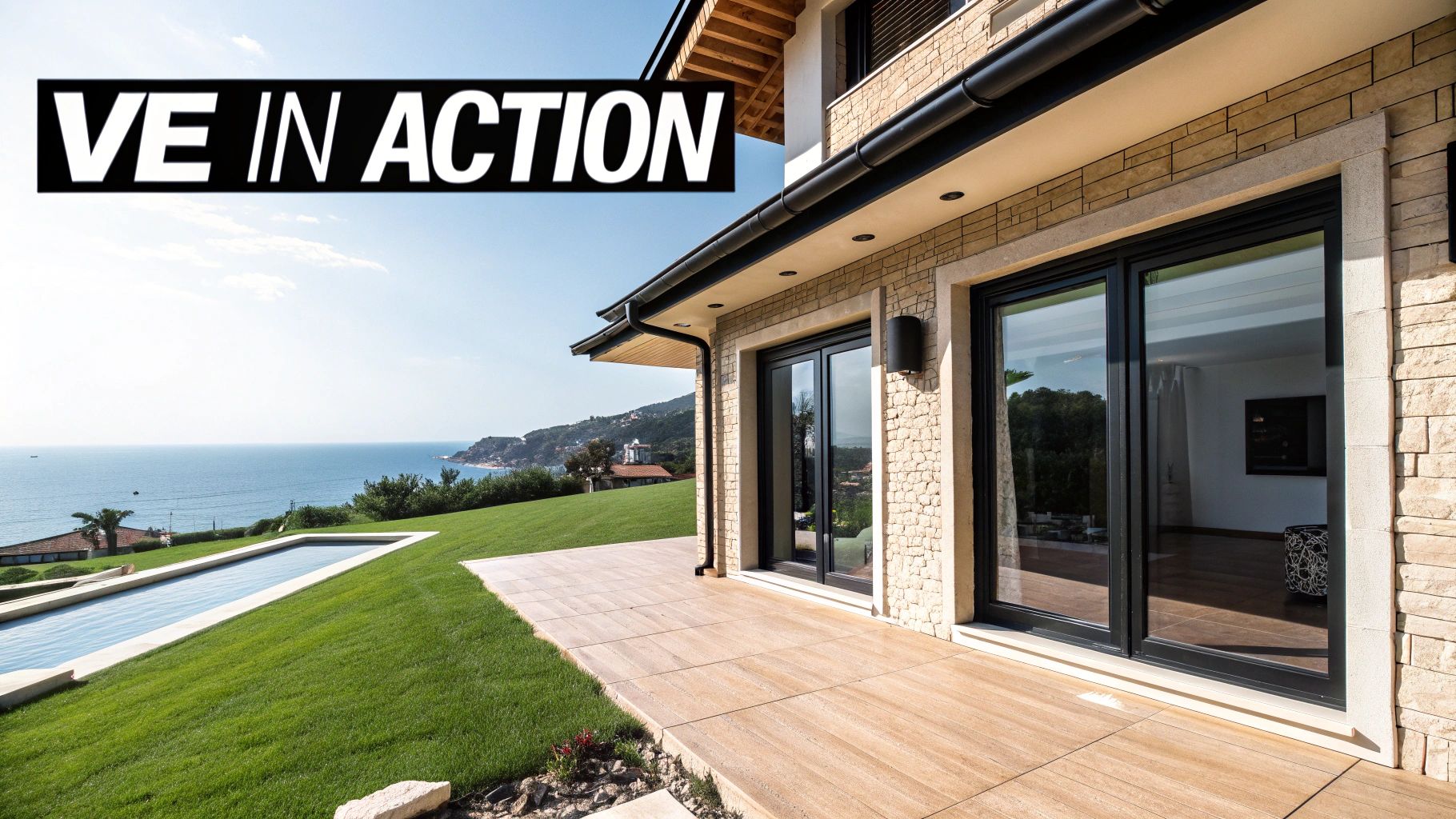
It’s one thing to talk about principles and processes, but it’s another to see them work magic on a real-world, high-stakes project. This is where value engineering truly shows its power. It’s not just about crunching numbers; it’s about delivering creative, tangible solutions that protect—and often elevate—the unique vision behind a luxury home.
Let’s step away from the theory and look at a few scenarios that show how this all plays out. These examples prove that you don’t have to choose between optimizing a budget and achieving stunning design. They can, and should, go hand-in-hand.
The Coastal Villa Window Dilemma
Picture this: a magnificent coastal villa, designed with vast walls of glass to capture every inch of the panoramic ocean view. The architect’s plans specified a premium European window brand, celebrated for its impossibly sleek, minimal frames. The problem? The cost was eye-watering, and the long lead times were putting the entire project timeline at risk.
This is where the value engineering team stepped in. They started by analyzing the core functions of the windows: “provide view,” “resist corrosion,” and “ensure insulation.” Instead of just hunting for a cheaper brand, they looked for an alternative that performed these specific functions exceptionally well.
Their deep dive uncovered a North American manufacturer that specialized in high-performance window systems built for harsh marine environments. This alternative was a game-changer.
- Superior Longevity: Its frames had a more robust, salt-resistant finish specifically engineered for coastal air, meaning lower long-term maintenance.
- Equivalent Aesthetics: The look was so close to the original European brand that the architect’s design intent was perfectly preserved.
- Significant Savings: The new system came in 15% below the original budget, and the shorter lead times brought the project schedule back from the brink.
In the end, value engineering didn’t just slash costs. It actually improved the home’s durability for the long haul while protecting the essential aesthetic. The process yielded a solution that was functionally superior for its specific setting.
The Minimalist Penthouse Structural Challenge
In another project, a minimalist penthouse featured a breathtaking open-plan living area. This design required long, uninterrupted spans supported by a complex structural steel frame. The initial engineering was sound, but it called for an enormous amount of heavy, custom-fabricated steel beams. This created a double-whammy: a strained budget and a logistical nightmare of craning materials to the top of a high-rise.
During a VE workshop, the team went back to the structure’s primary functions: “support load” and “create openness.”
By getting the structural engineer, architect, and steel subcontractor in the same room, the team fostered a collaborative environment where new ideas could surface. They weren’t just executing a plan; they were refining it together.
This brainstorming led to a breakthrough. By making subtle adjustments to a few non-load-bearing walls and tweaking the beam spacing, they completely optimized the structural grid. This new design cut the total steel tonnage by over 10% and allowed them to use more standard-sized beams.
The ripple effect was huge. It lowered material costs, simplified fabrication, and sped up the installation. Most importantly, the expansive, open-plan feel that the client dreamed of was perfectly intact. This integrated approach is a cornerstone of the modern custom home building process, where smart efficiency amplifies great design.
The Historic Estate HVAC Modernization
Our final example involves the intricate renovation of a historic estate. The mission was to integrate a cutting-edge, energy-efficient HVAC system without marring the home’s priceless period architecture. The first proposal was for a conventional system, which would have required large, intrusive ductwork—a non-starter.
The VE team defined the core functions as “provide comfort” while “preserving character.” This framing led them to propose a high-velocity, small-duct HVAC system. While the upfront equipment cost was slightly higher, its slender, two-inch ducts could be snaked through existing walls and ceilings with surgical precision.
This solution completely side-stepped the need for bulky soffits and massive plaster repairs, saving a fortune in restoration costs and, critically, preserving the home’s historic integrity. The result was a technologically advanced comfort system hidden completely from view. It was a perfect marriage of modern function and timeless form.
This kind of outcome isn’t an anomaly. Studies show that value engineering can deliver an average savings of 22% on a wide range of projects, proving its consistent impact.
Luxury Project VE Application Showcase
To pull these examples together, the table below summarizes how a focused VE approach turns complex challenges into elegant, high-value solutions. It’s a snapshot of the problem-solving power that defines this discipline.
| Project Type | Initial Challenge | Value Engineering Solution | Key Benefit Achieved |
|---|---|---|---|
| Coastal Villa | High cost and long lead times for specified European windows. | Sourced a high-performance North American alternative with superior corrosion resistance. | 15% cost savings, reduced lead time, and improved long-term durability. |
| Minimalist Penthouse | Excessive structural steel cost and complex high-rise logistics. | Optimized the structural grid, reducing steel tonnage and using standard beams. | 10% steel reduction, simplified installation, and preserved open-plan design. |
| Historic Estate | Intrusive HVAC ductwork threatened to damage historic interiors. | Proposed a high-velocity, small-duct system that fit within existing structures. | Preserved architectural integrity, avoided costly restoration, and delivered modern comfort. |
These case studies reveal a clear pattern: value engineering isn’t about finding the cheapest part. It’s about finding the smartest solution that delivers the best possible function and quality for the investment.
The Upside (and Downside) of Value Engineering
When you get value engineering right, it’s about so much more than just shaving dollars off the budget. It’s a strategic process that can genuinely elevate a project. But, like any powerful approach, it has to be handled with care. If misunderstood or mismanaged, it can cause more problems than it solves.
The most obvious win, of course, is a healthier bottom line. By systematically questioning how a design goal is achieved, the VE process often uncovers smarter, more efficient solutions that lead to significant savings on the initial build. These aren’t just random cuts; they’re intelligent choices.
The Real Benefits of a Value-Driven Approach
Beyond the upfront savings, a well-run VE process creates positive ripples that last for the entire life of the home. The benefits go way beyond the initial budget.
- A Better-Built Home: Questioning every assumption often leads to solutions that are not only less expensive but actually perform better. This could be as simple as choosing a more durable cladding material or specifying a more reliable HVAC system that delivers superior comfort.
- A Greener Footprint: The focus on lifecycle costs inherently points toward sustainability. A VE workshop might recommend high-performance windows that slash energy bills or suggest locally sourced stone that reduces the project’s carbon footprint. It’s about long-term value, not just short-term savings.
- A Faster Schedule: Finding and fixing design inefficiencies early on prevents those painful and expensive change orders during construction. A streamlined design using readily available materials can cut weeks or even months off the project timeline.
By truly understanding what determines luxury home construction costs, clients can see how value engineering strategically reallocates money toward the features and finishes that they will truly appreciate for years to come.
Avoiding the Common Traps and Missteps
For all its potential, value engineering has a dark side. The biggest risk is when it morphs into simple, unsophisticated cost-cutting. This is what happens when the team loses sight of preserving function and becomes obsessed with just lowering the price, often gutting the original design intent in the process.
When this goes wrong, you end up with a watered-down, compromised version of the architect’s vision. This is exactly why the architect and designer must have a central voice in the conversation, acting as guardians of the project’s soul.
The cardinal sin of value engineering is treating it as a last-ditch effort to save a busted budget. Real value is created through proactive analysis early in the design process—not reactive cuts made in a panic.
Timing is everything. Bringing in the VE team during the early schematic design phase gives everyone the most room to make meaningful changes without blowing up the budget or schedule. Trying to “value engineer” a project when the construction documents are nearly finished is a recipe for disaster, leading to expensive redesigns and frustrating delays.
The best way to sidestep these risks is to build a culture of genuine collaboration from day one. The client, architect, builder, and key consultants have to be in it together. The goal should never be to dilute the design, but to collectively find the most intelligent and efficient way to bring it to life. When that happens, value engineering acts as a shield, protecting both the budget and the architectural vision.
Putting Value Engineering to Work on Your Project
Knowing what value engineering is and actually putting it into practice are two different things. For architects, builders, and the high-net-worth clients they serve, the goal is to weave this process into the project’s fabric from the very beginning, not use it as a last-ditch effort to slash a bloated budget.
It’s all about shifting the conversation. Instead of asking, “How do we fix this budget?” the question becomes, “How do we build the most value from day one?” This fosters an environment where smart questions are encouraged and creative solutions can flourish. When you successfully integrate what is value engineering in construction into your workflow, it stops being a tool and becomes a guiding philosophy.
This proactive approach gives your team the power to deliver a final product that isn’t just built to spec, but is built with a deeper level of foresight and intelligence. The result is a home that perfectly captures the client’s vision in the most masterful and efficient way possible.
Your Actionable VE Checklist
To bring this methodology to your next luxury project, a structured approach is best. Use this checklist as a guide to ensure your team explores every opportunity to enhance value.
- Define ‘Value’ Early: Before the design is set in stone, sit down with the client for a serious conversation. What does “value” truly mean to them? Is it all about long-term durability and low running costs? Is it a particular aesthetic that must be achieved at all costs? Or is speed the primary driver? This definition will become the North Star for every decision that follows.
- Assemble a Diverse Team: A value engineering workshop thrives on different perspectives. Make sure the architect, interior designer, structural engineer, general contractor, and key subcontractors are all in the room. This is where the real magic happens, as cross-functional collaboration sparks the most innovative ideas.
- Time It Right: The sweet spot for a formal VE workshop is during the schematic design or early design development phase. At this point, the core decisions are still malleable. This makes it far easier and cheaper to implement smart changes without triggering a cascade of costly redesigns and delays.
- Focus on Function, Not Just Cost: Frame every discussion around one simple question: “What is this supposed to do?” By analyzing the core function of major systems and materials, you keep the conversation centered on finding better ways to achieve the goal, rather than just picking cheaper parts. This is the key to avoiding simple cost-cutting.
True luxury lies not just in opulence, but in the masterful execution of a vision. Value engineering is the discipline that ensures every dollar invested contributes directly to that masterful execution, eliminating waste and amplifying quality.
Finding a Facilitator and Measuring Success
For larger, more complex projects, it’s often wise to bring in an independent Certified Value Specialist (CVS). A trained facilitator can lead the workshop from a neutral standpoint, keeping the process on track and focused on creative problem-solving instead of letting it devolve into team members defending their initial design choices.
As for measuring the return on investment (ROI), it’s surprisingly straightforward. Just compare the total savings from the approved VE proposals to the cost of running the workshop itself (including any minor redesign fees). In nearly every case, the savings discovered will dwarf the initial investment, often by a factor of 10 to 1 or even more.
Ultimately, value engineering is a strategic partner in the pursuit of architectural excellence. It’s the process that ensures a remarkable vision is realized with the utmost intelligence, efficiency, and enduring value.
Common Questions About Value Engineering
When it comes to high-end custom homes, the term “value engineering” can raise a few eyebrows and a lot of questions. Homeowners, designers, and builders all want to know how it really works and what it means for their project. Let’s clear up some of the most common points of confusion.
When Is the Right Time for Value Engineering?
This is probably the single most important factor for success. For value engineering to have a real impact, it needs to happen early—ideally, during the schematic design phase. This is the stage where the big ideas are taking shape, but the blueprints aren’t set in stone. Things like the home’s layout, its orientation on the lot, and the core structural systems are still flexible.
If you wait until the construction documents are nearly complete, your hands are tied. Trying to swap out a major system or material at that point can cause a domino effect of expensive redesigns and frustrating delays. Getting the team together early allows for creative, high-impact changes that optimize the project without derailing the schedule.
Does Value Engineering Just Mean Using Cheaper Materials?
This is a huge and unfortunate myth. True value engineering is not about cutting corners or swapping high-end finishes for cheap knock-offs. It’s a much smarter, more disciplined process focused on maximizing value—which we define as Function divided by Cost. The entire goal is to preserve, or even enhance, the home’s function and quality while finding the most efficient way to achieve it.
For instance, a VE workshop might analyze the specified imported stone for a large patio. The team could discover a locally sourced stone that offers a nearly identical look but boasts superior durability in the local climate (an improved function) at a lower cost. This isn’t about being cheap; it’s about making an intelligent substitution that delivers better performance and financial sense without compromising the aesthetic.
Value engineering is a performance-focused discipline. It seeks the best possible outcome for the investment, ensuring every component contributes effectively to the project’s long-term quality and the client’s vision.
Who Sits at the Table in a Value Engineering Workshop?
A productive value engineering session is a team sport. You need a mix of experts in the room, each bringing a unique and vital perspective to the table. It’s this blend of viewpoints that leads to the best breakthroughs.
A typical VE team includes:
- The Client/Homeowner: They are the ultimate authority on the project’s vision and can clarify which elements are truly non-negotiable.
- The Lead Architect and Designer: As the creative stewards, they ensure that any proposed changes honor the original design intent.
- Key Engineering Consultants: The structural, mechanical, and electrical engineers who understand the technical performance of the home’s critical systems.
- The General Contractor: Their on-the-ground experience is invaluable for insights on buildability, labor costs, and material lead times.
Often, this group is led by a professional VE facilitator or a Certified Value Specialist (CVS). Having an independent expert guide the process keeps everyone objective and focused on finding the best solutions, rather than just defending their initial decisions.
At Haute Design, we connect you with professionals who understand how to merge visionary design with intelligent construction practices. Discover architects, builders, and designers who can bring exceptional value to your next project.