


If you’ve ever wondered, “what is interior architecture?”, here’s a simple way to think about it: it’s the art and science of shaping our experience inside a building. It’s a field that works with the very “bones” of a structure—the walls, ceilings, light, and the paths we walk—to create spaces that feel logical, safe, and functional, not just beautiful.
Defining Interior Architecture: The Art and Science of Space
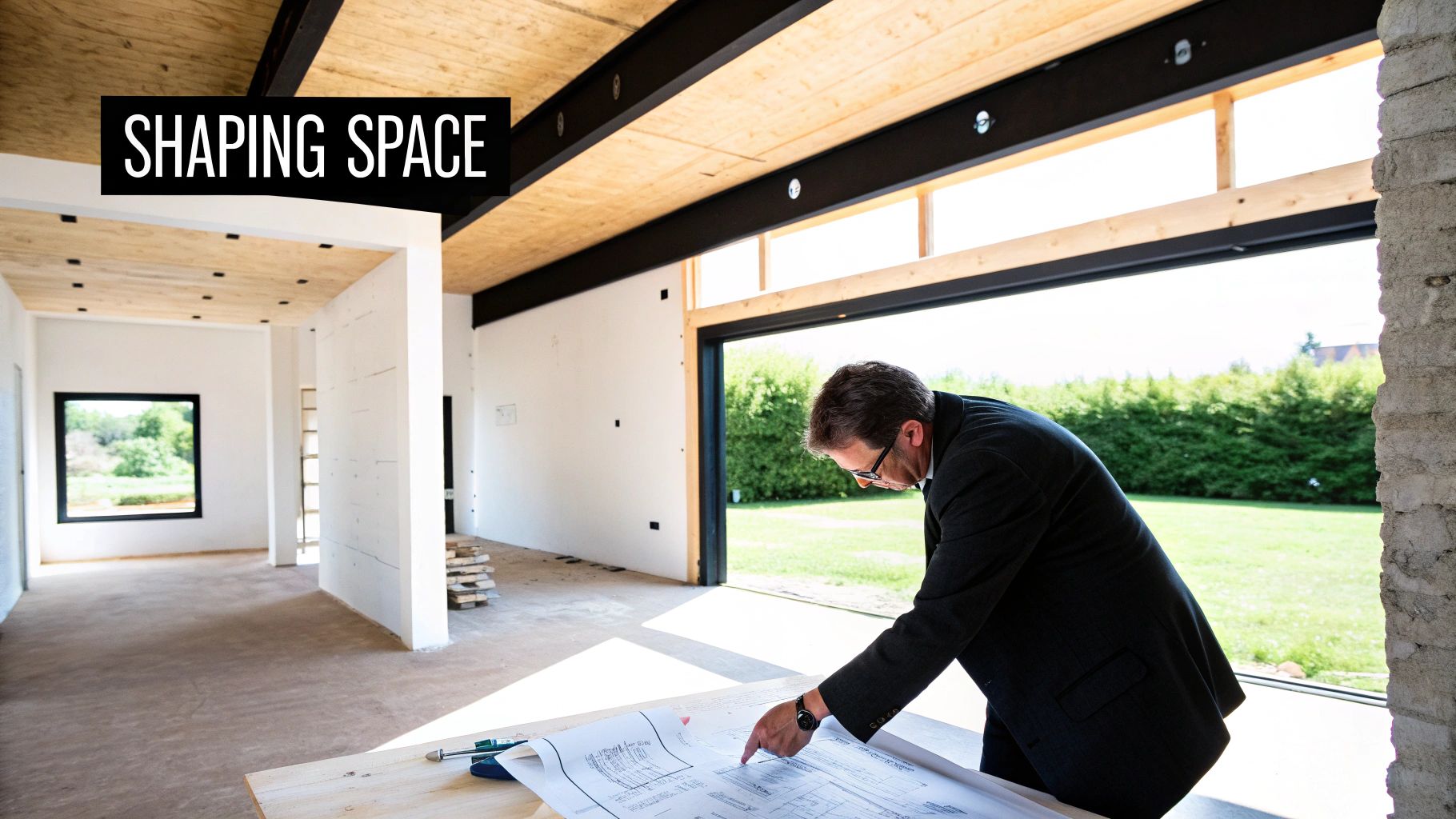
Interior architecture is about reshaping an interior by working with its structural elements, spatial volume, and surfaces. This goes so much deeper than decoration. The focus is on the technical and creative process of turning an empty shell into a space with a clear purpose, making sure every component supports the people who will use it.
Think of an old, empty industrial warehouse. Where most of us see cold concrete and exposed beams, an interior architect sees potential. They’re already envisioning how a mezzanine could create a second level, where new walls could define private offices versus open, collaborative areas, and how to route all the essential electrical and plumbing for a new kitchen and restrooms. That’s the work in a nutshell.
The Core Mission of an Interior Architect
At its heart, this discipline is a real blend of creativity and hard technical skill. An interior architect has to understand how a building is put together before they can safely or effectively change it.
Their mission really comes down to a few key responsibilities:
- Spatial Problem-Solving: Looking at a building’s layout and figuring out how to improve its flow, usability, and the overall experience for anyone inside.
- Structural Understanding: Working with load-bearing walls, ceiling heights, and building systems is non-negotiable for making smart structural changes.
- Code Compliance: Ensuring every single modification meets strict building codes, safety regulations, and accessibility standards like the ADA.
- Material Science: Choosing materials for how they perform, not just how they look. This includes durability, acoustics, and how they interact with light.
To better understand these focus areas, the table below breaks down the primary components that define the field.
Core Components of Interior Architecture
| Component | Description |
|---|---|
| Spatial Planning | The strategic arrangement of rooms, circulation paths, and open areas to optimize flow, function, and human interaction within a building. |
| Structural Integration | The modification of non-load-bearing and sometimes load-bearing elements, requiring a deep understanding of the building’s structural grid. |
| Building Systems | The integration and routing of HVAC, electrical, plumbing, and data systems to support the interior’s new function. |
| Materiality & Finishes | The selection of surface materials for walls, floors, and ceilings based on performance criteria like durability, acoustics, and safety. |
| Code & Accessibility | The adherence to building codes, fire safety regulations, and accessibility standards to ensure a safe and inclusive environment. |
This table really highlights how interior architecture is a technical discipline just as much as it is a creative one, bridging the gap between a building’s shell and the life that happens inside it.
The Art and Science Connection
This specialized field is where the artistic vision for a space meets the scientific reality of making it happen. While it feels like a modern profession, its roots trace all the way back to the Renaissance, when the inside of a building finally started getting as much design attention as its exterior. You can find plenty of great insights about the evolution of interior spaces and design statistics online that show this progression.
The true measure of great interior architecture is when a space feels so natural and intuitive that you don’t even notice the complex decisions that made it possible. It’s about creating an experience, not just a look.
Ultimately, interior architecture is the crucial link between a building’s structure and the human experience within it. It’s the discipline that ensures the inside is as intelligent and thoughtfully designed as the outside, crafting a complete and cohesive environment from the inside out.
A Brief History of Interior Architecture
The idea of “interior architecture” might sound new, but the practice is as old as the first roof built over a human head. While we only gave it a formal name recently, the art of shaping indoor spaces has been with us since the beginning. Early on, it was all about survival—creating shelter that was safe, functional, and kept the weather out.
Think about the tombs of ancient Egypt or the sprawling atriums in Roman villas. These weren’t just buildings; they were early examples of spaces designed with a purpose. The focus was always on how the structure itself—the walls, the openings, the sheer volume—influenced what happened inside. Whether for a religious ceremony or to project social power, the interior was a direct result of the building’s bones, not an afterthought.
The Renaissance: When the Interior Found Its Voice
The Renaissance was a major turning point. With a new explosion of art and human-centric thinking, the inside of a building became just as important as the outside. The interiors of palaces and churches were transformed into grand statements of wealth, power, and beauty.
Architects of the time, like Filippo Brunelleschi, weren’t just drawing up floor plans for buildings; they were masterminding the experience within. They obsessed over internal volumes, sightlines, and the feeling of proportion. This was the moment structural form and decorative beauty truly merged.
- A Unified Vision: Walls, floors, and ceilings were no longer just functional parts. They became canvases for frescoes and intricate carvings, all part of a single, cohesive design.
- Designing for People: Architects rediscovered classical principles of harmony, crafting spaces that felt both monumental and perfectly scaled to the people using them.
This period set the stage for seeing an interior not just as a container, but as a deliberately designed experience.
This was the critical shift: the realization that the feeling you get inside a building is as vital as how it looks from the street. Interior architecture was no longer a byproduct of construction; it was becoming a central part of the whole idea.
The Industrial Revolution and the Modern Era
Fast-forward to the 18th and 19th centuries, and the Industrial Revolution changed everything. New materials like steel, cast iron, and large sheets of glass blew the doors off what was possible. Suddenly, architects could design enormous, open-plan interiors and build them with incredible new efficiency.
This leap in technology laid the perfect groundwork for the modernist movements that followed. Icons like Le Corbusier, Mies van der Rohe, and Frank Lloyd Wright introduced a radical new idea: “form follows function.” This simple phrase became the heart of modern interior architecture. They stripped away the fussy, historical decoration and instead focused on clean lines, open spaces, and letting the materials speak for themselves.
Frank Lloyd Wright is a perfect example. He didn’t just design a house; he orchestrated the entire experience of living in it. He saw the interior and exterior as one seamless entity, with rooms flowing effortlessly into one another and out into the landscape.
This was the era that cemented interior architecture as its own respected field. The focus had shifted for good. It was no longer about just decorating a space, but about designing the very space itself to be functional, efficient, and good for the human psyche. This journey through time shows us exactly what interior architecture is today: a sophisticated blend of art and science dedicated to crafting the entire human experience within a building’s shell.
Interior Architecture vs. Interior Design: What’s the Real Difference?
It’s one of the most common points of confusion out there: what separates interior architecture from interior design? The terms get thrown around interchangeably all the time, but they’re actually two very different disciplines. Each has its own unique scope, skillset, and training, and knowing which one you need is the first step in any successful project.
Here’s a simple way to think about it. The interior architect is like a sculptor, while the interior designer is the stylist.
The sculptor works with the raw form—the stone or clay itself. They carve away material, add mass, and reshape the fundamental structure to define its shape, volume, and integrity. This is the interior architect, working with the “hard” stuff: walls, doorways, plumbing, electrical systems, and the overall flow of the building.
The stylist comes in once the sculpture is complete. They choose the lighting that best highlights its features, the pedestal it sits on, and the colors in the room that make it pop. This is the interior designer, who focuses on the “soft” finishes—furniture, textiles, paint, and decor—that bring the space to life.
The Foundation: Education and Technical Skill
The two paths diverge right from the beginning, starting with education. Interior architecture is rooted in the principles of architecture itself. Professionals in this field almost always have a degree in architecture or interior architecture, which means they’ve gone through years of intense training in structural engineering, building codes, material science, and construction technology. Their education is highly technical, centered on safety, function, and the permanent parts of a building.
Interior design programs, on the other hand, place a much stronger emphasis on aesthetics, art history, furniture design, and color theory. While they absolutely learn about space planning, they are trained to operate within the existing architectural shell. This is the key difference: an interior architect can design the shell itself, while an interior designer works within it.
An interior architect asks, “Where should this wall go to improve the flow and function of the entire floor?” An interior designer asks, “What color should we paint this wall, and what sofa should go in front of it?” Both questions are vital, but they address entirely different layers of the design process.
On the Job: Scope of Work
Nowhere is the difference clearer than in what each professional actually does on a project. An interior architect gets involved right at the start, often working alongside the building architect or taking the lead on a major gut renovation.
Their work involves things like:
- Structural Modifications: They have the know-how to move or remove walls. They can reconfigure a floor plan entirely, working with structural engineers when load-bearing elements are involved.
- Deep Spatial Planning: This isn’t just about where the sofa goes. This is about relocating a kitchen, combining small rooms into an open-plan living area, or carving out a new bathroom where a closet used to be.
- Integrating Building Systems: They are responsible for mapping out the new pathways for essential systems like HVAC, plumbing, and electrical to support the redesigned layout.
- Code Compliance and Permits: A massive part of their role is producing the technical drawings needed to get building permits. They ensure every change meets local building codes, fire safety regulations, and accessibility standards.
An interior designer usually steps in after the construction dust has settled. Their focus is on finishing the space to make it beautiful, comfortable, and a true reflection of the client’s personality. While their contribution is what makes a house feel like a home, a designer isn’t typically equipped to handle structural changes. If you’re starting a project, it’s worth understanding their specific role. Our guide on how to hire an interior designer breaks down what they bring to the table.
To make it even clearer, let’s look at a direct comparison.
Interior Architecture vs. Interior Design: A Head-to-Head Comparison
This table breaks down the fundamental distinctions between the two professions, from their core focus to their daily tasks.
| Aspect | Interior Architecture | Interior Design |
|---|---|---|
| Primary Focus | The structure, function, and flow of interior space. Modifying the “bones” of a building. | The aesthetics, furnishing, and decoration of an interior space. Finishing the “surface” of a room. |
| Core Skills | Technical drawing (CAD/BIM), structural knowledge, building codes, systems integration, space planning. | Color theory, material selection, furniture layout, styling, vendor management. |
| Education | Typically a degree in architecture or interior architecture, with a strong technical and engineering focus. | Often a degree or certificate in interior design, with a focus on art, history, and decorative principles. |
| Project Scope | Involves moving walls, altering layouts, planning electrical/plumbing, and obtaining permits. | Involves selecting furniture, paint, lighting fixtures, window treatments, and accessories. |
| Collaboration | Works closely with architects, structural engineers, and contractors on the building’s permanent elements. | Works with homeowners, furniture suppliers, painters, and installers on the movable and decorative elements. |
So, what is interior architecture? It’s the critical link between a building’s raw structure and its final, polished state. Both professions are absolutely essential for creating an incredible home, but they work at different depths. The interior architect sets the stage, and the interior designer crafts the scene that unfolds upon it.
The Interior Architect’s Process from Concept to Reality
Taking a raw space and turning it into a truly resolved environment is a meticulous journey. It’s so much more than just decorating a room. The interior architecture process is a disciplined sequence of analytical and creative phases, bridging a client’s vision with the hard realities of construction. Think of it as a collaborative effort demanding precision, foresight, and a deep, almost intuitive understanding of how people will actually live and move within the built environment.
This whole process kicks off long before a single wall is moved or a material sample is ordered. It starts with a conversation—a deep dive into the client’s needs, their aspirations, and the real-world problems the project needs to solve. This initial discovery phase is the bedrock upon which everything else is built.
Phase 1: Initial Consultation and Site Analysis
The first real step is what we call Programming and Feasibility. This is where the interior architect sits down with the client to define the project’s scope, goals, budget, and timeline. It involves asking the tough questions to understand not just what the client wants, but why they want it. What will happen in this space every day? What feeling should it evoke?
Immediately following that, a thorough Site Analysis begins. The architect meticulously measures and documents every inch of the existing space, noting structural columns, plumbing stacks, electrical systems, and the quality of natural light. This technical audit reveals both the hidden opportunities and the potential constraints of the space, creating a realistic foundation for the design to come.
An interior architect doesn’t just see a room; they see a system of interconnected elements. The initial analysis is about understanding this system completely before attempting to change any part of it.
Phase 2: Conceptual and Schematic Design
With a solid grasp of the project’s goals and its physical limitations, the Conceptual Design phase begins. This is where the big, broad ideas start to take shape. The architect will develop rough sketches, bubble diagrams, and mood boards to explore spatial relationships and define the aesthetic direction. It’s all about solving the big-picture puzzle of how the space will function as a whole.
From there, we move into Schematic Design, where those concepts become much more concrete. The architect translates the initial ideas into scaled floor plans and basic 3D models. This is a crucial checkpoint for the client, allowing them to truly visualize the proposed layout and flow before more detailed—and costly—work begins. It’s at this stage that the core principles of space planning are put into practice, creating a logical and efficient arrangement of rooms and pathways. If you’re curious about this critical step, digging into an interior design space planning guide can offer a deeper look at how professionals organize and optimize floor plans.
This infographic helps clarify the distinct responsibilities of an interior architect versus an interior designer.

As you can see, the architect’s process is fundamentally rooted in the structural and technical DNA of the building itself.
Phase 3: Design Development and Construction Documents
Once the schematic design gets the green light, the project moves into Design Development. Here, the approved layout is refined with an incredible level of detail. The architect selects specific materials, fixtures, and finishes, carefully considering their durability, performance, and, crucially, their compliance with building codes.
Next, the architect produces the Construction Documents. This is arguably the most technical and critical phase of the entire process. These aren’t just drawings; they are a comprehensive set of instructions and specifications that tell the contractor exactly how to build the project, down to the last screw.
This detailed set of blueprints typically includes:
- Demolition Plans: Showing precisely which existing elements are coming out.
- Construction Plans: Detailing new walls, doors, and any structural changes.
- Reflected Ceiling Plans: Indicating the exact placement of lighting, HVAC vents, and ceiling details.
- Electrical and Plumbing Plans: Mapping out every outlet, switch, pipe, and fixture.
These documents are the legal and technical backbone of the project, essential for securing building permits and getting accurate bids from contractors.
Phase 4: Construction Administration
The final phase is Construction Administration, and it’s a common misconception that the architect’s job is done when the drawings are handed over. Far from it. Throughout the build, they act as the client’s advocate, visiting the site regularly to ensure the contractor is executing the design faithfully. They answer questions, solve the inevitable unforeseen problems that crop up on-site, and review the quality of the work.
This hands-on oversight ensures the project stays on time, on budget, and is finished to the highest possible standard. It’s what guarantees the initial vision becomes a flawlessly executed reality.
Real-World Impact of Interior Architecture

It’s one thing to talk about theories and drawings, but the true value of interior architecture really comes to life when you see its effect on the spaces we occupy every day. This isn’t just about making things look good. It’s about solving complex spatial puzzles that have a direct impact on our productivity, our well-being, and even the financial value of a property.
From homes to offices to public buildings, interior architecture fundamentally shapes how we experience the world from the inside out.
Take the popular trend of converting old industrial warehouses into modern lofts. This is a classic example of interior architecture at its best. An interior architect isn’t just picking out furniture; they’re analyzing the building’s raw bones and figuring out how to make it not just livable, but truly desirable.
They have to solve real problems. How do you get natural light deep into a massive, cavernous space? Where do you build walls to create private bedrooms without losing that iconic open-loft feel? How do you weave modern plumbing and electrical systems into a structure that’s over a century old?
This work is all about intelligent adaptation, not just preservation. The architect respects the building’s soul while crafting a home that’s functional, safe, and inspiring. The result is a space that doesn’t just look amazing—it works on a deeply practical level.
Enhancing Commercial and Public Spaces
The same principles apply with equal force in the commercial world. In office design, for example, thoughtful spatial planning can lead to measurable jumps in productivity and employee happiness. An interior architect can transform a cramped, outdated office into a dynamic environment with a mix of collaborative zones, quiet nooks for deep focus, and comfortable breakout areas.
This goes far beyond just moving desks around. It requires a genuine understanding of:
- Acoustic Control: Using specific materials and structural layouts to dampen noise and cut down on distractions in an open office.
- Circulation and Flow: Designing intuitive pathways that prevent bottlenecks and make moving through the space feel natural and effortless.
- Accessibility: Making sure every corner of the environment is fully ADA-compliant, creating a space that’s welcoming and usable for everyone.
By focusing on these core structural and spatial elements, a business can create a workplace that doesn’t just look impressive but actively helps it achieve its goals.
Great interior architecture solves problems you didn’t even know you had. It makes a space feel right by optimizing light, sound, and movement in ways that quietly improve your daily life.
You see this in public spaces, too. In a hospital or an airport, interior architecture is mission-critical for managing huge crowds and keeping stress levels down. Clear signage, logical layouts, and durable, code-compliant materials aren’t just decorative choices—they are essential functional requirements that keep people safe and the building running smoothly.
Driving Value and Well-Being
It’s no surprise that the global interior design market, where interior architecture plays a huge role, is booming. This growth is driven by increasing urbanization and a post-pandemic shift toward creating homes that can do it all.
This trend also shines a light on the growing importance of sustainability. A well-planned interior can slash a building’s energy consumption by up to 50%.
Ultimately, the impact of interior architecture is measured in two key ways: improved quality of life and increased asset value. For a homeowner, a smart renovation can make daily living better while delivering a fantastic return on investment. For a business, a well-designed space becomes a powerful tool for attracting top talent and broadcasting its brand identity.
This discipline bridges the gap between a building’s potential and its actual performance, proving that the best spaces are always designed from the inside out. And as technology keeps moving forward, we’re seeing even more exciting possibilities, as you can see in how AI is reshaping luxury interior architecture.
Building a Career in Interior Architecture
If you’re drawn to the unique intersection of art and science, a career in interior architecture could be an incredibly rewarding path. It’s a field that calls for a special blend of creative vision and technical precision, all built on a foundation of rigorous training. That journey really starts with the right education.
Most aspiring professionals will need a degree from an accredited program—think a Bachelor or Master of Architecture, or a specialized degree in interior architecture. This isn’t just about color theory and furniture placement; this is deep-level training in structural principles, building systems, and the complex science of spatial theory.
The Path to Professional Licensure
Unlike a lot of creative careers, interior architecture is a regulated profession where your credentials carry serious weight. After graduating, the next step is to log several years of real-world work experience, typically under the guidance of a licensed professional. This is where you translate everything you learned in the classroom into practical, hands-on skills.
From there, the goal is professional licensure. The gold standard in North America is the National Council for Interior Design Qualification (NCIDQ) exam. It’s a tough, three-part test that proves you’ve mastered the critical health, safety, and welfare standards required to practice at the highest level.
Becoming a licensed interior architect isn’t just about getting a title. It’s a formal commitment to public safety and professional integrity. It tells the world you have the proven expertise to alter a building’s interior so that it’s not only beautiful but also structurally sound and up to code.
Essential Skills and Career Outlook
To succeed in this field, you need a diverse toolkit. Technical skills are absolutely essential. You’ll need to be fluent in software like AutoCAD for 2D drafting and Building Information Modeling (BIM) programs like Revit for creating intricate 3D models. But the tech is just one piece of the puzzle; a deep knowledge of building codes, material science, and accessibility standards is just as important.
The good news is that the career outlook is strong, with opportunities popping up in all sorts of sectors. Graduates often land roles in:
- Architectural Firms: Working on major new construction projects where interior spaces are integrated right from the start.
- Specialized Interior Architecture Studios: Focusing on bespoke projects like high-end residential remodels, commercial office fit-outs, or boutique hotels.
- In-House Corporate Teams: Designing and managing the spaces for large companies, retail chains, or healthcare systems.
Demand continues to rise for professionals who can craft interiors that are functional, sustainable, and genuinely inspiring. In fact, the U.S. workforce for interior design and architecture professionals has more than doubled, growing from 60,067 in 2015 to a projected 128,509 by 2025. This boom shows just how much we’ve come to value well-designed spaces that truly enhance our lives. You can learn about the industry’s growth on Homes.com to explore this trend further.
A Few Common Questions About Interior Architecture
Diving into a major renovation or new build can feel overwhelming, and it’s easy to get tangled up in the terminology. To help clear things up, let’s walk through a few of the most frequent questions people ask about this specialized field.
When Should I Bring in an Interior Architect Instead of an Interior Designer?
Think of it this way: if your project involves moving walls, you need an interior architect. Their expertise is essential anytime you’re making structural changes to the building. This could mean anything from knocking down a wall to combine two rooms, creating a new doorway, or completely reconfiguring a floor plan.
If your project is about bringing a finished space to life—selecting furniture, choosing paint colors, sourcing fabrics, and arranging decor—then an interior designer is the expert you’re looking for. They focus on the aesthetic layer that makes a space feel like home, without altering its fundamental structure.
What Is the Real Value an Interior Architect Brings to a Project?
The single greatest value they add is the ability to see and solve problems within the very “bones” of a space. They don’t just decorate a room; they fundamentally reshape it to improve how it works, how it feels, and how people move through it. An interior architect can completely change the way natural light fills a home or solve an awkward layout that’s been a problem for years.
Their real value lies in creating spatial harmony. An interior architect ensures the core structure of your space functions beautifully, which not only enhances your daily life but also significantly increases the property’s long-term worth.
How Do Interior Architects and Building Architects Collaborate?
On a new build, they are partners from day one. The building architect designs the external shell—the overall form, foundation, and roofline—while the interior architect takes charge of crafting the human experience inside that shell.
They work in tandem to make sure the interior layout is perfectly synchronized with the building’s main structure. This collaboration ensures that everything from window placement to the routing of plumbing and electrical systems is thoughtfully integrated, creating a truly cohesive design from the outside in. This teamwork prevents expensive revisions down the road and leads to a far more intelligent and well-resolved building.
Ready to find a professional who can bring your vision to life? Explore the curated network at Haute Design to connect with the nation’s leading architects and designers. Discover your perfect match on hauteliving.com/designnetwork.