


At its core, design-build construction is a project delivery method that brings everyone to the same table from the very beginning. Instead of hiring an architect and then separately finding a builder, you engage a single, unified team under one contract to handle the entire project—from the first sketch to the final walkthrough.
This integrated team—combining designers, architects, engineers, and construction professionals—works together from day one. Think of it as having one master builder who is responsible for the entire vision and its execution, rather than hiring separate artists and craftsmen who may have conflicting ideas.
Understanding The Design Build Construction Model
To really grasp what makes design-build different, it helps to look at the traditional method, often called design-bid-build. In that model, the process is linear and disconnected. The owner hires an architect to draw up a full set of plans. Once those plans are 100% complete, they’re sent out for general contractors to bid on the job.
This old-school approach almost guarantees a fragmented process. The architect and builder operate in separate silos, which often leads to friction when a beautiful design runs into the practical realities of construction. It’s a setup ripe for communication breakdowns, costly change orders, and a whole lot of finger-pointing when things go wrong, with the owner stuck in the middle.
A Unified Approach To Building
Design-build completely flips that script. By uniting the design and construction phases under one roof, it creates a collaborative environment from the get-go. There’s one contract, one team, and one shared goal: bringing the client’s vision to life on time and on budget.
This single point of responsibility is the true power of the design-build model. The owner has one point of contact, and that team is accountable for everything.
When designers and builders are in the same room from the start, problem-solving becomes a creative, collective effort. The entire dynamic of the project shifts from adversarial to cooperative.
The Impact Of Single Source Responsibility
Having construction experts involved during the design phase is a game-changer. They provide immediate, practical feedback on material costs, scheduling, and constructability. This early collaboration ensures the design aligns with the budget, preventing the all-too-common scenario of falling in love with a design you can’t actually afford to build.
To break it down even further, here are the foundational elements that define the design-build process.
Core Principles Of Design Build Construction At A Glance
| Principle | Description | Impact on Project |
|---|---|---|
| Single Contract | The owner signs one contract with a single entity for both design and construction. | Simplifies communication and eliminates owner-mediated disputes between architect and builder. |
| Integrated Team | Designers and constructors work together from the project’s inception. | Fosters collaboration, innovation, and proactive problem-solving. |
| Owner-Centric | The process is built around the owner’s goals, budget, and timeline. | Ensures the final product truly reflects the client’s vision and financial parameters. |
| Shared Risk | The design-build team assumes the risk for both design and construction execution. | Reduces the owner’s risk exposure and provides cost and schedule certainty. |
Ultimately, these principles work together to protect the client’s investment and vision.
The core advantage of the design-build model is its inherent accountability. With one team responsible for both design and execution, the focus shifts from assigning blame to finding collaborative solutions, which protects the client’s timeline, budget, and vision.
This shift isn’t just a trend; it’s a fundamental change in how high-end projects are being delivered. Industry data shows that design-build is projected to account for $1.9 trillion in construction spending from 2022 to 2026. Forecasts even suggest it could represent up to 47% of the entire U.S. construction market by 2026.
This growing preference highlights a clear move toward a smarter, more integrated way to build. You can learn more about these construction market trends and see the full analysis behind the numbers.
Comparing Design-Build With Traditional Construction Methods
To really get a feel for the design-build model, it helps to put it side-by-side with the more established ways of getting things built. The most familiar alternative is Design-Bid-Build (DBB), which is the classic, step-by-step approach where design and construction are completely separate phases.
In the DBB world, you start by hiring an architect to draw up a complete set of plans. It’s only when that design is 100% finished that you take those blueprints and shop them around to general contractors, who then bid on the job. This linear path seems logical enough, but in practice, it often sets the stage for a fragmented and sometimes combative process.
Think about it: the builder has zero input while the plans are being drawn. This frequently leads to conflicts when the architect’s vision runs into the hard realities of construction. It’s the perfect setup for the infamous “blame game,” with the architect and builder pointing fingers at each other over surprise costs or delays—leaving you stuck right in the middle.
The Design-Bid-Build Approach
The fundamental problem with DBB is that everyone works in their own silo. The owner contracts with each party separately, creating a dynamic where protecting one’s own interests can easily overshadow collaborating for the good of the project. A builder’s main job is simply to build what’s on the page for the price they bid, not to find smarter or more cost-effective ways to do it during the design phase.
This separation can lead to some serious headaches:
- Costly Change Orders: When a design detail turns out to be impractical or far more expensive to build than anyone thought, any change from the original plans requires a formal—and almost always expensive—change order.
- Extended Timelines: The whole process is sequential by nature, from design to bidding to building, which just takes longer. In fact, projects delivered via design-build are completed up to 102% faster than those using DBB.
- Increased Owner Risk: You, as the owner, end up being the referee between two separate teams. You carry all the risk for any gaps or mistakes between the design documents and what actually gets built.
Understanding Construction Management at Risk
Another popular method is Construction Management at Risk (CMAR). This model is more of a hybrid, trying to find a middle ground between DBB and design-build. In a CMAR setup, you hire both an architect and a construction manager (CM) early in the design phase.
The CM essentially acts as a consultant, offering feedback on buildability and cost estimates. The key difference, however, is that the architect and CM still have separate contracts with you. While this early collaboration is a definite improvement over DBB, it doesn’t create a truly unified team. The ultimate responsibility is still divided, which can cause friction when major challenges pop up.
A Clear Side-By-Side Comparison
Choosing a project delivery method is one of the most important decisions you’ll make, as it shapes everything from communication and risk to the final product. Looking at these three models side-by-side really clarifies their differences.
Design-Build vs. Design-Bid-Build vs. CMAR
| Attribute | Design-Build | Design-Bid-Build (DBB) | CMAR |
|---|---|---|---|
| Contract Structure | One contract with a single firm for both design and construction. | Two or more separate contracts (owner-architect, owner-builder). | Separate contracts for the designer and the construction manager. |
| Team Dynamic | Fully integrated and collaborative team from day one. | Sequential and often adversarial; builder is not involved in design. | Collaborative during design, but key parties remain separate entities. |
| Accountability | Single point of responsibility rests with the design-build firm. | Responsibility is divided; owner mediates disputes. | Divided responsibility between the architect and the CM. |
| Risk Management | The design-build team assumes the majority of the risk. | The owner carries significant risk for design errors and omissions. | Risk is shared between the owner and the CM. |
At the end of the day, the choice comes down to how your team is structured and who is ultimately responsible for what.
The fundamental distinction lies in where the responsibility lies. In design-build, the team is contractually obligated to work together to solve problems. In other models, the structure itself can create conflict, placing the burden of resolution squarely on the owner.
The global construction market, currently valued at over $15.78 trillion, is projected to soar to $20.44 trillion as cities expand and infrastructure demands grow. In this booming environment, the efficiency of design-build becomes incredibly appealing. It offers faster timelines and better cost control in an industry grappling with labor shortages and volatile material prices. You can explore the full scope of these industry projections for a deeper dive. This growth highlights why understanding what design-build construction is, and how it stacks up against traditional methods, is so crucial for anyone planning a luxury project.
The Key Advantages For Luxury Building Projects
When you’re building a high-end home, the experience itself has to match the quality of the final product. Clients investing in luxury expect more than just beautiful materials and finishes; they need a process that feels controlled, predictable, and free from the friction that so often plagues traditional construction projects. This is where the design-build model truly shines.
It all comes down to one fundamental shift: putting the architect and builder on the same team, under one contract, from the very beginning. This isn’t just a minor tweak in paperwork—it completely changes the dynamic. Instead of design and construction operating in separate, often conflicting worlds, they collaborate from the moment the first sketch is drawn. Every design idea is immediately weighed against its real-world cost and practicality.
This early, unified approach creates an environment where creativity can flourish without flying off the rails. It’s a space where ambitious ideas are met with constructive, real-time feedback on how to actually make them happen.
Fostering True Innovation and Creativity
Think about this common scenario: an architect designs a breathtaking cantilevered terrace. In a traditional project, this idea gets fully fleshed out in the blueprints. It’s only much later, when builders start bidding, that everyone discovers the structural work required will blow the budget by 20%. What follows is a painful cycle of disappointment, redesigns, and delays.
Now, imagine that same meeting with a design-build team. The builder is right there as the architect sketches the terrace. They can immediately jump in, perhaps suggesting a more efficient structural system or a different material that delivers the same aesthetic without the exorbitant cost. This kind of collaborative problem-solving turns potential roadblocks into moments of innovation. The result is a home that’s both visionary and viable.
By bringing design and construction expertise together from day one, design-build bridges the gap between what can be imagined and what can realistically be built. This synergy is the engine for a more creative, efficient, and ultimately more successful project.
This integrated model is proving its worth across the board. The U.S. construction market, valued at $1.77 trillion, is expected to climb to $2.52 trillion by 2030. A lot of that growth is happening in complex fields where design-build has become the standard, like data centers and advanced manufacturing, which saw spending jump 20% in a single year. It’s a clear sign that the model is perfectly suited for handling sophisticated, high-value projects. You can discover more insights about this evolving market and see the full analysis.
Delivering Unparalleled Budget Certainty
For any luxury project, financial predictability isn’t a bonus—it’s a requirement. The design-build model gives you a powerful grip on cost control by locking in a realistic budget during the earliest design phases. With the construction team providing input on materials and labor costs from the start, every estimate is grounded in current market reality, not abstract theory.
This proactive approach drastically cuts down the risk of expensive change orders later on. Most budget overruns stem from a few classic problems:
- Design Oversights: Plans that look great on paper but are impractical or impossible to build as drawn.
- Material Incompatibilities: Specifying a product that’s hard to get or requires specialized installation that wasn’t budgeted for.
- Unforeseen Site Conditions: Surprises that pop up during excavation that a builder could have anticipated with an earlier site visit.
In design-build, the team works as one to spot these issues and solve them long before they have a chance to derail the budget.
A Story Of Peace Of Mind
Let’s walk through two different journeys to building a dream coastal home. In the traditional approach, the homeowner spends months with their architect, perfecting every detail. They’re thrilled with the plans. Then the bids from builders come in, and reality hits: the project is $500,000 over budget. The “value engineering” that follows feels like a process of gutting the design, chipping away at the very features that made it special in the first place.
Now, picture that same project with a design-build firm. The homeowner, architect, and builder are all at the table for the first meeting. As the vision for the house comes to life, the builder gives immediate cost feedback. The team might decide together to invest more in expansive, hurricane-rated windows by finding a clever way to save money on the foundation design—a solution that would only emerge from their combined expertise. The home is built, it matches the vision, and it stays on budget. There’s no heartache, no stressful revisions. This is the very essence of what is design build construction: a unified path to a predictable and beautiful result.
Navigating The Five Phases Of The Design-Build Process
To truly grasp what design-build construction is, you need to walk through the journey from start to finish. Unlike traditional methods that often feel disconnected, the design-build process is a clear, five-phase roadmap built on collaboration. Think of it as a project GPS, guiding you from the initial handshake to the moment you get the keys. Every step is logical and transparent.
This cohesive approach ensures that the biggest advantages—budget certainty, creative innovation, and simplicity—are baked into the project from day one.
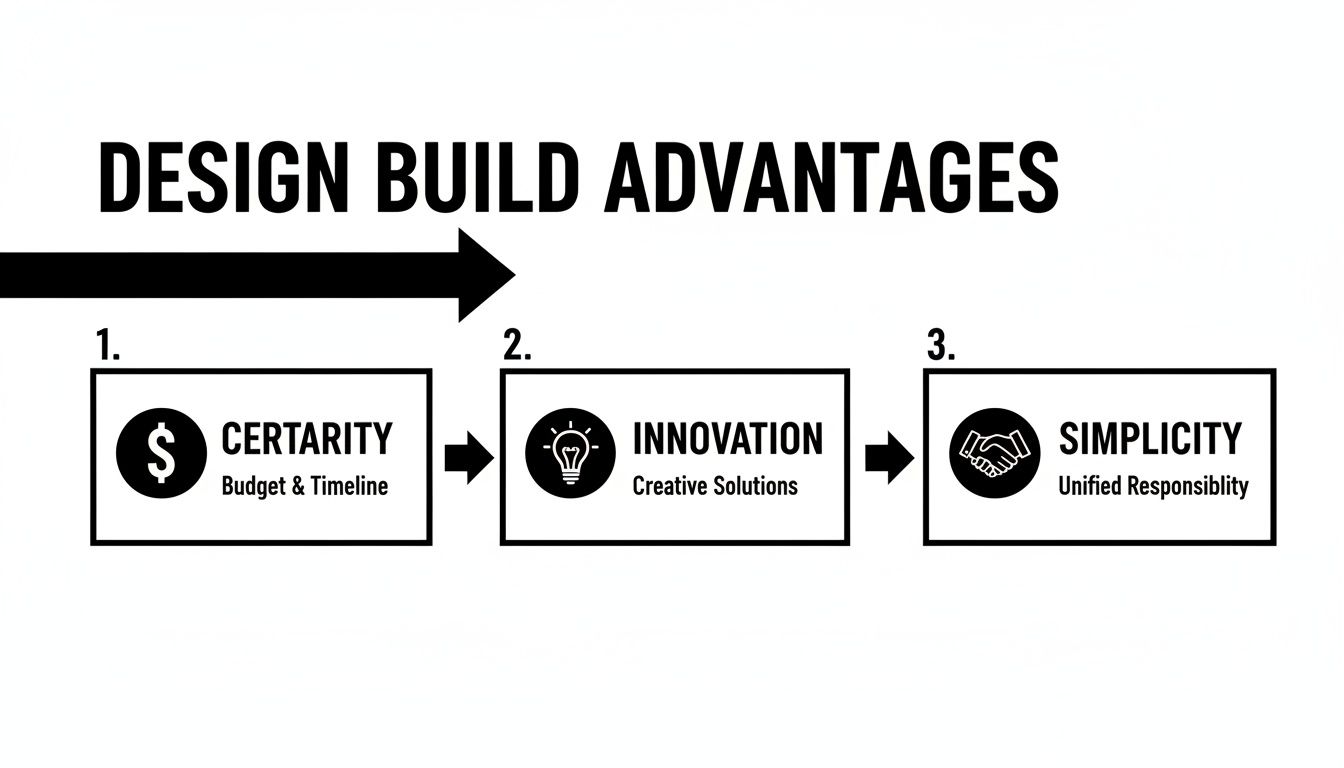
As the infographic shows, these core benefits form the very foundation of the design-build experience. The entire process is engineered for a seamless flow where financial predictability and creative problem-solving aren’t just afterthoughts—they’re integral to every single phase.
Phase 1: Team Selection and Project Definition
The first step is arguably the most important: selecting your design-build partner. This is much more than just hiring a contractor. You’re forming the collaborative team that will steer your entire project. During this phase, you’ll want to vet firms based on their portfolio, specific experience in luxury projects, and what past clients have to say.
Once you’ve found the right fit, the focus shifts to defining the project’s soul. This means deep-dive conversations about your vision, lifestyle, aesthetic tastes, and—crucially—your budget. The result of this phase is a detailed project brief that becomes the north star for everyone involved.
Phase 2: Schematic Design and Feasibility
With your team and a clear brief in hand, the real creative work begins. In this second phase, the design team starts developing initial concepts. You’ll see sketches, floor plans, and 3D renderings that start to give your vision a tangible shape.
But here’s the magic of the model: while the designers are dreaming, the construction experts are analyzing. They provide real-time cost estimates and constructability feedback, ensuring the design and the budget stay perfectly aligned. This early integration sidesteps the classic pitfall of falling in love with a design you can’t afford to build.
This collaborative design phase is the heart of the design-build model. It’s where creativity and practicality meet, allowing for ambitious design exploration without losing sight of the project’s financial and logistical realities.
This stage is all about exploring what’s possible while keeping a firm hand on the budget. By the end, you’ll have a clear conceptual design and a solid preliminary budget to match.
Phase 3: Design Development and Finalization
Phase three is where we get into the details. The approved concept is meticulously refined into a full-blown architectural plan. Every single element is specified, from structural systems and materials to interior finishes and fixture selections. It’s a highly collaborative period where your decisions truly define the look and feel of your future home.
The integrated team continues working in lockstep. As designers finalize material choices, the construction team instantly updates cost estimates and sourcing plans, maintaining complete financial transparency. By the end of this phase, you have a full set of construction-ready documents and a firm price—either fixed or a guaranteed maximum price (GMP). This level of detailed planning is a cornerstone of the broader custom home building process guide, setting the stage for a smooth transition to the build itself.
Phase 4: Construction and Project Management
With the design locked in and permits secured, the project finally moves from the drawing board to the job site. Now, your design-build firm takes over managing every single aspect of construction, from breaking ground to applying the final coat of paint. Because the designers and builders are one and the same team, communication is seamless.
Your role here is to stay informed. You’ll get regular updates and attend key site meetings to see the progress firsthand. Your design-build firm is your single point of contact, handling all the headaches of subcontractor coordination, scheduling, and quality control. This unified command structure is what keeps the project moving forward efficiently and with minimal disruption.
Phase 5: Post-Construction and Handover
The final phase kicks off as construction winds down. The team will conduct a meticulous walkthrough with you to identify any last-minute items needing attention. This generates a “punch list” to ensure every detail meets your exacting standards.
Once that list is cleared, the project is officially complete. You’ll receive all the necessary documentation, warranties, and a comprehensive guide to your new home’s systems. The handover is more than just getting the keys; it’s about making sure you are completely satisfied and comfortable in your new space. It’s the rewarding conclusion to a truly integrated process.
How To Choose Your Ideal Design Build Partner
Picking a design-build partner is easily the most critical decision you’ll make for your entire project. This isn’t just about hiring a contractor; you’re entering a long-term relationship built on trust, a shared vision, and constant communication. The right firm makes the journey rewarding. The wrong one can turn a dream project into a frustrating, costly ordeal.
That’s why the vetting process has to be thorough. Start with the basics—the non-negotiables. Any firm you consider must have comprehensive insurance and be fully licensed in your state. Once you’ve ticked those boxes, you can start digging into what really matters: their specific experience and how it aligns with your vision.
Evaluating Portfolios and Expertise
A firm’s portfolio is its story. Don’t just flip through glossy photos; look for the substance behind the style. A team that primarily builds commercial offices won’t have the same refined touch required for a luxury residence. You need to find proof that they’ve successfully built homes of a similar scale, aesthetic, and complexity to yours.
- Relevant Experience: Do they specialize in high-end homes? Ask to see projects that share key elements with yours, whether it’s a particular architectural style or a tricky hillside location.
- Quality of Craftsmanship: Get granular. Zoom in on the details of their past work—the joinery, the material transitions, the flawless finishes. Does it meet the exacting standards you expect for your own home?
- Client Testimonials: Go beyond the curated quotes on their website. Ask for a list of recent clients you can speak with. Hearing directly about their experience is invaluable.
This initial homework helps you narrow down the field to a shortlist of firms that are not just qualified on paper, but genuinely feel like the right fit for your unique project.
Key Questions To Ask Potential Partners
The interview is where you find out if the chemistry is right. This is your chance to see how they think, communicate, and solve problems. You’re not just asking questions; you’re starting a conversation that reveals their entire philosophy. A great partner will welcome your detailed questions as a chance to show you exactly how they operate.
The best design-build relationships are built on a foundation of absolute transparency and perfectly aligned expectations. Your goal is to understand their approach to collaboration, budget management, and problem-solving before you even think about signing a contract.
Use these questions to guide your conversation:
- How do you keep the design aligned with our budget from the first sketch to the final walk-through?
- Walk me through how you’d handle an unexpected issue, like a problem with the site or a major change we request mid-construction.
- What’s your communication process? Who is our day-to-day contact, and how often will we get updates?
- How do you vet and manage your subcontractors to ensure they deliver the quality you promise?
- Can you show us a detailed timeline from a recent project, from the initial concept to handing over the keys?
Their answers tell you everything you need to know about their commitment to transparency and a positive client experience. For a deeper dive, our guide on how to choose a home builder for your custom home offers even more insight into vetting these crucial professionals.
Understanding Contract Types
Finally, you need to be crystal clear on the contract. While there are a few variations, most luxury design-build projects fall under one of two common structures.
- Fixed-Price Contract: This sets a firm, total price for the entire project upfront. It gives you complete cost certainty, which is a major plus, but it also requires every design detail to be locked in before a shovel hits the ground. It leaves very little room for changes.
- Guaranteed Maximum Price (GMP) Contract: This popular model sets a ceiling on the project cost. You pay for the actual costs incurred plus a builder’s fee, but only up to that guaranteed maximum. GMP contracts almost always include “open-book” accounting, giving you full transparency and the chance to share in any savings if the project comes in under budget.
The design-build model continues to grow, especially in markets like the South Atlantic and West South Central regions, which have seen annual growth rates of 7.0% and higher. This trend, largely driven by complex educational and manufacturing projects, proves just how effective the integrated approach can be. By choosing the right partner and the right contract, you set your own luxury project up to benefit from that same proven success.
Understanding Potential Risks And How To Mitigate Them
As compelling as the design-build model is, it’s not without its own set of potential pitfalls. Honestly, no construction method is perfect, and the real secret to a successful project is knowing what to watch out for from the very beginning.
One of the first things clients ask about is the bidding process. In a traditional project, you get multiple builders to bid on a completed set of plans. With design-build, that competitive bidding phase is gone, which can make some people nervous about getting the best price.
It’s a fair concern. But it’s important to understand that design-build controls costs in a different way—by building value and transparency into the process from day one, rather than just chasing the lowest number at the end.
Ensuring Financial Transparency
To address the “no-bid” issue head-on, premier design-build firms insist on total financial transparency. Think of it as an open-door policy for your project’s finances, and it’s usually built right into the contract.
Two of the most effective tools for this are:
- Open-Book Accounting: This is exactly what it sounds like. You get to see everything—every invoice, every subcontractor bid, every material receipt. It’s the best way to ensure there are no hidden fees or surprise markups.
- Guaranteed Maximum Price (GMP): A GMP contract puts a hard cap on your project’s cost. If expenses go over that number, the design-build team eats the difference. This gives them a powerful incentive to manage the budget with incredible efficiency.
These aren’t just accounting tricks; they fundamentally change the dynamic. Your financial relationship becomes a true partnership where costs are developed together, not just handed to you in a sealed envelope.
The Importance Of Vetting Your Partner
The all-in-one nature of design-build is its biggest strength, but it also raises the stakes when choosing your team. You’re handing the keys to your entire project—from initial sketch to final nail—to a single firm. That requires an immense amount of trust in their skill, their integrity, and their ability to communicate.
The success of a design-build project hinges almost entirely on the quality and trustworthiness of the firm you select. The vetting process isn’t just a preliminary step; it is the most critical risk mitigation strategy you have.
This is why you have to do your homework. Dig into their portfolio. Call their references. Have frank conversations to see if your personalities and expectations align. Getting this choice right is the single most important thing you can do to de-risk your project.
It’s also crucial to get the paperwork right. A well-structured agreement protects everyone involved. For a deeper dive, our guide to your custom home builder contract offers essential advice on how to formalize these protections. By being deliberate upfront, you transform potential risks into manageable parts of the process, setting the stage for a truly collaborative and successful build.
Diving Deeper: Your Design-Build Questions Answered
Exploring a different way of building naturally brings up questions. When you’re considering the design-build approach for your luxury home, getting a feel for how it really works is key. Let’s tackle some of the most common concerns clients have before they jump in.
Making the right choice for your project starts with having clear, honest answers.
Is the Design-Build Approach More Expensive?
It’s a fair question, but the answer is typically no. At first glance, a design-build proposal might seem higher because it wraps design fees into the total cost, unlike traditional bids that separate them. But when you look at the final, all-in number, design-build often comes out ahead.
How? The integrated process catches costly issues before they happen, drastically cutting down on expensive change orders down the line. Plus, a faster timeline means you save on financing and carrying costs. The budget is a living, breathing part of the design conversation from day one, not an afterthought. This single contract gives you a level of cost certainty you just don’t get with other methods.
Will I Lose Creative Control Over My Project?
Actually, it’s the complete opposite. In a design-build project, you’re not just a client—you’re the central pillar of the team right from the beginning. Your vision is the starting point, and every design idea gets immediate, real-world feedback from the people who will actually build it.
This setup prevents that all-too-common heartbreak of falling in love with a beautiful design, only to discover later that it’s wildly over budget or structurally impractical. You gain more meaningful control because your creative decisions are instantly grounded in feasibility.
The real power of the design-build model is how it keeps your vision tethered to reality. The creative process becomes productive and exciting, not a series of frustrating compromises, ensuring the home you get is the one you dreamed of—and the one you can afford.
What Happens If the Designer and Builder Don’t See Eye to Eye?
This is where the beauty of the model truly shines. Because the architect, interior designer, and construction manager are all part of the same team, under the same contract, any internal friction is their problem to solve, not yours.
The firm’s leadership is responsible for delivering a seamless, unified result. You’re completely shielded from playing mediator between feuding parties. That single point of accountability is one of the biggest stress-reducers in the entire process, keeping your project moving forward smoothly.
Finding a partner who lives and breathes collaboration and transparency is what makes or breaks a luxury project. At Haute Design, we specialize in connecting clients like you with the most accomplished and trusted design-build professionals in the country.
Ready to find the right team to bring your vision to life? Explore our exclusive network of experts on Haute Design.