


Construction administration is the crucial phase where an architect’s vision gets translated into physical reality. Think of it as the essential bridge connecting the detailed blueprints from the design studio to the day-to-day work happening on the construction site. It’s a proactive service designed to ensure the final building is a perfect match for the original design, protecting both the client’s investment and the integrity of the architecture.
What Is Construction Administration in High-End Projects
Imagine an orchestra conductor who, score in hand, ensures every section plays in perfect harmony to bring a complex symphony to life. In a luxury construction project, the construction administrator plays that same role. They are on-site, directing the performance to ensure the architectural plans are executed flawlessly. Essentially, they serve as the architect’s eyes and ears on the ground, safeguarding the design’s integrity from the first day of excavation to the final walkthrough.

This isn’t about micromanaging the contractor. Instead, it’s about providing expert quality control and facilitating crystal-clear communication between all parties. It is a formal set of services, typically performed by the architect or a designated representative, throughout the entire building phase.
The Guardian of Design Intent
At its heart, construction administration is about making sure the two-dimensional drawings become a three-dimensional reality without any loss of detail, quality, or nuance. This becomes absolutely critical in high-end residential projects, where bespoke finishes, intricate structural details, and one-of-a-kind materials are the standard.
Here’s a quick look at the core functions this role covers, which we’ll dive into deeper later in the guide.
Core Functions of Construction Administration at a Glance
This table breaks down the main responsibilities of a Construction Administrator, offering a clear snapshot of their role in bringing a project to life as intended.
| Function | Objective |
|---|---|
| Site Observation | To regularly monitor work quality and progress, ensuring it aligns perfectly with the design documents. |
| Information Clarification | To answer contractor questions (RFIs) promptly, preventing ambiguities from turning into expensive errors. |
| Submittal Review | To vet all contractor-submitted drawings, material samples, and product data to confirm they meet project specifications. |
| Change Management | To process and document any necessary changes to the project’s scope, timeline, or budget in a formal manner. |
| Payment Certification | To review and approve the contractor’s applications for payment, verifying that the work billed has been completed. |
| Project Closeout | To manage the final steps, including punch lists and final inspections, ensuring a seamless handover to the client. |
Each of these functions is a deliberate step to ensure the final product is exactly what was envisioned from the start.
Construction administration is the essential quality assurance mechanism that verifies the promises made on paper are delivered in brick and mortar. It transforms a detailed blueprint from a mere possibility into a tangible, high-quality reality.
A Vital Layer of Risk Management
For affluent homeowners and luxury developers, formal construction administration is a powerful form of risk management. Through consistent site observation, meticulous progress documentation, and a systematic process for handling contractor questions, it protects the original design intent.
This oversight guarantees that premium finishes, custom millwork, and specific performance features—like those related to sustainability—are executed exactly as specified, not watered down on the job site. You can get a sense of the industry trends impacting these decisions from the economic forecast insights from ConstructConnect. It’s this painstaking attention to detail that ultimately protects the significant financial and creative investment poured into every luxury property.
The Difference Between Administration and Management
It’s one of the most common points of confusion in the building industry, but getting it right is vital. People often toss around “construction administration” and “construction management” as if they’re the same thing, but they are two distinct roles with different priorities, loyalties, and contractual duties. On a luxury project, mistaking one for the other can create costly overlaps or, even worse, dangerous gaps in oversight.
Think of it like this: the Construction Administrator (CA) is the guardian of the design. Their primary loyalty is to the architectural plans and the vision they represent. They are on-site to ensure every material, every joint, and every finish is executed exactly as the architect intended. Their job is to protect the integrity of the design.
In contrast, the Construction Manager (CM) is the general of the construction site. Their world is logistics. They’re focused on scheduling subcontractors, wrestling with the budget, enforcing safety, and making sure materials arrive when needed. The CM’s mission is to bring the project across the finish line on time and on budget.
Defining Separate Allegiances
The real difference comes down to their core objective. The CA, who is usually the architect or someone from their firm, observes the work to verify it complies with the contract documents. They aren’t responsible for how the contractor builds something—the means, methods, or safety on site are the contractor’s domain.
A CM, on the other hand, is right in the thick of it, deeply involved in the day-to-day operations and actively directing the flow of work. While both roles are absolutely essential for a successful outcome, they look at the project through different lenses. This distinction is especially important when you consider the role of the general contractor, who often handles many of the management tasks. You can learn more about what a general contractor does in our detailed guide.
A Construction Administrator asks, “Does this match the blueprint?” A Construction Manager asks, “Is this the most efficient way to build it?” Both questions are critical, but they come from two very different professional mindsets.
This separation of duties is more important than ever. With today’s workforce constraints and supply chain hiccups, disciplined construction administration—with its focus on clear documentation and quick, informed decisions—is what keeps a project from grinding to a halt. For luxury homes that have to satisfy demanding design review boards and navigate complex building codes, this structured approach ensures everyone stays on the same page. You can read more about how market conditions are impacting the industry in the 2025 construction market outlook.
A Clear Comparison of Roles
To cut through any lingering confusion, it helps to see the two roles side-by-side. The table below breaks down the fundamental differences between a Construction Administrator and a Construction Manager, showing why both are often necessary for a complex, high-end build.
Construction Administration vs Construction Management
| Aspect | Construction Administration (CA) | Construction Management (CM) |
|---|---|---|
| Primary Focus | Design integrity and quality control. | Schedule, budget, and site logistics. |
| Key Allegiance | The architectural and engineering documents. | The project’s financial and timeline goals. |
| Typical Role | Performed by the Architect or a designated agent. | Performed by the General Contractor or a hired CM firm. |
| Main Activities | Reviewing submittals, answering RFIs, site observation. | Coordinating trades, managing resources, safety enforcement. |
| Core Question | “Is it being built correctly?” | “Is it being built efficiently?” |
Ultimately, the CA ensures the final product is what was envisioned, while the CM ensures the process of getting there is smooth and financially sound. On a truly exceptional project, you can’t have one without the other.
How Construction Administration Unfolds Phase by Phase
Think of construction administration not as one long, monolithic task, but as a carefully orchestrated journey. It has a clear beginning, middle, and end, ensuring every detail gets the attention it deserves at precisely the right moment. By breaking the project down into distinct phases, we create a reliable roadmap that keeps everyone—from the homeowner to the lead contractor—on the same page.
This process generally flows through three primary stages, with the responsibilities of each one building directly on the last.
The Pre-Construction Foundation
Long before the first shovel ever breaks ground, the construction administrator is already hard at work, laying a solid foundation for the entire project. This initial stage is all about meticulous planning and nipping potential problems in the bud.
A huge part of this is a deep dive into the contractor bids and proposals. The administrator pores over them, cross-referencing every line item with the architect’s plans to make sure the bids truly align with the design intent and scope of work. They also play a pivotal role in hammering out the final construction contract, clarifying ambiguities and making sure responsibilities, timelines, and payment schedules are crystal clear. This early diligence is what prevents costly and frustrating misunderstandings later on.
This timeline illustrates how administrative roles complement on-site management roles, showing their distinct yet interconnected responsibilities throughout a project’s life.
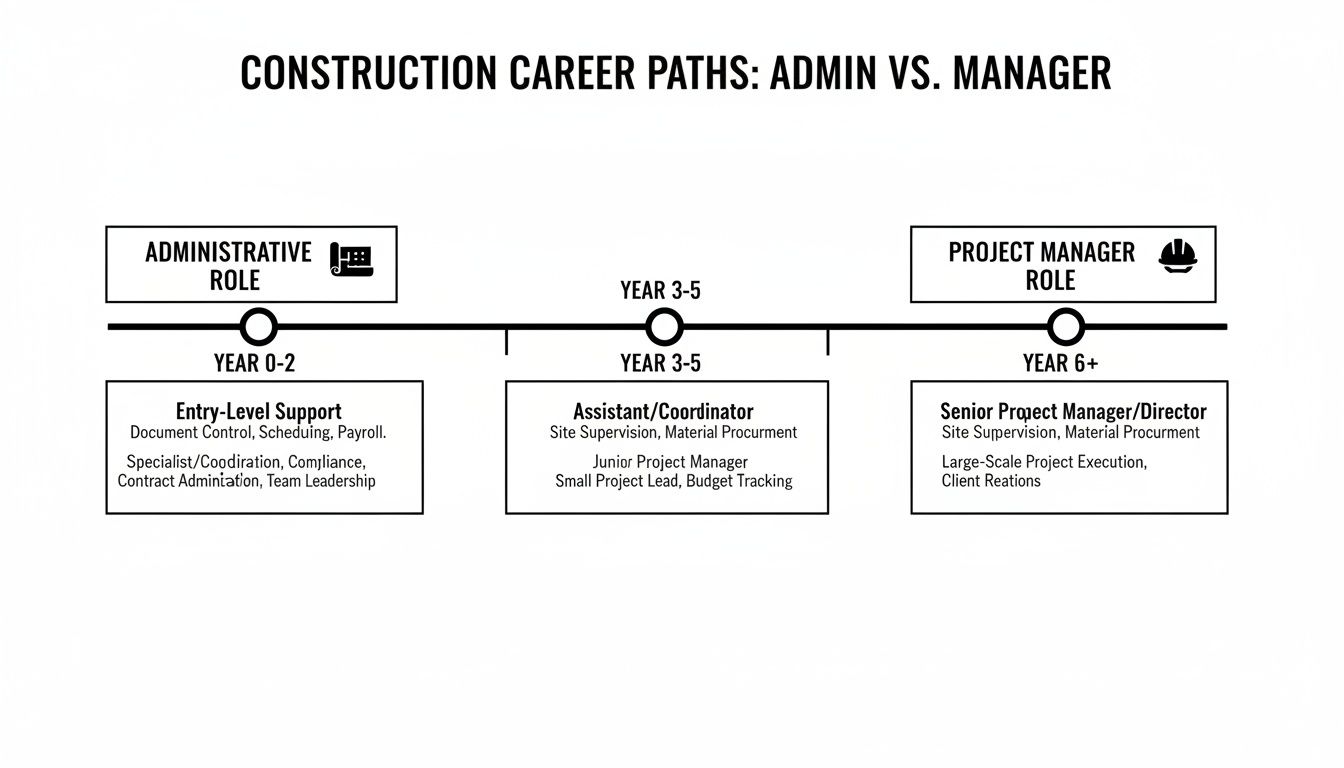
As you can see, while a project manager is focused on the day-to-day logistics of the build, the administrator’s focus is steadfast: ensuring the final product is a faithful execution of the original design.
Active Construction Oversight
Once the build is underway, the administrator shifts gears, becoming the architect’s eyes and ears on the ground. This is the most dynamic part of their job, a constant loop of quality control, communication, and problem-solving.
During this active phase, their key duties include:
- Submittal Reviews: The administrator meticulously vets all material samples, shop drawings, and product data that the contractor submits. They’re confirming that every tile, fixture, and finish meets the exact project specifications.
- Site Observations: Regular site visits are non-negotiable. They walk the job site to monitor the progress and quality of the work firsthand, documenting everything in detailed field reports for the record.
- Information Management: They act as the central hub for all design-related questions. When a contractor submits a Request for Information (RFI), the administrator provides a prompt and clear answer to prevent delays.
- Change Order Processing: No project is without its surprises. When changes are unavoidable, the administrator manages the formal process, ensuring any adjustments to scope, cost, or schedule are properly documented and approved by all parties. This can sometimes lead to creative problem-solving, a concept you can learn more about by understanding what is value engineering in construction.
Project Closeout and Final Handover
As construction winds down, the administrator’s focus shifts again—this time to guaranteeing a flawless finish and a seamless handover to the client. This final stage is all about triple-checking the details and ensuring every contractual obligation has been met.
The closeout phase isn’t just about finishing the work; it’s about delivering a complete, documented, and fully operational asset to the owner, ensuring its long-term value.
A critical step here is developing the punch list. This is an exhaustive inventory of every last item that needs to be fixed or finished. The administrator won’t sign off until every single item is addressed to their satisfaction. Only then do they certify the project as substantially complete and approve the contractor’s final payment. The last step is gathering and delivering all essential closeout documents, from warranties and maintenance manuals to the “as-built” drawings that perfectly capture the finished home.
Why Your Luxury Project Needs Construction Administration
In the high-stakes world of luxury property development, construction administration isn’t just a nice-to-have service; it’s a critical investment in quality and certainty. Think of it as the project’s central nervous system, ensuring the ambitious vision created in the design studio is brought to life with absolute precision on the job site.
Without this dedicated oversight, even the most brilliant architectural plans are left open to misinterpretation, corner-cutting, and costly mistakes.
For high-end homes defined by unique features and bespoke materials, this level of supervision is non-negotiable. The construction administrator is your advocate—the architect’s eyes and ears on-site. They are there to meticulously verify that every custom finish, complex structural detail, and imported material meets the exacting standards laid out in the specifications. This rigorous quality control is the only way to safeguard the project’s unique character and integrity.
Protecting Your Financial and Design Investment
Beyond making sure everything looks right, construction administration provides a crucial layer of financial protection. The administrator scrutinizes every contractor payment application, making sure the billing accurately reflects the work actually completed.
They also manage the change order process with an expert eye. This prevents uncontrolled scope creep and ensures any modifications are justified, fairly priced, and formally documented before work proceeds.
This process creates an indisputable paper trail for the entire project, which offers three key benefits:
- Dispute Resolution: It provides a clear, factual basis for resolving disagreements before they can escalate into expensive legal battles.
- Accountability: It ensures every decision, observation, and financial transaction is logged, holding all parties accountable for their work.
- Value Preservation: It documents the quality and specifics of the construction, which can be invaluable for future appraisals or the eventual sale of the property.
A Necessity in Volatile Markets
When economic conditions are uncertain, you can’t rely on market momentum alone to protect your investment. Proactive, hands-on management becomes essential. This is where construction administration proves its worth by enforcing schedule milestones, managing payments, and documenting every delay or change.
Luxury clients benefit most from this elevated approach, where detailed meeting minutes and systematic closeout procedures preserve asset value in a market where even small execution errors can lead to six-figure impacts. You can learn more about how market forecasts influence project strategies from the AIA.
In luxury construction, the smallest details carry the most weight. Construction administration is the disciplined process that ensures those details—the ones that define the project’s soul—are executed perfectly, protecting the property’s ultimate value and delivering true peace of mind.
An Essential Checklist for Your Project Team
To keep everyone on the same page, a shared checklist is an invaluable tool for aligning your entire team on the critical tasks of construction administration. It’s more than just a to-do list; it’s a roadmap.
This simple tool empowers you, whether you’re the homeowner or the designer, to have productive, focused conversations with your architect and builder. It makes sure no administrative detail falls through the cracks, turning abstract duties into a concrete plan of action.
Use this phased checklist as a solid starting point for discussions with your team.
Pre-Construction Phase
- Confirm CA Scope: Before any dirt moves, make sure the architect’s construction administration scope and the frequency of their site visits are spelled out clearly in their contract.
- Establish Protocols: Set up a clear, agreed-upon process for handling Requests for Information (RFIs) and contractor submittals, including firm timelines for responses.
- Define Communication: Decide on the schedule and format for all project meetings and progress reports. Will it be a weekly call? A monthly in-person meeting? Get it on the calendar.
Active Construction Phase
- Document Everything: Insist that all site visits and observations are formally documented. This means dated photos and detailed notes compiled into official field reports.
- Track Changes: Keep a running log of every single proposed change and formal change order. This log must track the impact on both the project budget and the timeline.
- Review Payments: Scrutinize every payment application from the contractor. It needs to be carefully checked against the actual work completed on-site before anyone signs off on the check.
A well-maintained checklist isn’t just about ticking boxes. It’s a documentation framework that protects everyone involved by creating a clear, indisputable record of the project’s journey from start to finish.
Project Closeout Phase
Wrapping up the project requires just as much precision to ensure a seamless and successful handover.
- Verify Punch List: The final walkthrough generates a list of remaining items to be fixed. Confirm every single one is complete. Knowing what is a punch list is absolutely critical before you release that final payment.
- Collect Documents: Don’t consider the job done until you have all the essential paperwork in hand. This includes all warranties, operating manuals for equipment, and the final “as-built” drawings from the contractor.
Frequently Asked Questions
When you’re building a high-end property, the details matter immensely, and it’s natural for questions about construction administration to come up. The stakes are just too high to leave anything to chance. Here are some straightforward answers to common queries we hear from homeowners and design professionals.
Does an Architect’s Standard Fee Include Construction Administration?
Not necessarily, and this is a critical point to clarify upfront. While many architects might bundle a basic level of site observation into their standard fees, comprehensive construction administration is almost always a distinct phase of work with its own fee structure.
Think of it this way: their basic service might cover a few site visits to check on general progress. But the rigorous, detailed oversight your project needs—reviewing every shop drawing, processing payment applications, and documenting everything meticulously—is a separate, dedicated service. Always comb through the architect’s proposal to see exactly what’s included. You need to know how many site visits are planned, what kind of reports you’ll get, and how they’ll manage contractor submittals to avoid any expensive misunderstandings down the road.
How Does the Administrator Handle Disagreements?
The construction administrator acts as the impartial interpreter of the construction documents, not a mediator or a judge. When a dispute pops up between the contractor and the owner or design team, their job isn’t to pick a side.
Instead, they bring everyone back to the blueprints and specifications. Their role is to provide objective clarification based on what was officially agreed upon in the contract documents. By grounding the conversation in facts and facilitating clear communication, they can often defuse conflicts before they escalate into costly delays or legal issues, keeping the focus squarely on quality and progress.
A construction administrator’s authority is rooted entirely in the contract documents. Those plans and specifications are the single source of truth, ensuring decisions are driven by the design intent, not personal opinions. This objectivity is the key to maintaining a fair, professional, and productive job site.
How Does This Role Differ for Renovations?
For a luxury renovation, construction administration is a whole different ballgame—and often far more demanding than for new construction. You’re dealing with the unknown. The administrator is constantly navigating surprises, like discovering outdated wiring or a hidden structural issue once a wall comes down.
Their expertise becomes invaluable in integrating brand-new, sophisticated systems with the home’s existing infrastructure. A huge part of the job also involves protecting the finished parts of your home from the dust, debris, and disruption of construction. The amount of real-time problem-solving and quick, critical thinking required is significantly higher than on a new build where you’re starting with a clean slate.
Ready to connect with the industry’s most esteemed professionals for your next project? Find architects, builders, and interior designers who understand the nuances of luxury construction on the Haute Design network. Visit us at https://hauteliving.com/designnetwork.