


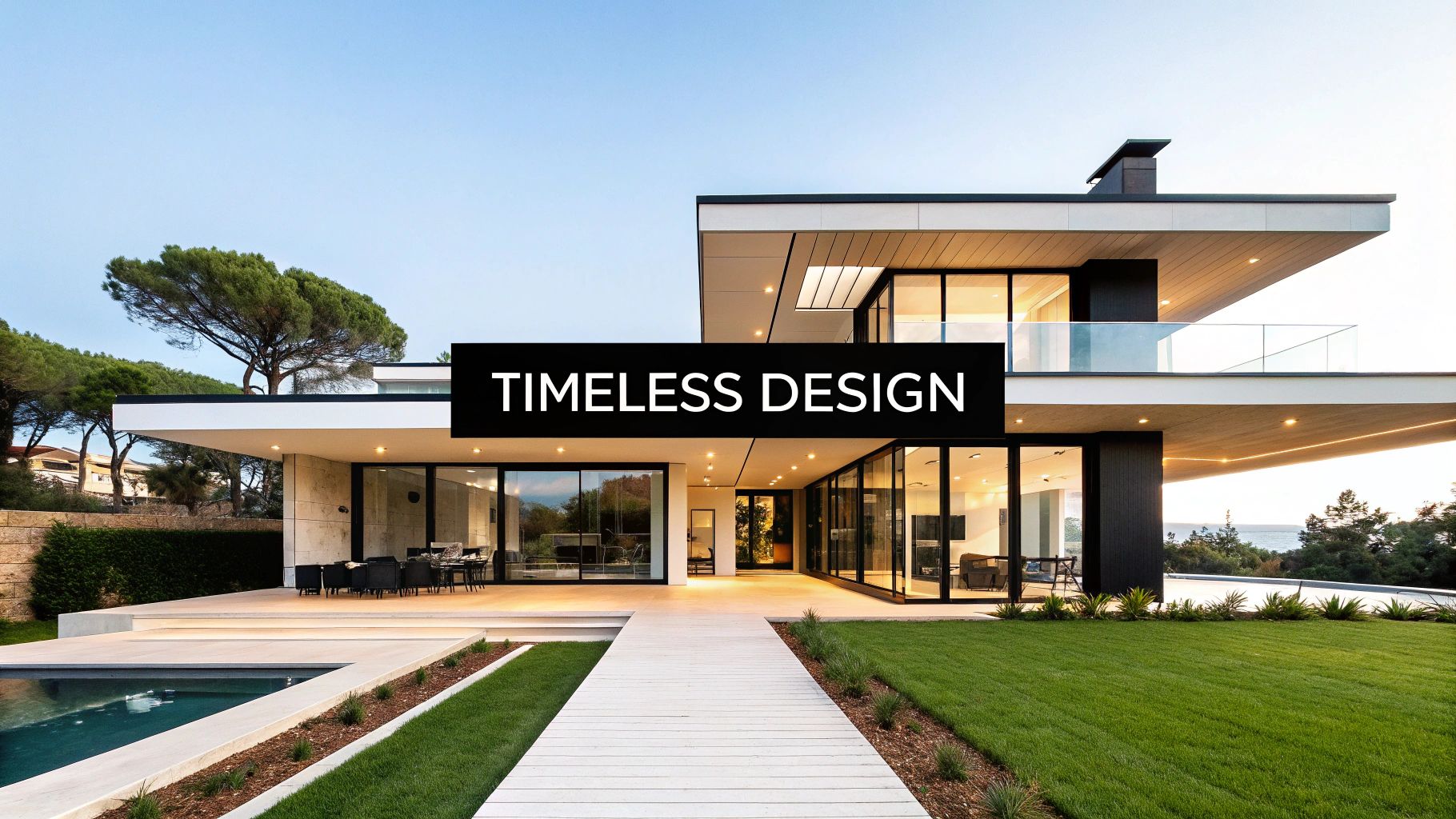
Mid-century modern architecture isn’t just a retro trend; it’s a design philosophy built on simplicity, functionality, and a profound connection with the natural world. Its principles of clean lines, organic forms, and bright, open spaces have left an indelible mark on what we consider contemporary luxury living today.
The Timeless Appeal of Mid Century Modern Design
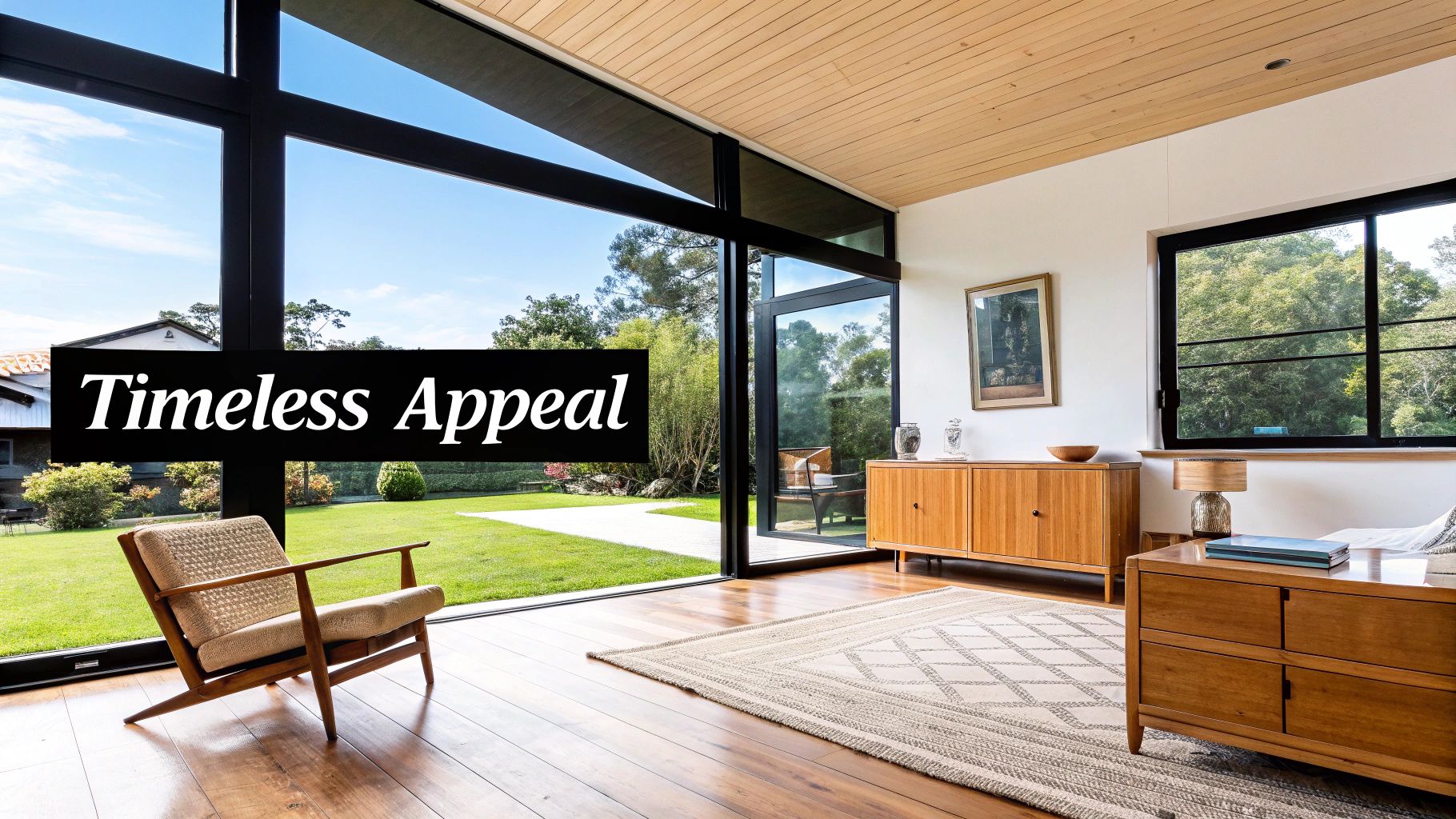
Born from the optimism of the post-war era, mid-century modern design was a breath of fresh air. It was a complete departure from the ornate, closed-off homes of the past, championing a more open, casual way of life that still feels perfectly in tune with how we want to live now.
This architectural style is about more than just a look. It’s a deliberate, thoughtful response to human needs and the environment. By tearing down visual barriers and celebrating natural materials, these homes manage to feel both expansive and deeply connected to the world just outside their walls.
A Philosophy Built on Core Principles
The lasting power of this style comes down to its core ideas. The architects of the time weren’t just creating beautiful buildings; they wanted to design practical, accessible homes. The famous principle of “form follows function” was their guide, meaning every design choice served a purpose. The result? Homes that are as beautiful to look at as they are to live in.
These foundational concepts continue to shape high-end design today:
- Simplicity and Clean Lines: The focus on uncluttered, geometric forms brings a sense of calm and order. It lets the architecture and the landscape be the stars of the show.
- Indoor-Outdoor Connection: Floor-to-ceiling glass, sliding doors, and open layouts weren’t just stylistic choices; they were designed to completely dissolve the line between inside and out.
- Honesty in Materials: Natural wood, stone, and visible structural elements like post-and-beam construction are left exposed, celebrated for their authentic texture and beauty.
- Functionality for Modern Life: Open-concept living and flexible, multi-use spaces were designed for the dynamic needs of a modern family—a principle that remains absolutely central to custom home design.
At its heart, mid-century modern architecture is about creating honest, uncluttered, and joyful spaces. It’s a design philosophy that champions a simpler, more connected way of life, which is why it feels just as relevant today as it did seventy years ago.
This overview is just the beginning. To truly appreciate how these post-war ideals became an architectural language that defines modern luxury, we need to dig deeper. For homeowners, architects, and designers looking to create spaces with enduring elegance, understanding these tenets is the essential first step. This guide will unpack the style’s history, defining features, and practical applications.
The Making of an Architectural Icon
To get to the heart of mid-century modern design, you have to understand the world it came from. This wasn’t just a style that appeared out of thin air; it was a powerful, optimistic reaction to the seismic social and technological shifts that followed World War II. It was a collective exhale, a deep-seated desire to build a future that was brighter, smarter, and more in tune with how people wanted to live.
After years of global turmoil and economic hardship, families were searching for a new kind of normal. They wanted comfort and stability, but they also wanted to break free from the stuffy, closed-off homes of the past. This was more than an aesthetic choice—it was a philosophical one. Architects of the day saw an opportunity to use good design to improve everyday life, making it accessible to everyone, not just the ultra-wealthy. Their vision was for homes that were functional, democratic, and woven into the landscape.
A New World, A New Home
The post-war economic boom, especially in the United States, created a massive, newly prosperous middle class. This surge in financial security ignited an unprecedented demand for housing. At the same time, families began migrating from dense cities to the burgeoning suburbs, seeking more space, a yard, and a closer connection to the outdoors.
This mass suburbanization was the perfect testing ground for new ideas. Architects and developers were given a blank slate to completely rethink the American home. They threw out the rulebook of ornate, fussy styles from previous decades and embraced something clean, honest, and forward-thinking. The objective was clear: create homes that supported a more relaxed, informal lifestyle built around family and leisure.
“The architects of the mid-century period were fundamentally optimistic. They believed that through thoughtful design and new technology, they could solve problems and create a better model for modern living.”
This spirit of innovation was fueled by incredible breakthroughs in materials and construction methods, many of which had been fast-tracked by the war effort.
From War Machine to Dream Home
The technological leaps made during WWII had a direct and profound impact on residential architecture. Materials that were once restricted to military use suddenly became available for home building, handing architects an entirely new set of tools to play with. This sparked a creative explosion.
The mid-century modern movement took root in this fertile ground, flourishing from the early 1950s through the early 1970s. This era was defined by economic growth and a wave of technological progress that powered a global design shift. In the U.S., a booming middle class—with more Americans identifying as such than ever before—drove the demand for homes that looked to the future. Architects began using wartime innovations like reinforced concrete, steel frames, massive sheets of glass, and new materials like plywood, fiberglass, and plastics to design sleek, minimalist homes. To see how this era reshaped design globally, the Eichler Network offers a great perspective.
This new material palette was the backbone of the style’s identity:
- Steel and Reinforced Concrete: These materials made strong, slender post-and-beam construction possible. This meant interior walls no longer had to bear weight, paving the way for the open floor plans we now love.
- Large Panes of Glass: Manufacturing advancements allowed for entire walls of glass and sliding doors, effectively erasing the line between inside and out.
- Plywood and Plastics: These versatile materials opened the door to creating the organic curves and molded shapes seen in both the architecture and the furniture of the period, a clear departure from traditional woodworking.
A Global Phenomenon with Local Flavor
While the style exploded most dramatically in American suburbs, particularly across California, its core principles found an audience around the world. The fundamental ideas—simplicity, function, and a connection with nature—were translated into different climates, cultures, and contexts, creating distinct regional variations.
In Scandinavia, for example, designers like Alvar Aalto and Arne Jacobsen pioneered what became known as Scandinavian Modern. They championed a softer, more organic approach that celebrated natural wood and focused on human-centric, comfortable design. Down in Brazil, architects such as Oscar Niemeyer took a different path, using reinforced concrete to create breathtakingly bold and sculptural forms that were perfectly suited to the tropical environment.
No matter the location, the underlying belief was the same: modern architecture had the power to make the world a better, more beautiful, and more functional place. It was this shared, powerful vision that turned a post-war building boom into an enduring design movement that still shapes how we live today.
The Defining Hallmarks of Mid Century Modern Homes
To really get a feel for Mid-Century Modern architecture, you have to understand its visual language. It’s a style that speaks through clean lines, organic materials, and a deep sense of openness, prizing thoughtful function over fussy ornamentation. There are a few core ideas that truly define its character.
When you see these elements working together, you get homes that are as beautiful to look at as they are to live in. The style’s timeless appeal comes from how it answers our desire for spaces that are uncluttered, bright, and deeply connected to the world just outside the window.
Clean Lines and Geometric Forms
At its heart, Mid-Century Modern design is all about simplicity. You see it most clearly in the crisp lines and straightforward geometric shapes that define these homes. Forget intricate moldings or elaborate decorations; here, the architecture itself is the main event.
Picture those long, low rooflines that seem to hug the landscape, often with just a gentle slope or sometimes completely flat. Walls are treated as bold, clean planes, not just barriers. This focus on pure geometry brings a sense of calm and order, letting the building’s form and its natural surroundings shine.
Designers also played with different levels to create interest without adding clutter. You’ll often see split-level layouts or varied ceiling heights that subtly define different living zones, a clever way to shape a space without putting up a solid wall.
An Emphasis on Natural Materials
Mid-Century Modern architects had a profound respect for the inherent beauty of their materials. They didn’t hide the home’s structure—they celebrated it. This principle of “truth to materials” meant that wood, stone, brick, and glass were often left in their most natural, unadorned state.
This approach created homes with a wonderfully rich textural palette and a warm, organic feel.
- Wood: Teak, walnut, and oak were everywhere—in exposed beams, wall paneling, and built-in cabinetry, bringing an immediate sense of warmth and nature indoors.
- Stone and Brick: Fireplaces were often dramatic, floor-to-ceiling focal points made of stone or brick that anchored the main living space. These materials would frequently continue from the inside to an exterior wall, further blurring the lines.
- Glass: Huge panes of glass weren’t just windows. They were transparent walls, intentionally designed to frame the view outside and drench the interiors in natural light.
This diagram captures how the optimism and material innovations of the post-war era came together to shape a new approach to home design.
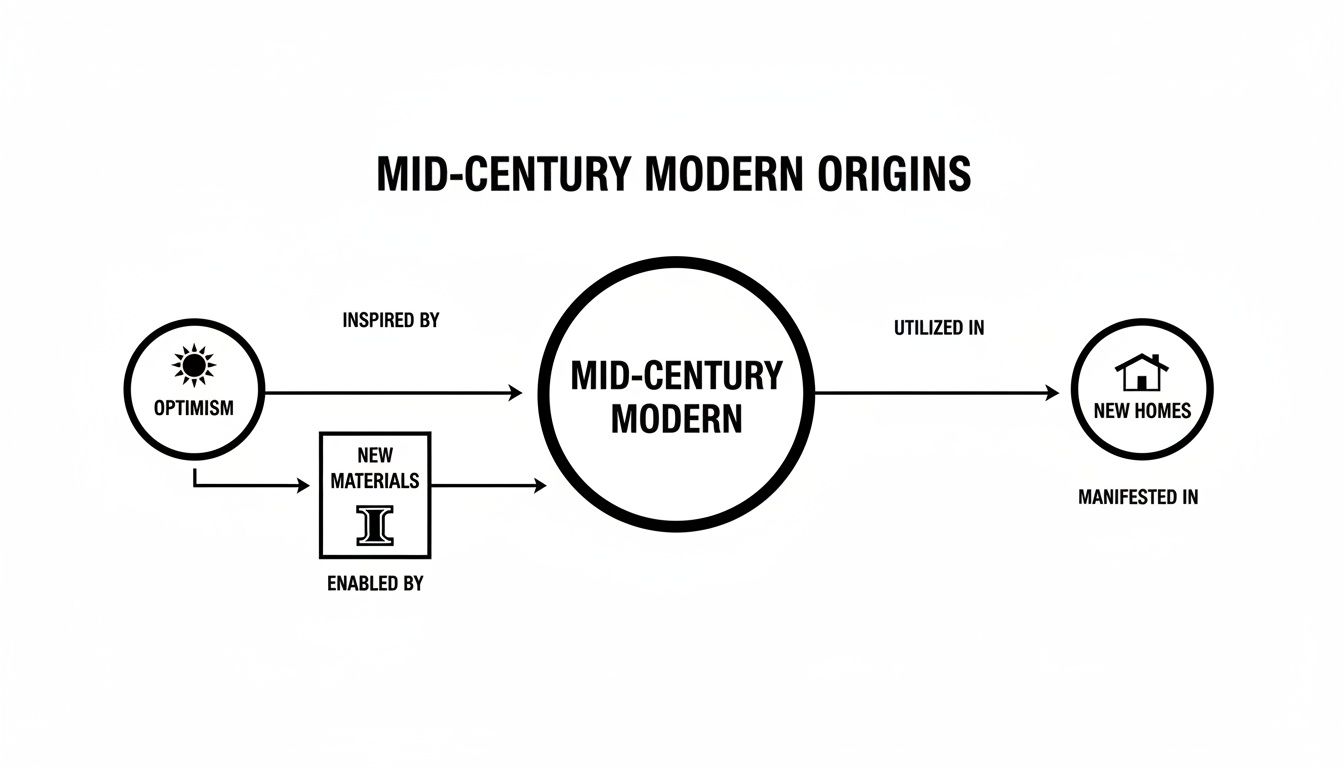
You can see the direct line from the cultural mood and new technology to an entirely fresh vision for how a home could look and feel.
Open Concept Living Spaces
The open-concept floor plan is arguably one of the most enduring legacies of Mid-Century Modern architecture. Before this period, homes were generally a maze of small, boxy rooms. But new construction methods, especially post-and-beam systems, changed everything.
By using a strong structural frame of posts and beams, architects could get rid of most interior load-bearing walls. This freed up the floor plan entirely, allowing for vast, flowing spaces where the kitchen, dining, and living areas all merged into one.
This wasn’t just a gimmick to make homes feel bigger. It was a direct response to the post-war desire for a more casual, connected, and family-focused lifestyle—a powerful idea that still dominates home design today. Architects would use subtle cues like partial walls, open shelving, or a step down in the floor to suggest different “zones” without killing the wide-open vibe.
A Profound Indoor Outdoor Connection
More than perhaps any other style, Mid-Century Modern architecture is on a mission to erase the boundary between a house and its landscape. This was achieved with very specific architectural moves designed to pull nature right inside.
Floor-to-ceiling windows and sliding glass doors became signatures of the style, turning solid walls into transparent screens that provided seamless views and access to patios and gardens.
Clerestory windows—those narrow bands of glass set high up on a wall—were another key tool. They let daylight pour in from above while preserving privacy, creating bright, airy interiors that felt connected to the outdoors from every angle. This deep integration with the environment is a hallmark that feels just as fresh and desirable today. To see how this concept has evolved, you can explore the modern principles of indoor outdoor living in today’s luxury design.
To bring these concepts together, the following table summarizes the core tenets of the style.
Table: Key Characteristics of Mid Century Modern Architecture
| Characteristic | Description | Design Philosophy |
|---|---|---|
| Clean, Geometric Lines | Features flat or low-pitched roofs, strong horizontal lines, and minimal ornamentation. | Simplicity and functionality are paramount; the structure itself provides the aesthetic appeal. |
| Open Floor Plans | Interior spaces flow into one another, often combining living, dining, and kitchen areas. | To create a more casual, connected, and spacious environment for modern family life. |
| Large Windows & Glass Walls | Extensive use of floor-to-ceiling windows, clerestory windows, and sliding glass doors. | To dissolve the barrier between inside and out, maximizing natural light and landscape views. |
| Honest Use of Materials | Natural materials like wood, stone, and brick are left exposed and celebrated for their texture. | Materials should be used authentically, showcasing their inherent beauty rather than concealing them. |
Each of these characteristics reinforces the others, working together to create a cohesive and timeless architectural statement.
The Visionaries Who Shaped a Movement
Mid-century modern isn’t just a set of design rules; it’s the collected vision of architects who saw the world differently. These weren’t just builders. They were artists, thinkers, and social commentators who used steel, glass, and concrete to propose a whole new way of living. They took abstract ideas about honesty in materials and connection to nature and turned them into real, breathtaking spaces that still feel fresh today.
To get to the heart of this style, you have to look at the masterpieces these pioneers left behind. Their buildings are more than just structures; they’re living portfolios, each telling a story of post-war optimism and a deep-seated faith in the power of good design.
Charles and Ray Eames: A Unified Vision for Living
While many know them for their iconic furniture, Charles and Ray Eames were, at their core, holistic designers. For them, a building and everything in it was part of a single, unified experience. You can see this philosophy perfectly captured in their own home, the Eames House (also known as Case Study House No. 8) in Los Angeles.
Finished in 1949, the house is a brilliant mix of off-the-shelf industrial parts, like prefabricated steel frames and glass panels, yet it feels anything but cold. It was built not as an architectural statement but as a flexible, functional backdrop for work and life. Inside, it’s a vibrant collage of objects, books, and textiles—proof of their belief that a home should be a direct reflection of the people who live there.
The Eameses proved that modernism could be warm, playful, and deeply human, pushing back against any notion that it had to be stark or severe.
Richard Neutra: Architecture for the Mind and Body
Richard Neutra was, in many ways, a psychologist with a sketchbook. He was intensely focused on how our surroundings impact our well-being. He even came up with a term for it: “biorealism,” an approach that sought to harmonize a building with human biology and the natural world around it.
His most celebrated project, the Kaufmann Desert House in Palm Springs (1946), is the ultimate expression of this idea. The home’s low-slung planes of glass and stone seem to float in the rugged desert landscape, practically dissolving the line between inside and out. Massive sliding glass walls open the living areas to patios and the legendary pool, making the desert an integral part of the home’s experience. Neutra obsessed over every detail, carefully framing views and modulating light to create a tranquil sanctuary that’s as much a machine for living as it is a work of art.
Eero Saarinen: The Sculptor of Modernism
While many of his peers were devoted to the right angle, Eero Saarinen brought a bold, sculptural expressionism to the mid-century movement. He believed a building’s form should not only serve its function but also elevate the human spirit. His work is defined by dramatic, sweeping curves that feel both futuristic and profoundly organic.
You can’t miss this in the TWA Flight Center at New York’s JFK Airport (1962). Designed to capture the sheer romance and excitement of the jet age, the building is pure motion. Its wing-like roof and fluid concrete forms create a space that doesn’t just contain an activity—it is that activity. Saarinen showed the world that functional design could also be powerfully poetic.
A building is not just a place to be, but a way to be. – Eero Saarinen
This very idea—that architecture actively shapes our experience—is a cornerstone of the entire mid-century modern ethos.
Oscar Niemeyer: Brazil’s Poet of the Curve
As mid-century modern ideas spread across the globe, they were adapted and reinterpreted in fascinating ways. In Brazil, this new language of design found its most lyrical voice in Oscar Niemeyer. When Brazil decided to build a new capital, Brasília, in the late 1950s, it was Niemeyer’s futuristic, curvilinear buildings that defined the utopian city. This global fascination, reignited by Cara Greenberg’s 1984 book on the topic, has fueled a vintage revival where iconic pieces see their value climb; an Eames chair, for instance, can appreciate by 10-15% annually. For more on the style’s rich timeline, you can find a great overview of Danish furniture history at Huset.com.au.
Niemeyer was a virtuoso with reinforced concrete, pushing the material to create fluid, sensual forms that seemed to defy gravity. “It is not the right angle that attracts me,” he famously said, “nor the straight line, hard and inflexible.” His work, like the flying-saucer-shaped Niterói Contemporary Art Museum perched on a cliff, is a pure celebration of the curve and a bold, artistic vision. He gave Brazilian modernism its own distinct identity, proving just how adaptable this architectural style could be.
Adapting the Style for Contemporary Luxury Living
While the core principles of mid-century modern design have aged incredibly well, bringing this beloved style into the 21st century is more than just a simple refresh. Today’s high-end homes need amenities and technologies that architects in the 1950s couldn’t have dreamed of. The real art lies in weaving these modern necessities into the design without sacrificing its iconic character.
This isn’t about creating a time capsule. It’s a delicate balancing act—a conversation between past and future. The goal is to hold onto that original spirit of simplicity, functionality, and connection to nature, but see it through a contemporary lens that defines luxury living today.
Merging Modern Tech with Timeless Aesthetics
One of the biggest hurdles is incorporating smart home technology. The clean, uncluttered lines that define mid-century modern interiors are easily spoiled by clunky speakers, oversized screens, and walls cluttered with control panels. The solution? Make the technology disappear.
Think of it as embedding intelligence into the home’s DNA, not just tacking on gadgets. Smart systems should melt into the architecture, preserving that minimalist feel. This way, the home’s technology serves its owners without ever fighting for visual attention.
Here are a few ways to get it right:
- Invisible Audio: Use in-wall or in-ceiling speakers that can be plastered over and painted. You get incredible, high-fidelity sound without a single piece of visible hardware.
- Concealed Screens: Motorized lifts are a designer’s best friend. They can hide televisions inside custom cabinetry, ceilings, or even floors, making them appear only when you want them.
- Minimalist Controls: Ditch the distracting bank of light switches. A single, elegant keypad programmed for different lighting scenes does the job with far more grace.
Updating Key Spaces with Respect
Nowhere is the tension between period style and modern life more obvious than in the kitchen and bathroom. A vintage 1950s kitchen is full of charm, but it rarely meets the functional demands of a serious home cook today. The trick is to capture the original vibe using far superior modern materials.
For instance, you can swap out the classic laminate countertops for a durable quartz with a clean, simple profile. Flat-panel cabinetry, a hallmark of the era, can be reimagined in high-performance wood veneers or sleek, modern lacquers. It’s all about capturing the feeling of the original while delivering the performance and luxury expected in a modern home.
“Adapting mid-century modern architecture for today’s luxury market means honoring its soul while upgrading its systems. The best projects feel authentic to the era’s spirit of innovation, using modern materials and technology to enhance the original vision of effortless living.”
This same philosophy works wonders in the bathroom. Think floating vanities, minimalist hardware, and large-format tiles to create a clean, spa-like space that feels both current and true to the style’s uncluttered roots.
Expanding the Footprint Thoughtfully
Lifestyles have changed, and families often need more room than a classic mid-century home can offer. Expanding these structures takes real finesse. A clumsy addition can feel tacked on, disrupting the all-important flow between the indoors and outdoors.
A brilliant strategy for a successful expansion is to use glass as a bridge. A transparent hallway or a glass-walled great room can link the original structure to a new wing, preserving that vital visual connection to the landscape. This approach respects the home’s original scale while delivering the extra square footage that modern life often requires.
Ultimately, adapting mid-century modern architecture for today’s luxury client isn’t about replication; it’s about translation. It’s about taking the brilliant, forward-thinking ideas of the past and reinterpreting them with the best materials, technology, and building science available now. The result is a home that is not only beautiful and functional but also deeply rooted in a powerful design legacy.
Curating Interiors with Iconic Furnishings
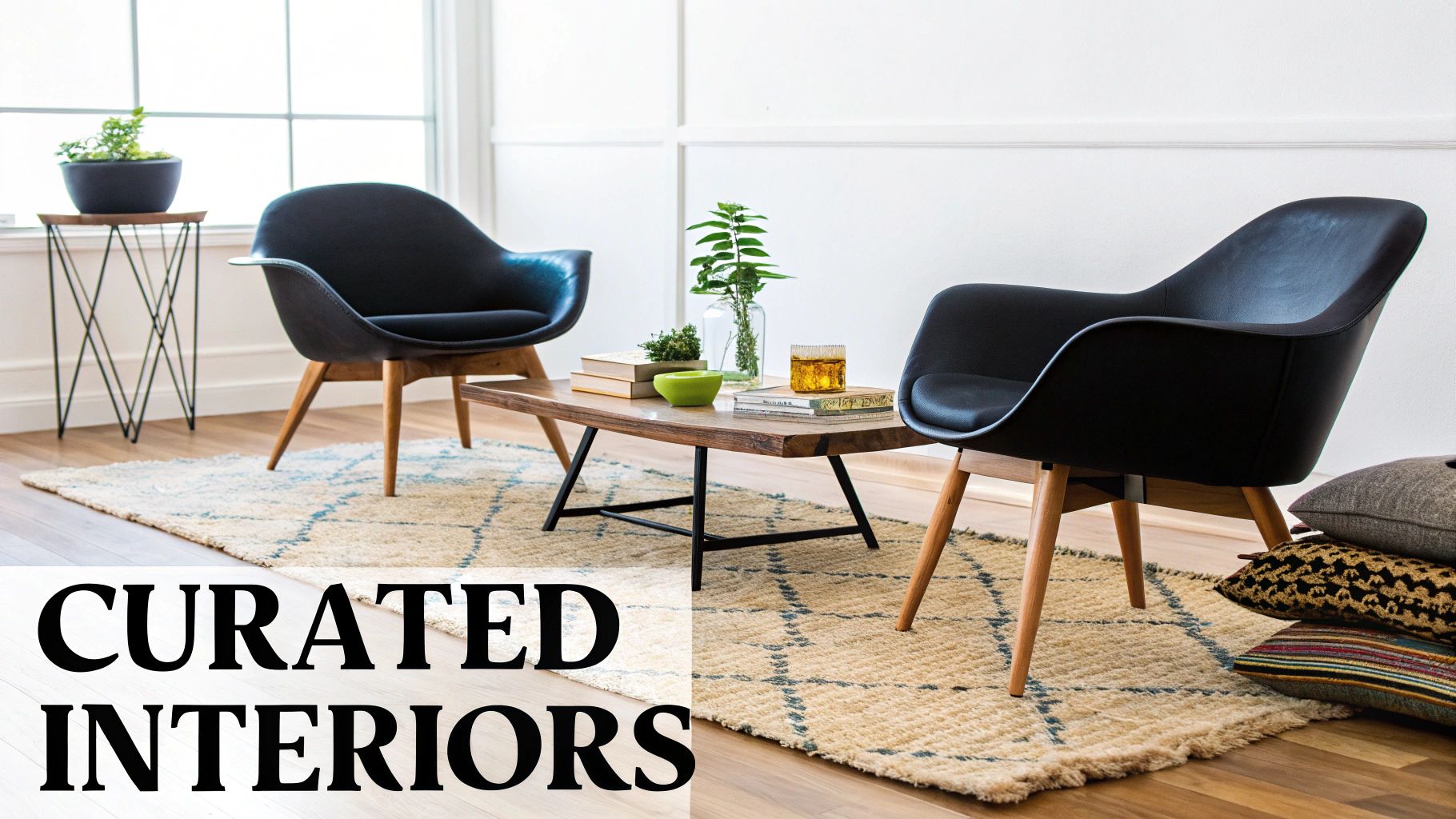
The architectural shell of a mid-century modern home is only half the story. The soul of the space truly comes alive through its furnishings. The era’s core principles of simplicity, organic form, and function flow directly from the building’s structure into every chair, table, and lamp inside. Think of the architecture as the canvas; the iconic pieces from designers of the day are the masterful brushstrokes that complete the picture.
Filling these homes isn’t just a shopping exercise. It’s about grasping the philosophy behind each piece to create a space that feels authentic and deeply personal. The ultimate goal is a comfortable, lived-in home—not a sterile museum exhibit.
Identifying and Sourcing Iconic Pieces
The names behind mid-century furniture are as legendary as the architects who designed the homes. Designers like Hans Wegner, Arne Jacobsen, and the powerhouse duo Charles and Ray Eames created pieces celebrated for their sculptural beauty and thoughtful ergonomics. Finding the genuine article takes a practiced eye.
- Look for Authenticity: Original vintage items will almost always show subtle signs of age and patina. Always check for a maker’s mark, label, or stamp, which you can typically find on the underside of a chair or inside a drawer.
- Consider Licensed Reproductions: If you’re looking for pristine condition, many of the original manufacturers like Herman Miller and Knoll still produce these iconic designs to the exact specifications. This route offers heirloom quality without the wear and tear of a 60-year-old find.
- Know Your Sources: You can find authenticated originals at specialized vintage dealers and high-end auction houses. For new, licensed productions, authorized retailers are your best bet.
The real magic of mid-century modern furnishings is their versatility. An Eames Lounge Chair or a Noguchi coffee table can anchor a room and look just as right alongside contemporary art as it does with other period-correct pieces.
This ability to blend old and new is essential. A home filled exclusively with vintage items can feel more like a time capsule than a living space. The secret lies in mixing iconic mid-century pieces with modern textiles, personal art, and contemporary furniture. This creates a layered, sophisticated feel, and you can find more expert advice on crafting a mid-century modern interior that feels both timeless and current.
Creating a Cohesive and Personal Space
Achieving harmony is about more than just collecting famous designs. It’s about orchestrating a conversation between the objects, the architecture, and the people who live there. A playful piece like a George Nelson Marshmallow Sofa makes a bold statement and needs plenty of visual space to shine. In contrast, the quiet elegance of Wegner’s Wishbone Chair works beautifully in a group around a dining table.
A good approach is to start with a few “hero” pieces that establish the room’s purpose and aesthetic. From there, you can build out the space with complementary textures and forms. Imagine pairing the smooth, molded plywood of an Eames chair with a plush, hand-knotted wool rug. Or contrasting the sharp, geometric lines of a sideboard with a soft, organically shaped sofa.
This thoughtful interplay of materials, shapes, and eras is what elevates a house into a truly curated home, one that embodies the enduring spirit of mid-century modern architecture.
Common Questions About Mid-Century Modern Architecture
Stepping into the world of mid-century modern architecture often raises a few practical questions, especially for those looking to build, buy, or renovate. It’s a style with a very distinct personality, and understanding its nuances is the first step toward a successful project. Let’s tackle some of the most common queries we hear.
Is This Style Suitable For All Climates?
Yes, absolutely—with a little intelligent adaptation. The core principles of mid-century modern design are surprisingly flexible.
Think of it this way: in colder climates, an architect might use modern triple-paned glass and high-performance insulation to maintain those signature walls of windows without sacrificing warmth. In a hot, sunny place like Palm Springs, the design would lean into deep roof overhangs for shade and carefully placed clerestory windows to capture light without the heat. The style’s versatility is one of its greatest strengths.
The real goal is to work with the environment, not against it. A thoughtfully designed home will harness the local climate for passive heating and cooling, which is perfectly aligned with the original mid-century philosophy of connecting with nature.
How Do I Maintain Original Materials?
Preserving the soul of an authentic mid-century home is all about caring for its unique materials. It’s not about making everything look brand new, but about protecting its history.
- Wood Paneling: Forget harsh chemicals. All you really need is regular dusting and an occasional wipe-down with a gentle, wood-safe soap to keep that rich, warm luster alive.
- Terrazzo Floors: This material is incredibly durable, but acidic spills are its enemy. Stick to a pH-neutral cleaner for regular mopping and have them professionally sealed every few years to prevent staining.
- Original Fixtures: For that vintage brass or chrome hardware, a gentle polish is usually enough to restore its shine. If you’re ever unsure, it’s always best to call a restoration specialist.
The key to maintaining these materials is consistent, gentle care, not intense scrubbing. You want to preserve the beautiful patina that tells the story of the home.
Embarking on a renovation is a major undertaking. If you need help finding the right professional to guide your project, our article on how to choose an architect provides practical advice for making that crucial decision.
Are you an architect or designer specializing in creating timeless, luxurious spaces? Join the Haute Design network to connect with affluent clients and elevate your brand’s visibility. Showcase your work to an exclusive audience that values exceptional design.